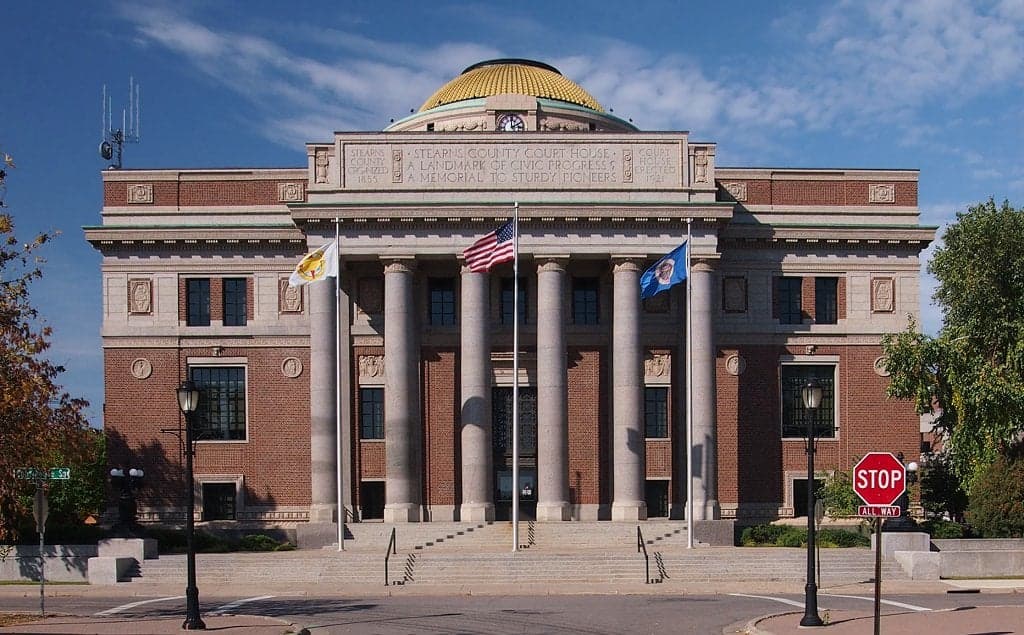
Photo: Wikipedia
Political ClimatePolitical Climate in Stearns County
Showing district-level results — no local-only data available.
Local Political AnalysisPolitical Analysis of Stearns County
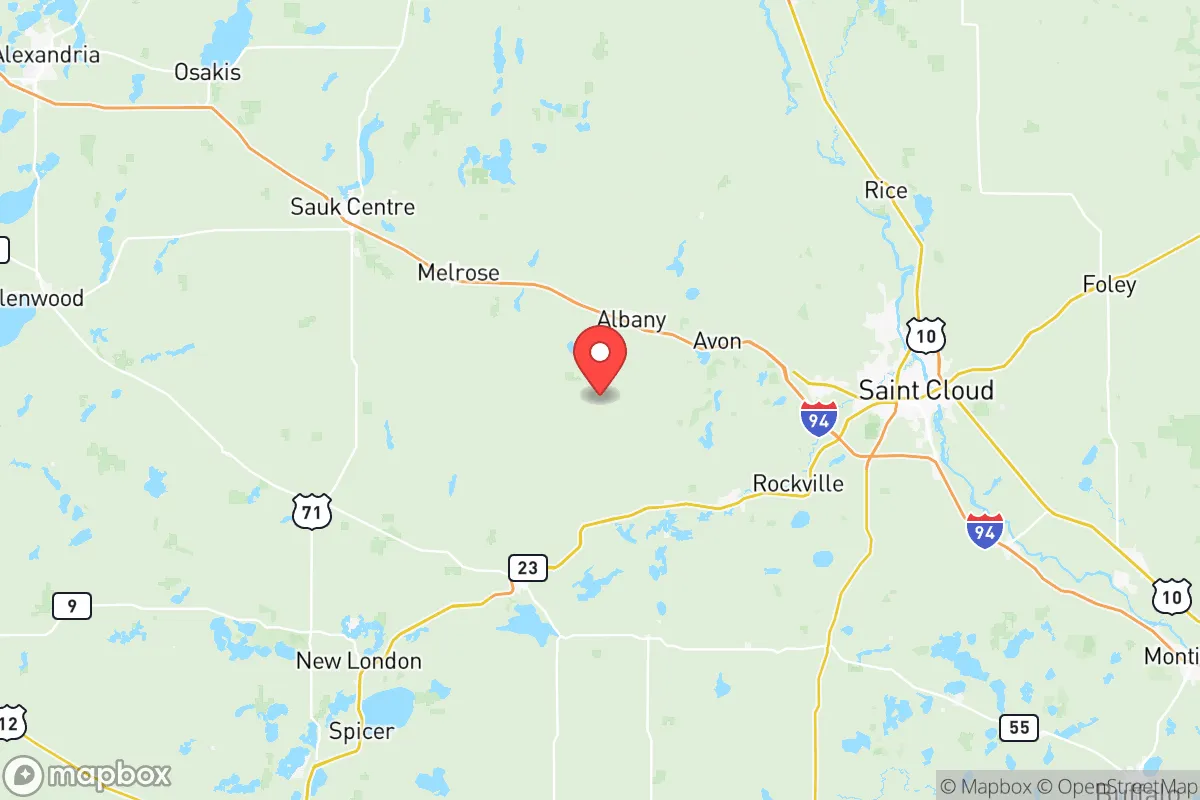
Stearns County has long been a reliably conservative stronghold in Central Minnesota, with a Cook Partisan Voting Index of R+18 that makes it one of the most Republican-leaning counties in the state outside the metro suburbs. The county hasn't voted for a Democratic presidential candidate since Lyndon B. Johnson in 1964, and in 2024, Donald Trump carried it by roughly 20 points. That said, the political reality here is more nuanced than the raw numbers suggest, with a noticeable split between the rural, agricultural townships and the college city of St. Cloud, which injects a consistent liberal counterweight into local elections.
How it compares to Minnesota as a whole
While Minnesota statewide has trended blue in recent presidential cycles — voting for Democrats in every election since 1976 except 2016 — Stearns County sits firmly in the red column, often by margins of 15 to 25 points. The contrast is starkest when you look at St. Cloud, the county seat and home to St. Cloud State University. Precincts around the university and downtown St. Cloud regularly vote 60-70% Democratic, while outlying towns like Sauk Centre, Melrose, and Albany routinely deliver 70-80% Republican majorities. The swing precincts tend to be in the suburban fringe of St. Cloud — places like Waite Park and Sartell — where growth from the metro area has brought more moderate voters. In 2020, Biden actually won St. Cloud's Ward 1 and Ward 4 precincts, but Trump crushed him in the rural townships by enough to keep the county comfortably red. The state as a whole, meanwhile, remains a toss-up battleground, with the Twin Cities metro offsetting the rural and exurban Republican vote.
What this means for residents
For conservative residents, Stearns County offers a political environment where their views are the clear majority — local school boards, county commissions, and state legislative seats are dominated by Republicans, and conservative social values are reflected in many public policies. The county's strong Catholic and Lutheran heritage, particularly in the German and Scandinavian farming communities, reinforces a culturally conservative atmosphere that feels natural to many lifelong residents. For liberal residents, especially those in St. Cloud, the experience is different. They are a distinct minority in countywide elections but hold real influence in city politics — St. Cloud's mayor and city council have leaned more progressive in recent years, and the university community provides an active base for Democratic organizing. The practical effect is that liberals can feel politically isolated in the rural parts of the county but find a genuine community in the city, while conservatives enjoy broad representation at the county level but must contend with a vocal and organized progressive minority in St. Cloud itself.
Culturally, the divide shows up in everyday ways. Gun rights are widely supported — you'll see "Come and Take It" decals on trucks in Richmond and Cold Spring — and the county has a strong agricultural identity that shapes local policy on land use and taxation. At the same time, St. Cloud's growing Somali and East African population has brought new political dynamics, with issues around immigration, policing, and school funding becoming more prominent in local debates. The trajectory seems to be a slow, incremental shift toward competitiveness — St. Cloud's growth and the influx of Twin Cities commuters into Sartell and Sauk Rapids are gradually pulling the county's overall numbers closer to the state average. But for the foreseeable future, Stearns County remains a reliably red anchor in a purple state, with enough internal diversity to keep local politics interesting for both sides.

State Political ClimatePolitical Climate in Minnesota
State Political AnalysisPolitical Environment in the State
Minnesota has undergone a striking political transformation over the past decade, shifting from a classic purple battleground to a state where Democrats now hold unified control of the governorship, state House, and state Senate as of 2023. While the state hasn't voted Republican for president since 1972, the margin has tightened considerably — from a 7.7-point Obama win in 2012 to a 7.1-point Biden win in 2020, with Trump losing by just 1.5 points in 2016. The real story is the geographic sorting: the Twin Cities metro has grown bluer and more populous, while Greater Minnesota has swung hard right, creating a political landscape that feels like two different states under one capitol dome.
Urban vs. rural divide
The political map of Minnesota is essentially a battle between the metro core and everything else. Hennepin and Ramsey counties — home to Minneapolis and St. Paul — delivered a combined 400,000-vote margin for Biden in 2020, enough to overcome Trump's massive wins in the rest of the state. The suburban ring tells a more nuanced story: Dakota County, once a reliable swing area, has trended blue and voted for Biden by 10 points, while Washington County is now consistently Democratic. But drive 45 minutes outside the metro and the landscape flips hard. Greater Minnesota's rural counties have moved rightward by 20-30 points since 2000, with places like Stearns County (St. Cloud) and Olmsted County (Rochester) becoming key battlegrounds. The Iron Range in northeastern Minnesota — historically a DFL stronghold — has shifted dramatically toward Republicans, with St. Louis County (Duluth) barely staying blue and surrounding mining counties like Itasca and St. Louis now competitive or red. Mankato in Blue Earth County remains a blue island in southern Minnesota, buoyed by Minnesota State University, while Bemidji in Beltrami County has become a microcosm of the state's divide — a blue college town surrounded by deep-red farmland.
Policy environment
Minnesota's policy landscape is defined by its progressive tax structure and robust public services. The state has a progressive income tax with rates from 5.35% to 9.85%, one of the highest top marginal rates in the nation. Property taxes are moderate but vary significantly by locality — expect to pay more in the metro than in greater Minnesota. Sales tax is 6.875% statewide, with local options pushing it higher in some cities. The regulatory environment leans heavily toward environmental protection and labor rights: Minnesota has a $10.85 minimum wage (indexed to inflation), paid family and medical leave (starting 2026), and some of the strongest clean energy mandates in the Midwest. Education spending is among the highest per pupil nationally, and the state has a robust public university system anchored by the University of Minnesota and Minnesota State colleges. On election law, Minnesota is known for same-day voter registration and no-excuse absentee voting, making it one of the easiest states to vote in — a feature that draws both praise and criticism depending on your perspective.
Recent policy direction
The 2023-2024 legislative session was a watershed moment for Minnesota's policy direction, with Democrats passing a sweeping agenda that will define the state for years. On gun and self-defense law, the legislature passed universal background checks and a red flag law (extreme risk protection orders), making Minnesota one of the stricter states in the Midwest for firearm regulation. Parental and education rights saw major changes: the state codified abortion rights into law, eliminated the "parental notification" requirement for minors seeking abortions, and passed a law requiring school districts to provide free menstrual products in restrooms. On speech and privacy, Minnesota enacted a strong data privacy law and banned the use of facial recognition technology by law enforcement without a warrant. Medical and bodily autonomy saw the most dramatic shift: the Protect Reproductive Options Act (PRO Act) established a fundamental right to reproductive healthcare, including abortion and contraception, while the state also legalized recreational cannabis for adults 21 and over starting August 2023. Property rights remain relatively strong, though the state has expanded rent control options for local governments — Minneapolis already has rent stabilization on the ballot. Taxation saw a new 1% surcharge on incomes over $1 million and a new 0.15% payroll tax to fund the paid leave program. Voting and ballot access expanded with automatic voter registration and pre-registration for 16- and 17-year-olds, while the state also restored voting rights for felons upon release from prison.
Civil unrest & political movements
Minnesota has been a flashpoint for national political movements, most notably following the murder of George Floyd in Minneapolis in 2020, which sparked the largest protests in the state's history and a global reckoning on policing. The aftermath saw the Minneapolis City Council attempt to dismantle the police department (ultimately unsuccessful), a failed ballot measure to replace the police with a public safety department, and ongoing debates about public safety that have reshaped local elections. On the right, the Minnesota Gun Owners Caucus and Minnesota Freedom Fund have become influential activist organizations, while the state's Second Amendment sanctuary movement saw over 60 counties pass resolutions opposing new gun laws — though these are largely symbolic. Immigration politics are less volatile than in border states, but Minnesota is a sanctuary state in practice: the state limits cooperation with federal immigration enforcement, and Minneapolis has a formal "Welcoming City" ordinance. Election integrity controversies have been relatively muted compared to other states, though the 2020 election saw Trump's campaign challenge Minnesota's results without success. The state's strong tradition of civic engagement — consistently among the highest voter turnout rates in the nation — means political movements on both sides are well-organized and visible, from the Minnesota Farmers Union on the left to the Minnesota Family Council on the right.
Projection
Looking ahead 5-10 years, Minnesota's political trajectory points toward continued polarization and a slow but steady Democratic consolidation at the state level. The Twin Cities metro is growing faster than Greater Minnesota, and its population is becoming more diverse and younger — demographic trends that favor Democrats. However, the rural exodus is real: many small towns are losing population, and the remaining rural voters are becoming more conservative. The wild card is the suburbs: places like Anoka County and Washington County are trending blue, but Scott County and Carver County remain reliably red. The 2024 election will be a key test — if Democrats hold the state House and Senate while winning the presidency, expect the current policy direction to accelerate. If Republicans flip either chamber, expect gridlock on major legislation but no rollback of the 2023-2024 agenda due to Governor Walz's veto power. The biggest unknown is the impact of in-migration: Minnesota is seeing modest population growth from domestic migration, but it's losing people to states like Florida and Texas. The people moving in tend to be younger and more educated, which likely benefits Democrats, while those leaving are often retirees and families seeking lower taxes — a net loss for the GOP's base.
For a new resident, the bottom line is this: Minnesota is a state where your experience of politics will depend heavily on where you live. If you're a conservative moving to the Twin Cities metro, you'll find yourself in a blue bubble where your views are a minority — but you'll have strong representation in the state legislature from suburban and rural districts. If you're a liberal moving to Greater Minnesota, you'll find the opposite. The state's policy environment is now firmly progressive on social issues, gun control, and labor rights, but its tax burden and regulatory approach are significant factors to weigh. The practical takeaway: Minnesota offers a high quality of life with strong public services, but it comes with a price tag — both in taxes and in the cultural divide between its urban core and its vast rural expanse. If you value civic engagement, outdoor recreation, and a state that's willing to experiment with progressive policy, Minnesota is a good fit. If you're looking for low taxes, minimal regulation, or a conservative cultural environment, you'll want to look at the western or southern suburbs — or consider a different state entirely.
* Values derived from national, state, county, city and local statistics and may differ in a specific area. Last updated: 2026-07-02T22:52:18.000Z
Narrative content on this page is AI-generated and may contain mistakes. Verify any details that matter before acting on them.
ReloMaps may earn a commission from affiliate links at no extra cost to you.

