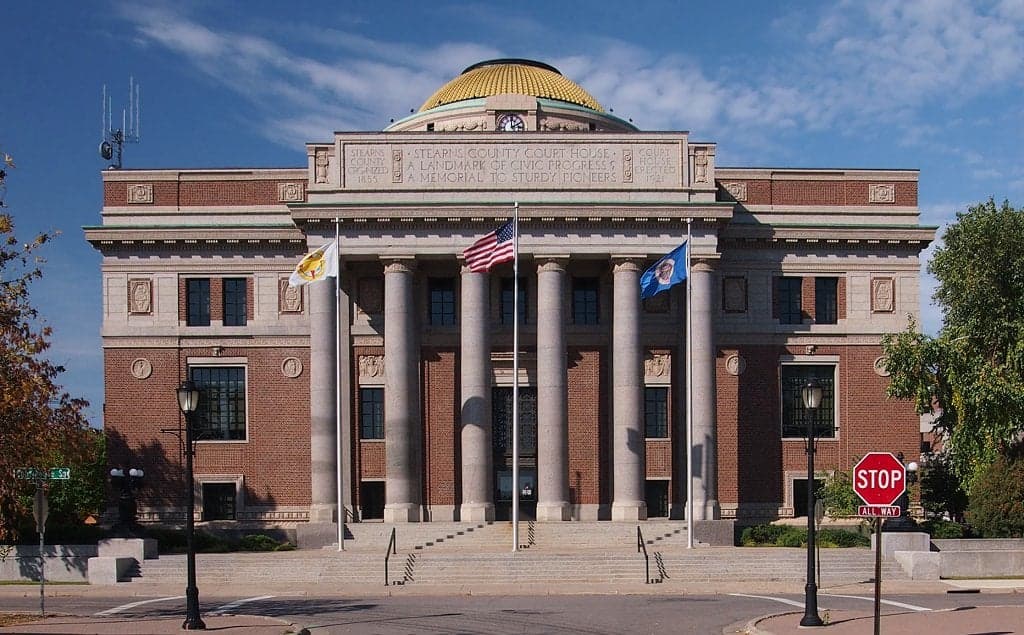
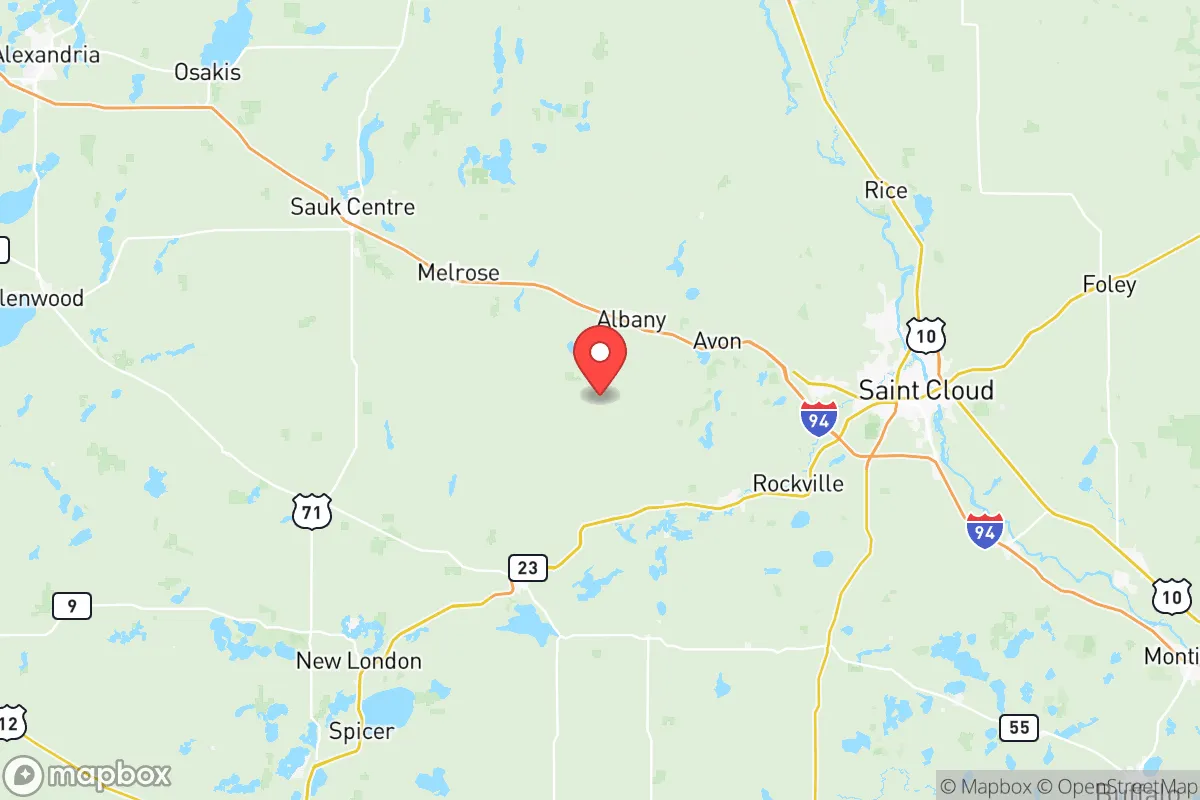
Photo: Wikipedia
Demographics of Stearns County
Affluence Level in Stearns County
A middle-class area roughly in line with national averages across income, home values, education, and employment.
People of Stearns County
Stearns County, Minnesota, is home to 159,358 residents, a population that remains predominantly white (81.5%) but is gradually diversifying, with a notable Black community (8.3%) and a growing Hispanic population (4.5%). The county's identity is deeply rooted in its German Catholic heritage, a legacy of 19th-century settlement that still shapes its small cities and rural towns. St. Cloud serves as the urban core, while communities like Sartell, Sauk Rapids, and Waite Park anchor a region known for its strong work ethic, family-oriented values, and a slower pace of life compared to the Twin Cities metro.
Settlement & growth (pre-1960)
Before European settlement, the area that is now Stearns County was the homeland of the Dakota (Sioux) and, later, the Ojibwe (Chippewa) nations, who used the Mississippi River and its tributaries for travel and trade. The region was part of the vast territory ceded to the United States in the 1837 Treaty with the Ojibwe, opening the land for American settlement. The first permanent European settlers arrived in the 1850s, drawn by the promise of fertile farmland and the construction of the Great Northern Railway.
The defining wave of immigration to Stearns County came from German-speaking regions of Europe, particularly the Rhineland and Bavaria, beginning in the 1850s and continuing through the 1880s. These German Catholics were fleeing political instability and economic hardship, and they found in central Minnesota a landscape reminiscent of their homeland—rolling hills, lakes, and forests. They established farming communities and founded towns such as St. Cloud (the county seat), Melrose, Albany, and Richmond, where German was spoken in churches and schools well into the 20th century. The Catholic Church was the central institution of these communities, with parishes like St. Mary's Cathedral in St. Cloud and St. Boniface in Melrose anchoring religious and social life.
A smaller but significant wave of Polish immigrants arrived in the late 19th and early 20th centuries, settling primarily in the northeastern part of the county around Holdingford and Upsala. These families were also Catholic and found common ground with their German neighbors, though they maintained distinct cultural traditions, including Polish-language masses and festivals. The county's population grew steadily through the early 1900s, driven by agriculture, dairy farming, and the granite quarrying industry in St. Cloud, which earned the city the nickname "Granite City." By 1960, Stearns County was overwhelmingly white, German Catholic, and rural, with St. Cloud serving as a regional hub for commerce, education, and healthcare.
Modern era (post-1965)
The 1965 Hart-Cellar Act fundamentally reshaped U.S. immigration, but its effects were slow to reach Stearns County, which remained demographically stable through the 1970s and 1980s. The most significant change began in the 1990s, when a wave of Somali refugees began resettling in St. Cloud, drawn by affordable housing, job opportunities in manufacturing and meatpacking, and the presence of existing Somali community networks. By 2020, St. Cloud had become home to one of the largest Somali populations in Minnesota, with estimates suggesting several thousand residents. This community is concentrated in the city's south side and has established mosques, halal markets, and community organizations, contributing to the county's Black population of 8.3%.
Hispanic residents, now 4.5% of the county, began arriving in larger numbers in the 2000s, many from Mexico and Central America, drawn to agricultural work and construction. They have settled in St. Cloud and smaller towns like Waite Park and Sauk Rapids, where they have formed tight-knit communities centered on Catholic parishes and Spanish-language services. The East/Southeast Asian population (1.5%) includes a mix of Hmong, Vietnamese, and Chinese residents, many of whom arrived as refugees or through family reunification in the 1980s and 1990s, settling primarily in St. Cloud. The Indian subcontinent population (0.4%) is small but growing, largely composed of professionals in healthcare and technology who work at St. Cloud Hospital or the city's growing medical sector.
Domestic migration has also played a role. Since the 1990s, Stearns County has attracted families and retirees from the Twin Cities metro, seeking lower housing costs and a quieter lifestyle. Suburbanization has pushed development into Sartell and Sauk Rapids, which have seen new housing developments and retail growth. However, the county's overall foreign-born population remains low at 3.4%, reflecting its continued reliance on domestic growth and the slow pace of international migration compared to the Twin Cities.
The future
Stearns County is slowly becoming more diverse, but the pace of change is gradual. The white population, while still dominant at 81.5%, is aging, and younger cohorts are more diverse. The Hispanic and Black populations are expected to grow, driven by both natural increase and continued migration, particularly as St. Cloud's manufacturing and healthcare sectors expand. The Somali community is likely to become more established, with second-generation residents entering the workforce and civic life, potentially increasing political representation and cultural visibility.
New communities are concentrating in St. Cloud and its immediate suburbs, while rural towns like Melrose and Albany remain overwhelmingly white and German Catholic. The county's cultural identity is evolving, but the German Catholic heritage remains a powerful force, visible in the annual festivals, church attendance, and conservative social values that define much of the region. The next 10-20 years will likely see continued suburban growth around St. Cloud, a modest increase in diversity, and ongoing debates about integration, housing, and schools as the county adjusts to its changing demographics.
For someone moving in now, Stearns County offers a stable, family-friendly environment with a strong sense of community, affordable housing, and access to outdoor recreation. The population is becoming more diverse, but the county's German Catholic roots still shape its character, making it a place where tradition and change coexist. New residents, particularly those from more diverse backgrounds, will find a welcoming but slowly adapting region, where the pace of demographic change is measured and the future is being written one generation at a time.

* Values derived from national, state, county, city and local statistics and may differ in a specific area. Last updated: 2026-07-02T22:52:18.000Z
Narrative content on this page is AI-generated and may contain mistakes. Verify any details that matter before acting on them.
ReloMaps may earn a commission from affiliate links at no extra cost to you.

