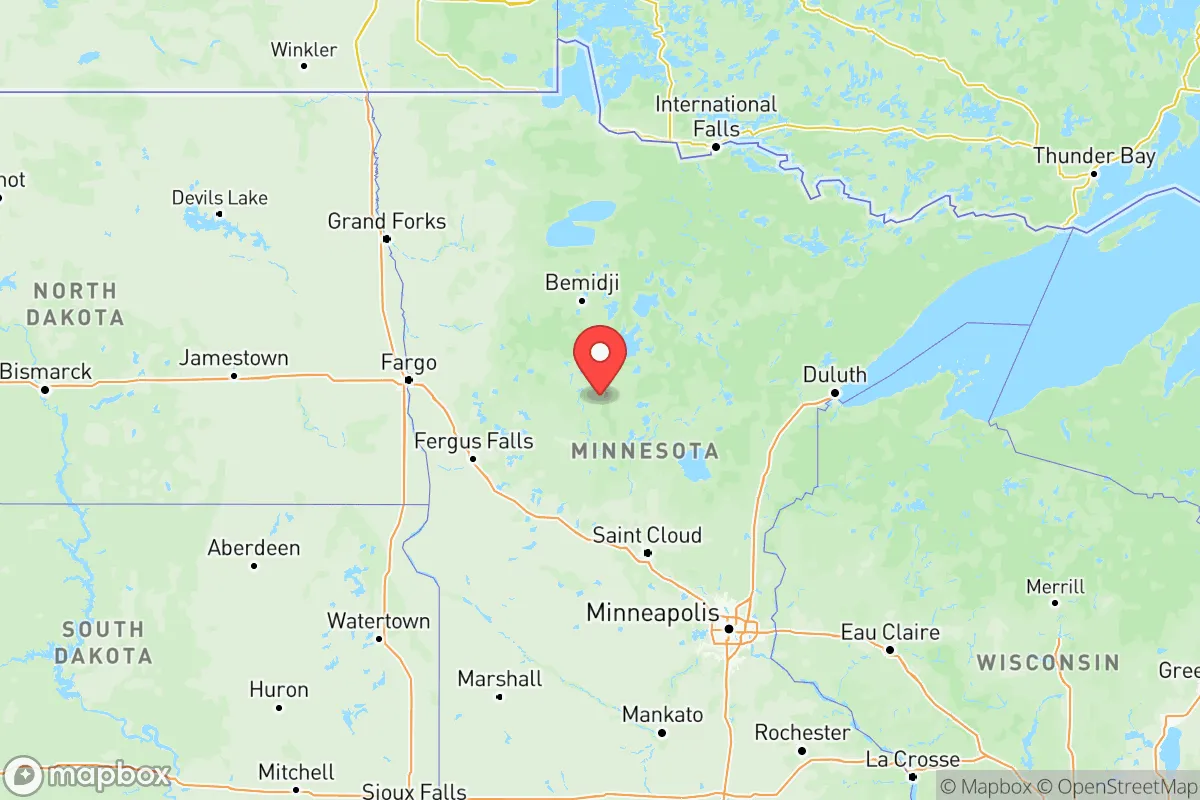
Photo: Wikipedia
Demographics of Minnesota
Affluence Level in Minnesota
An upper-middle-class area. Household wealth, education levels, and homeownership run ahead of national benchmarks.
People of Minnesota
Minnesota’s 5.7 million residents today are defined by a distinctive blend of Scandinavian and German heritage, a strong civic culture, and a population that remains one of the whitest in the nation at 76.7%, though that share is slowly declining. The state’s identity is shaped by its cold climate, progressive politics, and a reputation for high quality of life, but beneath the surface, demographic shifts are creating new enclaves and tensions. The foreign-born population is just 3.6%, well below the national average, yet the Twin Cities metro area is increasingly diverse, while greater Minnesota remains overwhelmingly white and is aging faster.
Settlement & growth (pre-1960)
Before European settlement, Minnesota was home to the Dakota (Sioux) and Ojibwe (Chippewa) nations, who lived across the state’s forests, prairies, and lakes. The Dakota controlled the southern and western regions, while the Ojibwe held the north and east, a division that persists in the locations of modern reservations like Red Lake, White Earth, and Lower Sioux. French fur traders and missionaries arrived in the 1600s, establishing posts at Grand Portage and along the Mississippi River, but they left little permanent settlement. The United States acquired the land through the Louisiana Purchase (1803) and subsequent treaties, with Fort Snelling built in 1819 at the confluence of the Mississippi and Minnesota Rivers to assert control.
Organized American settlement began in earnest after the 1851 Treaty of Traverse des Sioux opened southern Minnesota to homesteaders. The first major wave was Yankees from New England and New York, who founded St. Paul and Stillwater in the 1840s-1850s, bringing a culture of education, abolitionism, and small-town governance. They were quickly followed by massive numbers of German and Irish immigrants, who took up farming in the fertile south-central counties and worked on the railroads. New Ulm, founded in 1854 by the German Land Association of Chicago, became a distinct German enclave that still holds annual Oktoberfest celebrations and maintains a strong German dialect into the 20th century.
The defining migration, however, was from Scandinavia. Between 1850 and 1920, over 600,000 Swedes, Norwegians, and Finns settled in Minnesota, drawn by cheap land, the Homestead Act, and letters from earlier settlers. Lindström in Chisago County was founded by Swedish immigrants in 1854 and today markets itself as "America's Little Sweden." Norwegians concentrated in the Red River Valley, founding Moorhead and Fergus Falls, while Finns settled the Iron Range towns of Eveleth and Virginia, where they worked in the iron mines. These Scandinavian groups shaped Minnesota’s political culture—cooperative movements, Lutheran social conservatism, and a preference for clean, orderly government.
The late 19th and early 20th centuries brought smaller but significant waves. Polish and Czech immigrants settled in Winona and St. Paul, working in breweries and meatpacking. Italian immigrants arrived for the Iron Range mines, settling in Hibbing and Aurora. The Great Migration of Black Americans from the South began during World War I, with most moving to Minneapolis’s Near North Side and St. Paul’s Rondo neighborhood, seeking industrial jobs in flour milling and rail yards. By 1960, Minnesota was 98.5% white, with Black residents concentrated almost entirely in the Twin Cities and Native Americans largely confined to reservations.
Modern era (post-1965)
The 1965 Hart-Cellar Act fundamentally changed Minnesota’s demographics, though the effects were slower and more muted than in coastal states. The first post-1965 wave was Hmong refugees from Laos, who began arriving in 1975 after the Vietnam War. Minnesota’s existing Lutheran and Catholic refugee resettlement networks, combined with affordable housing and entry-level jobs, drew over 60,000 Hmong to St. Paul by 2000. Today, St. Paul’s Frogtown and Payne-Phalen neighborhoods are the largest urban Hmong enclave in the United States, with Hmong-owned businesses, a Hmong-language radio station, and the Hmong Cultural Center. The Asian population (East/Southeast Asian) now stands at 4.0%, with Hmong, Vietnamese, and Karen refugees from Myanmar forming the core.
Hispanic migration accelerated in the 1990s and 2000s, driven by meatpacking and food processing jobs. Worthington in southwestern Minnesota saw its Hispanic population surge to over 40% as workers from Mexico and Central America filled jobs at JBS Swift pork plant. Willmar and St. James experienced similar transformations, with Hispanic residents now forming the majority in some school districts. Statewide, the Hispanic share is 6.2%, but it is heavily concentrated in rural industrial towns and a growing corridor along Interstate 94 in the Twin Cities.
The Black population has grown from under 1% in 1970 to 6.7% today, driven by two distinct streams: African American families moving from Chicago and Detroit for affordable housing and jobs, and a newer wave of African immigrants, particularly Somali refugees. Minneapolis’s Cedar-Riverside neighborhood became the largest Somali enclave in the United States after civil war broke out in Somalia in 1991. The Indian-subcontinent population (1.0%) is smaller but growing, concentrated in the western suburbs of Eden Prairie and Maple Grove, where tech and medical jobs at companies like UnitedHealth Group and Medtronic have drawn professionals from India.
Domestic migration has been a net negative for Minnesota since the 1980s, with more people leaving for Sun Belt states than arriving. However, the Twin Cities metro area continues to attract college-educated professionals from the Midwest and Northeast, drawn by a strong job market in healthcare, finance, and technology. Greater Minnesota, outside the metro and a few college towns like Northfield and Duluth, is losing population and aging rapidly, with many small towns seeing their schools consolidate and main streets hollow out.
The future
Minnesota’s population is heading toward greater racial and ethnic diversity, but the change is uneven and creating distinct enclaves rather than a melting pot. The Twin Cities metro is projected to become majority-minority by 2040, driven by Hispanic, Asian, and African immigrant communities, while greater Minnesota will remain overwhelmingly white and older. The Hmong and Somali communities are growing through high birth rates and continued refugee resettlement, but they are also experiencing second-generation assimilation, with younger members moving to suburbs like Brooklyn Park and Maplewood.
The white population is declining in absolute numbers in many rural counties, while the metro area’s white share is dropping as young professionals and immigrants replace retiring Baby Boomers. Political and cultural tensions are rising, particularly around policing, education, and housing density, as the state’s historically progressive and homogeneous civic culture adjusts to a more diverse reality. The 2020 George Floyd protests in Minneapolis accelerated a small but notable exodus of Black families to suburbs and even to southern states, while some white families have moved to exurban and rural areas.
For the next 10-20 years, Minnesota will likely see continued growth in the Twin Cities and a handful of regional centers, with the rest of the state stagnating or shrinking. The immigrant communities will become more politically influential, particularly in St. Paul and Minneapolis city politics, while the rural-urban divide will deepen. The state’s identity as a Scandinavian-German stronghold will persist in cultural memory but will increasingly be a minority experience in the metro area.
For someone moving to Minnesota now, the state offers a choice: the diverse, economically dynamic, but politically contentious Twin Cities, or the quieter, whiter, and more affordable small towns and rural areas, where the population is aging and the culture remains rooted in the 19th-century immigrant waves. The state is becoming two Minnesotas, and newcomers should understand which one they are choosing.

Most Diverse Cities in Minnesota

Most Homogenous Cities in Minnesota
* Values derived from national, state, county, city and local statistics and may differ in a specific area. Last updated: 2026-06-06T23:11:41.000Z
Narrative content on this page is AI-generated and may contain mistakes. Verify any details that matter before acting on them.
ReloMaps may earn a commission from affiliate links at no extra cost to you.

