
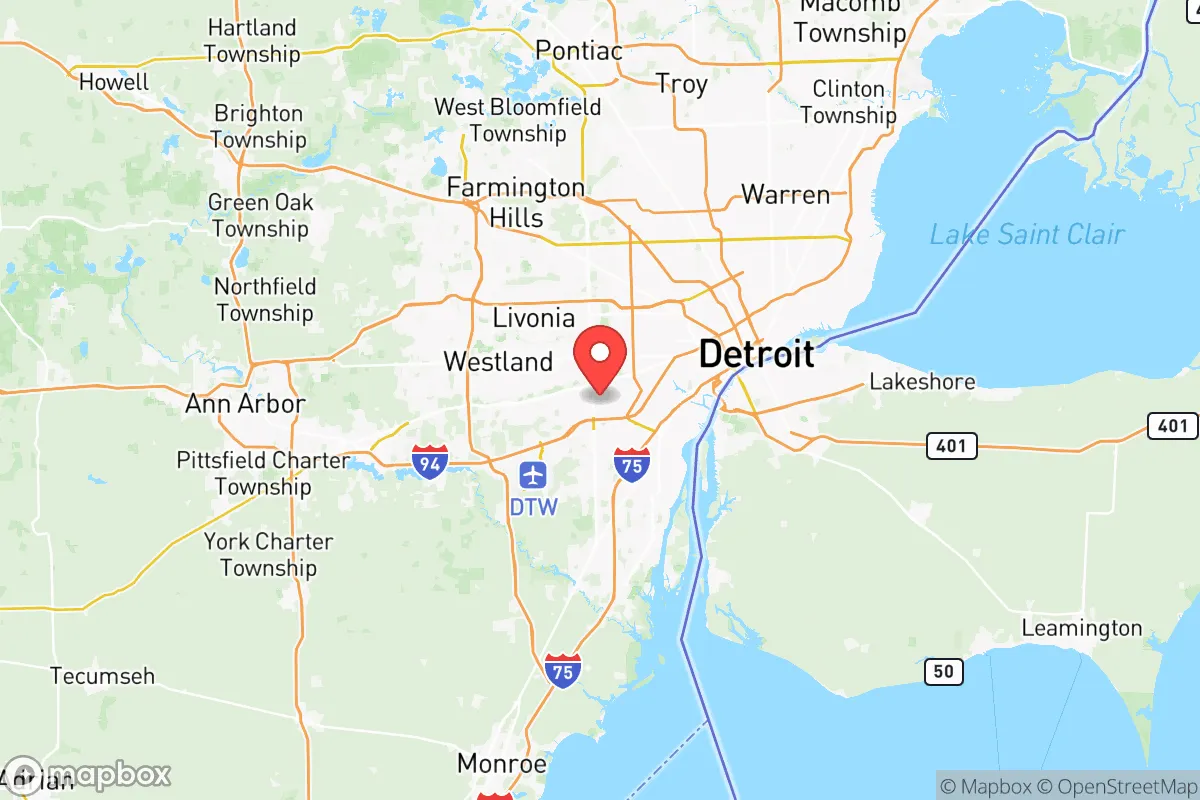
Photo: Wikipedia
Personal Sovereignty in Wayne County
Strong independent fundamentals that actively favor personal liberty and low regulation.
What does Personal Sovereignty tell us?
Personal Sovereignty measures your capacity for self-reliance and independence with minimal government friction. Higher scores mean fewer barriers between you and the way you want to live... but it assumes you have the space you need and good neighbors.
What does this tell us?
Personal Sovereignty measures your capacity for self-reliance and independence with minimal government friction. Higher scores mean fewer barriers between you and the way you want to live... but it assumes you have the space you need and good neighbors.
State Policy
Energy independence: Importer (20% of energy produced in-state)
Personal Liberty
Homesteading

Personal Liberty Analysis
Wayne County, Michigan presents a deeply conflicted environment for personal sovereignty, where the promise of Michigan’s constitutional protections clashes with the reality of dense, heavily regulated urban governance. For conservative-leaning individuals and parents prioritizing autonomy, the county is a study in extremes: the city of Detroit and its inner-ring suburbs impose some of the most restrictive local ordinances in the state, while outlying communities like Northville, Plymouth, and the rural fringes near Romulus and Sumpter Township offer pockets of relative freedom. The key to navigating this landscape lies in understanding that your ZIP code determines your actual level of sovereignty far more than your state of residence.
Tax burden and regulatory posture in Wayne County’s urban core versus outer townships
Michigan’s state-level tax framework is moderate—a flat 4.25% income tax and a 6% sales tax—but Wayne County layers on significant local burdens that erode financial autonomy. Detroit residents face a city income tax of 2.4% for residents and 1.2% for non-residents, plus some of the highest property tax rates in the state, often exceeding 3.5% of assessed value due to the Wayne County millage and Detroit Public Schools levies. This creates a total tax load that can approach 7-8% of income for a homeowner, severely limiting the ability to save or invest in self-reliance. In contrast, communities like Northville and Plymouth operate under lower city tax rates (0% income tax) and more predictable property tax structures, though still subject to Wayne County’s base millage. Regulatory posture follows the same split: Detroit’s building codes, business licensing, and zoning are notoriously bureaucratic, with permit delays common for anything from a fence to a home workshop. The outer townships—Brownstown, Huron, and Sumpter—enforce fewer overlay districts and have planning departments that process permits in weeks, not months. For a prepper or homesteader, the regulatory friction in Detroit and its inner suburbs (Dearborn, Livonia) is a dealbreaker; the outer townships are workable but still require navigating county-level health department rules for septic systems and wells.
Self-defense and gun law specifics in Wayne County’s varied jurisdictions
Michigan is a shall-issue state for concealed pistol licenses (CPL), and Wayne County’s gun board historically processes applications within the statutory 45-day window, though Detroit’s police department has faced lawsuits for delays. The state preempts local firearm ordinances, meaning Detroit cannot ban guns outright, but the city’s culture and enforcement create a de facto hostile environment. Open carry is legal statewide, but in Detroit, it invites police contact and potential harassment; in Plymouth and Northville, open carry is generally tolerated. Stand-your-ground laws apply statewide, but Wayne County prosecutors—particularly in Detroit and Dearborn—are known for aggressively charging self-defense claims, forcing defendants to prove immunity at trial. The practical reality: if you use a firearm in self-defense in Detroit, expect a lengthy legal battle even if justified. In Romulus and Sumpter Township, where sheriff’s deputies handle most calls, the legal climate is more aligned with conservative self-defense norms. Magazine capacity and assault weapon bans are state-level issues (currently no bans), but Wayne County’s urban jurisdictions have attempted local restrictions that were struck down in court. For the sovereignty-minded, living outside Detroit’s city limits is essential for a clean self-defense posture; the outer townships offer the best balance of legal protection and cultural acceptance.
Self-reliance and homesteading viability across Wayne County’s zoning landscape
Homesteading in Wayne County is a game of zoning loopholes and lot size minimums. Detroit’s residential zones are primarily R1-R4, with standard lots of 30 to 40 feet wide—too small for meaningful food production or livestock. The city’s urban agriculture ordinance allows chickens (hens only, no roosters) and bees with a permit, but goats, pigs, and larger livestock are banned outright. In Northville and Plymouth, lot sizes range from 0.25 to 1 acre, and zoning typically permits small-scale gardening and limited poultry, but livestock is restricted to agricultural zones. The real opportunity lies in Brownstown, Huron, and Sumpter Townships, where minimum lot sizes of 1 to 5 acres are common, and agricultural zoning allows for goats, sheep, and even small cattle operations. Off-grid feasibility is limited county-wide: Michigan’s building code requires connection to municipal water and sewer in most subdivisions, but in rural Sumpter Township, well and septic systems are standard, and solar panels are permitted without HOA interference. Rainwater collection is legal statewide, but Wayne County’s health department imposes strict cistern standards. For a serious homesteader, the outer townships are viable but require a 30-45 minute commute to Detroit for work; the inner suburbs are essentially suburban lawns with no self-reliance potential.
Personal liberties: parental rights, medical autonomy, speech, and property
Michigan’s state constitution protects parental rights in education, but Wayne County’s school districts—particularly Detroit Public Schools and Dearborn Public Schools—have implemented curriculum mandates that bypass parental input, including comprehensive sex education and DEI programs. Charter schools and homeschooling are legal, but Detroit’s zoning makes homeschooling space tight, and the county’s truancy officers are aggressive in urban districts. Medical autonomy is under pressure: Wayne County’s health department enforced strict COVID-19 mandates longer than most, and vaccine requirements for school attendance remain in place for standard immunizations. The county’s public health orders have a history of exceeding state guidance, a pattern that concerns medical freedom advocates. Free speech is protected by the First Amendment, but Detroit’s city council has attempted to regulate protest locations and noise ordinances that chill public assembly. Property rights are the brightest spot: Michigan’s Property Rights Protection Act limits eminent domain abuse, and Wayne County’s tax foreclosure process, while aggressive, has been reformed to give owners more redemption time. However, Detroit’s blight enforcement can result in fines for unkempt lawns or unpermitted structures, a direct threat to the prepper’s desire to maintain a low-profile, self-sufficient property. In Plymouth and Northville, property rights are stronger due to active homeowner associations that enforce covenants—a double-edged sword for those wanting to build a bunker or store supplies visibly.
Overall, Wayne County offers a fractured sovereignty landscape where personal autonomy is highly dependent on municipality choice. The urban core of Detroit and its inner suburbs (Dearborn, Livonia) are net negatives for the conservative prepper: high taxes, hostile self-defense enforcement, restrictive zoning, and overreaching health mandates. The outer townships—Sumpter, Brownstown, Huron, and parts of Romulus—provide a more favorable environment with lower taxes, agricultural zoning, and a culture of self-reliance. Compared to rural counties in Michigan’s Upper Peninsula or northern Lower Peninsula, Wayne County falls short on homesteading viability and regulatory freedom, but it offers proximity to jobs, medical infrastructure, and supply chains that preppers value. For the strategic relocator, the calculus is clear: choose a township on the county’s fringe, not the city’s core, and accept that Wayne County will never match the sovereignty of a place like Alpena or Marquette. It is a compromise location—better than Chicago or New York, but far from the libertarian ideal.

* Values derived from national, state, county, city and local statistics and may differ in a specific area. Last updated: 2026-05-16T03:08:25.000Z
Narrative content on this page is AI-generated and may contain mistakes. Verify any details that matter before acting on them.
ReloMaps may earn a commission from affiliate links at no extra cost to you.

