Photo: Wikipedia
Demographics of Wayne County
Affluence Level in Wayne County
A below-average socioeconomic profile. Incomes, home values, and educational attainment trail the U.S., with higher poverty and unemployment.
People of Wayne County
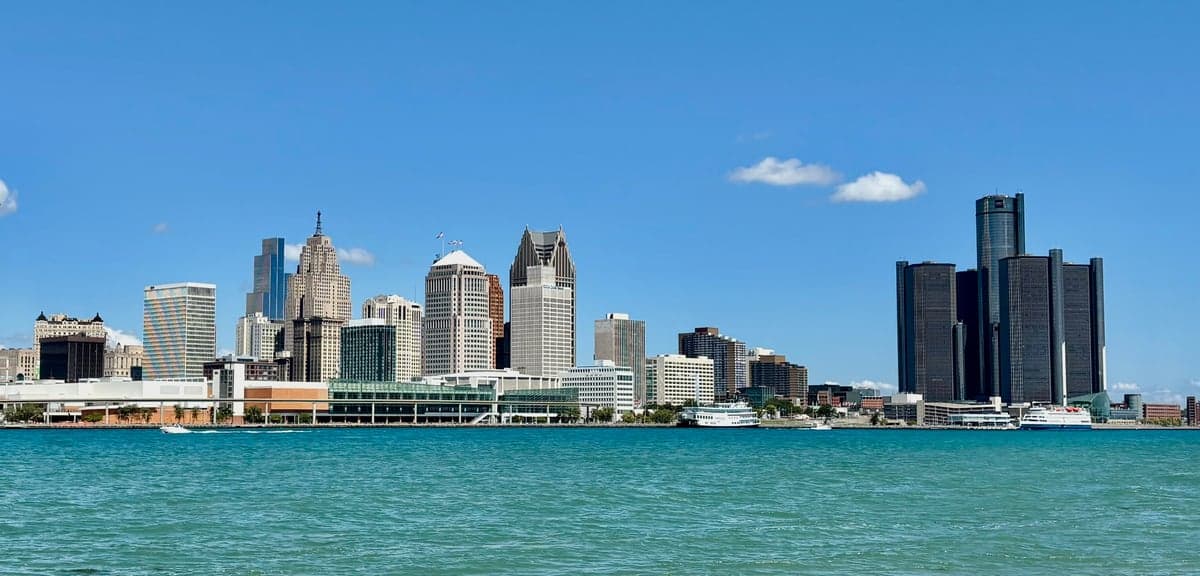
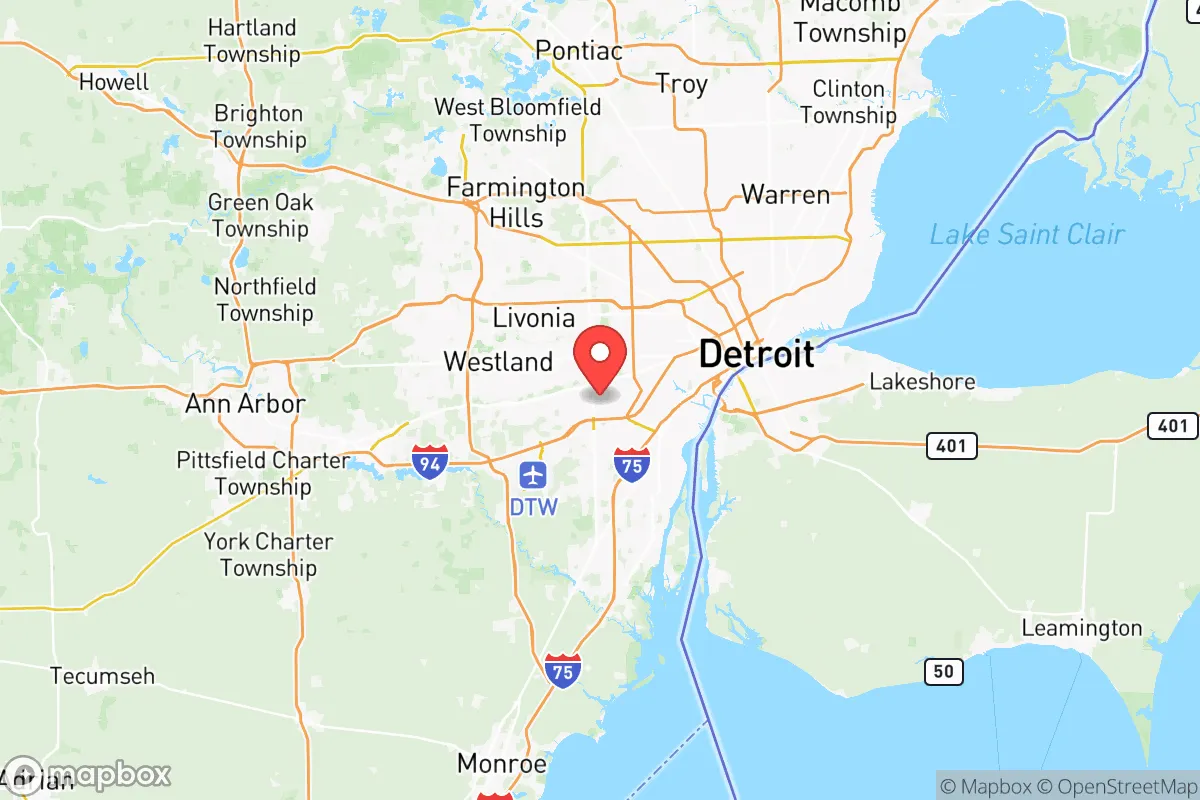
Wayne County, Michigan, is a densely populated, majority-minority urban core with a population of 1,773,767, anchored by Detroit. Its people are defined by a deep industrial heritage, a stark racial and economic divide between the city and its suburbs, and a distinctive identity rooted in the Great Migration, European immigration, and a recent, modest influx of immigrants from the Middle East and South Asia. The county is 48.2% White, 37.0% Black, 6.7% Hispanic, 2.3% Indian (subcontinent), and 1.2% East/Southeast Asian, with only 3.8% foreign-born—a figure far lower than coastal metros, reflecting a population that is largely native-born and shaped by decades of domestic migration.
Settlement & growth (pre-1960)
Before American settlement, the region was inhabited by the Wyandot (Huron) and other Algonquian-speaking peoples, who used the Detroit River as a major trade route. French colonists established the first European settlement in 1701 with Fort Pontchartrain du Détroit, creating a small agricultural and fur-trading community along the river in what is now Detroit. The British took control in 1760, and after the American Revolution, the area became part of the United States, attracting Yankee settlers from New England and New York in the early 1800s. These pioneers founded towns like Plymouth and Northville, establishing a Yankee Protestant cultural base that dominated the county through the mid-19th century.
The first major immigrant wave came from Germany and Ireland in the 1840s–1860s, drawn by cheap land and industrial jobs. Germans settled heavily in Detroit's east side and in Dearborn, where they built breweries, churches, and tight-knit neighborhoods. Irish immigrants concentrated in Detroit's Corktown neighborhood, working on the railroads and in the growing shipbuilding industry. By 1900, Polish immigrants began arriving in massive numbers, fleeing poverty and partition in Europe. They established a powerful ethnic enclave in Detroit's Poletown and in Hamtramck, an independent city that became the most Polish-majority municipality in the United States, with Polish-language newspapers, Catholic parishes, and fraternal organizations that persisted for generations.
The single most transformative event in Wayne County's human history was the Great Migration (1910–1970). Hundreds of thousands of Black Americans fled Jim Crow violence and economic oppression in the Deep South—particularly from Alabama, Mississippi, and Georgia—for industrial jobs in Detroit's auto plants. They settled overwhelmingly in Detroit's Black Bottom and Paradise Valley neighborhoods, later spreading to the city's west side and into inner-ring suburbs like Inkster and Ecorse. By 1960, Detroit was 29% Black, and the city's Black population had built a vibrant middle class with its own businesses, churches, and cultural institutions, including the Motown record label. Simultaneously, Italian immigrants arrived in the early 1900s, settling in Detroit's east side and in Wyandotte, while Jewish immigrants from Eastern Europe concentrated in Detroit's northwest side and later in Oak Park and Southfield.
Modern era (post-1965)
The 1965 Hart-Cellar Act opened immigration from outside Europe, but Wayne County's foreign-born share remained low compared to the nation. The most notable post-1965 shift was the arrival of Arab immigrants, particularly from Lebanon, Iraq, and Yemen, who began settling in Dearborn and Dearborn Heights in the 1970s. This community grew steadily through chain migration, establishing the largest Arab-American concentration in the United States, with a visible presence of mosques, halal markets, and Arabic-language media. A smaller but significant Indian (subcontinent) community formed in Detroit's suburbs, particularly in Canton and Troy (the latter in neighboring Oakland County), drawn by engineering and medical jobs. East/Southeast Asian communities, including Vietnamese and Chinese immigrants, settled in Madison Heights and Troy, though their numbers in Wayne County proper remain modest at 1.2%.
The dominant demographic story of the post-1965 era, however, is not immigration but domestic migration: white flight. From the 1970s through the 2000s, hundreds of thousands of White residents left Detroit for the outer-ring suburbs of Livonia, Canton, Plymouth, and Northville, as well as for neighboring Macomb and Oakland counties. This suburbanization reshaped Wayne County into a starkly segregated landscape: Detroit became 78% Black, while its western suburbs remained overwhelmingly White. The county's Black population also suburbanized, with middle-class Black families moving to Southfield, Inkster, and Westland. Hispanic growth, driven by Mexican and Puerto Rican migration, concentrated in Detroit's southwest side and in Melvindale, reaching 6.7% of the county's population.
The future
Wayne County's population is projected to continue a slow decline, as Detroit's losses are only partially offset by stable or growing suburbs. The county is becoming more racially diverse but also more economically polarized. The Arab-American community in Dearborn is growing and consolidating, with a high birth rate and continued immigration, making it a distinctive, culturally distinct enclave that shows no signs of rapid assimilation. The Indian-subcontinent population in Canton is expanding, driven by professional-class migration, and is increasingly integrated into the broader suburban middle class. The East/Southeast Asian population remains small and stable, concentrated in a few suburban pockets. The Black population is slowly suburbanizing further, with growth in Canton and Westland, while Detroit's Black population is aging and declining. The White population, now 48.2% of the county, is increasingly concentrated in the western suburbs and is also aging, with younger White families often choosing Macomb or Oakland counties over Wayne.
The next 10–20 years will likely see a continued tribalization into distinct enclaves: a heavily Arab Dearborn, a majority-Black Detroit and inner-ring suburbs, and predominantly White, middle-class suburbs in the west. The county's low foreign-born share (3.8%) means it will not experience the rapid demographic transformation seen in coastal metros. Instead, the story will be one of slow decline, suburbanization of poverty, and the persistence of racial and ethnic boundaries that were drawn in the 20th century.
For someone moving into Wayne County today, the reality is a region of stark contrasts: a revitalizing but struggling urban core, stable but aging suburbs, and a few growing, diverse enclaves. The county's identity remains deeply tied to its industrial past and its racial history, and newcomers will find a place where community is often defined by city limits and ethnic lines rather than by a shared regional culture. It is a place for those who value strong, established ethnic and racial communities, but it offers less of the dynamic, immigrant-driven growth found in other parts of the country.

* Values derived from national, state, county, city and local statistics and may differ in a specific area. Last updated: 2026-05-16T03:08:25.000Z
Narrative content on this page is AI-generated and may contain mistakes. Verify any details that matter before acting on them.
ReloMaps may earn a commission from affiliate links at no extra cost to you.

