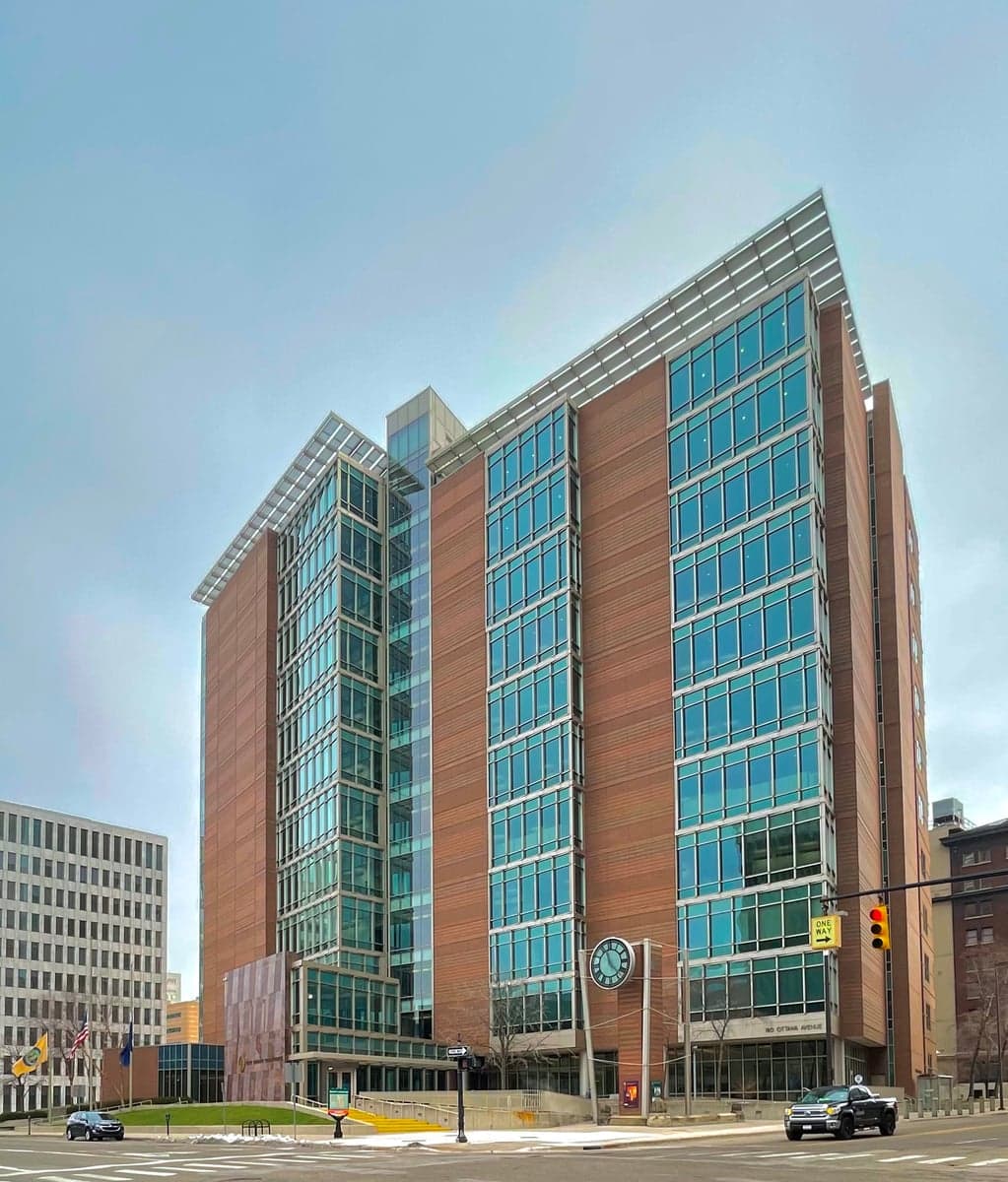
Photo: Wikipedia
Demographics of Kent County
Affluence Level in Kent County
A middle-class area roughly in line with national averages across income, home values, education, and employment.
People of Kent County
Kent County, Michigan, is home to 658,844 residents, a population that remains predominantly white (71.1%) but is growing more diverse, with a Hispanic population of 11.5% and a Black population of 9.2%. The county’s character is shaped by its deep Dutch Reformed roots, a strong manufacturing and healthcare economy, and a conservative-leaning political culture that is increasingly being tested by suburbanization and immigration. Grand Rapids serves as the economic and cultural hub, while smaller communities like Wyoming, Kentwood, and Walker reflect distinct waves of settlement and modern growth.
Settlement & growth (pre-1960)
The land that became Kent County was originally inhabited by the Odawa (Ottawa) and Ojibwe (Chippewa) peoples, who used the Grand River as a major transportation and trade route. French fur traders and missionaries were the first Europeans to pass through in the 17th and 18th centuries, but they established no permanent settlements. The area was ceded by Native nations through a series of treaties in the 1820s and 1830s, opening it to American settlement.
The first major wave of American settlers arrived in the 1830s and 1840s, primarily from New York and New England. These Yankees founded the city of Grand Rapids in 1831, drawn by the water power of the Grand River for sawmills and gristmills. The lumber boom of the 1850s through the 1880s transformed Grand Rapids into a major furniture-manufacturing center, attracting skilled craftsmen from Germany and the Netherlands. German immigrants settled heavily in the near-west side of Grand Rapids, establishing neighborhoods like the West Side and the area around Bridge Street, where their descendants still live today.
The most defining migration for Kent County was the mass arrival of Dutch immigrants, beginning in the 1840s and continuing through the early 20th century. These were primarily conservative Calvinists fleeing religious persecution and economic hardship in the Netherlands. They founded the city of Holland (in adjacent Ottawa County) but spread into Kent County, establishing the communities of Grandville, Jenison, and Cutlerville. The Dutch established the Christian Reformed Church, which became a dominant cultural and political force, shaping the county’s conservative values, its strong work ethic, and its emphasis on private Christian education. By 1900, Kent County was one of the most heavily Dutch areas in the United States.
Polish immigrants arrived in smaller numbers in the late 19th and early 20th centuries, settling in the southeast side of Grand Rapids, particularly around the area now known as the Eastown and Garfield Park neighborhoods. They worked in furniture factories and foundries. A small wave of Italian immigrants also settled in the city, concentrated near the Belknap Lookout neighborhood. African Americans began arriving during the Great Migration from the South after World War I, but their numbers remained small until the post-World War II era. They settled primarily in the Madison Square and Baxter neighborhoods of Grand Rapids. The post-war period also saw the growth of suburbs like Wyoming and Kentwood, which attracted white families leaving the city for newer housing and schools.
Modern era (post-1965)
The 1965 Hart-Cellar Act fundamentally changed Kent County’s demographics, though the effects were slower to arrive than in coastal regions. The most significant post-1965 immigrant group has been Hispanic, primarily from Mexico and Puerto Rico. They began arriving in the 1970s and 1980s, drawn by jobs in manufacturing, agriculture, and food processing. Today, the Hispanic population stands at 11.5% and is concentrated in the Burton Heights and Division Avenue corridors of Grand Rapids, as well as in the city of Wyoming. This community has grown steadily through both immigration and natural increase, and it is now the county’s largest minority group.
East and Southeast Asian communities (2.4% of the population) arrived in smaller but notable waves. Vietnamese refugees came after the fall of Saigon in 1975, settling in Grand Rapids and Kentwood, where a small commercial corridor serves the community. Korean and Chinese immigrants have arrived more recently, often drawn by professional opportunities in healthcare and education. The Indian subcontinent population (0.7%) is a newer and more affluent group, with many working in the medical and technology sectors; they are concentrated in Cascade Township and the East Grand Rapids area.
Domestic migration has also reshaped the county. The decline of the furniture industry in the 1970s and 1980s led to population stagnation in Grand Rapids proper, but the rise of healthcare (Spectrum Health, now Corewell Health) and manufacturing (Steelcase, Amway, Meijer) fueled suburban growth. Walker and Grandville have seen significant in-migration from other parts of Michigan and the Midwest, while Rockford has become a popular destination for families seeking good schools and a small-town feel. The Black population (9.2%) has grown through both domestic migration from Chicago and Detroit and through African immigration, particularly from Liberia and Somalia, with a concentration in the Alger Heights and East Hills neighborhoods.
The future
Kent County is becoming more diverse, but the pace is moderate compared to the national average. The white population is slowly declining as a share, while the Hispanic and Asian populations are growing. The county is not tribalizing into distinct, isolated enclaves; rather, the suburbs are absorbing new groups, with Hispanic families moving into Wyoming and Kentwood and Asian professionals settling in Cascade Township. The Dutch Reformed cultural dominance is fading, but its legacy of conservative politics, strong private schools, and community institutions remains influential.
The foreign-born population (4.8%) is low by national standards, suggesting that immigration will continue to be a gradual, rather than transformative, force. The county’s economy is stable and diversified, with healthcare, manufacturing, and retail providing a solid base. In-migration from other parts of Michigan is likely to continue, as Grand Rapids remains one of the state’s most economically vibrant regions. The next 10-20 years will likely see continued diversification, but Kent County will remain a predominantly white, Midwestern, conservative-leaning area, with the Hispanic community becoming an increasingly visible and integrated part of the social fabric.
For someone moving in now, Kent County offers a stable, family-oriented environment with a strong economy and a conservative cultural base. The population is slowly becoming more diverse, but the change is gradual and unlikely to disrupt the county’s fundamental character. New residents will find a community that values work, faith, and education, with a growing appreciation for its multicultural future.

* Values derived from national, state, county, city and local statistics and may differ in a specific area. Last updated: 2026-05-16T04:01:29.000Z
Narrative content on this page is AI-generated and may contain mistakes. Verify any details that matter before acting on them.
ReloMaps may earn a commission from affiliate links at no extra cost to you.

