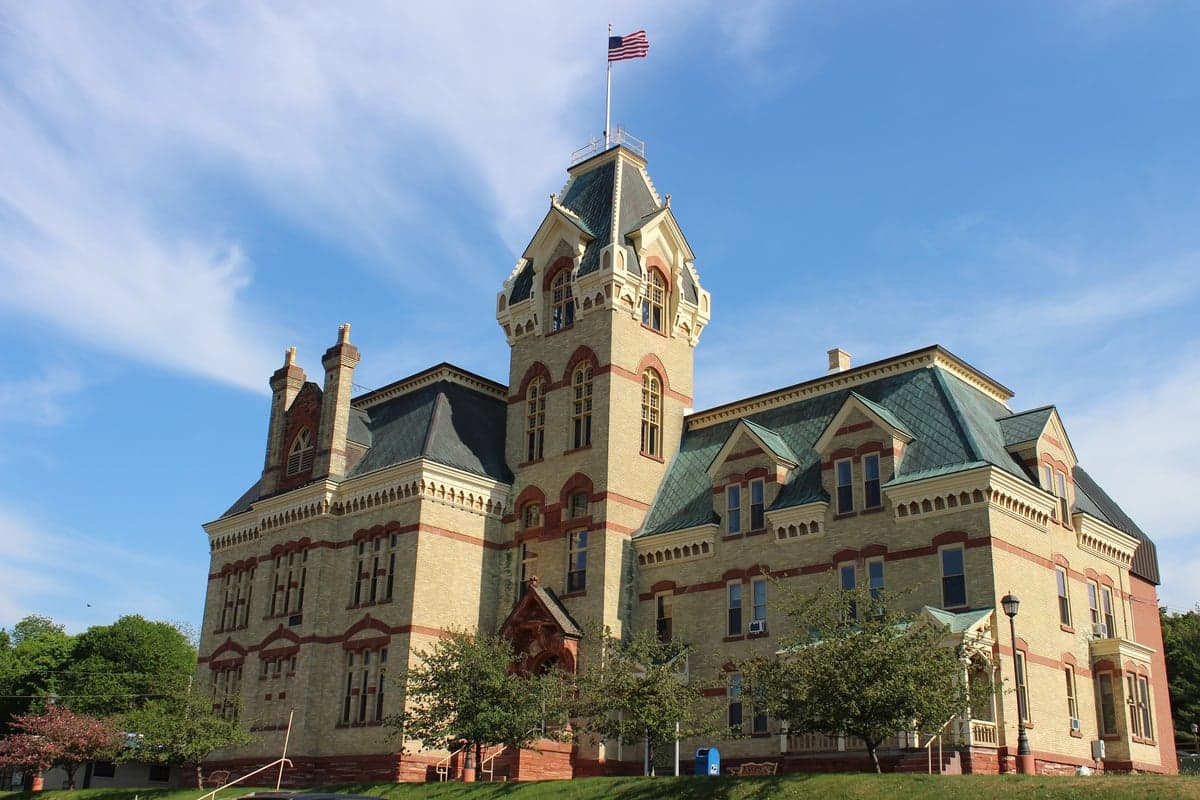
Photo: Wikipedia
Political ClimatePolitical Climate in Houghton County
Showing district-level results — no local-only data available.
Local Political AnalysisPolitical Analysis of Houghton County
Houghton County, Michigan, is a reliably Republican stronghold in the Upper Peninsula, carrying a Cook Partisan Voting Index (PVI) of R+11. That means the county consistently votes about 11 points more Republican than the national average, a stark contrast to the state of Michigan as a whole, which sits at a PVI of EVEN. While the county has a deep-rooted conservative bent, the political reality on the ground is more nuanced than a simple red-blue map suggests, with the city of Houghton itself and the Michigan Technological University campus acting as a persistent blue island in a sea of red.
How it compares
The gap between Houghton County and the state of Michigan is significant and growing. While Michigan is a classic swing state that flipped from Trump to Biden in 2020 and back to Trump in 2024, Houghton County has remained a solid Republican vote. In the 2024 presidential election, the county gave Trump a roughly 60-38 margin, a far cry from the statewide split. The real political divide within the county is between the college town of Houghton and the rest of the county. Precincts in Houghton city, especially those near the university, often vote Democratic, sometimes by double digits. In contrast, the townships of Calumet, Laurium, and the rural areas like Chassell and Otter Lake are deeply conservative. The swing precincts are the more suburban areas just outside Houghton, like the Portage Township precincts, where the vote can be closer to 50-50, reflecting a mix of university-affiliated professionals and long-time local families.
What this means for residents
For a conservative resident, Houghton County feels like a natural fit. Local politics, from the county commission to the sheriff's office, are dominated by Republicans. Gun rights are widely respected, and the local economy, heavily tied to mining, logging, and small business, aligns with a pro-business, low-tax philosophy. For a liberal resident, the experience is more of a live-and-let-live arrangement. The university provides a cultural and political counterweight, and the city of Houghton itself is a safe space for progressive views. You'll find plenty of "Coexist" bumper stickers on campus and in the downtown coffee shops, but you'll also see "Trump 2024" flags flying from pickup trucks in the same parking lot. The key is that most people here are too busy dealing with the harsh winters and the practical challenges of rural life to get into daily political fights. The local culture is one of self-reliance and neighborly help, which often transcends party lines.
The most distinctive policy distinction in Houghton County is its relationship with the state government in Lansing. There's a strong, almost reflexive, distrust of "downstate" politics, regardless of which party is in power. This manifests in local resistance to state-level environmental regulations on mining and a general preference for local control over land use and education. The county's economy is also uniquely tied to the Keweenaw Peninsula's copper mining history and the modern resurgence of mineral exploration, which creates a political dynamic where economic development often trumps environmental concerns. For anyone moving here, the practical takeaway is simple: your vote will likely be in the minority if you're a Democrat, but you won't be alone, and the community's focus on survival and practicality means political differences rarely get in the way of a good snowmobile ride or a helping hand when your car gets stuck in a drift.

State Political ClimatePolitical Climate in Michigan
State Political AnalysisPolitical Environment in the State
Michigan is the ultimate swing state, with a Cook PVI of EVEN that perfectly captures its knife-edge political balance. Over the past 20 years, the state has lurched from reliably blue (voting for Gore, Kerry, and Obama twice) to a Trump pickup in 2016, then back to Biden in 2020 by just 154,000 votes out of 5.5 million cast. The dominant coalitions are a shrinking, union-heavy blue wall in the southeast versus a growing, exurban and rural red wave everywhere else, with the critical swing voters living in the suburbs of Grand Rapids, Lansing, and Traverse City. If you're moving here, understand that your vote will matter more than almost anywhere else in the country.
Urban vs. rural divide
The political map of Michigan is a story of three distinct regions. Southeast Michigan, anchored by Detroit and its inner-ring suburbs like Southfield and Dearborn, is the Democratic stronghold, delivering massive margins that statewide Democrats need to overcome. Ann Arbor (Washtenaw County) is the bluest of the blue, with a progressive activist base that drives the state party's platform. Western Michigan tells a different story: Grand Rapids (Kent County) has been trending blue in recent cycles as the city grows younger and more diverse, but the surrounding Ottawa and Allegan counties are deeply red. The real Republican engine is the "Outstate" — the rural Upper Peninsula, the Thumb, and the northern Lower Peninsula, where counties like Oscoda and Missaukee routinely vote 70%+ Republican. The swing counties that decide elections are the suburban ring around Detroit (Macomb County, which flipped from Obama to Trump to Biden) and the Grand Rapids exurbs. A new resident in Traverse City will experience a purple bubble in a sea of red, while someone in Midland will find a reliably conservative community with a strong chemical industry base.
Policy environment
Michigan's policy environment is a mixed bag that reflects its swing-state status. The state has a flat income tax rate of 4.25%, which is moderate by national standards, and a 6% sales tax. Property taxes are relatively high, especially in school districts with strong local support. The regulatory posture leans moderate: Michigan is a right-to-work state (though Democrats repealed the law in 2023, effective 2025), and it has a robust manufacturing base with significant environmental regulations around the Great Lakes. Education policy is a flashpoint: the state has a thriving charter school sector (one of the most permissive in the Midwest) alongside traditional public schools, and the debate over school choice is constant. Healthcare is dominated by the Big Three automakers' legacy insurance systems and the expansion of Medicaid under the Healthy Michigan Plan. Election laws are relatively accessible: no-excuse absentee voting was approved by voters in 2018, and same-day voter registration is available. For a conservative relocator, the tax burden is manageable, but the regulatory environment in southeast Michigan can feel heavy.
Recent policy direction
The last three years under Governor Gretchen Whitmer and a Democratic trifecta (2023-2024) have produced a sharp leftward shift on several fronts. Gun laws tightened significantly: universal background checks and safe storage requirements were enacted in 2023, and a "red flag" law (extreme risk protection order) was passed. Parental and education rights saw a major battle: the state repealed the 2020 law requiring schools to post curriculum online and notify parents of LGBTQ+ content, replacing it with a "model policy" that emphasizes inclusivity. Medical and bodily autonomy saw the biggest change: Proposal 3 in 2022 enshrined abortion rights in the state constitution, and the 1931 abortion ban was repealed. Property rights remain strong, with no statewide rent control and relatively permissive zoning in rural areas, though urban areas like Ann Arbor have tightened short-term rental rules. Voting and ballot access expanded: the 2022 ballot initiative (Proposal 2) established nine days of early voting, automatic voter registration, and state-funded absentee ballot drop boxes. For a conservative relocator, the gun and parental rights changes are the most significant concerns; for a liberal relocator, the abortion and voting access wins are major draws.
Civil unrest & political movements
Michigan has been a national flashpoint for political movements on both sides. The 2020 Whitmer kidnapping plot and the armed protests at the state capitol over COVID-19 restrictions put Michigan at the center of the national debate over public health mandates and extremism. The "Wolverine Watchmen" militia group was a stark example of far-right organizing. On the left, the 2023 Israel-Hamas war protests in Dearborn and Ann Arbor were among the largest in the country, reflecting the state's significant Arab-American population (the largest per capita in the U.S.). Immigration politics are relatively quiet compared to border states, but the debate over sanctuary policies flares up in Detroit and Washtenaw County. Election integrity remains a live issue: the 2020 "Stop the Steal" movement had strong support in rural counties, and the 2024 election saw intense scrutiny of absentee ballot processing in Detroit. A new resident in Lansing will see regular protests at the capitol, while someone in Holland will find a quieter, more conservative community with strong Dutch Reformed church influence.
Projection
Over the next 5-10 years, Michigan is likely to remain a competitive swing state, but the demographic trends favor a slow shift rightward. The population is aging and the Detroit metro area is shrinking, while the western and northern parts of the state are growing with retirees and remote workers from Chicago and the East Coast. The in-migration from blue states is not as pronounced as in Texas or Florida, but it's real in places like Traverse City and Grand Rapids. The Democratic trifecta of 2023-2024 may prove to be a temporary peak, as the state's natural partisan lean is slightly right of center. The wild card is the auto industry's transition to electric vehicles: if the EV transition creates jobs in Michigan, it could stabilize the blue-leaning union vote; if it destroys jobs, the backlash could accelerate the red shift. A conservative moving in now should expect to see the state's politics remain competitive, with occasional Democratic control of the governor's office and legislature, but with a persistent Republican base that can win statewide in a good year.
For a new resident, the bottom line is that Michigan offers a genuine swing-state experience where your vote matters and the political culture is engaged but not toxic in most communities. If you're conservative, you'll find welcoming communities in the western and northern parts of the state, but you'll need to accept that the state government will occasionally be controlled by Democrats who will pass laws you disagree with. If you're liberal, you'll find strong urban and suburban bases, but you'll need to accept that the state's rural majority will push back hard. The practical takeaway: choose your community carefully, because the political experience in Grand Rapids is completely different from Detroit, and both are valid Michigan experiences.
* Values derived from national, state, county, city and local statistics and may differ in a specific area. Last updated: 2026-07-08T14:42:37.000Z
Narrative content on this page is AI-generated and may contain mistakes. Verify any details that matter before acting on them.
ReloMaps may earn a commission from affiliate links at no extra cost to you.

