Photo: Wikipedia
Demographics of Houghton County
Affluence Level in Houghton County
A middle-class area roughly in line with national averages across income, home values, education, and employment.
People of Houghton County
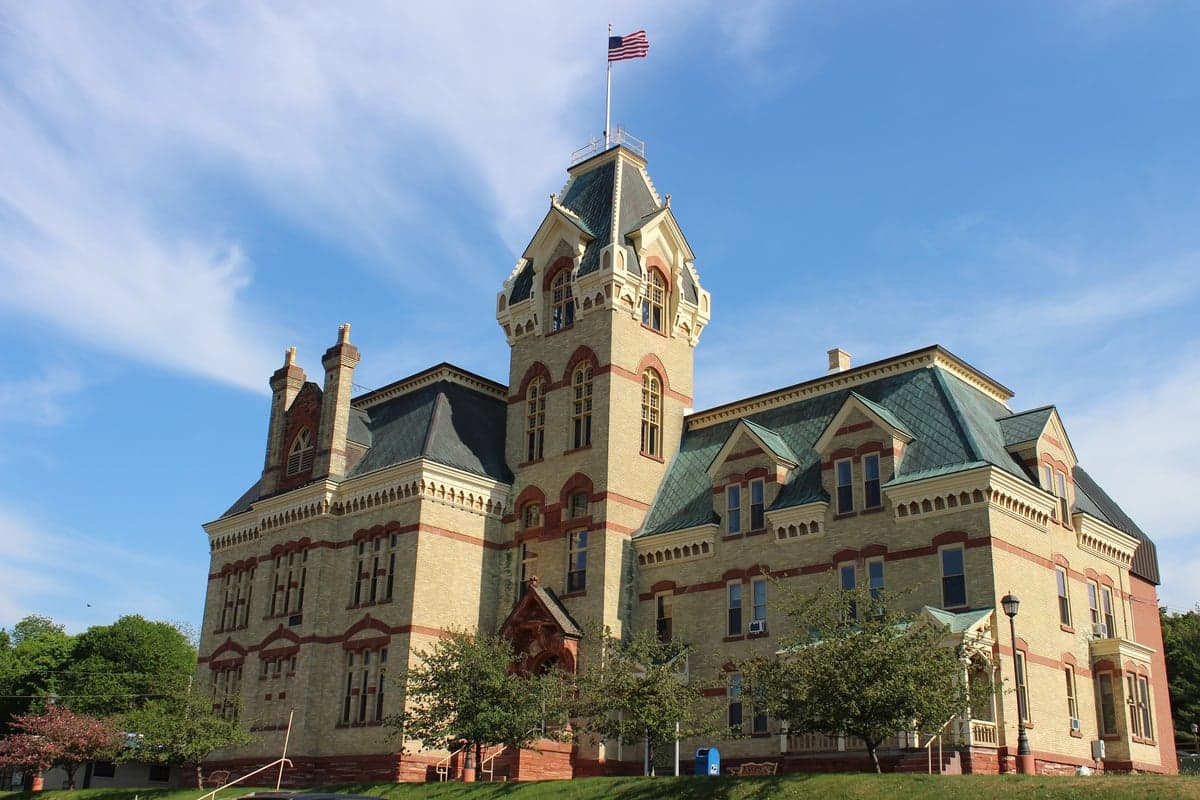
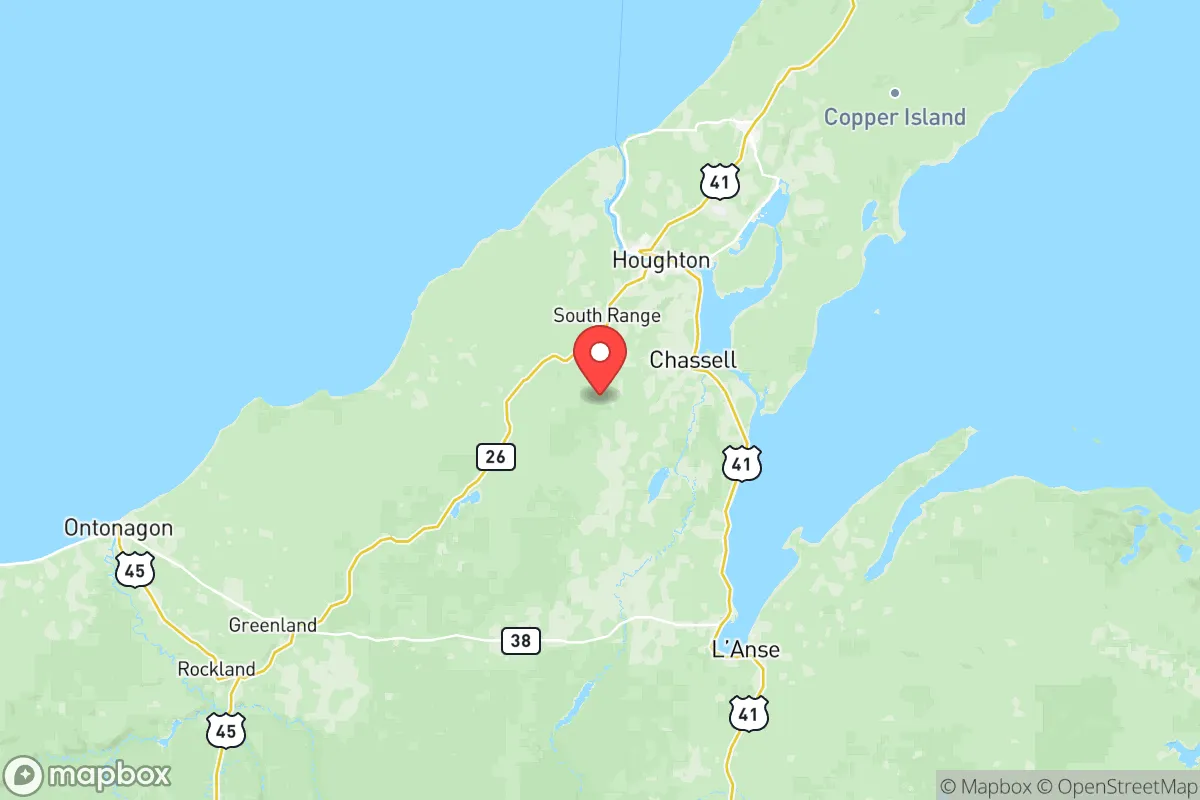
The people of Houghton County, Michigan, today number 37,428 and are defined by a deep-rooted sense of place, a strong work ethic inherited from generations of miners, and a predominantly white, ethnically European character that is notably older and more stable than the national average. With 91.2% of residents identifying as white and a foreign-born population of just 3.7%, the county retains the cultural imprint of its 19th- and early 20th-century immigrant founders. This is a community where Finnish, Italian, and Cornish surnames are common, where the past is visible in the architecture of towns like Calumet and Hancock, and where the population is slowly declining even as the region’s flagship university, Michigan Technological University in Houghton, brings a steady influx of students and faculty.
Settlement & growth (pre-1960)
Long before European settlers arrived, the region that is now Houghton County was the homeland of the Ojibwe (Chippewa) people, who used the area’s abundant copper for tools and trade for thousands of years. French fur traders and Jesuit missionaries passed through in the 17th and 18th centuries, but no permanent European settlement took hold until after the United States acquired the territory in the 1840s. The discovery of massive copper deposits along the Keweenaw Peninsula triggered the first major wave of settlement, and Houghton County was officially organized in 1845.
The copper boom drew a remarkably diverse mix of immigrants, each group arriving in distinct waves and settling in specific communities. The earliest miners were Cornish from England, known locally as "Cousin Jacks," who brought deep-shaft mining expertise and established themselves in the towns of Hancock and Calumet in the 1850s and 1860s. They were followed by Irish immigrants, who worked the mines and built the railroads, and by Germans, who settled in Houghton and Lake Linden as merchants and skilled tradesmen. By the 1880s, the mines were recruiting heavily from Finland, and Finns soon became the largest ethnic group in the county, concentrating in South Range, Painesdale, and the rural areas around Chassell. Italian immigrants arrived in the 1890s and early 1900s, settling in Laurium and Dollar Bay, while smaller numbers of Slovenians, Croatians, and French Canadians also joined the workforce. The peak of the copper industry came around 1910, when the county’s population exceeded 88,000—more than double its current size.
The collapse of copper prices after World War I, followed by the Great Depression and the final mine closures in the 1960s, triggered a long, slow population decline. Many families left for industrial jobs in Detroit, Chicago, and Milwaukee, but those who stayed formed a tight-knit, ethnically conscious society centered on churches, mutual aid societies, and the sauna culture brought by the Finns. Michigan Technological University, founded in 1885 as the Michigan Mining School, became an increasingly important economic anchor, drawing faculty and students from across the Midwest and keeping the county’s educated population from disappearing entirely.
Modern era (post-1965)
The 1965 Hart-Cellar Act had a relatively muted effect on Houghton County compared to urban and coastal areas, but it did open the door for a small but visible influx of international students and professionals tied to Michigan Technological University. The most notable post-1965 demographic shift has been the growth of the Indian subcontinent population, which now stands at 1.2% of the county’s residents. These are overwhelmingly graduate students, engineers, and faculty at Michigan Tech, and they have concentrated in the city of Houghton and the adjacent village of Hancock, where university housing and rental properties are most available. The East and Southeast Asian population, at 1.6%, follows a similar pattern, with many Chinese, Korean, and Vietnamese students and researchers living in the same university-adjacent neighborhoods.
Domestic migration since 1965 has been largely outbound. The county has lost population in every decade since 1920, with the exception of a brief stabilization in the 1970s. Young adults continue to leave for job opportunities in larger metropolitan areas, while retirees and second-home buyers from downstate Michigan and the Midwest have begun to trickle in, drawn by the region’s natural beauty, low cost of living, and outdoor recreation. The Black population remains very small at 1.1%, and the Hispanic population at 1.8%, reflecting the county’s limited draw for the larger domestic migration streams that have reshaped other parts of the country. Suburbanization has been minimal; the county’s development pattern remains centered on the historic mining towns, with new housing concentrated in the Houghton-Hancock metro area and along the US-41 corridor.
The future
Houghton County’s population is projected to continue its slow decline over the next 10 to 20 years, driven by an aging population and the outmigration of young adults. The median age is already above the national average, and the county’s birth rate is below replacement level. However, Michigan Technological University provides a powerful counterweight: its enrollment has grown modestly in recent years, and the university’s focus on engineering, computing, and sustainability is attracting a steady stream of domestic and international students. If the university can retain more graduates as local entrepreneurs and remote workers, the county could see a modest stabilization or even a slight increase in its college-educated, higher-income population.
Diversity is likely to increase slowly, primarily through the university pipeline. The Indian and East/Southeast Asian populations will probably grow as a share of the total, but they will remain small in absolute numbers and concentrated in Houghton and Hancock. The county’s cultural identity will remain strongly tied to its Finnish and Cornish heritage, with events like the annual Heikinpäivä festival in Hancock and the Copper Dog 150 sled dog race keeping traditions alive. New residents from outside the region will find a community that is welcoming but insular, where social networks are built through church, volunteer fire departments, and winter sports clubs.
For someone moving in now, Houghton County offers a place where the past is still present, where the cost of living is low, and where the natural environment—Lake Superior, the Keweenaw’s forests, and the region’s four distinct seasons—defines daily life. It is not a place of rapid growth or dramatic change, but it is a place of deep roots, strong community bonds, and a quiet resilience that has carried its people through boom, bust, and the long decades since the mines closed.

* Values derived from national, state, county, city and local statistics and may differ in a specific area. Last updated: 2026-07-08T14:42:37.000Z
Narrative content on this page is AI-generated and may contain mistakes. Verify any details that matter before acting on them.
ReloMaps may earn a commission from affiliate links at no extra cost to you.

