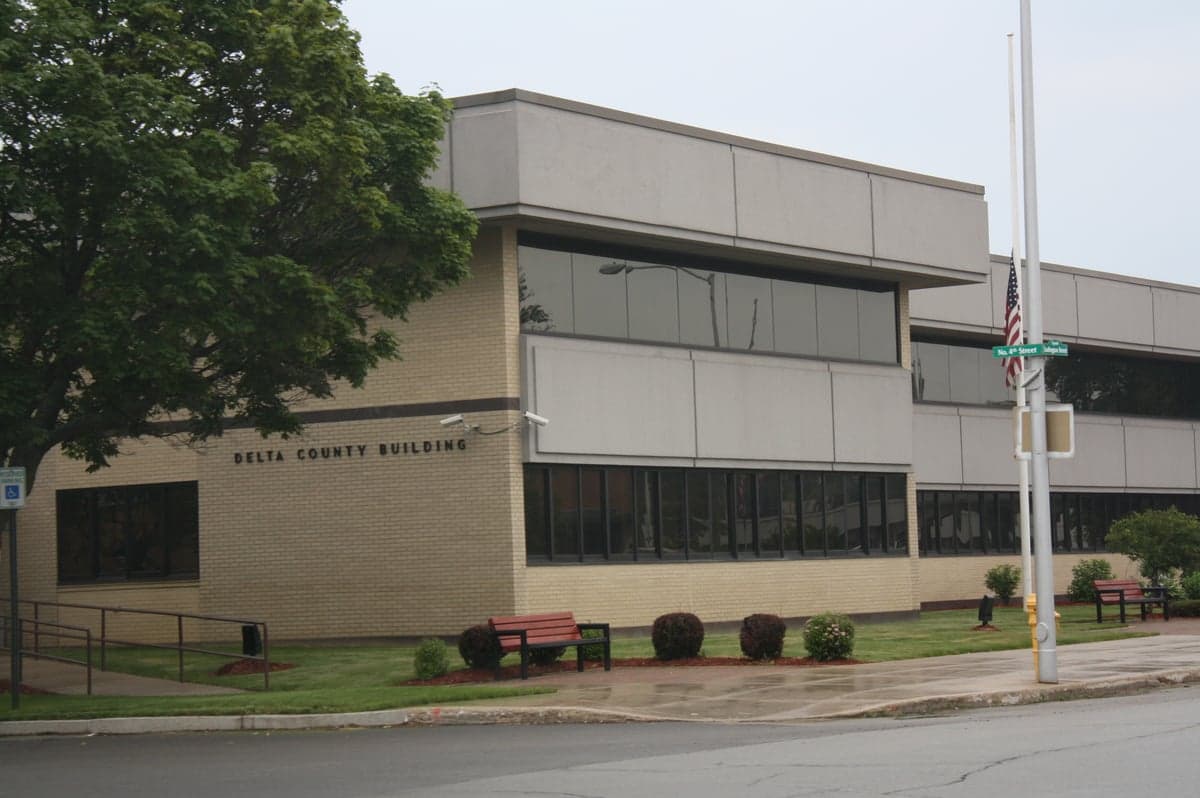
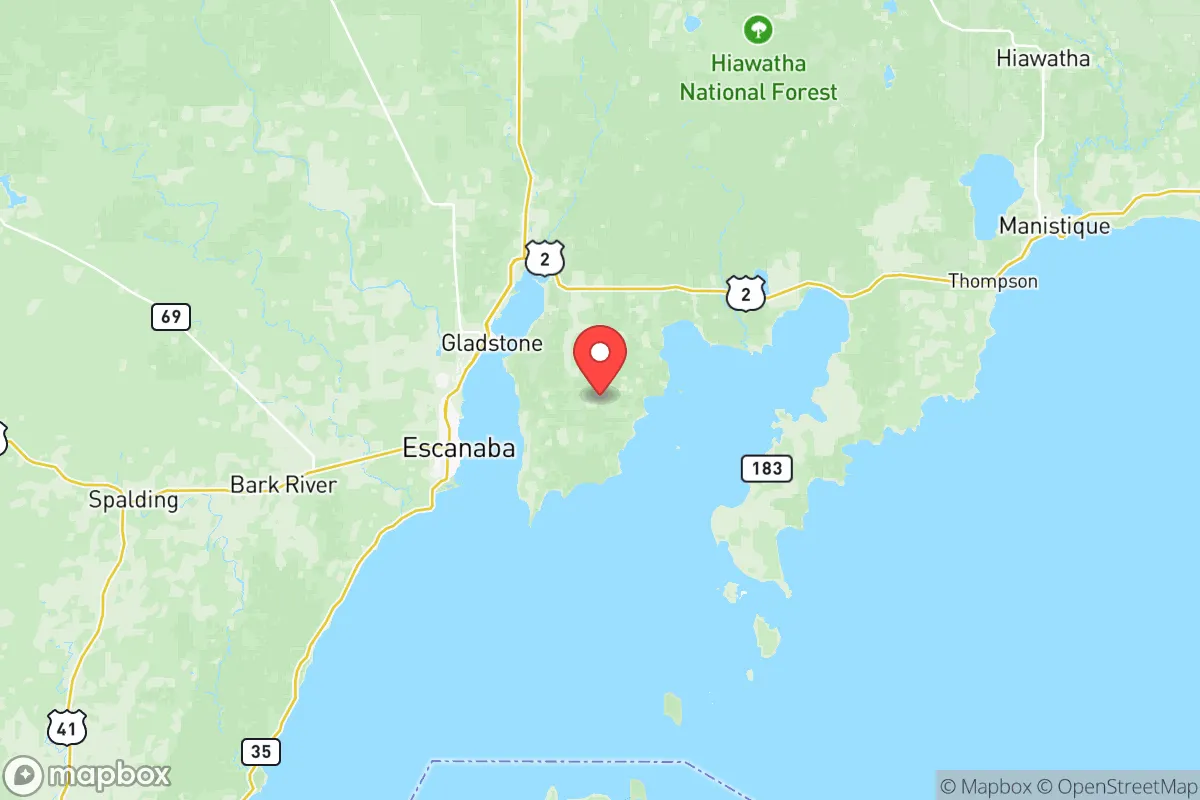
Photo: Wikipedia
Political ClimatePolitical Climate in Delta County
Showing county-level results — no local-only data available.
Lean and PVI are calculated from this county’s 2020 and 2024 presidential results, Cook-style.
Political rankings in Michigan
- Most Conservative Cities in Michigan
- Most Liberal Cities in Michigan
- Best Liberal-Leaning Towns in the Midwest
- Safest Liberal-Leaning Towns in the Midwest
- Safest Conservative-Leaning Towns in the Midwest
- Affordable Small Towns for Conservatives
- Most Affordable Liberal-Leaning Small Towns in the U.S.
- Safest Conservative-Leaning Cities in the U.S.
- Most Conservative Counties in Michigan
- Most Liberal Counties in Michigan
Local Political AnalysisPolitical Analysis of Delta County
Delta County is a reliably Republican stronghold in Michigan’s Upper Peninsula, carrying a Cook Partisan Voting Index (PVI) of R+15. That means the county consistently votes about 15 points more Republican than the national average, a stark contrast to the state of Michigan as a whole, which sits at EVEN on the PVI. In practice, this has meant that while Michigan has swung back and forth in presidential elections—going for Trump in 2016, Biden in 2020, and Trump again in 2024—Delta County has stayed deeply red, with Republican candidates routinely winning by double-digit margins. The trend has actually hardened over the past decade; the county’s Republican vote share has increased in every presidential election since 2008, even as the state’s overall partisan balance has tightened.
How it compares
Delta County’s R+15 PVI puts it in a different political universe from Michigan’s statewide EVEN rating. To put it in perspective, the county votes more Republican than places like Ottawa County (R+14) or Livingston County (R+13) in the Lower Peninsula. But the real story is the internal variation. The county seat, Escanaba, is the only real blue dot in the county—it tends to vote Democratic by a narrow margin, thanks to its union-heavy industrial base and public-sector workforce. In the 2024 election, Escanaba’s precincts split roughly 52-48 for the Democratic candidate. Meanwhile, the smaller towns tell a different story. Gladstone leans Republican by about 10 points, while Rapid River and Bark River are deep red, often going 65-35 or more for the GOP. The swing precincts are in the rural townships just outside Escanaba—like Wells Township and Ford River Township—where the vote is usually within 5 points either way, making them the real battlegrounds in local races.
What this means for residents
For conservative residents, Delta County feels like a safe haven. Republican candidates rarely have to worry about the general election here, and local offices—county commission, sheriff, road commission—are almost always held by Republicans. The county’s politics are heavily influenced by hunting rights, Second Amendment issues, and opposition to state-level environmental regulations on mining and logging. For liberal residents, it can feel isolating. Escanaba is the only place where you’ll regularly see Democratic yard signs, and even there, progressive candidates often struggle to win countywide races. The practical effect is that local policy tends to be conservative by default—zoning is minimal, taxes are low, and there’s little appetite for new social programs. But the flip side is that the county’s small population means politics rarely gets as heated as in swing areas; most people know their neighbors regardless of party.
Culturally, Delta County is distinct from the rest of Michigan in a few key ways. The strong Finnish and Swedish heritage in places like Escanaba and Gladstone fosters a communitarian, “we take care of our own” ethos that sometimes cuts across partisan lines. You’ll find conservative voters who support robust local funding for the Delta County Senior Center or the Escanaba Public Library, even as they vote against state-level tax increases. The county also has a notable independent streak—third-party candidates often pull 3-5% of the vote, higher than the state average. Looking ahead, the political trajectory seems set: as long as the U.P.’s economy remains tied to natural resources and tourism, Delta County will stay R+15 or even redder. The only wildcard is if Escanaba’s population grows faster than the rural townships, which could slowly shift the county’s center of gravity—but that’s a long shot.

State Political ClimatePolitical Climate in Michigan
State Political AnalysisPolitical Environment in the State
Michigan is the ultimate swing state, with a Cook PVI of EVEN that perfectly captures its knife-edge balance between the two major parties. Over the last 20 years, the state has lurched from reliably blue (voting for Kerry in 2004) to a shocking Trump win in 2016 (by 0.2%), back to Biden in 2020 (by 2.8%), and then saw Republicans sweep the state legislature and flip the state House in 2024. The dominant coalitions are a shrinking, union-heavy, urban Democratic base in Southeast Michigan and a growing, exurban and rural Republican base in the western and northern parts of the Lower Peninsula. The long-term trajectory is a slow reddening of the suburbs and exurbs, even as Detroit and Ann Arbor remain deep blue, making every election a toss-up.
Urban vs. rural divide
The political map of Michigan is a tale of two peninsulas, but really three distinct zones. The Democratic stronghold is Southeast Michigan, anchored by Detroit (Wayne County, ~68% Biden in 2020) and its inner-ring suburbs. Ann Arbor (Washtenaw County) is the state's most liberal city, driven by the University of Michigan. The Republican base is the western side of the state, from the Grand Rapids metro (Kent County, which flipped from red to purple but still leans right) north through Traverse City and the entire Upper Peninsula. The key battlegrounds are the "blue wall" counties that flipped to Trump in 2016: Macomb County (north of Detroit) and Genesee County (Flint). Macomb is the quintessential bellwether—working-class, heavily union, and culturally conservative. In 2024, Macomb went for Trump by about 8 points, while the rest of the state was nearly tied. The rural Upper Peninsula, once reliably Democratic, has shifted hard right, with counties like Gogebic and Iron voting +30 to +40 points for Trump in 2024.
Policy environment
Michigan's policy environment is a mixed bag that reflects its swing-state status. The state has a flat income tax rate of 4.25% (down from 4.35% in 2023 via automatic trigger), and a 6% sales tax. Property taxes are relatively high, with an average effective rate around 1.5%, but the Proposal A system (1994) caps annual increases for primary residences at the rate of inflation or 5%, whichever is lower. The regulatory posture is moderate—Michigan is a right-to-work state (the 2012 law was repealed in 2023 by the Democratic trifecta, but a 2024 ballot initiative to reinstate it failed). Education policy is a flashpoint: the state has a robust charter school sector (one of the most permissive in the Midwest) but also some of the lowest per-pupil funding in the region. Healthcare is dominated by the Big Three insurers (Blue Cross, Priority Health, McLaren), and the state expanded Medicaid under the Healthy Michigan Plan in 2014. Election laws are relatively accessible: no-excuse absentee voting was approved by voters in 2018, and same-day voter registration is available. However, voter ID is required at the polls (with a signed affidavit as an alternative).
Recent policy direction
The 2023-2024 Democratic trifecta (Governor Gretchen Whitmer, state House, and state Senate) passed a flurry of legislation that shifted the state leftward, but the 2024 election flipped the state House back to Republicans, creating a divided government. Key recent laws include: Repeal of right-to-work (2023, now being challenged in court), expansion of the Elliott-Larsen Civil Rights Act to include sexual orientation and gender identity (2023), repeal of the 1931 abortion ban and codification of abortion rights via Proposal 3 (2022), and universal background checks and safe storage laws for firearms (2023). On the gun front, Michigan now has a "red flag" law (extreme risk protection orders) and requires safe storage of firearms when minors are present. Self-defense law remains "stand your ground" (codified in 2006), but the new safe storage law has drawn criticism from gun rights advocates. Parental rights in education saw a major fight over the 2023 "Don't Say Gay" bill (which failed), but the state did pass a law requiring schools to notify parents of a student's mental health status. On property rights, the state has a strong "takings" clause, but the 2020 Line 5 pipeline controversy (Enbridge's underwater pipeline in the Straits of Mackinac) remains a simmering property and environmental rights issue. Voting access was expanded with automatic voter registration at the DMV and pre-registration for 16-year-olds.
Civil unrest & political movements
Michigan has been a national flashpoint for political movements. The 2020 Whitmer kidnapping plot (involving militia groups from across the state) and the armed protests at the state capitol over COVID-19 lockdowns (Operation Gridlock) put Michigan at the center of the anti-government movement. The Wolverine Watchmen militia group was indicted in 2020 for plotting to kidnap the governor. On the left, the Rise Up Michigan protests (2020) drew tens of thousands to the capitol for racial justice, and the Michigan Democratic Party has seen a surge in grassroots activism since 2016. Immigration politics are relatively quiet—Michigan is not a border state, but it does have a small sanctuary city movement (Ann Arbor, Detroit, and Kalamazoo have "welcoming city" ordinances). Election integrity remains a hot-button issue: the 2020 election in Michigan was the subject of numerous lawsuits and audits (all of which affirmed the results), and the 2024 election saw a Republican-led investigation into absentee ballot drop boxes in Oakland County. The Upper Peninsula secession movement (the "Superior State" proposal) is a perennial but fringe idea, with no serious legislative traction.
Projection
Over the next 5-10 years, Michigan is likely to remain a true swing state, but with a slight rightward drift. The key demographic shift is the continued exodus from Detroit and the inner suburbs (Wayne County lost 5% of its population from 2020-2024) and the growth of exurban counties like Livingston (+8% since 2020) and Ottawa (+6%). These are heavily Republican areas. At the same time, the Grand Rapids metro is becoming more diverse and younger, which could keep it competitive. The state's aging population (Michigan has the 8th oldest median age in the U.S.) tends to vote more Republican, but the influx of remote workers from Chicago and the coasts (especially to Traverse City and the Lake Michigan shoreline) could bring more liberal voters. The wild card is the auto industry's transition to electric vehicles—if the EV transition creates jobs in the state, it could stabilize the Democratic base in union-heavy areas. If it destroys jobs, expect more Macomb County-style flips to the GOP. A new resident moving in now should expect a state where every election is decided by 1-3 points, and where control of the legislature will flip every 2-4 years.
For a new resident, the bottom line is that Michigan offers a genuine swing-state experience. If you're conservative, you'll find a strong and growing Republican base in the western and northern parts of the state, with a state legislature that will likely be Republican-controlled for much of the next decade. If you're liberal, you'll find deep-blue enclaves in Ann Arbor, Detroit, and the inner suburbs, with a governor's office that will remain competitive. The practical takeaway: your vote will genuinely matter here, and the policy environment will shift with every election cycle. Expect high property taxes, a moderate regulatory climate, and a state that is deeply divided but not dysfunctional—Michiganders tend to get along in daily life, even if they disagree at the ballot box.
* Values derived from national, state, county, city and local statistics and may differ in a specific area. Last updated: 2026-11-15T22:54:34.000Z
Narrative content on this page is AI-generated and may contain mistakes. Verify any details that matter before acting on them.
ReloMaps may earn a commission from affiliate links at no extra cost to you.

