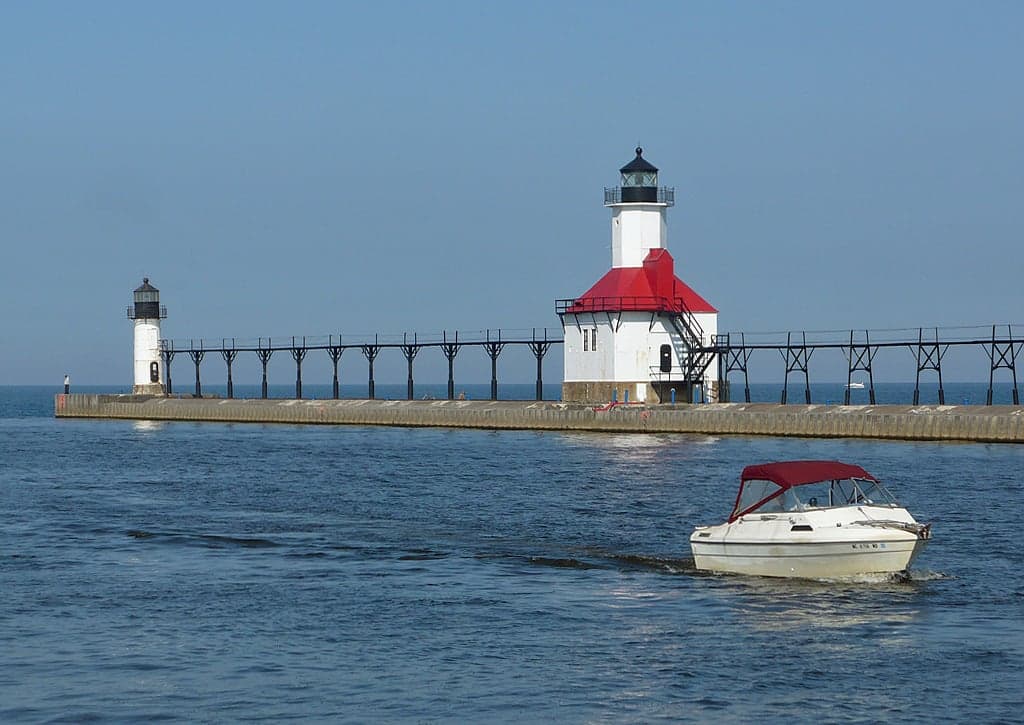
Photo: Wikipedia
Political ClimatePolitical Climate in Berrien County
Showing county-level results — no local-only data available.
Lean and PVI are calculated from this county’s 2020 and 2024 presidential results, Cook-style.
Political rankings in Michigan
- Most Conservative Cities in Michigan
- Most Liberal Cities in Michigan
- Best Liberal-Leaning Towns in the Midwest
- Safest Liberal-Leaning Towns in the Midwest
- Safest Conservative-Leaning Towns in the Midwest
- Affordable Small Towns for Conservatives
- Most Affordable Liberal-Leaning Small Towns in the U.S.
- Safest Conservative-Leaning Cities in the U.S.
- Most Conservative Counties in Michigan
- Most Liberal Counties in Michigan
Local Political AnalysisPolitical Analysis of Berrien County
Berrien County, Michigan, has been a reliably Republican stronghold for decades, carrying a Cook Partisan Voting Index of R+13, which makes it one of the most conservative counties in the state. That said, the county is not a monolith—its political reality is shaped by a sharp urban-rural divide, with the lakeshore communities and college towns pulling left while the inland farming and exurban areas anchor the right. Over the last three presidential cycles, the county has shifted about 3 points toward Democrats relative to the national average, but it still votes about 13 points more Republican than the state of Michigan as a whole, which sits at EVEN on the Cook PVI. The trajectory is one of slow, uneven polarization: the red areas are getting redder, the blue pockets are getting bluer, and the middle ground is shrinking.
How it compares
Michigan statewide is a pure toss-up—EVEN on the Cook PVI—meaning it swings between parties every few cycles. Berrien County, by contrast, is R+13, a margin that puts it in the same league as deep-red counties in western Michigan like Ottawa or Allegan. The difference is stark: in 2020, Donald Trump won Berrien County by about 12 points, while Joe Biden carried Michigan by 2.8 points. That 15-point gap is the practical distance between living in a county where Republicans dominate local offices and one where the state government is split or Democratic-controlled. Within Berrien County itself, the political geography is telling. St. Joseph and Benton Harbor are the two reliably blue anchors—St. Joseph's lakefront affluence and Benton Harbor's majority-Black population both vote Democratic by wide margins. Niles is a genuine swing town, often tipping the county's overall result; it went for Obama twice, then flipped to Trump in 2016 and 2020. Buchanan, Bridgman, and Stevensville lean Republican but are more moderate than the deep-red rural townships like Bainbridge, Pipestone, and Sodus, where Republican margins routinely exceed 70%. The swing precincts are concentrated in the central corridor along I-94, where newer subdivisions and commuters to South Bend create a more mixed electorate.
What this means for residents
For conservative residents, Berrien County's R+13 lean means local government—county commission, sheriff, road commission, and most township boards—is reliably Republican. Tax policy, land use, and law enforcement priorities tend to align with conservative preferences. The county's Republican primary is often the de facto general election for local offices. For liberal residents, the picture is more mixed: they can reliably win city-level races in St. Joseph and Benton Harbor, but countywide and state legislative seats are an uphill climb. The practical effect is that progressive policy initiatives—like sanctuary city resolutions, renewable energy mandates, or zoning reforms—tend to stall at the county level but can pass in the blue cities. Benton Harbor's city government, for example, has pursued community development and housing initiatives that would face resistance in the county commission. The state-level dynamic matters too: because Michigan as a whole is evenly split, Berrien County's Republican lean means its state representatives and senator are almost always in the minority party in Lansing, which limits their ability to deliver state funding or policy wins for the county. That's a source of frustration for both sides—conservatives feel their local majority doesn't translate to state power, and liberals feel their city-level wins are constantly under threat from county and state Republican majorities.
Cultural and policy distinctions
Berrien County's political culture is distinct from the rest of Michigan in a few notable ways. First, the county's economy is heavily tied to agriculture—particularly fruit farming along the Lake Michigan shoreline—and that shapes policy debates around water rights, pesticide regulation, and seasonal labor. The "fruit belt" townships like Sodus, Hagar, and Coloma tend to vote Republican and prioritize agricultural interests over environmental regulations, a stance that sometimes puts them at odds with the lakeshore resort communities that depend on tourism and clean water. Second, the county's proximity to South Bend, Indiana, creates a cross-border commuter dynamic that softens some of the cultural conservatism—many residents work in Indiana, which exposes them to a different political environment and makes them less insular than inland Michigan conservatives. Third, the racial and economic divide between Benton Harbor and the rest of the county is a persistent political fault line. Benton Harbor is roughly 85% Black and has a poverty rate above 40%, while the surrounding townships are overwhelmingly white and middle-to-upper income. This disparity drives debates over school funding, public transit, and economic development that are more intense here than in most Michigan counties. Efforts to merge the Benton Harbor and St. Joseph school districts, for instance, have repeatedly failed due to political and racial mistrust. Looking ahead, the county's R+13 lean is likely to persist, but the margins may narrow slightly as the St. Joseph and Benton Harbor populations grow and the rural townships age. The real wildcard is whether Niles and the I-94 corridor continue to swing—if they trend Democratic, the county could become competitive within a decade; if they stay red, Berrien will remain one of Michigan's most reliably Republican counties.

State Political ClimatePolitical Climate in Michigan
State Political AnalysisPolitical Environment in the State
Michigan is the ultimate swing state, with a Cook PVI of EVEN that perfectly captures its knife-edge political balance. Over the past 20 years, the state has lurched from reliably blue in the 1990s and early 2000s, to a narrow Republican win in 2016, to a Democratic trifecta in 2022 that enacted a sweeping progressive agenda. The dominant coalitions are a shrinking but still potent union-heavy, blue-collar Democratic base in the southeast, counterbalanced by a growing, increasingly conservative exurban and rural vote across the rest of the Lower Peninsula and the Upper Peninsula. The long arc is a slow rightward drift in the northern half of the Lower Peninsula and the UP, while the Grand Rapids suburbs and the Detroit collar counties have become more competitive, keeping the state in a perpetual toss-up.
Urban vs. rural divide
The political map of Michigan is a story of three distinct regions. Wayne County (Detroit) and Washtenaw County (Ann Arbor) are the Democratic strongholds, delivering margins of 60-70% for Democratic candidates. In 2022, Governor Gretchen Whitmer won Wayne County by over 300,000 votes alone. The second region is the "blue wall" of the Grand Rapids suburbs—Kent County, once a Republican bastion, flipped to Biden in 2020 and has become a genuine swing county as the city of Grand Rapids grows and diversifies. The third region is everything else: the rural Lower Peninsula, the Thumb, and the Upper Peninsula. These areas have shifted hard right. Counties like Midland, Gladwin, and Missaukee now vote 65-70% Republican, a stark change from the 50-55% margins of the 1990s. The UP, once a Democratic stronghold due to mining unions, has flipped dramatically—Marquette County is now the only reliably blue county in the UP, while the rest vote 60%+ Republican. The key battlegrounds are the collar counties around Detroit—Macomb, Oakland, and Livingston—where suburban voters, particularly in Macomb, have swung between parties in every election since 2016.
Policy environment
Michigan’s policy environment is a patchwork. The state has a flat income tax rate of 4.25%, which was temporarily reduced to 4.05% in 2023 due to a 2015 law that triggers automatic cuts when revenues exceed a certain threshold. Property taxes are relatively high, with an average effective rate of 1.54%, but the Proposal A system caps annual increases on primary residences. Sales tax is 6%. The regulatory posture is moderate—Michigan is not Texas or California. Education policy is a major flashpoint: the state has a universal school choice system (charter schools and inter-district open enrollment), but the 2023 Democratic trifecta eliminated the "right-to-work" law that had been in place since 2012, a major win for unions. Healthcare is dominated by the expansion of Medicaid under the Healthy Michigan Plan, which covers over 1 million residents. Election laws are relatively accessible: no-excuse absentee voting was passed by a 2018 ballot initiative, and same-day voter registration is available. However, voter ID is required at the polls, with a signed affidavit as an alternative.
Recent policy direction
The 2023-2024 Democratic trifecta was a legislative firehose. On gun and self-defense law, Michigan passed universal background checks and a "red flag" law (extreme risk protection orders), a major shift for a state with a strong hunting culture. On parental and education rights, the state repealed the 1931 abortion ban and codified abortion rights into state law, and also passed a ban on conversion therapy for minors. On speech and privacy, the state expanded LGBTQ+ non-discrimination protections. On medical and bodily autonomy, the repeal of the 1931 abortion ban was the headline, but the state also expanded Medicaid coverage for doula services. On property rights, the state has not passed any major reforms to eminent domain or land use. On taxation, the temporary income tax cut was a rare bipartisan win, but the overall direction is toward higher spending—the 2024 budget increased by 8.5%. On voting and ballot access, the 2018 and 2022 ballot initiatives (Prop 2 and Prop 3) enshrined no-excuse absentee voting, same-day registration, and independent redistricting. The net effect is a state that has moved decisively left on social and civil liberties issues, while maintaining a relatively moderate tax and regulatory environment.
Civil unrest & political movements
Michigan has been a national flashpoint for political movements. The 2020 Gretchen Whitmer kidnapping plot and the armed protests at the state capitol over COVID-19 lockdowns put Michigan at the center of the national debate on civil liberties and government overreach. The "Wolverine Watchmen" militia group was a major story. On the left, the 2023-2024 protests over the Israel-Hamas war in Dearborn and Ann Arbor were significant, with Dearborn's large Arab-American population becoming a vocal political force—the "Uncommitted" movement in the 2024 Democratic primary drew over 100,000 votes. Immigration politics are relatively quiet compared to border states, but the state has sanctuary city policies in Detroit, Ann Arbor, and Kalamazoo. Election integrity controversies have been muted since 2020, with the independent redistricting commission reducing gerrymandering complaints. The most visible flashpoint for a new resident would be the sharp cultural divide between the urban core and the rural areas, visible in everything from yard signs to local school board meetings.
Projection
Over the next 5-10 years, Michigan will remain a battleground, but the demographic trends favor a slow shift rightward in the northern half of the state and the UP, while the Detroit suburbs continue to moderate. The in-migration pattern is key: Michigan is gaining population from Illinois and California, but losing it to Florida and Texas. The newcomers tend to be younger and more diverse, settling in the Grand Rapids and Ann Arbor areas, which helps Democrats. However, the exodus of blue-collar workers from the UP and the Thumb is accelerating the rural reddening. The 2024 election will be a test of whether the Democratic trifecta's progressive agenda energizes the base or alienates swing voters in Macomb and Kent counties. Expect the state to remain a toss-up for the foreseeable future, with control of the legislature and governor's office flipping every 4-8 years. A new resident moving in now should expect to live in a state where their vote genuinely matters, but where the political climate can shift dramatically with each election cycle.
For a new resident, the bottom line is this: Michigan offers a genuinely competitive political environment where your vote carries weight, but the policy landscape can change rapidly depending on which party controls Lansing. If you lean conservative, you'll find strong communities in the rural areas and the Grand Rapids exurbs, but you'll be living under a state government that is currently pursuing a progressive agenda on guns, abortion, and education. If you lean liberal, you'll find a welcoming environment in the urban cores and college towns, but you'll be in a state where the legislature could flip back to Republican control in a single election. The practical takeaway is to pay close attention to local elections—school boards, county commissions, and city councils—because in a swing state, those are where the real action is.
* Values derived from national, state, county, city and local statistics and may differ in a specific area. Last updated: 2026-10-25T21:42:46.000Z
Narrative content on this page is AI-generated and may contain mistakes. Verify any details that matter before acting on them.
ReloMaps may earn a commission from affiliate links at no extra cost to you.

