
Photo: Wikipedia
Personal Sovereignty in Bay County
Strong independent fundamentals that actively favor personal liberty and low regulation.
What does Personal Sovereignty tell us?
Personal Sovereignty measures your capacity for self-reliance and independence with minimal government friction. Higher scores mean fewer barriers between you and the way you want to live... but it assumes you have the space you need and good neighbors.
What does this tell us?
Personal Sovereignty measures your capacity for self-reliance and independence with minimal government friction. Higher scores mean fewer barriers between you and the way you want to live... but it assumes you have the space you need and good neighbors.
State Policy
Energy independence: Importer (20% of energy produced in-state)
Personal Liberty
Homesteading

Personal Liberty Analysis
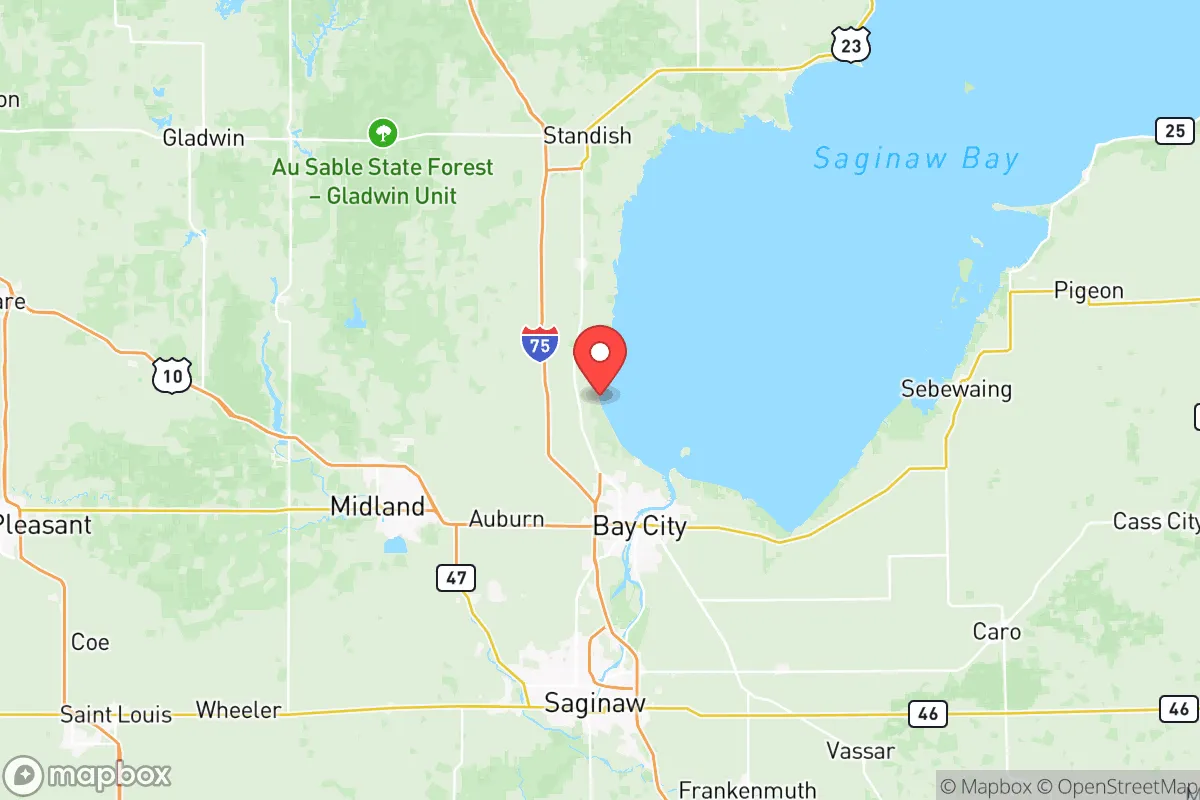
Bay County, Michigan, offers a moderate-to-high degree of personal sovereignty relative to the state's urban cores, though it is not a libertarian free zone. The county's regulatory environment is shaped by a mix of state-level mandates and local ordinances that vary significantly between the more urbanized city of Bay City and the surrounding rural townships like Bangor, Hampton, and Monitor. For a relocation-minded individual or family prioritizing autonomy, the key trade-offs involve navigating Michigan's uniform state tax and gun laws while leveraging the lighter-touch zoning and enforcement found outside the city limits.
Tax burden and regulatory posture in Bay County vs. Michigan's urban centers
Michigan's tax structure is relatively flat, with a 4.25% flat state income tax and a 6% state sales tax, which applies uniformly across Bay County. Property taxes are the primary local variable: Bay City levies a city income tax of 1% for residents and 0.5% for non-residents working in the city, while unincorporated townships like Bangor Township and Frankenlust Township do not. The county's overall property tax millage is moderate for Michigan, typically falling between 30 and 40 mills depending on the township and school district. Regulatory posture is notably lighter in rural townships such as Portsmouth Township and Essexville, where zoning enforcement is less aggressive and business licensing is straightforward. In contrast, Bay City has a more active code enforcement department, particularly regarding rental properties and short-term rentals, which can feel intrusive to those accustomed to minimal oversight. The county's economic development office actively courts small manufacturers and trades, signaling a generally pro-business stance, but the state's prevailing wage laws and occupational licensing requirements still apply.
Self-defense and gun law specifics in Bay County's communities
Michigan is a "shall-issue" state for concealed pistol licenses (CPL), and Bay County's gun culture is robust, with several local gun shops and ranges in Bay City and Essexville. The county sheriff's office processes CPL applications efficiently, typically within the statutory 45-day window. Open carry is legal without a permit for anyone 18 or older who can legally possess a firearm, and this is commonly observed in rural areas like Kawkawlin and Linwood. However, Michigan's 2023 red flag law (extreme risk protection order) applies statewide, allowing law enforcement to petition for temporary firearm removal, and Bay County courts have issued such orders, though less frequently than in urban counties. Stand-your-ground law is not codified in Michigan; the state uses a "duty to retreat" standard except within one's own dwelling (Castle Doctrine). This is a meaningful distinction for self-defense-minded residents. Local ordinances in Bay City prohibit discharging firearms within city limits, but rural townships like Monitor Township and Bangor Township allow target shooting on private property with reasonable setback requirements. For those prioritizing maximum gun freedom, the unincorporated areas of the county are far more permissive than the city.
Self-reliance and homesteading viability: lot sizes, zoning, and off-grid feasibility
Homesteading viability in Bay County is highly location-dependent. In rural townships such as Fraser Township and Gibson Township, minimum lot sizes are typically 1 to 5 acres, and zoning codes are permissive regarding livestock, poultry, and small-scale agriculture. Chickens, goats, and even pigs are commonly allowed with minimal permitting in these areas. Off-grid feasibility is moderate: Michigan's building code requires a permit for any habitable structure, and the county health department mandates septic system inspections, but there is no county-wide ban on composting toilets or rainwater collection. Solar panels are permitted without special zoning in most townships, though net metering with Consumers Energy (the dominant utility) is capped at 150% of annual usage. In contrast, Bay City and its close suburbs like Essexville have stricter lot size minimums (often 6,000-10,000 square feet) and prohibit livestock entirely. For a family seeking true self-reliance—growing food, raising animals, and reducing utility dependence—the rural townships north and west of Bay City offer the most favorable conditions, while the city itself is more suited to a conventional suburban lifestyle.
Personal liberties: parental rights, medical autonomy, speech, and property
Parental rights in Bay County are generally respected, with the local school districts—particularly in Bangor Township Schools and Essexville-Hampton Public Schools—maintaining conservative curriculum policies relative to state standards. Michigan's 2023 law requiring parental notification for any mental health or sexual education services in schools applies statewide, and Bay County districts comply. Medical autonomy is constrained by state-level vaccine mandates for school attendance (MMR, DTaP, polio, varicella), though philosophical exemptions are available for some requirements. The county's health department does not actively enforce mask or quarantine mandates beyond state guidance. Free speech and property rights are strongly protected under Michigan law, with no county-specific restrictions on political signage or expressive conduct. Property rights are robust in rural townships, where zoning variances are routinely granted by local boards, and there is no county-wide rent control or eviction moratorium. Bay City does have a rental registration ordinance, which some property owners view as an overreach, but it is less onerous than similar laws in Ann Arbor or Detroit. Overall, the county strikes a balance between state-level mandates and local discretion, with the rural townships offering the greatest latitude for personal choice.
Compared to Michigan's more heavily regulated urban counties like Washtenaw or Oakland, Bay County provides a noticeably higher degree of personal sovereignty, particularly in its rural townships. The combination of a flat state tax structure, permissive gun laws outside city limits, and flexible zoning for homesteading makes it a viable option for those seeking independence without relocating to a remote, low-amenity area. However, the county is not a regulatory vacuum: state-level red flag laws, vaccine mandates, and building codes still apply, and the city of Bay City itself has a more interventionist posture. For a family or individual who values autonomy and is willing to live outside the urban core, townships like Monitor, Bangor, and Fraser offer a practical middle ground between total rural freedom and the convenience of nearby services.

* Values derived from national, state, county, city and local statistics and may differ in a specific area. Last updated: 2026-07-09T15:11:22.000Z
Narrative content on this page is AI-generated and may contain mistakes. Verify any details that matter before acting on them.
ReloMaps may earn a commission from affiliate links at no extra cost to you.

