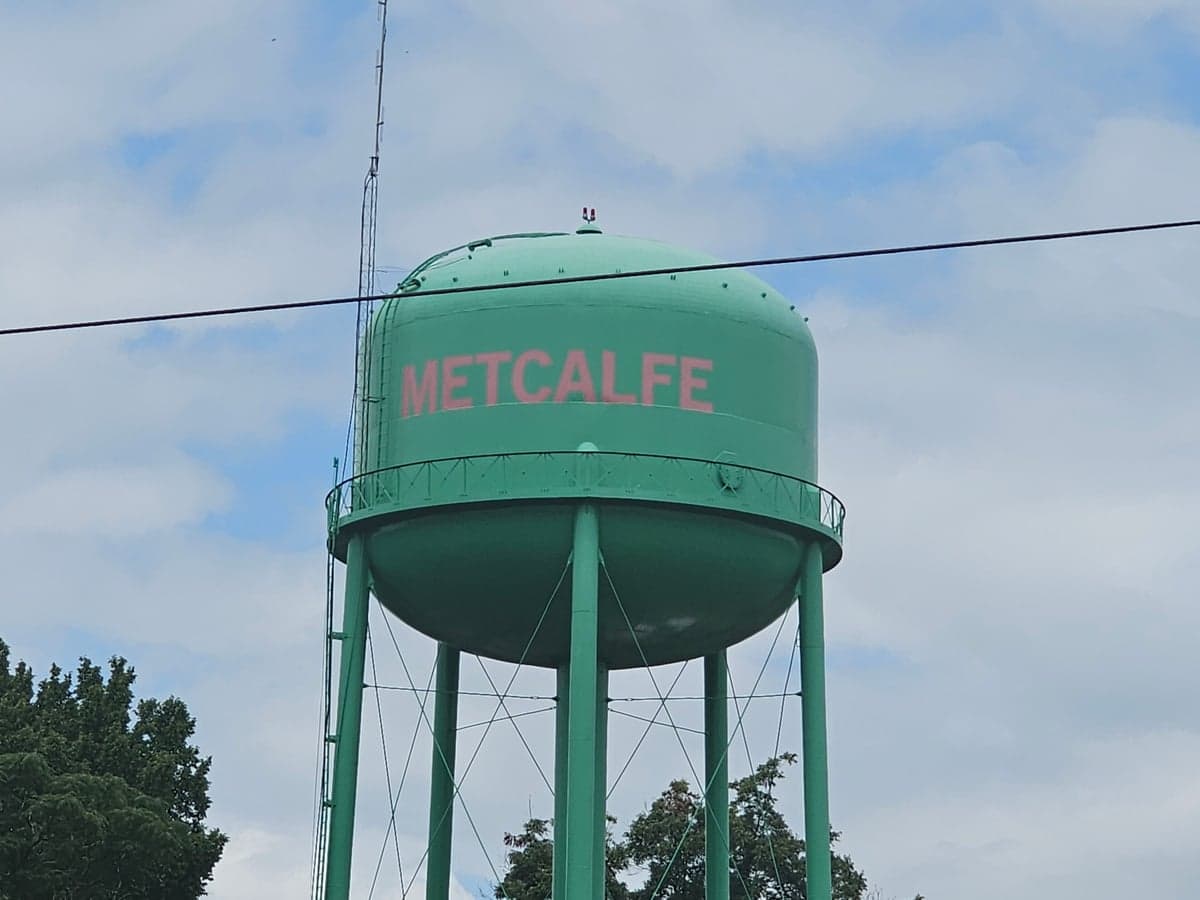
Photo: Wikipedia
Strategic Assessment of Metcalfe, MS
Workable tactical position. Some exposure to population density or targets, but generally defensible in a crisis.
What does the Strategic Assessment tell us?
Our Strategic Assessment grades tactical survivability of an area. Major population centers, military targets, fallout zones, natural disasters, and border exposure all drive risk — lower exposure means a more defensible position in a crisis.
This is heavily inspired by Joel Skousen's Strategic Relocation book. Highly recommended you checkout the book ($)What does this tell us?
Our Strategic Assessment grades tactical survivability of an area. Major population centers, military targets, fallout zones, natural disasters, and border exposure all drive risk — lower exposure means a more defensible position in a crisis.
This is heavily inspired by Joel Skousen's Strategic Relocation book. Highly recommended you checkout the book ($)Strategic Pillars
Key Distances
Regional Safe Places
Below is our recommended "safe zones" in Mississippi and the surrounding area based on our strategic heuristics. For most people, it's unrealistic to live in a “safe zone” full-time due to work, family or other personal reasons. They tend to be more rural. However, many of these areas are perfect for second homes and retreat properties that double as a vacation home or even a short-term rental.
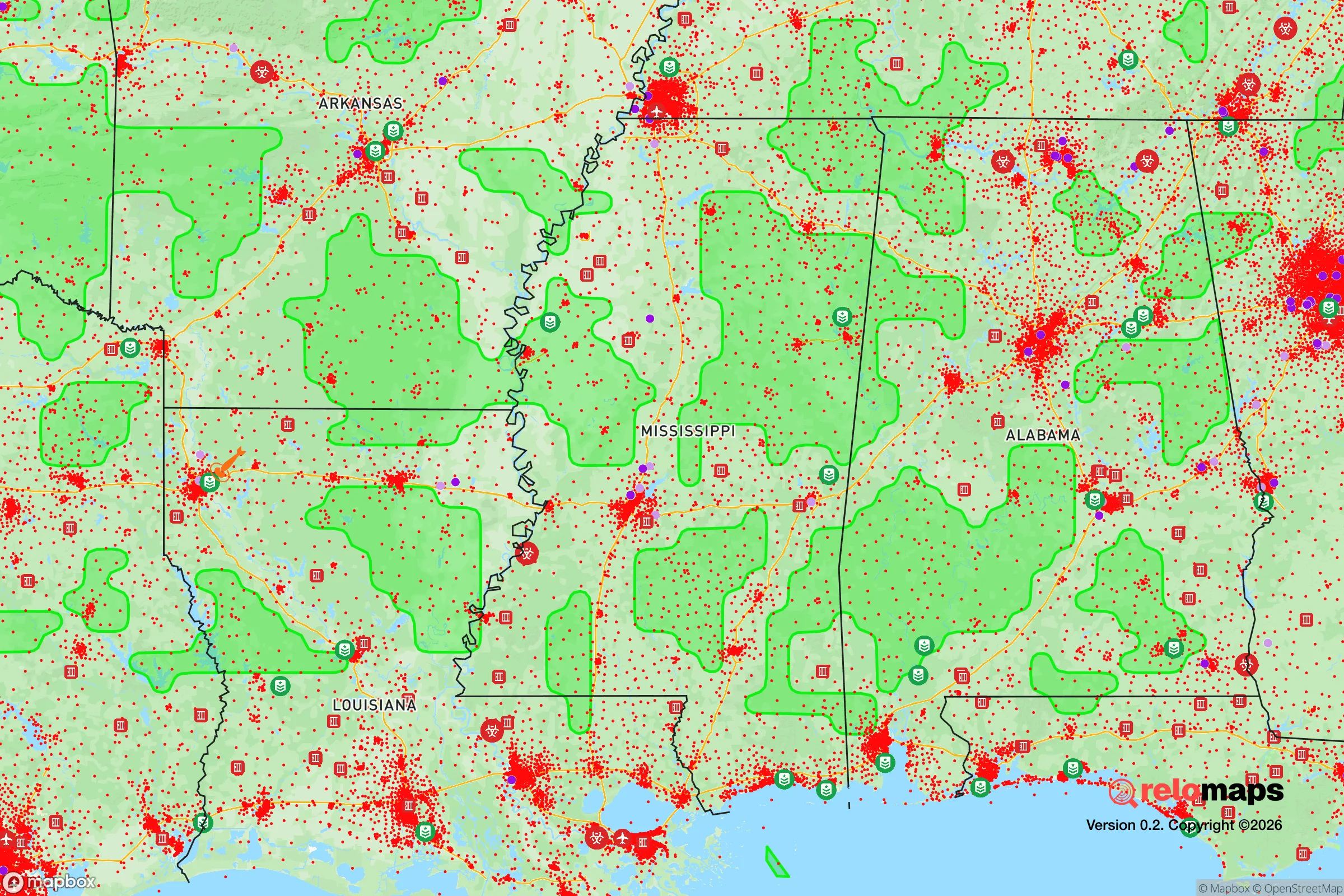
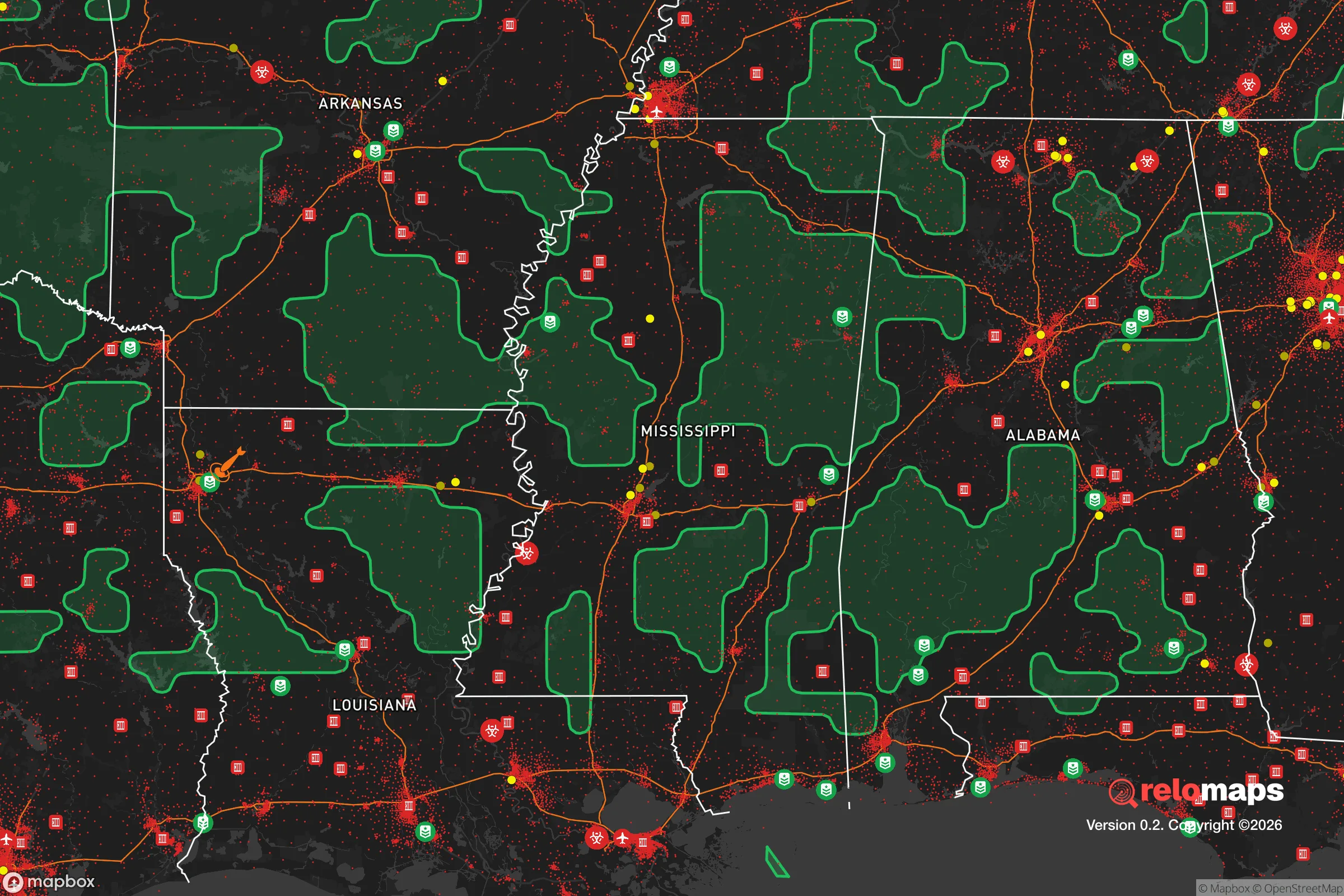


Important Note: For informational purposes only. This does not mean nothing bad ever happens in the green zones. Please use common sense. This is based on public data and modeled with AI. We tried to take a conservative approach but mistakes happen. We update this regularly as new information becomes available.
Solar Generator Recommendations
Backup power matters more here than in safer locations. We've picked three solar generators across budgets and capacity tiers — start with the budget unit if you only need a few essentials, or step up if you want to run a fridge and HVAC for days at a time.
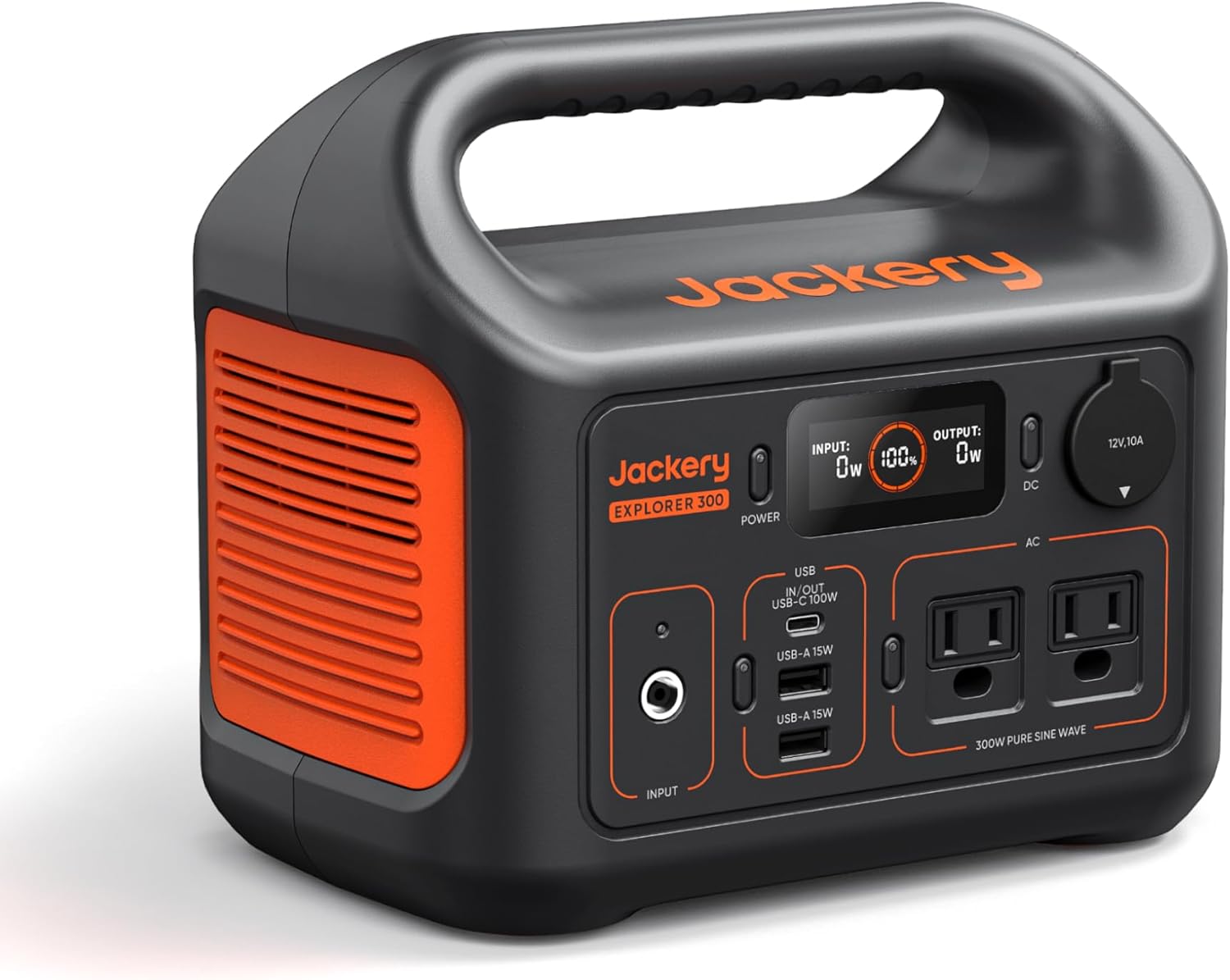
Jackery Portable Power Station Explorer 300
Budget OptionPower on the Go: Weighing only 11 lbs, it's convenient to set up and store with book-sized foldable solar panels

BLUETTI Portable Power Station AC180
Designed for both indoor and outdoor scenarios, AC180 is highly capable as it has a robost capacity and continuous output power.

EF ECOFLOW DELTA Pro Ultra Power Station
Upgraded PickEcoFlow DELTA Pro Ultra is a whole-home energy system designed to grow with your family. Integrated with the Smart Home Panel 2, it scales to meet your evolving energy needs — keeping your home powered, intelligent, and secure through every stage of life.
We earn a commission, at no additional cost to you.
Strategic Assessment Analysis
Metcalfe, Mississippi, offers a strategic paradox for the resilience-minded relocator: it sits in the Mississippi Delta, a region defined by flat, fertile land and proximity to the Mississippi River, yet its small population (roughly 1,000 residents) and distance from major urban centers provide a buffer that larger Delta towns lack. The town’s location along U.S. Highway 61 and near the intersection of Interstate 69 gives it practical access to Greenville (about 15 miles north) and the broader region, but its low profile means it avoids the congestion and target density of cities like Memphis or Jackson. For someone prioritizing self-sufficiency and disaster readiness, Metcalfe’s primary advantage is its obscurity—it’s not a place that draws attention, which is a genuine asset in a crisis scenario.
Geographic position and natural advantages for long-term stability
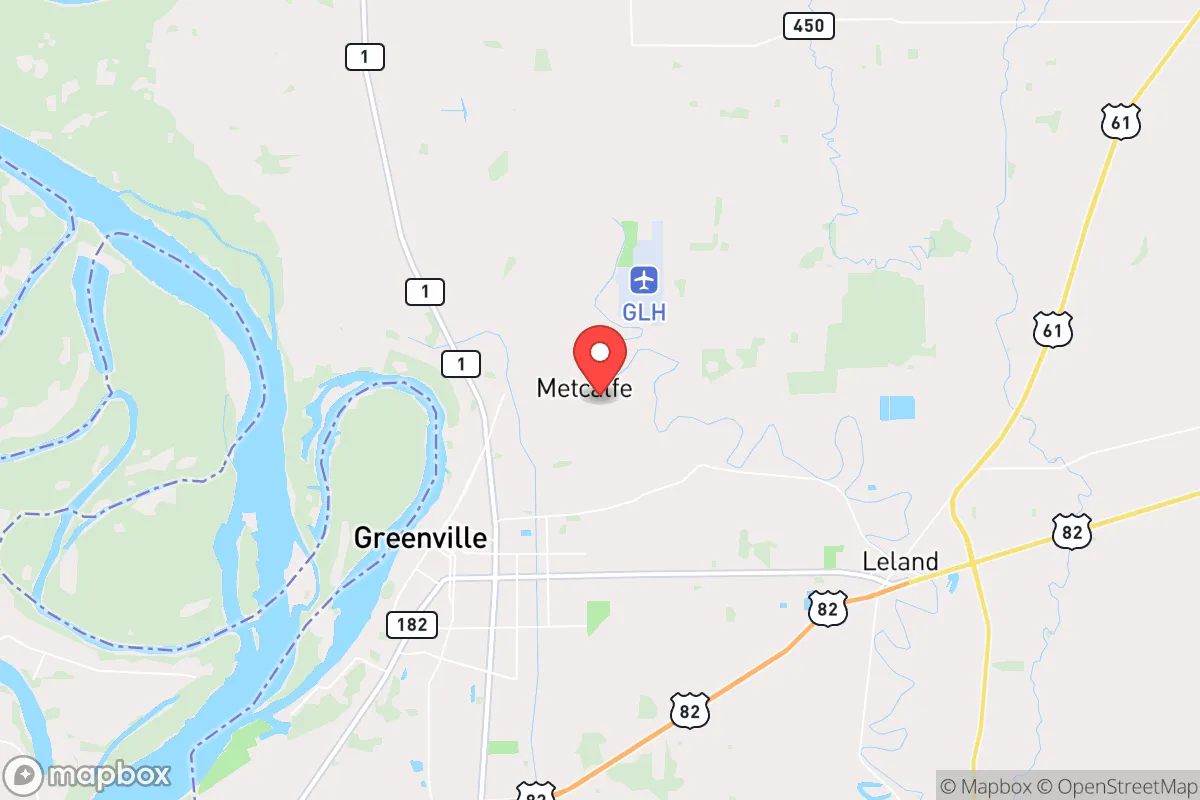
Metcalfe sits in Washington County, roughly 90 miles south of Memphis and 120 miles northwest of Jackson, placing it in a corridor that is neither isolated nor overly exposed. The surrounding Delta landscape is remarkably flat, with elevations rarely exceeding 100 feet, which simplifies construction and land use but also means the area is highly dependent on levees and drainage systems. The Mississippi River lies about 10 miles west, and while this proximity offers water access, it also introduces flood risk—the 2011 and 2019 floods demonstrated that even minor levee failures can inundate large swaths of farmland. However, Metcalfe itself sits on slightly higher ground relative to the immediate riverfront, and the town’s small footprint means that a single elevated road (e.g., Highway 61) can serve as a reliable evacuation route. The region’s soil is among the most productive in the country, with deep alluvial deposits ideal for row crops like soybeans, cotton, and corn. For a relocator thinking about food security, this agricultural base is a tangible advantage: local farms and farmers’ markets in nearby Greenville provide a direct source of fresh produce and livestock, reducing dependence on long supply chains.
Risks, exposures, and proximity to fallout-relevant landmarks
The Delta’s primary natural risks are flooding, tornadoes, and extreme heat. Metcalfe lies in Tornado Alley’s southeastern extension, and the flat terrain offers no natural shielding—a direct hit from an EF-3 or stronger tornado is a real possibility, as seen in the 2023 Rolling Fork disaster about 60 miles south. Flooding from the Mississippi River or its tributaries (like the Yazoo River, which runs near Greenville) is the more persistent threat, with the U.S. Army Corps of Engineers’ levee system providing imperfect protection. In terms of man-made risks, the area is relatively low on the list of strategic targets. The nearest major infrastructure of concern is the Entergy nuclear plant at Grand Gulf, about 70 miles south near Port Gibson, which is a pressurized water reactor with a solid safety record but still a potential fallout source in a worst-case scenario. More relevant to a resilience analysis is the proximity to Greenville’s industrial base, which includes chemical storage and processing facilities along the river—a major spill or fire could disrupt local air quality and water sources. The town’s distance from Memphis (90 miles) and Jackson (120 miles) means it is outside the immediate blast or fallout zone of a major urban attack, but it lies within the plausible evacuation shadow of both cities. In a crisis, Metcalfe could see an influx of refugees from those urban centers, straining local resources. The flat, open terrain also offers little natural cover or defensible chokepoints, which is a drawback for those prioritizing security.
Practical resilience for a relocator: food, water, energy, and defensibility
For a relocator serious about self-sufficiency, Metcalfe’s practical resilience hinges on its agricultural environment and low population density. Food security is the strongest asset: the Delta’s farmland is among the most productive in the U.S., and a small homestead can easily support vegetable gardens, fruit trees (pecans, figs, and persimmons thrive here), and livestock like chickens or goats. Local hunting for deer, turkey, and waterfowl is excellent, with the Mississippi Delta offering some of the best duck hunting in the country. Water access is more nuanced—the Mississippi River is a reliable surface water source, but it requires filtration and treatment due to agricultural runoff and industrial contaminants. Groundwater from the Mississippi River Valley Alluvial Aquifer is generally clean and accessible via shallow wells (50–150 feet deep), but testing is essential because of nitrate contamination from fertilizer use. Energy resilience is moderate: the grid is served by Entergy Mississippi, which has a mixed reliability record during storms, but the flat terrain makes solar panel installation straightforward and effective, with an average of 215 sunny days per year. Wood for heating is abundant in the bottomland hardwood forests along the river, though clearing and seasoning it requires labor. Defensibility is the weakest category. The flat, open landscape offers no natural high ground or cover, and the town’s layout—a few blocks of homes along Highway 61—means that any determined group could easily observe and approach. A relocator would need to invest in perimeter fencing, reinforced structures, and a well-thought-out security plan, especially if they are on the outskirts of town. The local law enforcement presence is minimal (Washington County Sheriff’s Office covers a large area), so self-reliance in security is a given.
The overall strategic picture for Metcalfe is one of trade-offs. It offers genuine advantages in food production, water access, and low visibility, making it a viable option for someone who wants to be off the radar and close to productive land. The risks—flooding, tornadoes, and the flat terrain’s lack of defensibility—are real but manageable with preparation: elevated structures, a storm shelter, and a security perimeter. The town’s proximity to Greenville provides access to medical care (Delta Health System) and supplies without the density of a major city. For a conservative-leaning relocator who values self-sufficiency and community scale, Metcalfe is a solid, if unglamorous, choice—provided they are willing to invest in the infrastructure that the landscape does not naturally provide. It is not a fortress, but it is a place where a prepared individual can build a resilient life with reasonable effort.

* Values derived from national, state, county, city and local statistics and may differ in a specific area. Last updated: 2026-11-20T10:49:52.000Z
Narrative content on this page is AI-generated and may contain mistakes. Verify any details that matter before acting on them.
ReloMaps may earn a commission from affiliate links at no extra cost to you.

