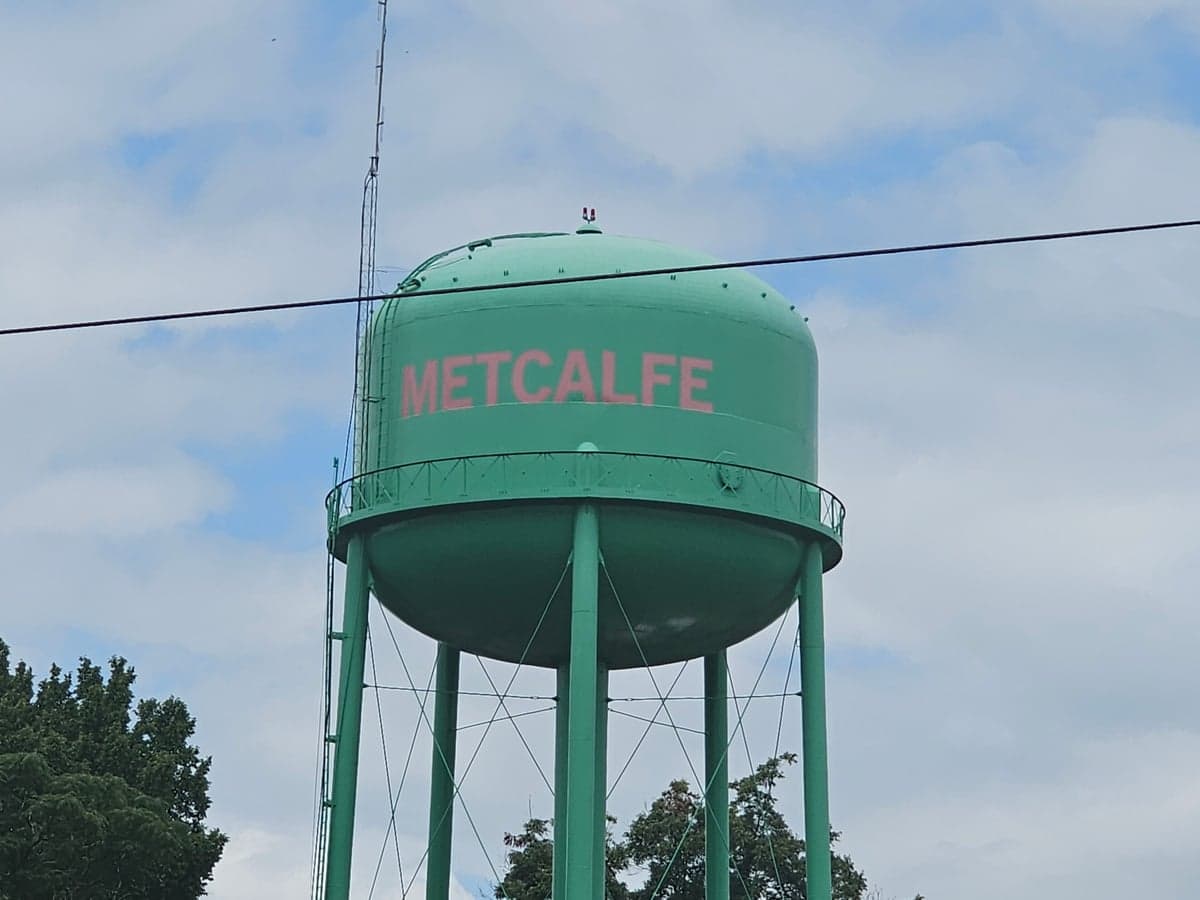
Photo: Wikipedia
Political ClimatePolitical Climate in Metcalfe, MS
District shown is the primary district for this city’s centroid. Cities may span multiple districts.
Inherited from parent county — no local data available.
* Lean and PVI are calculated from the surrounding county’s 2020 and 2024 presidential results, Cook-style — a finer measure here than its congressional district (MS-2).
Political rankings in Mississippi
- Most Conservative Cities in Mississippi
- Most Liberal Cities in Mississippi
- Best Liberal-Leaning Towns in the South
- Best Liberal-Leaning Towns in the Deep South
- Safest Liberal-Leaning Towns in the South
- Safest Conservative-Leaning Towns in the South
- Affordable Small Towns for Conservatives
- Safest Conservative-Leaning Cities in the U.S.
- Most Conservative Counties in Mississippi
- Most Liberal Counties in Mississippi
Local Political AnalysisPolitical Analysis of Metcalfe, MS
Metcalfe, Mississippi, is a political outlier in the Delta, a deep-blue island in a sea of red. With a Cook Partisan Voting Index (PVI) of D+18, the town leans heavily Democratic, a stark contrast to the state of Mississippi as a whole, which carries a PVI of R+11. This isn't a recent shift; it's a long-standing reality rooted in the town's demographics and history, and it shows no signs of flipping anytime soon. If you're moving here, you're stepping into a place where local elections are decided in Democratic primaries, and the general election is often a formality.
How it compares
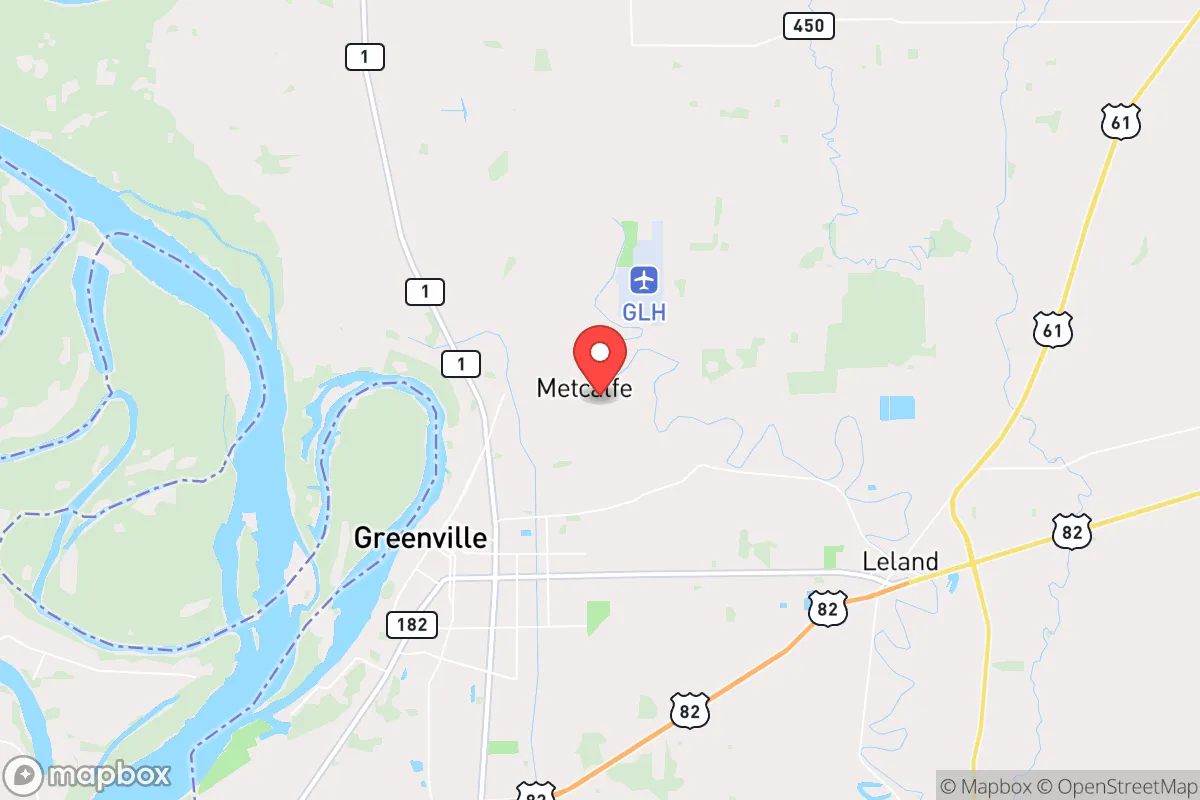
The political gulf between Metcalfe and the rest of Mississippi is about as wide as the Mississippi River itself. Drive 15 miles north to Greenville, and you'll find a similar Democratic lean, but head east to Leland or south to Arcola, and the partisan lines start to blur. The surrounding Washington County is more competitive than the state average, but Metcalfe itself is a Democratic stronghold. In contrast, the state of Mississippi has voted Republican in every presidential election since 1980, with margins growing wider in recent cycles. The 2024 election saw the state go R+17, while Metcalfe's precinct likely delivered a 70-80% Democratic vote share. This means a Metcalfe resident's vote for president is essentially symbolic in the statewide tally, but it carries real weight in local races for county supervisor, school board, and constable.
What this means for residents
For a liberal resident, Metcalfe offers a rare sense of political alignment in a deeply conservative state. You'll find local officials who share your views on issues like public school funding, infrastructure, and social services. The local Democratic party is active, and community events often have a progressive bent. For a conservative resident, life here can feel like swimming upstream. Your vote in local primaries may not align with the winning candidate, and you might find yourself in the minority on issues like tax policy or law enforcement priorities. However, the state-level Republican dominance means that conservative values still shape state laws on gun rights, abortion, and education. The practical reality is that Metcalfe's local government focuses on bread-and-butter issues—potholes, water bills, and the local library—rather than national culture wars. Most folks just want the trash picked up on time, regardless of party.
Culturally, Metcalfe is a tight-knit, predominantly African American community with a strong sense of place. The political lean here is less about ideology and more about community identity and historical voting patterns. You won't see many yard signs for national candidates, but you will see strong turnout for local school board races. The biggest policy distinction from the rest of Mississippi is the local emphasis on public investment—Metcalfe tends to support higher local taxes for better schools and public services, while the state government in Jackson pushes for tax cuts and limited government. If you're moving here, expect a place where your neighbors know your name and your vote matters most in the local elections that shape your daily life. The trajectory is stable: Metcalfe will remain a Democratic stronghold for the foreseeable future, even as the state around it grows redder.

State Political ClimatePolitical Climate in Mississippi
State Political AnalysisPolitical Environment in the State
Mississippi is one of the most reliably Republican states in the country, with a Cook Partisan Voting Index of R+11, meaning it votes about 11 points more Republican than the national average in presidential elections. The state hasn't voted for a Democratic presidential candidate since Jimmy Carter in 1976, and that margin has only widened over the past two decades — Donald Trump carried the state by 16 points in 2024, down slightly from his 17-point win in 2020 but still a commanding margin. The dominant coalition is a mix of white evangelical voters in rural areas and small towns, combined with a growing conservative suburban base in the Jackson metro's outer rings and along the Gulf Coast. Democrats remain competitive only in the Mississippi Delta (the majority-Black northwestern counties) and in a handful of majority-Black urban wards in Jackson and the Mississippi River towns.
Urban vs. rural divide
The political map of Mississippi is starkly divided along racial and geographic lines. The state's three major metro areas — Jackson, the Gulf Coast (Biloxi-Gulfport-Pascagoula), and the DeSoto County suburbs of Memphis — each tell a different story. Jackson, the capital and largest city, is overwhelmingly Democratic and majority-Black; Hinds County gave Joe Biden 80% of the vote in 2020. But the surrounding suburban counties — Madison and Rankin — are among the most Republican in the state, with Madison County voting 67% for Trump. DeSoto County, the fast-growing Memphis suburb just across the Tennessee line, is a Republican stronghold (72% for Trump in 2020) and the state's third-largest county by population. The Gulf Coast is more competitive: Harrison County (Biloxi-Gulfport) went 62% for Trump, but the coastal counties have a stronger Democratic presence in the Black communities of Biloxi and Gulfport proper. The Mississippi Delta counties — Bolivar, Washington, Sunflower, Coahoma — are the state's Democratic base, often voting 70-80% Democratic, but they are also the state's fastest-shrinking areas, losing population every decade. The rural Pine Belt and northeastern hill counties (Tupelo, Corinth, Oxford's Lafayette County) lean Republican but are less intensely partisan than the suburbs; Oxford itself, home to the University of Mississippi, is a small blue dot in a red county, with the university precincts often splitting 50-50 or leaning Democratic.
Policy environment
Mississippi's policy environment is among the most conservative in the nation. The state has no state income tax on Social Security benefits and a flat 4% income tax on most other income, with a phase-down to 3.99% by 2026. The state sales tax is 7% on most goods (one of the highest in the country), but groceries are taxed at a reduced rate. Property taxes are low by national standards, with a median effective rate of about 0.8% of home value. The state is a right-to-work state and has some of the weakest labor protections in the country. Education policy is dominated by school choice: Mississippi has a robust charter school law, a voucher-like Education Scholarship Account program for special-needs students, and a new universal school choice program passed in 2025 that allows any family to use state funds for private school tuition. The state's public schools rank near the bottom nationally in test scores and graduation rates, though the DeSoto County School District and Madison County Schools are notable exceptions, performing at or above national averages. Healthcare policy is minimal: Mississippi did not expand Medicaid under the Affordable Care Act, leaving about 100,000 low-income adults in the coverage gap. The state has some of the highest rates of chronic disease and infant mortality in the country. Election laws are restrictive: Mississippi requires a government-issued photo ID to vote, has no early voting (only absentee voting by mail with an excuse), and has one of the shortest early voting windows in the nation — though a 2025 law expanded in-person absentee voting to 14 days before Election Day. The state also has a strict voter ID law and purges inactive voters from the rolls every four years.
Recent policy direction
Mississippi's recent legislative sessions have pushed the state further right on nearly every front. In 2024, the legislature passed a constitutional carry law (permitless carry of handguns, both open and concealed) — joining 28 other states — and a stand-your-ground law that removes the duty to retreat in any place where a person has a legal right to be. On education, the 2025 universal school choice program (the Mississippi Choice Act) allows any family to redirect state per-pupil funding to private or homeschool expenses, a major win for school choice advocates. On parental rights, the state passed a Parents' Bill of Rights in 2023 that requires schools to notify parents of any changes to a child's mental or physical health and prohibits instruction on sexual orientation or gender identity in K-3 classrooms. On medical and bodily autonomy, Mississippi has a near-total abortion ban (the Gestational Age Act) with no exceptions for rape or incest, only to save the mother's life. The state also bans gender-affirming care for minors (the Regulate Experimental Adolescent Procedures Act), passed in 2023. On property rights, Mississippi is a strong right-to-farm state, protecting agricultural operations from nuisance lawsuits. On privacy and surveillance, the state has no comprehensive data privacy law, but it does have a biometric privacy law that requires consent before collecting biometric data. On voting, the 2025 expansion of in-person absentee voting was a modest liberalization, but the state still has no no-excuse early voting or automatic voter registration. On speech, Mississippi has no hate crime law covering sexual orientation or gender identity, and the state has passed a campus free speech act that prohibits public universities from designating "free speech zones" — speech is allowed anywhere on campus.
Civil unrest & political movements
Mississippi has a quieter political landscape than many states, but there are visible flashpoints. The Jackson water crisis of 2022-2023 — when the capital city's water system failed for weeks — became a national story and a rallying point for civil rights and environmental justice activists, who argued the state had neglected the majority-Black city's infrastructure. Protests were frequent but largely peaceful, with the NAACP and local faith groups leading marches to the state capitol. On the right, the Mississippi Freedom Caucus (a group of hardline conservative state legislators) has been active in pushing the school choice and permitless carry bills, and they've clashed with the more establishment Republican leadership over budget priorities. Immigration politics are less heated than in border states, but the legislature passed a bill in 2024 requiring law enforcement to cooperate with federal immigration authorities (a "sanctuary city ban") and making it a state crime to harbor undocumented immigrants. There is no serious secessionist movement in Mississippi, though some rural counties have passed symbolic "Second Amendment sanctuary" resolutions. Election integrity controversies have been minimal compared to states like Georgia or Arizona; the 2020 and 2024 elections in Mississippi were largely uncontested, with no major fraud allegations or recounts. The most visible political movement a new resident would notice is the school choice advocacy — yard signs for "School Choice Now" are common in suburban neighborhoods, and the issue dominates local political conversations.
Projection
Over the next 5-10 years, Mississippi is likely to become even more Republican, but with important internal shifts. The population is slowly moving south and west: the Delta continues to shrink, while DeSoto County (Memphis suburbs) and the Gulf Coast are growing. This means the Democratic base in the Delta is eroding, while the Republican suburbs are expanding. The state's Black population, which is about 38% of the total, is also slowly declining as a share due to out-migration. The University of Mississippi and Mississippi State University are drawing more out-of-state students and faculty, which could create small liberal pockets in Oxford and Starkville, but these are unlikely to flip any counties. The biggest wildcard is the school choice expansion: if it leads to a mass exodus from public schools, rural districts could face funding crises, potentially accelerating population loss in already-depopulating areas. On the policy front, expect further tax cuts (the flat income tax may be phased out entirely), continued restrictions on abortion and transgender rights, and possibly a move toward a school voucher system that covers all students. The state's political culture will remain deeply conservative, with a strong emphasis on local control, gun rights, and religious liberty. A new resident moving in now should expect to find a state where conservative values are the default in both law and daily life, where the pace of change is slow, and where the political conversation is dominated by education, taxes, and cultural issues rather than infrastructure or economic development.
For a new resident, the bottom line is this: Mississippi offers a low-tax, low-regulation environment with strong protections for gun owners, school choice advocates, and religious conservatives. Liberal residents will find themselves in a clear minority, especially outside of Jackson and the Delta, and will need to accept that state policy will consistently lean right on social issues. The state's political stability — no major election controversies, no violent protests, no dramatic policy swings — is a double-edged sword: it means predictability, but also a resistance to change that can frustrate those hoping for progress on healthcare, education funding, or civil rights. If you value low taxes, gun rights, and a government that stays out of your business (and your children's education), Mississippi is a strong fit. If you want a state that invests heavily in public services or protects a wide range of personal liberties, you'll need to look closely at the trade-offs.
* Values derived from national, state, county, city and local statistics and may differ in a specific area. Last updated: 2026-11-20T10:49:52.000Z
Narrative content on this page is AI-generated and may contain mistakes. Verify any details that matter before acting on them.
ReloMaps may earn a commission from affiliate links at no extra cost to you.

