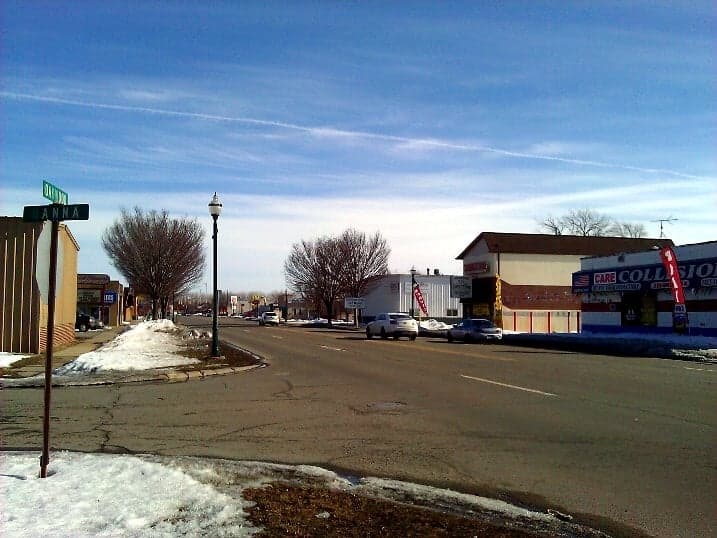
Photo: Wikipedia
Demographics of Melvindale, MI
Affluence Level in Melvindale, MI
A below-average socioeconomic profile. Incomes, home values, and educational attainment trail the U.S., with higher poverty and unemployment.
People of Melvindale, MI
Melvindale, Michigan, is a compact, working-class city of 12,605 residents, characterized by a dense, older housing stock and a population that is majority White (62.5%) but with a substantial and growing Hispanic community (23.1%) and a notable Black population (12.3%). The city’s identity is rooted in its industrial past as a factory town for auto workers, and today it retains a blue-collar, family-oriented character with a lower median age than the surrounding Downriver area. With only 15.0% of adults holding a college degree, Melvindale is a place where skilled trades and manufacturing jobs have long defined the local culture, though the population has been slowly declining from its mid-20th-century peak.
How the city was settled and grew
Melvindale’s human history begins not with colonial settlement but with the explosive growth of the American auto industry in the early 20th century. The area was originally part of Ecorse Township, a sparsely populated farming community, until the 1920s when the Ford Motor Company built its massive River Rouge Complex just to the north. This industrial behemoth drew a wave of European immigrants and domestic migrants seeking work on the assembly lines. The city was officially incorporated in 1933, and its early population was overwhelmingly made up of Polish, Italian, and German immigrants and their children, who settled in the tightly packed bungalows and duplexes of the Rosedale Park and South Ecorse neighborhoods. These areas, with their grid-like streets and small lots, were built specifically to house Ford workers within walking distance of the plant. By 1950, Melvindale’s population had surged to over 10,000, and it was a classic "ethnic white" working-class suburb, with strong parish identities centered on churches like St. Mary Magdalen.
Modern era (post-1965)
The post-1965 era brought significant demographic change, driven by the decline of heavy manufacturing and the broader suburbanization of the Detroit region. As the Ford Rouge plant automated and shed jobs, the city’s population began a slow decline from its 1970 peak of roughly 13,000. The most notable shift has been the growth of the Hispanic population, which rose from a negligible share in 1980 to 23.1% today. This wave was primarily composed of Mexican-American families, many of whom moved from older neighborhoods in southwest Detroit and Dearborn, drawn by affordable housing and a familiar industrial landscape. These families concentrated in the Allen Park border area and the northern section of the city near the Rouge plant, where older, lower-cost homes were available. The Black population, now at 12.3%, also grew during this period, with families settling more evenly across the city, though a visible cluster developed in the central corridor near Melvindale High School. The White population, while still the majority, has aged and declined in number, with many younger families moving to farther-out suburbs. The foreign-born share of 8.0% is modest but reflects a steady trickle of immigrants from the Middle East and Latin America, though the city has not seen the large-scale Asian or Indian immigration that has reshaped other parts of metro Detroit.
The future
Melvindale’s population is projected to continue a slow decline, mirroring the broader Downriver trend of aging housing stock and limited new construction. The city is becoming more diverse, with the Hispanic share expected to rise further as younger families replace an aging White population. This diversification is likely to be concentrated in the southwest quadrant near the Ecorse border, where multi-generational Hispanic households are buying and renovating older homes. The Black population is stable, while the White population will continue to shrink as older residents pass away or move to retirement communities. The city’s cultural identity is evolving from a historically Polish-Catholic enclave to a more pan-Latino and African American community, though the industrial, blue-collar ethos remains strong. New residents are unlikely to be drawn by new jobs, as the city has little developable land, but rather by the area’s affordability relative to Wayne County as a whole. The next 10-20 years will likely see a smaller, browner, and slightly younger Melvindale, with a continued emphasis on family and trade work.
For someone moving in now, Melvindale offers a low-cost, no-frills entry point into the Detroit metro area, with a strong sense of local identity and a population that is increasingly Hispanic and working-class. It is not a place of rapid growth or high-end amenities, but rather a stable, modest community where homeownership is attainable and the legacy of the auto industry still shapes daily life. The city is becoming more diverse, but it remains a predominantly blue-collar, family-focused suburb where the key draw is affordability and proximity to industrial employment.

* Values derived from national, state, county, city and local statistics and may differ in a specific area. Last updated: 2026-10-18T18:13:52.000Z
Narrative content on this page is AI-generated and may contain mistakes. Verify any details that matter before acting on them.
ReloMaps may earn a commission from affiliate links at no extra cost to you.

