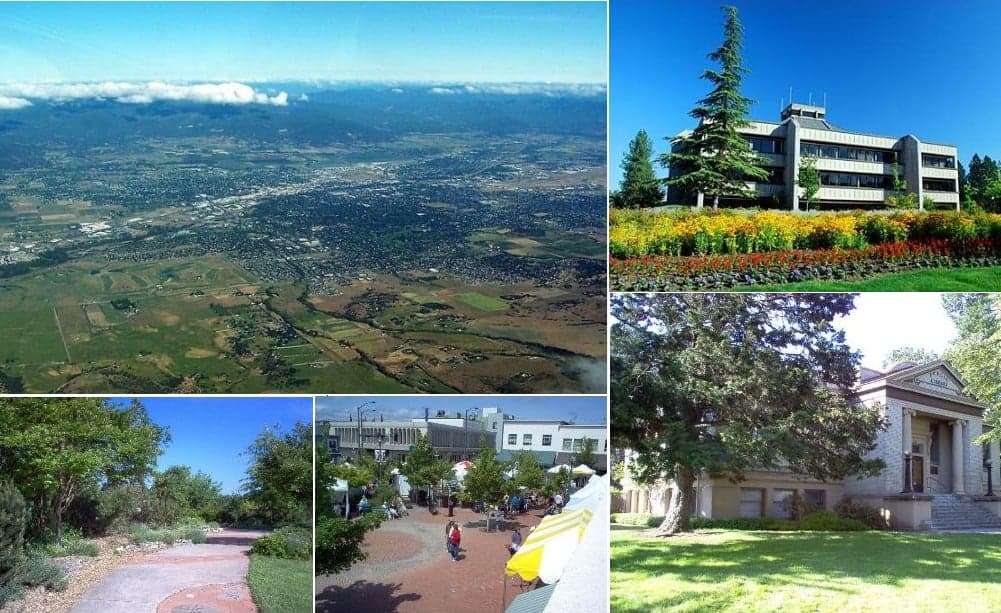
Photo: Wikipedia
Personal Sovereignty in Medford, OR
Viable for self-reliance. Generally workable, though some barriers may limit total independence.
What does Personal Sovereignty tell us?
Personal Sovereignty measures your capacity for self-reliance and independence with minimal government friction. Higher scores mean fewer barriers between you and the way you want to live... but it assumes you have the space you need and good neighbors.
What does this tell us?
Personal Sovereignty measures your capacity for self-reliance and independence with minimal government friction. Higher scores mean fewer barriers between you and the way you want to live... but it assumes you have the space you need and good neighbors.
State Policy
Energy independence: Importer (35% of energy produced in-state)
Personal Liberty
Homesteading

Personal Liberty Analysis
Medford, Oregon, offers a notably high degree of personal sovereignty relative to many West Coast cities, driven by a state-level framework that respects self-defense rights and property use, though tempered by Oregon’s progressive tax structure and land-use regulations. For individuals and families prioritizing autonomy, the Rogue Valley presents a pragmatic balance: you can own firearms with few restrictions, build a self-sufficient homestead on affordable land, and exercise significant parental control over education, but you will pay a moderate-to-high income tax and navigate strict urban growth boundaries. The overall environment leans toward personal responsibility, with fewer nanny-state intrusions than Portland or Eugene, making it a viable option for those seeking independence without the extremes of rural Idaho or Montana.
Tax burden and regulatory posture: What you pay and what you can do
Oregon’s tax burden is a mixed bag for sovereignty-minded residents. The state has no sales tax, which is a major advantage for large purchases and daily spending, but it imposes a progressive income tax ranging from 4.75% to 9.9% on higher earners. For a family earning $100,000, the effective rate lands around 7-8%, which is higher than neighboring California’s lower brackets but below Washington’s sales-tax-heavy system. Property taxes in Jackson County are moderate, averaging about 0.85% of assessed value, significantly lower than Portland’s metro area. Medford itself has no local income tax, keeping city-level burdens light. The regulatory posture is more hands-off than coastal Oregon: Jackson County generally permits accessory dwelling units, small-scale agriculture, and home-based businesses without excessive red tape, though state-level land-use laws (Senate Bill 100) strictly control urban growth boundaries and limit rural subdivision. This means you can buy a 5-acre parcel outside Medford and build a shop or keep livestock, but you cannot easily split that land for resale or develop it commercially without county approval. The net effect: you keep more of your money than in California or New York, but you face a higher income tax than Texas or Florida, and land-use rules are tighter than in most Mountain West states.
Self-defense and gun law specifics: What you can carry and where
Oregon is a shall-issue state for concealed handgun licenses, meaning Jackson County must issue a permit if you meet basic criteria (age 21+, no felony, completed a safety course). The process is straightforward: a four-hour class and a $65 fee, with permits valid for four years. Medford has no additional city-level restrictions beyond state law. Open carry is legal without a permit for anyone 18 or older, though it is uncommon in urban areas. The state does not require registration of firearms, and there is no waiting period for purchases from private sellers, though federal background checks apply at licensed dealers. Magazine capacity is not restricted, and there is no state-level assault weapons ban. However, Oregon passed Measure 114 in 2022, which required a permit to purchase any firearm and banned magazines over ten rounds; this measure is currently blocked by court injunction and not enforced as of 2026. If Measure 114 is eventually upheld, it would significantly tighten access, but for now, Medford remains a free environment for gun owners. Stand-your-ground laws do not exist in Oregon; the state imposes a duty to retreat in public places if safely possible, though the Castle Doctrine applies in your home. For self-defense-minded residents, Medford offers a permissive baseline compared to California or Washington, but less absolute protection than states like Arizona or Texas.
Self-reliance and homesteading viability: Lot sizes, zoning, and off-grid feasibility
Medford’s surrounding area is a strong candidate for homesteading and self-reliance. Unincorporated Jackson County allows residential lots as small as 1 acre for keeping chickens, goats, and up to two cows, while larger parcels (5+ acres) permit horses and more intensive livestock without special permits. Zoning in rural residential zones (RR-5) allows accessory structures like barns, greenhouses, and workshops by right. Off-grid living is feasible but regulated: Oregon requires a septic system permit for any dwelling, and well drilling requires a water right permit from the state, which can take 6-12 months and cost $5,000-$15,000. Solar panels are unrestricted, and net metering is available through Pacific Power, though battery storage is recommended for reliability. Rainwater collection is legal without a permit for non-potable uses, and many rural properties have seasonal creeks. The biggest constraint is Oregon’s Statewide Planning Goal 3, which restricts building on land zoned as Exclusive Farm Use (EFU) to farm dwellings only, so buyers must verify zoning before purchasing. Medford’s climate—hot, dry summers and mild, wet winters—supports year-round vegetable gardening, fruit trees, and even some vineyards. For a family wanting to produce a significant portion of their own food, the Rogue Valley offers better conditions than the Willamette Valley’s constant rain or eastern Oregon’s aridity.
Personal liberties: Parental rights, medical autonomy, speech, and property
Oregon’s legal landscape for personal liberties is a study in contrasts. Parental rights are strong in education: Oregon allows homeschooling with minimal oversight (a simple notice of intent and annual standardized testing, but no curriculum approval), and charter schools and online public options are widely available. The state does not mandate vaccines for school attendance if parents claim a medical or religious exemption, though philosophical exemptions were removed in 2019. Medical autonomy is more restricted: Oregon has legalized physician-assisted suicide (Death with Dignity Act) and recreational marijuana, but it also mandates COVID-19 vaccine requirements for healthcare workers and some state employees, and it has a strict vaccine schedule for schoolchildren. Free speech protections align with the First Amendment, and Medford has no local hate speech or mask mandates that would curtail expression. Property rights are constrained by Oregon’s land-use system: you cannot build a fence over six feet without a permit in most zones, and removing trees over a certain diameter on undeveloped land may require a forestry permit. However, there is no statewide rent control, and short-term rental regulations are light in unincorporated areas. The overall liberty environment is best described as “live and let live” for most daily choices, but with a regulatory floor that prevents extreme individualism—you can build a tiny house on your own land, but it must meet state building codes and septic standards.
Compared to other regions, Medford offers a strong sovereignty profile for the West Coast, ranking above Portland, Seattle, and San Francisco in nearly every metric of personal freedom. It falls short of states like Texas, Idaho, or Wyoming on tax burden and gun law absoluteness, but it compensates with lower housing costs, abundant public land access, and a climate that supports self-sufficiency. For a conservative-leaning individual or family who wants to own firearms, homeschool children, grow their own food, and keep more of their income than in coastal cities, Medford is a pragmatic middle ground—not a libertarian paradise, but a place where personal responsibility is still the default expectation.

* Values derived from national, state, county, city and local statistics and may differ in a specific area. Last updated: 2026-06-14T13:55:25.000Z
Narrative content on this page is AI-generated and may contain mistakes. Verify any details that matter before acting on them.
ReloMaps may earn a commission from affiliate links at no extra cost to you.

