Photo: Wikipedia
Political ClimatePolitical Climate in Mechanicsburg, PA
District shown is the primary district for this city’s centroid. Cities may span multiple districts.
Local Political AnalysisPolitical Analysis of Mechanicsburg, PA
Mechanicsburg leans reliably Republican, with a Cook Partisan Voting Index of R+3, meaning the borough and its immediate surroundings vote about three points more conservative than the national average. That’s a noticeable shift from the statewide Pennsylvania PVI of EVEN, which reflects the commonwealth’s status as a true swing state. Over the past decade, Mechanicsburg has held steady in its GOP lean, even as the broader Harrisburg-Carlisle metro area has seen some suburban drift toward the center. The 2024 presidential race here likely mirrored the 2020 pattern, where Cumberland County as a whole went for Trump by about 10 points, while the state as a whole flipped back to the Democratic column by a razor-thin margin. If you’re looking for a place where the political temperature is warm but not boiling, this is it.
How it compares
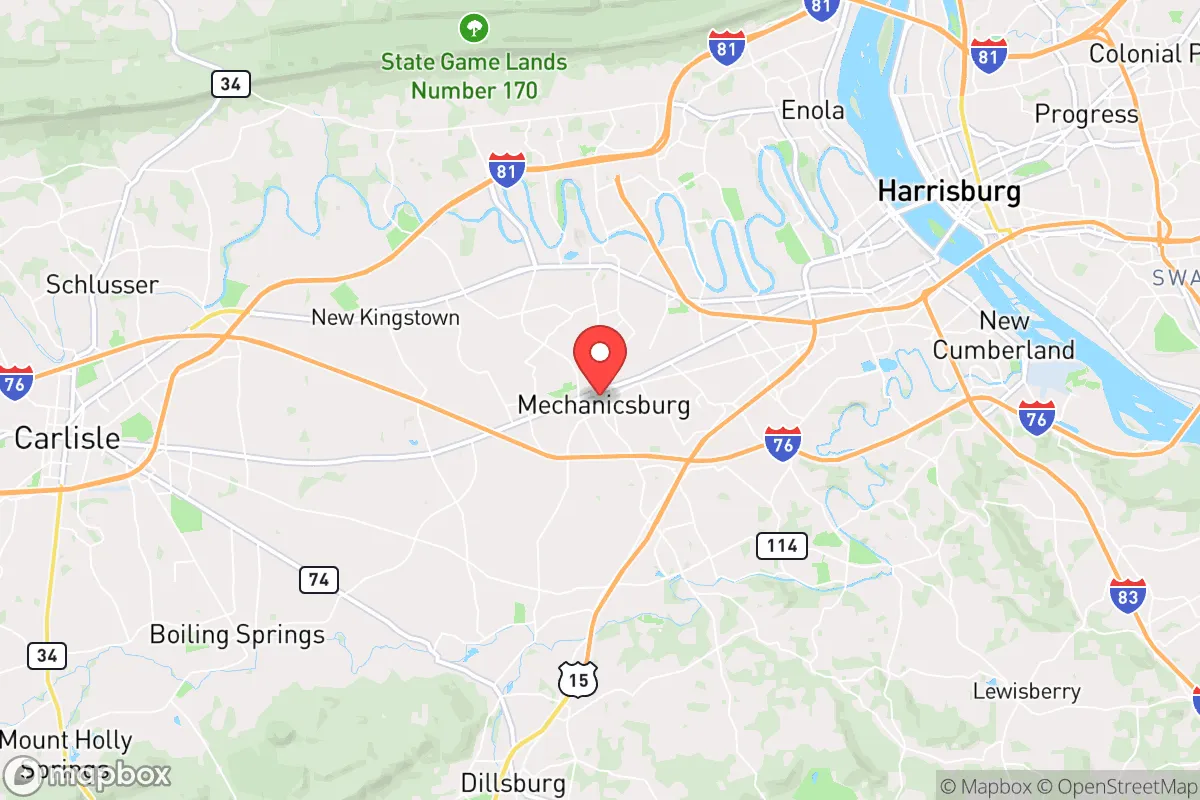
Mechanicsburg sits in Cumberland County, which is one of the most reliably Republican counties in Pennsylvania outside of the deep-red rural north. Drive 15 minutes east into Harrisburg (Dauphin County), and you’re in a Democratic stronghold that went for Biden by roughly 30 points in 2020. Head 20 minutes west to Carlisle, and you’ll find a college town that leans left, especially around Dickinson College. That contrast makes Mechanicsburg feel like a quiet conservative anchor in a region that’s otherwise politically mixed. The borough itself is more moderate than the surrounding farmland—think suburban Republicans who prioritize low taxes and school quality over culture-war flashpoints. Compared to Pennsylvania’s statewide EVEN rating, Mechanicsburg is a clear outlier, but it’s not an extreme one. It’s the kind of place where a Democrat can live comfortably without feeling isolated, and where a Republican can assume their neighbors share most of their views on fiscal policy and local governance.
What this means for residents
For conservative residents, Mechanicsburg’s lean means local elections tend to reflect their priorities: school boards, borough council, and county commissioners are generally GOP-held, and tax policy stays restrained. The Cumberland Valley School District, which serves Mechanicsburg, has been a flashpoint in recent years over curriculum and library books, but the board has remained conservative-leaning without swinging to the far-right fringe. For liberal residents, the political climate is manageable but requires engagement. You won’t find a progressive majority on the borough council, but you will find a vocal Democratic minority that organizes around issues like affordable housing and transit. Statewide elections are where Mechanicsburg’s R+3 lean gets diluted—your vote for governor or U.S. Senate matters just as much as one in Philadelphia, but the local culture means you’ll hear more talk about Second Amendment rights and school choice than about defunding the police or universal basic income.
Culturally, Mechanicsburg is a place where the VFW hall and the farmers market are neutral ground. The borough’s policy distinctions are subtle: zoning leans toward single-family homes, public spending on infrastructure is steady but not lavish, and the local GOP is more Chamber of Commerce than MAGA. That’s changing slowly as the region grows—newer residents from the Philly and Baltimore exurbs are bringing more diverse political habits—but for now, Mechanicsburg remains a comfortable, center-right suburb where the biggest political fights are about school taxes and traffic lights, not national culture wars. If you’re moving here, expect a community that votes Republican but lives pragmatically, and where your neighbors are more interested in your lawn care than your lawn signs.

State Political ClimatePolitical Climate in Pennsylvania
State Political AnalysisPolitical Environment in the State
Pennsylvania is the ultimate swing state, with a Cook PVI of EVEN that perfectly captures its knife-edge balance between the two major parties. Over the past 20 years, the state has shifted from a reliably blue-leaning battleground in presidential races (voting for John Kerry in 2004) to a true toss-up that flipped for Donald Trump in 2016, then for Joe Biden in 2020, and remains deeply contested at every level. The dominant coalitions are a shrinking but still potent union-backed Democratic base in the southeast and southwest, squared off against a growing, populist-leaning Republican coalition in the vast rural and exurban middle, with the critical suburbs of Philadelphia and Pittsburgh acting as the ultimate deciders.
Urban vs. rural divide
The political map of Pennsylvania is a study in stark contrasts. Philadelphia and Pittsburgh are the Democratic strongholds, delivering massive margins that the party needs to offset losses elsewhere. The Philadelphia collar counties — Bucks, Montgomery, Chester, and Delaware — have become the state's most critical battlegrounds, trending sharply toward Democrats over the last decade as educated suburbanites have moved left. Meanwhile, the vast rural expanse from the northern tier down through the center and into the southwest is deeply Republican. Lancaster County remains a GOP anchor, though its growing Hispanic population and suburban expansion around the city of Lancaster are slowly shifting the math. Erie County on Lake Erie is a classic bellwether: it went for Obama twice, flipped to Trump in 2016, and then narrowly went back to Biden in 2020, reflecting the broader statewide volatility. The Scranton/Wilkes-Barre area in the northeast is another key region where working-class voters have moved sharply toward Republicans, flipping counties like Luzerne that were once reliably blue.
Policy environment
Pennsylvania's policy environment reflects its divided government. The state has a flat income tax rate of 3.07%, which is relatively low and popular among conservatives, but property taxes are among the highest in the nation, a perennial complaint for homeowners. There is no state sales tax on most clothing and groceries, though the overall sales tax rate is 6%. The regulatory posture is moderate — not as business-friendly as Texas or Florida, but not as restrictive as New York or California. Education policy is a major flashpoint: the state has a patchwork of 500 school districts with wildly varying funding levels, and a 2023 court ruling declared the current funding system unconstitutional, setting up a long-term battle over school choice and equitable funding. Healthcare is dominated by large systems like UPMC in the west and Jefferson Health in the east. Election laws are relatively accessible: no-excuse mail-in voting was enacted in 2019 under Act 77, though it remains a source of partisan controversy, with Republicans frequently calling for tighter restrictions and Democrats defending expanded access.
Recent policy direction
The last few years have seen Pennsylvania lurch in different directions depending on which party holds the governor's office. Under Democratic Governor Josh Shapiro, the state has moved toward expanding LGBTQ+ protections and defending abortion access, with Shapiro vowing to veto any new restrictions. On gun policy, Pennsylvania remains a "shall issue" state for concealed carry permits, and there is no universal background check law for private sales, though Philadelphia has its own stricter local ordinances that are frequently challenged in court. In 2022, voters approved a constitutional amendment stating there is no right to abortion funding, a symbolic but significant move. On election integrity, the state has been a flashpoint: the 2020 election saw intense litigation over mail-in ballot deadlines, and Republicans continue to push for voter ID requirements and stricter ballot security measures. Property rights are generally respected, though the state's extensive Marcellus Shale natural gas drilling has created ongoing tensions between mineral rights owners and environmental regulations. Parental rights in education have become a hot-button issue, with heated school board meetings over library books and curriculum content, though no major statewide legislation has passed.
Civil unrest & political movements
Pennsylvania has seen its share of political turbulence. The 2020 election aftermath was particularly intense in Philadelphia, where Republican poll watchers alleged irregularities, and in York County, where a controversy over ballot counting procedures made national news. The January 6th Capitol riot had direct Pennsylvania connections, with several residents from the Harrisburg area and the northern tier facing charges. On the left, Pittsburgh and Philadelphia have seen large protests for racial justice and abortion rights, including a massive 2022 demonstration in Philadelphia after the Dobbs decision. Immigration politics are less visible than in border states, but sanctuary city policies in Philadelphia have been a persistent source of tension with state Republicans, who have tried repeatedly to pass legislation stripping state funding from such cities. There is no serious secessionist movement, but the urban-rural cultural divide is so deep that talk of splitting the state into two commonwealths occasionally surfaces in conservative circles, particularly in the northern tier and central counties.
Projection
Over the next 5-10 years, Pennsylvania is likely to remain a competitive swing state, but the demographic trends favor Democrats in the long run. The Philadelphia suburbs are growing and diversifying, while many rural counties are aging and losing population. However, the in-migration pattern is not as dramatic as in Sun Belt states — Pennsylvania gains population slowly, and the newcomers tend to be concentrated in the southeast and around Pittsburgh's tech and medical sectors. The wild card is the continued realignment of working-class voters: if Republicans continue to gain ground among non-college voters in places like Erie and Luzerne County, they can offset suburban losses. A new resident moving in now should expect a decade of close elections, divided government, and policy gridlock on major issues like education funding and election laws. The state will not become reliably blue or red anytime soon.
For a new resident, the bottom line is that Pennsylvania offers a genuine swing-state experience. Conservatives will find a relatively low income tax, strong gun rights, and a vibrant rural culture, but they will also face high property taxes, a Democratic governor who can veto conservative legislation, and a growing progressive presence in the cities and suburbs. Liberals will appreciate the strong union heritage, expanding protections for abortion and LGBTQ+ rights, and the cultural amenities of Philadelphia and Pittsburgh, but they will have to contend with a Republican-controlled legislature that can block their priorities and a deeply conservative rural electorate that shapes statewide elections. The practical takeaway is that your vote will genuinely matter here, and the political climate will feel like a constant tug-of-war — which is exactly what makes Pennsylvania the most important swing state in the country.
* Values derived from national, state, county, city and local statistics and may differ in a specific area. Last updated: 2026-10-21T14:29:15.000Z
Narrative content on this page is AI-generated and may contain mistakes. Verify any details that matter before acting on them.
ReloMaps may earn a commission from affiliate links at no extra cost to you.

