Photo: Wikipedia
Demographics of Hampden County
Affluence Level in Hampden County
A middle-class area roughly in line with national averages across income, home values, education, and employment.
People of Hampden County
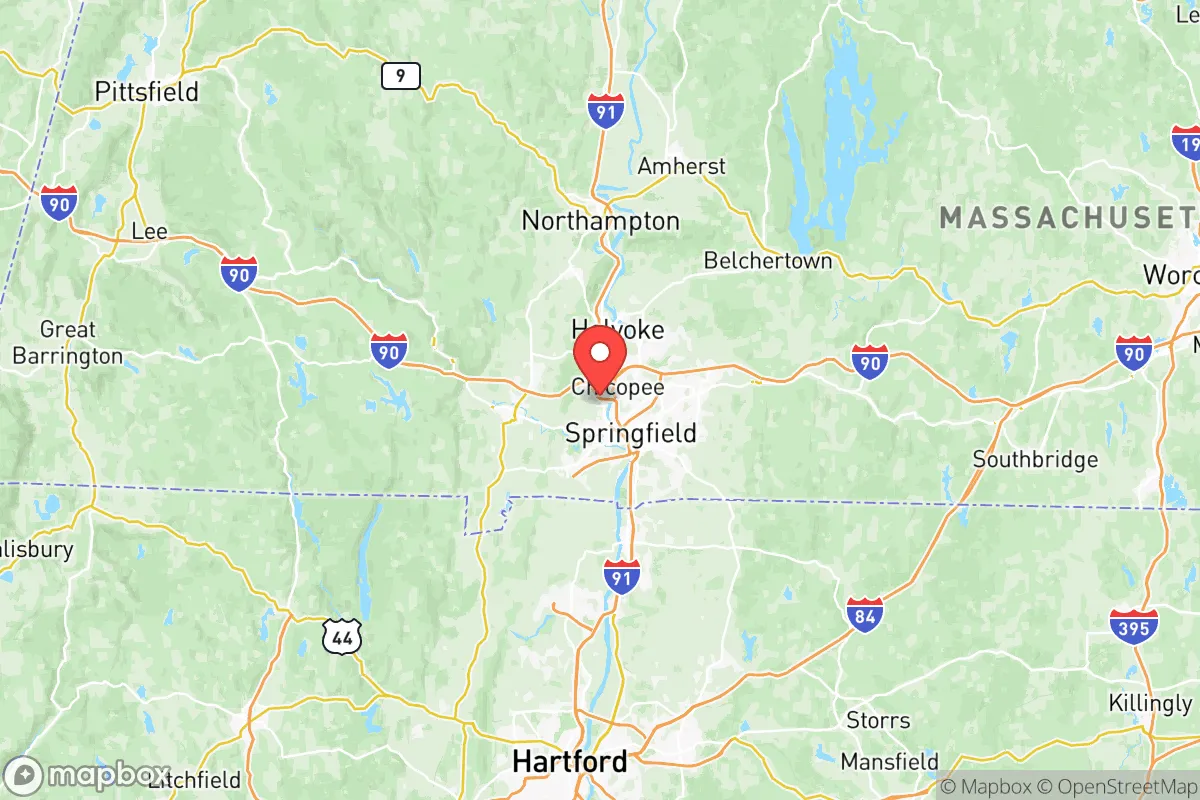
The people of Hampden County, Massachusetts, today number 462,853, forming a densely populated, historically industrial corridor along the Connecticut River. The county is characterized by its stark urban-rural divide, anchored by the post-industrial city of Springfield, which concentrates much of the county's diversity, while surrounding towns like Longmeadow and East Longmeadow remain predominantly white and affluent. With a population that is 60.2% white, 26.6% Hispanic, and 7.6% Black, Hampden County is one of the most ethnically diverse regions in New England outside of Boston, yet it also holds a distinctive, working-class identity shaped by waves of European immigration and a more recent, rapid influx of Puerto Rican and Dominican families.
Settlement & growth (pre-1960)
Before European colonization, the area now known as Hampden County was the homeland of the Pocomtuc and Nipmuc peoples, Algonquian-speaking tribes who lived in fortified villages along the Connecticut River and its tributaries. The first permanent English settlement began in 1636 when William Pynchon led a group from the Massachusetts Bay Colony to establish Springfield, originally called Agawam Plantation. This was the northernmost English settlement on the Connecticut River for decades, and its location at the confluence of the Connecticut and Westfield Rivers made it a natural trading post and transportation hub.
Throughout the 18th and early 19th centuries, the county's population grew slowly, composed primarily of English and Scots-Irish farmers who spread into towns like Westfield, Wilbraham, and Longmeadow. The real demographic transformation began with the Industrial Revolution. By the 1820s, the Springfield Armory (established in 1777) became a national center for firearms manufacturing, drawing skilled mechanics and laborers. The construction of the Western Railroad in the 1830s connected Springfield to Boston and Albany, turning the city into a major rail hub and factory town.
The great wave of European immigration hit Hampden County between 1880 and 1920. Irish immigrants, fleeing the Great Famine, arrived first, settling in Springfield's "Hungry Hill" neighborhood and working in the armory, railroads, and textile mills. They were followed by French Canadians, who came south from Quebec to work in the mills of Chicopee and Holyoke, creating dense, French-speaking parishes that persisted for generations. Italian immigrants, primarily from southern Italy and Sicily, concentrated in Springfield's South End and in West Springfield, where they worked in construction, masonry, and the growing tobacco fields of the Connecticut River Valley. Polish immigrants established a strong presence in Chicopee and Ludlow, building their own churches and social clubs. Smaller but significant numbers of German, Jewish, and Lithuanian immigrants also arrived, each group clustering in distinct neighborhoods and maintaining their languages and traditions well into the mid-20th century.
By 1950, Hampden County was a classic industrial melting pot: overwhelmingly white (over 98%), heavily Catholic, and dominated by unionized manufacturing jobs in firearms, paper, textiles, and precision tools. The African American population was tiny, concentrated in a few blocks of Springfield's Mason Square neighborhood, a legacy of the Great Migration that had brought a modest number of Black families north from the Jim Crow South after 1910.
Modern era (post-1965)
The 1965 Hart-Cellar Act fundamentally reshaped Hampden County, but the most dramatic change was not from overseas immigration but from domestic migration. Starting in the 1970s, a massive wave of Puerto Rican migration transformed Springfield and Holyoke. Puerto Ricans, who are U.S. citizens, left the island's collapsing economy and found work in the region's remaining factories and service industries. By 2020, Holyoke had become the most Puerto Rican city per capita in the continental United States, with over 50% of its population claiming Puerto Rican heritage. This migration shifted the county's racial and cultural identity profoundly, introducing Spanish as a common second language and creating vibrant, if economically struggling, barrios in Springfield's North End and Holyoke's Flats and Churchill neighborhoods.
Simultaneously, the county experienced a significant Black population increase, growing from roughly 3% in 1970 to 7.6% today. This growth came from two streams: continued African American migration from the South, and a newer wave of African and Caribbean immigrants, including families from Ghana, Nigeria, Haiti, and Jamaica, who settled primarily in Springfield and Chicopee. The county's East/Southeast Asian population (1.4%) is modest, concentrated in Springfield and East Longmeadow, with a notable Vietnamese community that arrived after the fall of Saigon in 1975. The Indian subcontinent population (1.1%) is smaller but growing, drawn by jobs in healthcare and technology, and tends to settle in the more suburban towns like Longmeadow and Wilbraham.
Domestically, the post-1965 period was marked by white flight and suburbanization. As Springfield's industrial base collapsed—the Armory closed in 1968, and manufacturing jobs bled away through the 1980s and 1990s—many white, middle-class families moved to the surrounding towns. Longmeadow, East Longmeadow, Wilbraham, and Southwick grew rapidly, becoming predominantly white, higher-income bedroom communities. Meanwhile, Springfield's population dropped from a peak of 174,000 in 1960 to roughly 155,000 today, while its poverty rate climbed above 25%. The county's foreign-born population remains low at just 3.6%, a figure that underscores that the region's diversity is overwhelmingly driven by U.S.-born Puerto Ricans and African Americans, not new international arrivals.
The future
Hampden County is projected to become more Hispanic and more diverse over the next two decades, while its total population is expected to remain flat or decline slightly. The white population, already a bare majority at 60.2%, is aging and shrinking, as younger white families continue to leave for lower-cost Sun Belt states or more dynamic urban centers like Boston. The Hispanic population, which is much younger on average, will likely approach or exceed 35% by 2040, driven by higher birth rates and continued migration from Puerto Rico and, to a lesser extent, the Dominican Republic and Central America.
Geographically, the county is becoming more polarized. The urban core—Springfield, Holyoke, and Chicopee—will continue to diversify and grow poorer, while the outer ring of towns—Longmeadow, East Longmeadow, Wilbraham, and Hampden—will remain predominantly white, older, and more affluent. There is little sign of significant reverse migration back to the cities. The county's cultural identity is evolving into a tripartite character: a declining, older Yankee and Irish-Catholic tradition in the suburbs; a vibrant, working-class Puerto Rican and Dominican culture in the cities; and a small but growing Black professional class scattered across both. The region's economy, anchored by healthcare (Baystate Health, Mercy Medical Center), education (Western New England University, Springfield College), and logistics (the region's position on I-91 and the Massachusetts Turnpike), is unlikely to attract large numbers of new international immigrants, keeping the foreign-born share low.
For someone moving into Hampden County now, the region offers a clear choice. The suburban towns provide safe, well-funded schools and a traditional New England small-town feel, but at a premium cost and with limited diversity. The cities offer lower housing costs and genuine multicultural vitality, but with higher crime rates and struggling school systems. The county as a whole is becoming a place where the future is increasingly Hispanic and urban, while the past remains preserved in the leafy, quiet towns that ring the old industrial heartland.

* Values derived from national, state, county, city and local statistics and may differ in a specific area. Last updated: 2026-06-14T23:01:35.000Z
Narrative content on this page is AI-generated and may contain mistakes. Verify any details that matter before acting on them.
ReloMaps may earn a commission from affiliate links at no extra cost to you.

