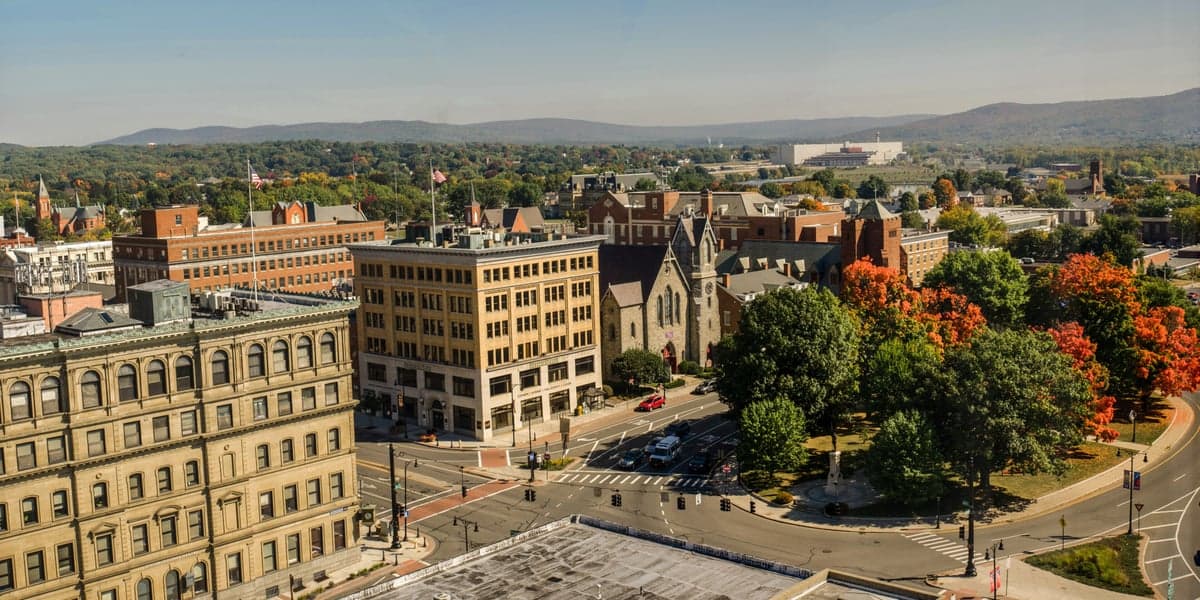
Photo: Wikipedia
Personal Sovereignty in Berkshire County
Moderate friction. Expect trade-offs in some aspect of personal liberty and independence.
What does Personal Sovereignty tell us?
Personal Sovereignty measures your capacity for self-reliance and independence with minimal government friction. Higher scores mean fewer barriers between you and the way you want to live... but it assumes you have the space you need and good neighbors.
What does this tell us?
Personal Sovereignty measures your capacity for self-reliance and independence with minimal government friction. Higher scores mean fewer barriers between you and the way you want to live... but it assumes you have the space you need and good neighbors.
State Policy
Energy independence: Importer (5% of energy produced in-state)
Personal Liberty
Homesteading

Personal Liberty Analysis
Personal sovereignty in Berkshire County, Massachusetts, presents a nuanced trade-off for families and individuals who prioritize autonomy. The county’s rural character and small-town governance structures offer pockets of genuine independence, but these exist within a state framework that is among the most regulatory-heavy in the nation. In towns like Adams and Chester, daily life can feel remarkably self-directed, while Pittsfield and Great Barrington reflect denser, more administered environments. The net effect is that Berkshire County provides a greater degree of personal freedom than much of eastern Massachusetts, yet it remains a place where sovereignty is exercised within clearly defined state boundaries.
Tax burden and regulatory posture across Berkshire County towns
Massachusetts imposes a flat 5.0% state income tax and a 6.25% sales tax, figures that are moderate nationally but high relative to neighboring New Hampshire. Property taxes in Berkshire County average roughly 1.25% of assessed value, though rates vary noticeably by municipality: Williamstown tends toward higher mill rates due to its college-town services, while Savoy and Peru offer lower effective rates on more modest housing stocks. The regulatory posture is mixed at the county level. Zoning and building codes follow state mandates, meaning septic system approvals, wetland protections, and energy codes are uniformly enforced. However, smaller towns like Becket and Chester often staff their permitting offices only a few days per week, creating a de facto lighter enforcement environment. For a business or homeowner, the practical burden is lower in these rural communities than in Pittsfield or Great Barrington, which have full-time planning departments and more detailed local ordinances. The state’s corporate tax rate of 8.0% and its strict independent-contractor classification law can deter entrepreneurial ventures, but many Berkshire residents operate sole proprietorships in construction, trades, or land-based businesses with minimal friction at the local level.
Self-defense and firearm law specifics in Massachusetts and Berkshire County
Massachusetts has some of the strictest gun laws in the country, and Berkshire County residents live under those same statutes. A License to Carry (LTC) is required for both open and concealed carry, and issuance is discretionary at the local police chief level. In practice, most Berkshire County chiefs, particularly in smaller departments like Adams and Lee, issue LTCs without undue delay for residents who complete the required safety course and have a clean record. The state bans so-called assault weapons and standard-capacity magazines over ten rounds, restrictions that are consistently enforced. Stand-your-ground law does not exist; a duty to retreat is required outside the home. The county does have a visible gun culture: the Berkshire County Sportsmen’s Club near Lanesborough is active, and hunting remains common in the rural towns. For a self-defense-oriented reader, the practical reality is that carrying a firearm legally requires a bureaucratic process and compliance with the state’s approved firearms roster, but once licensed, daily carry is feasible in most of the county. Enforcement of the state’s storage laws tends to be complaint-driven rather than proactive in rural areas.
Self-reliance and homesteading viability: lot sizes, zoning, and off-grid feasibility
Berkshire County’s terrain and land-use patterns make it one of the more viable regions in Massachusetts for homesteading and self-reliance projects. Minimum lot sizes in unzoned or lightly zoned towns like Windsor and Chester often run 2 to 5 acres, with some areas permitting agricultural use on parcels as small as one acre if served by on-site septic. Off-grid living is legally complicated but practically possible. The state building code does not prohibit solar panels, composting toilets, or rainwater catchment, but any dwelling must meet sanitation and electrical safety standards. Several towns, including Becket and Savoy, allow agricultural exemptions for accessory dwellings and farm stands, easing the path to small-scale food production. Septic system regulations are the primary constraint: a perc test is required for any new dwelling, and some rocky hillside lots in towns like Florida or Hancock can fail, limiting where a self-sufficient homestead can sit. Wood heat is common; many rural homes rely on it as a primary source without regulatory pushback, though local fire codes apply. For raising livestock, the county’s agricultural commission supports small farms, and towns like Great Barrington have right-to-farm bylaws that protect animal keeping even on smaller lots.
Personal liberties: parental rights, medical autonomy, speech, and property
On parental rights, Massachusetts public schools operate under state curriculum frameworks that include comprehensive sex education and diversity, equity, and inclusion mandates, which some conservative families in Pittsfield and North Adams find restrictive. Homeschooling is legal and relatively straightforward, requiring only an annual notification to the local school superintendent, with no portfolio review or testing requirement mandated by state law. In practice, districts like Williamstown may request a brief educational plan, but approval is not discretionary. Medical autonomy is constrained by state vaccine mandates for school attendance, which apply in all Berkshire County public and most private schools, though philosophical exemptions have been eliminated. On speech and assembly, the county is generally tolerant, and public pushback against local government decisions is common at town meetings. Property rights are protected by the state’s strong eminent domain compensation laws, but local zoning and wetland regulations can sharply limit what a landowner may build without a lengthy variance process. In the more rural towns, however, neighbors are unlikely to complain about a workshop, greenhouse, or fenced garden, and code enforcement is largely complaint-driven.
Compared to other parts of the Northeast, Berkshire County offers a meaningful but incomplete version of personal sovereignty. It lacks the low taxes and permissive gun laws of nearby New Hampshire or Vermont, and its state-level mandates on healthcare and education are fixed. However, within that framework, the county’s geography and town-level governance allow a degree of self-reliance that is rare in Massachusetts. For a family or individual who values independence and is willing to navigate state requirements, towns like Chester, Savoy, and Becket provide the most room to live by one’s own rules, while still being part of a functioning rural community.

* Values derived from national, state, county, city and local statistics and may differ in a specific area. Last updated: 2026-06-24T22:48:13.000Z
Narrative content on this page is AI-generated and may contain mistakes. Verify any details that matter before acting on them.
ReloMaps may earn a commission from affiliate links at no extra cost to you.

