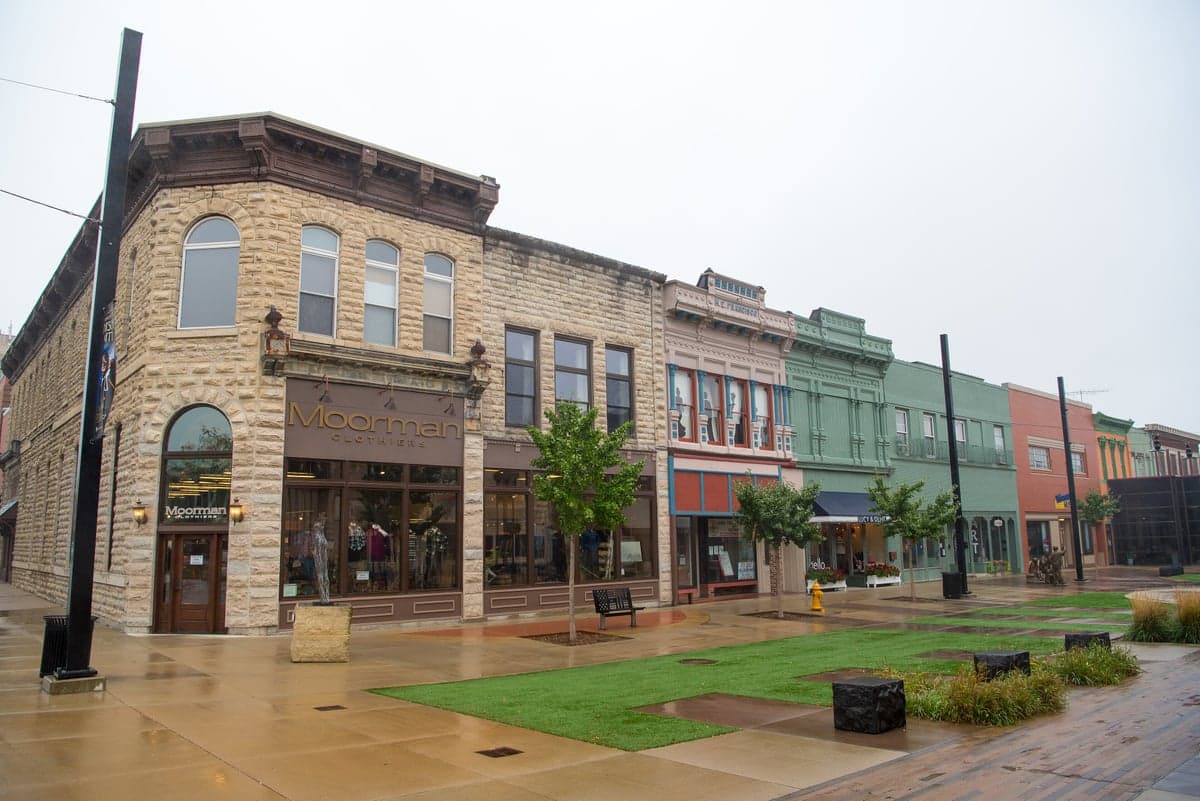
Photo: Wikipedia
Political ClimatePolitical Climate in Mason City, IA
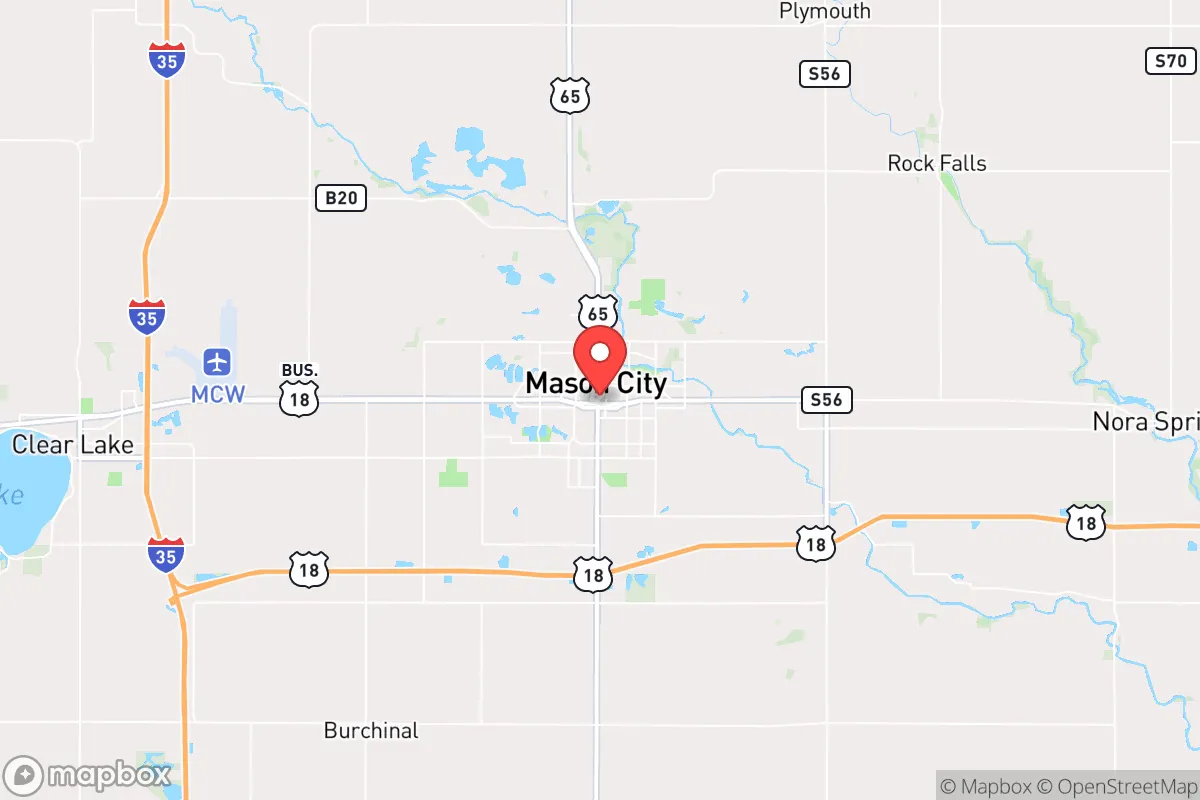
District shown is the primary district for this city’s centroid. Cities may span multiple districts.
Local Political AnalysisPolitical Analysis of Mason City, IA
Mason City sits in a reliably Republican part of Iowa, but its politics are a bit more nuanced than the surrounding countryside. The city itself has a Cook PVI of R+4, meaning it leans Republican by four points relative to the national average, while the state of Iowa as a whole is R+6. That two-point gap might not sound like much, but it reflects a real difference between Mason City’s old-school, union-influenced manufacturing base and the deeply red rural areas that surround it. In practice, Cerro Gordo County has voted Republican in every presidential election since 2000, but the margins here are usually tighter than in places like Clear Lake or Forest City to the north, where the GOP often runs up the score.
How it compares
Compared to the rest of Iowa, Mason City is a slight moderating influence in a state that has shifted rightward over the past decade. The R+6 statewide PVI is driven by booming conservative growth in places like Dallas County (west of Des Moines) and the rural northwest, while Mason City’s R+4 reflects a more stable, older electorate that still remembers when the area was a Democratic stronghold for labor unions and farm policy. Drive 20 minutes south to Rockwell or 30 minutes west to Britt, and you’ll find precincts that routinely vote 70-80% Republican. Head east to Charles City, and you’ll see a similar manufacturing town with a slightly more competitive mix. The key contrast is that Mason City’s politics are less about culture-war flashpoints and more about bread-and-butter issues like property taxes, school funding, and the future of the local hospital and meatpacking plants.
What this means for residents
For conservative residents, Mason City is a comfortable place to live where their views align with the majority on most local and state issues. School board races and city council elections tend to be low-key and pragmatic, with candidates often running on fiscal responsibility rather than national talking points. The local Republican party is active but not hyper-partisan, and you’ll see plenty of “Trump 2024” signs mixed in with “Support Our Farmers” banners. For liberal residents, the picture is more mixed. You won’t feel isolated or unsafe, but you’ll be in the minority in most public forums. The local Democratic party is small but persistent, and there are active groups around issues like affordable housing and environmental conservation. The real challenge for liberals is that state-level policies—like the 2023 law restricting collective bargaining for public employees and the 2024 law banning most abortions after six weeks—are deeply unpopular here among union households and moderate women, but there’s no real electoral path to change them from Mason City alone. The city’s politics are essentially a blue-collar Republicanism that’s skeptical of both coastal elites and far-right social agendas.
Culturally, Mason City stands out for its strong sense of civic pride and its resistance to the most extreme partisan divides you see in bigger Iowa cities like Des Moines or Cedar Rapids. The local newspaper, the Mason City Globe Gazette, still covers city council meetings in detail, and the biggest political fights in recent years have been over the downtown revitalization project and the future of the North Iowa Events Center. You won’t find the kind of performative outrage that dominates national politics here. Instead, the political climate is shaped by a practical, “can we fix the potholes and keep the hospital open” mindset. That’s likely to continue as the city’s population slowly ages and the manufacturing base holds steady. The long-term trajectory is probably a slow drift rightward, mirroring the state, but Mason City will probably always be a few points more moderate than the rest of Iowa—a place where a Republican can win a city council seat by talking about street repairs, and a Democrat can win one by talking about the library.

State Political ClimatePolitical Climate in Iowa
State Political AnalysisPolitical Environment in the State
Iowa has shifted from a classic purple swing state to a solidly Republican-leaning one, carrying a Cook PVI of R+6 after a decade-long rightward march. The state voted for Donald Trump by nearly 9 points in 2020 and 2024, a stark contrast from 2012 when it went for Obama by 5 points. The dominant coalition is now a mix of rural conservatives, evangelical voters, and working-class defectors from the old Democratic base, concentrated outside the few remaining blue metros.
Urban vs. rural divide
The political map of Iowa is a tale of two islands in a red sea. The Des Moines metro (Polk and Dallas counties) and Iowa City (Johnson County) are the only reliably blue anchors. Johnson County, home to the University of Iowa, gave Biden 71% of the vote in 2020, while Polk County went 56% for Biden. But the rest of the state is deeply Republican. The rural northwest, including Sioux County (home to conservative Dordt University and a strong Dutch Reformed community), routinely votes 80%+ Republican. The old Democratic strongholds in the northeast — counties like Dubuque and Black Hawk (Waterloo) — have flipped hard; Dubuque County went from Obama +10 in 2012 to Trump +8 in 2020. The suburbs of Des Moines, particularly Ankeny and Waukee, have become competitive swing areas, trending slightly right as they fill with families fleeing higher taxes in blue states. The Quad Cities (Scott County) remains a purple battleground, but even there, the rural edges are pulling it rightward.
Policy environment
Iowa’s policy environment is aggressively conservative on fiscal and social fronts. The state has a flat income tax of 3.8% (phased down from nearly 9% a decade ago), with a goal of reaching 3.5% by 2027. Property taxes are relatively low, averaging about 1.5% of home value, but vary by district. There is no state estate tax. Education policy is a flashpoint: Iowa enacted a universal school voucher program in 2023 (Students First Act), allowing any family to use public funds for private or homeschool expenses — one of the most expansive in the nation. The state also banned nearly all abortions after six weeks (the “fetal heartbeat” law) in 2023, with no exceptions for rape or incest, though a temporary court injunction has paused enforcement. Election laws tightened in 2021: absentee ballot drop boxes were banned, early voting windows shortened, and polling hours reduced. Voter ID is required. On healthcare, Iowa did not expand Medicaid under the ACA and has a privatized Medicaid managed-care system, which has drawn criticism for limiting access in rural areas.
Recent policy direction
The last three years have seen a full-spectrum conservative overhaul. On gun and self-defense law, Iowa became a permitless carry state in 2021 (HF 756), allowing any legal adult to carry a concealed firearm without a permit. Parental and education rights were supercharged: the 2023 law (HF 68) bans instruction on sexual orientation and gender identity through grade 6, and requires schools to notify parents of any student requests for pronoun or name changes. Speech and privacy saw a crackdown on “divisive concepts” in public universities (HF 802, 2021), barring mandatory diversity training that suggests the U.S. is systemically racist. Medical and bodily autonomy is heavily restricted: the six-week abortion ban, plus a 2022 law (SF 523) that bans gender-affirming care for minors. Property rights are strong — Iowa is a “right-to-farm” state, limiting nuisance lawsuits against agricultural operations. Taxation is trending downward: the flat tax was signed in 2022 (HF 2317), and the state eliminated the inheritance tax entirely in 2021. Voting and ballot access is restrictive: same-day registration is still allowed, but the 2021 law (SF 413) cut early voting from 29 days to 20, and eliminated straight-ticket voting. The net effect is a state that prioritizes low taxes, parental control, and gun rights, while sharply limiting abortion access and transgender care.
Civil unrest & political movements
Iowa has seen relatively low levels of civil unrest compared to coastal states, but there are flashpoints. The 2020 Black Lives Matter protests in Des Moines and Iowa City were large but mostly peaceful, with some property damage in downtown Des Moines. The state’s immigration politics are muted — Iowa has no sanctuary cities, and a 2024 law (HF 260) requires local law enforcement to cooperate with ICE detainers. There is no serious secession or nullification movement, though some rural counties have passed symbolic “Second Amendment sanctuary” resolutions. Election integrity controversies flared after 2020, when Trump allies challenged results in a few counties, but no major fraud was found. The most visible political movement is the growing homeschool and private school advocacy network, fueled by the voucher program. You’ll see “Parents’ Rights” signs in yards across Ankeny and Waukee, and the Iowa GOP’s annual Lincoln Dinner draws thousands. On the left, the Iowa City chapter of the Democratic Socialists of America is active, but its influence is limited to the university bubble.
Projection
Over the next 5-10 years, Iowa will likely become more Republican, not less. The rural population is aging and shrinking, but the exurbs of Des Moines — places like Adel, Grimes, and Norwalk — are growing fast with conservative-leaning transplants from Illinois and Minnesota. The Democratic base in Johnson and Polk counties is growing too, but not fast enough to offset rural losses. The state’s flat tax and voucher program are magnets for families seeking lower costs and school choice, which will reinforce the conservative tilt. However, the abortion ban could create a backlash among suburban women in swing areas like Ankeny and the Quad Cities, potentially keeping the state competitive in gubernatorial races. Expect continued fights over education funding (public schools vs. vouchers) and further tax cuts. The 2026 governor’s race will be a bellwether: if a Republican wins by double digits again, the state is locked in as R+8 or higher. If it tightens, the old purple streak may still flicker.
For a new resident, the bottom line is this: Iowa offers a low-tax, high-control environment for conservatives who value school choice, gun rights, and limited government. Liberals will find a hostile policy landscape on abortion and LGBTQ+ issues, but can find community in Des Moines or Iowa City. The state is safe, affordable, and politically predictable — but the culture war is real, and it plays out in school board meetings and legislative sessions. If you’re moving here, pick your county carefully: Johnson County feels like a blue island, while Sioux County is as red as they come. The rest is a spectrum of purple to deep red, with the rural areas setting the tone for the state’s future.
* Values derived from national, state, county, city and local statistics and may differ in a specific area. Last updated: 2026-06-15T02:49:00.000Z
Narrative content on this page is AI-generated and may contain mistakes. Verify any details that matter before acting on them.
ReloMaps may earn a commission from affiliate links at no extra cost to you.

