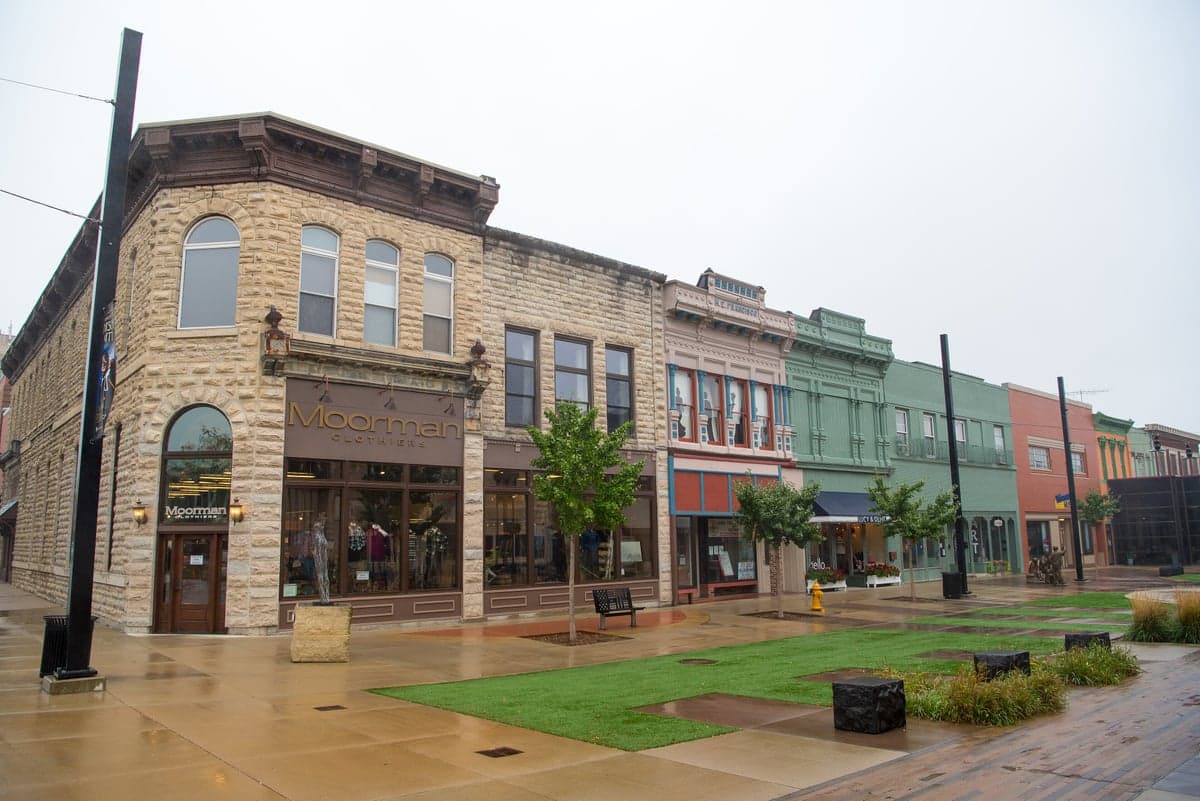
Photo: Wikipedia
Strategic Assessment of Mason City, IA
Workable tactical position. Some exposure to population density or targets, but generally defensible in a crisis.
What does the Strategic Assessment tell us?
Our Strategic Assessment grades tactical survivability of an area. Major population centers, military targets, fallout zones, natural disasters, and border exposure all drive risk — lower exposure means a more defensible position in a crisis.
This is heavily inspired by Joel Skousen's Strategic Relocation book. Highly recommended you checkout the book ($)What does this tell us?
Our Strategic Assessment grades tactical survivability of an area. Major population centers, military targets, fallout zones, natural disasters, and border exposure all drive risk — lower exposure means a more defensible position in a crisis.
This is heavily inspired by Joel Skousen's Strategic Relocation book. Highly recommended you checkout the book ($)Strategic Pillars

Key Distances
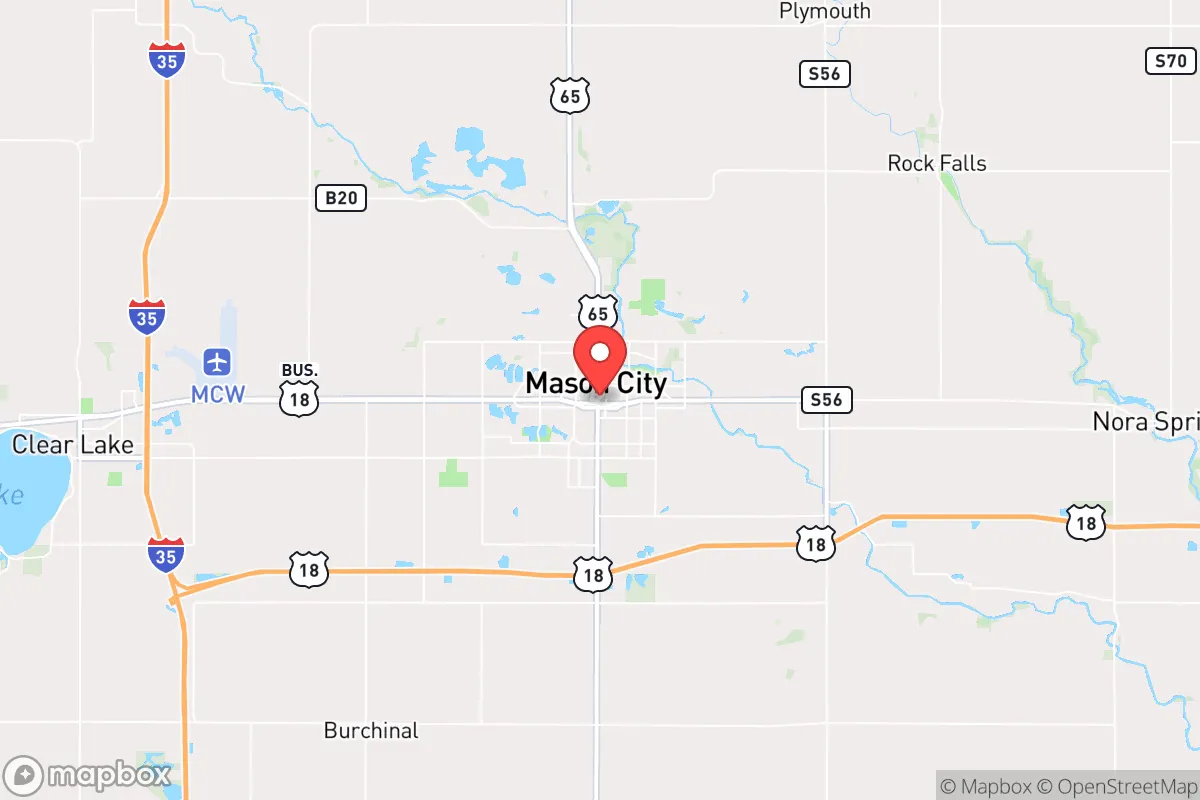
Regional Safe Places
Below is our recommended "safe zones" in Iowa and the surrounding area based on our strategic heuristics. For most people, it's unrealistic to live in a “safe zone” full-time due to work, family or other personal reasons. They tend to be more rural. However, many of these areas are perfect for second homes and retreat properties that double as a vacation home or even a short-term rental.
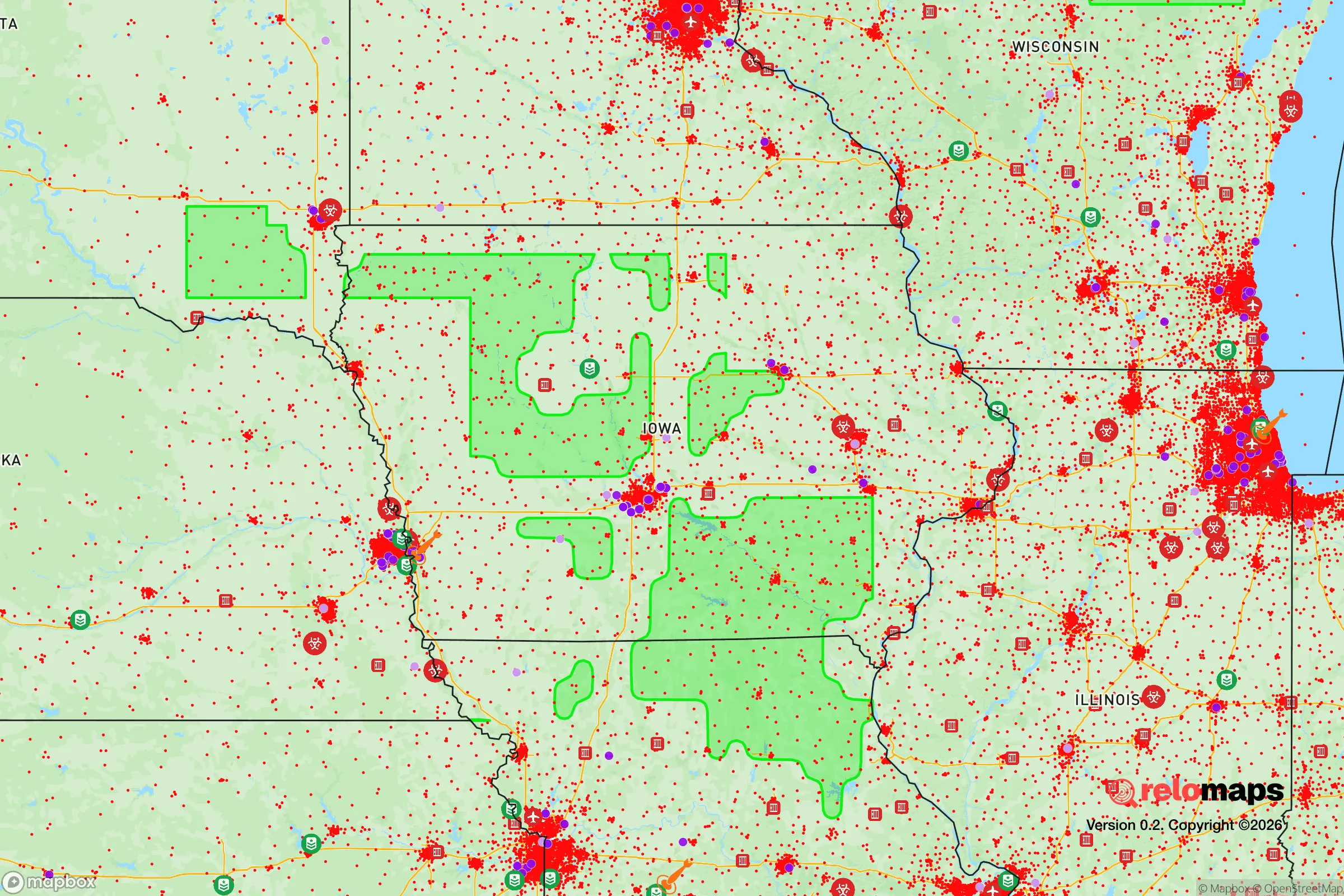
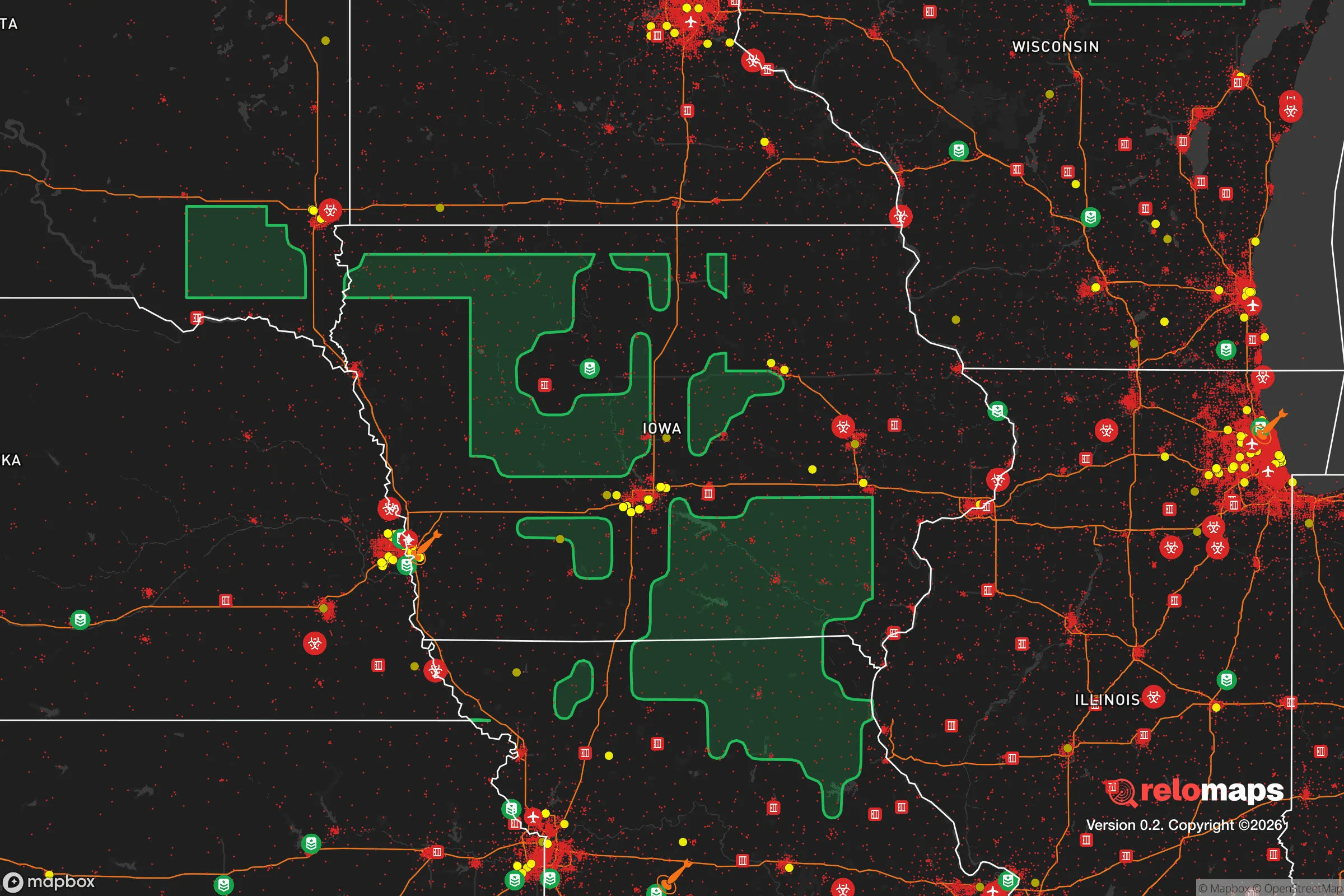


Important Note: For informational purposes only. This does not mean nothing bad ever happens in the green zones. Please use common sense. This is based on public data and modeled with AI. We tried to take a conservative approach but mistakes happen. We update this regularly as new information becomes available.
Solar Generator Recommendations
Backup power matters more here than in safer locations. We've picked three solar generators across budgets and capacity tiers — start with the budget unit if you only need a few essentials, or step up if you want to run a fridge and HVAC for days at a time.

Jackery Portable Power Station Explorer 300
Budget OptionPower on the Go: Weighing only 11 lbs, it's convenient to set up and store with book-sized foldable solar panels

BLUETTI Portable Power Station AC180
Designed for both indoor and outdoor scenarios, AC180 is highly capable as it has a robost capacity and continuous output power.

EF ECOFLOW DELTA Pro Ultra Power Station
Upgraded PickEcoFlow DELTA Pro Ultra is a whole-home energy system designed to grow with your family. Integrated with the Smart Home Panel 2, it scales to meet your evolving energy needs — keeping your home powered, intelligent, and secure through every stage of life.
We earn a commission, at no additional cost to you.
Strategic Assessment Analysis
Mason City, Iowa, occupies a strategic position in the north-central part of the state that offers a blend of geographic insulation and practical self-sufficiency potential, making it a noteworthy consideration for those prioritizing disaster readiness and long-term resilience. The city’s location roughly 120 miles south of the Minnesota border and 60 miles west of the Mississippi River places it within a region characterized by flat, fertile farmland, a moderate population density, and a distance from major metropolitan targets that could be advantageous in a variety of disruption scenarios. For a relocator thinking seriously about preparedness, Mason City presents a credible option where the trade-offs between isolation and access to resources are relatively balanced, provided one understands the specific risks and assets of the area.
Geographic position and natural advantages for disaster preparedness
Mason City sits within the Iowa Great Lakes region, a landscape defined by the Winnebago River and the surrounding glacial plains. This geography provides several inherent advantages. The area is far enough from major population centers—Des Moines is roughly 120 miles south, Minneapolis about 140 miles north, and Chicago over 300 miles east—to reduce the likelihood of being affected by fallout or cascading failures from a metropolitan crisis. The local topography is gently rolling, offering natural drainage and reducing flood risk in most residential areas, though low-lying properties near the river require attention. The region’s agricultural base is a significant asset: Cerro Gordo County, where Mason City is the seat, is part of one of the most productive corn and soybean belts in the world, meaning local food production capacity is high even in normal times. The area also benefits from a relatively stable climate, with no hurricane, tsunami, or seismic threats, and while tornadoes are a seasonal risk, the open terrain allows for ample warning time and straightforward sheltering options. For a relocator, the key takeaway is that Mason City offers a defensible position with strong natural resource access, but it is not immune to weather-related events that require basic preparedness.
Risks, exposures, and proximity to fallout-relevant landmarks
While Mason City’s distance from major cities is a resilience plus, the area is not without its own risk profile. The most significant man-made exposure comes from the Duane Arnold Energy Center, a decommissioned nuclear power plant located roughly 90 miles east near Palo, Iowa. Though the plant ceased operations in 2020 and is in decommissioning, spent fuel remains stored on-site, which introduces a low-probability but non-zero risk of radiological release in the event of a severe incident or targeted attack. Additionally, the city lies within the general flight path of commercial and military aviation corridors serving the Upper Midwest, though no major military installations or high-value infrastructure targets are within a 50-mile radius. The Iowa Army Ammunition Plant near Burlington is over 200 miles away, and the nearest major rail hub for hazardous materials is in Waterloo, about 60 miles southeast. For a relocator, the practical risk assessment is that Mason City is far enough from high-consequence targets to avoid primary fallout zones, but close enough to regional infrastructure that secondary effects—such as supply chain disruptions or population displacement from larger cities—could be felt. The area’s primary natural risk is severe weather: Cerro Gordo County averages about 20 tornado warnings per year, and straight-line winds can cause significant damage. Flooding along the Winnebago River is a localized concern, particularly in the southern parts of the city near the river’s floodplain. Overall, the risk profile is moderate and manageable with standard preparedness measures.
Practical resilience for a relocator: food, water, energy, and defensibility
For someone serious about self-sufficiency, Mason City offers several practical advantages. Access to local food is strong: the city hosts a year-round farmers’ market, multiple grocery cooperatives, and is surrounded by farms where direct-to-consumer meat, eggs, and produce are readily available. The area’s agricultural extension services through Iowa State University provide resources for home gardening, livestock raising, and food preservation, which is a tangible benefit for those looking to reduce reliance on supply chains. Water availability is generally good, with the city drawing from the Jordan Aquifer, a deep sandstone formation that is less susceptible to surface contamination than shallow wells. However, relocators should note that private wells in the surrounding rural areas require testing for nitrates and coliform bacteria, common issues in agricultural regions. For off-grid water, the Winnebago River and numerous smaller creeks provide surface sources, but treatment is necessary. Energy resilience is a mixed picture: the local grid is served by Alliant Energy, which has invested in grid hardening, but power outages from storms are not uncommon. Solar potential is moderate, with about 200 sunny days per year, making a hybrid system with battery storage a viable option for backup. Natural gas is widely available in the city, but rural properties often rely on propane, which requires storage and delivery. Defensibility is a strong point: Mason City’s layout is compact, with a population of about 27,000, and the surrounding rural areas offer numerous properties with good sightlines, limited access points, and a culture of neighborly mutual aid. The local law enforcement presence is adequate, but for a relocator, the real security asset is the community’s self-reliant mindset—many residents already garden, hunt, and maintain emergency supplies as a matter of course.
The overall strategic picture for Mason City is that of a solid, middle-of-the-road relocation option for the preparedness-minded individual or family. It does not offer the extreme isolation of a remote mountain retreat, nor does it carry the high-risk exposure of a coastal or metropolitan area. Instead, it provides a balanced environment where the fundamentals of resilience—food, water, energy, and community—are accessible without requiring extreme measures or significant financial outlay. The area’s agricultural productivity, moderate climate, and distance from high-value targets make it a defensible choice, while its manageable risks (tornadoes, localized flooding, and distant nuclear storage) are well-understood and can be mitigated with standard planning. For a relocator who values practical self-sufficiency over dramatic seclusion, Mason City represents a viable and grounded option in the Upper Midwest’s preparedness landscape.

* Values derived from national, state, county, city and local statistics and may differ in a specific area. Last updated: 2026-06-15T02:49:00.000Z
Narrative content on this page is AI-generated and may contain mistakes. Verify any details that matter before acting on them.
ReloMaps may earn a commission from affiliate links at no extra cost to you.

