Photo: Wikipedia
Demographics of Mason City, IA
Affluence Level in Mason City, IA
A middle-class area roughly in line with national averages across income, home values, education, and employment.
People of Mason City, IA
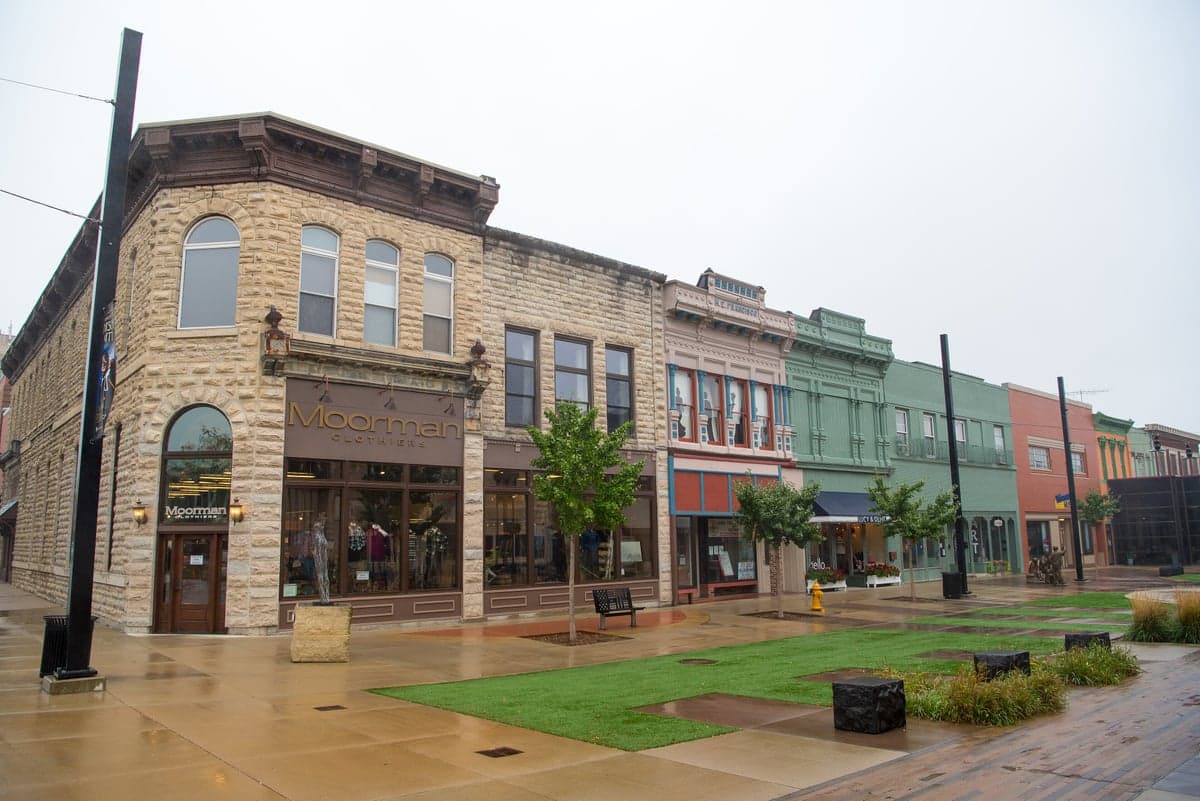
Mason City, Iowa, is a predominantly white, family-oriented community of 27,135 residents, shaped by waves of European immigration and a stable, slow-growth population. With 86.2% of residents identifying as white and a foreign-born population of just 1.5%, the city retains a strong Midwestern cultural identity rooted in its industrial and agricultural past. The city’s character is defined by its historic neighborhoods, a modest but growing Hispanic community (6.5%), and a population that is older and less college-educated (21.3%) than the national average, reflecting its blue-collar heritage.
How the city was settled and grew
Mason City’s population history begins with the arrival of the railroad in the 1850s, which transformed a small trading post into a regional hub for agriculture and manufacturing. The city’s original settlers were primarily Yankee and German immigrants drawn by the fertile prairie land and the promise of work on the Illinois Central Railroad. By the 1870s, the discovery of limestone and clay deposits spurred a brickmaking and cement industry, attracting a second wave of laborers. German and Irish immigrants settled in the Southbridge neighborhood, building modest homes near the rail yards and brickyards. Scandinavian immigrants, particularly Swedes and Norwegians, arrived in the 1880s and 1890s, establishing a strong presence in the East Park area, where they built the city’s first Lutheran churches and formed tight-knit farming communities on the city’s eastern edge. The early 20th century saw an influx of Italian and Polish immigrants, who concentrated in the Mason City Heights district, working in the packing plants and foundries that defined the local economy. By 1920, the city’s population had swelled to over 20,000, with these European ethnic groups forming the backbone of the community.
Modern era (post-1965)
After the 1965 Immigration and Nationality Act, Mason City saw only modest demographic change, as the city’s industrial base began to decline. The foreign-born population remained low, hovering around 1-2%, as the city did not attract the large-scale immigration seen in larger Midwestern metros. The most notable shift has been the growth of the Hispanic population, which rose from under 1% in 1990 to 6.5% today. Hispanic families, many of Mexican heritage, began arriving in the 1990s to work in the city’s remaining meatpacking and food-processing plants. They have concentrated in the North End neighborhood, near the industrial corridor along Highway 122, where a small cluster of Hispanic-owned businesses and a Catholic mission church have taken root. The Black population (2.9%) and East/Southeast Asian population (0.9%) remain small, with most Black families living in the Willow Creek area, a post-war subdivision near the community college. The Indian subcontinent population (0.3%) is negligible, with no distinct neighborhood concentration. Suburbanization in the 1970s and 1980s drew many white families to newer developments in the West Side and Southwest neighborhoods, leaving the older core neighborhoods like Southbridge and East Park with aging housing stock and a slightly older, more stable population.
The future
Mason City’s population is projected to remain stable or decline slightly over the next 10-20 years, as the city’s economy shifts from manufacturing to healthcare and education. The Hispanic population is expected to continue its gradual increase, potentially reaching 10-12% by 2040, driven by family reunification and labor demand in the service sector. This growth will likely remain concentrated in the North End, though some dispersal into the West Side is possible as younger Hispanic families seek newer housing. The white population will continue to age, with the median age (currently 42) rising further, as younger residents leave for larger cities. The city’s cultural identity is slowly diversifying, with the annual North Iowa Hispanic Festival and the growing presence of Spanish-language church services in the North End signaling a shift from a purely European-American heritage. However, Mason City is unlikely to become a majority-minority community; its future is one of gradual, modest diversification within a predominantly white, conservative-leaning framework.
For someone moving in now, Mason City offers a stable, affordable, and safe environment with a strong sense of community, but with limited ethnic diversity and a slowly aging population. The city is becoming slightly more Hispanic and slightly more suburban, but its core identity as a white, working-to-middle-class Midwestern town remains intact. New residents should expect a place where change comes slowly, and where the historic neighborhoods of Southbridge and East Park still echo the immigrant stories of the 19th century.

* Values derived from national, state, county, city and local statistics and may differ in a specific area. Last updated: 2026-06-15T02:49:00.000Z
Narrative content on this page is AI-generated and may contain mistakes. Verify any details that matter before acting on them.
ReloMaps may earn a commission from affiliate links at no extra cost to you.

