
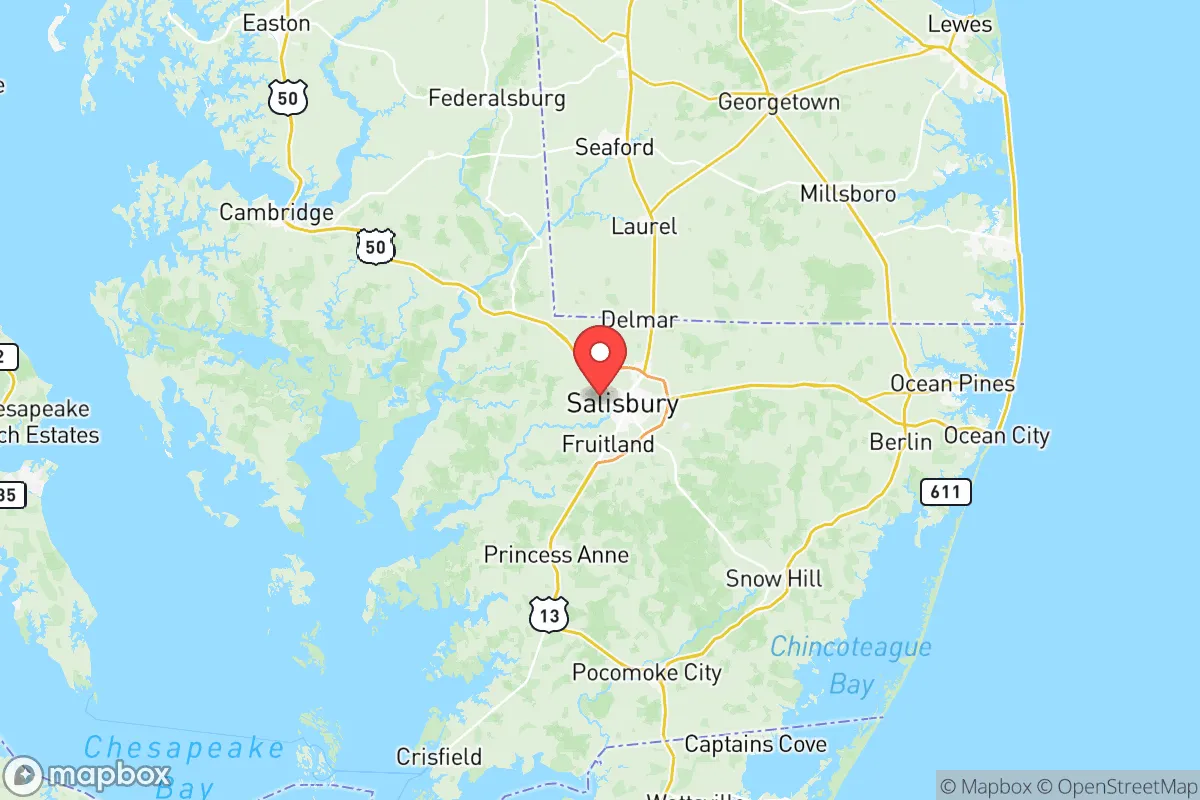
Photo: Wikipedia
Personal Sovereignty in Wicomico County
Viable for self-reliance. Generally workable, though some barriers may limit total independence.
What does Personal Sovereignty tell us?
Personal Sovereignty measures your capacity for self-reliance and independence with minimal government friction. Higher scores mean fewer barriers between you and the way you want to live... but it assumes you have the space you need and good neighbors.
What does this tell us?
Personal Sovereignty measures your capacity for self-reliance and independence with minimal government friction. Higher scores mean fewer barriers between you and the way you want to live... but it assumes you have the space you need and good neighbors.
State Policy
Energy independence: Importer (8% of energy produced in-state)
Personal Liberty
Homesteading

Personal Liberty Analysis
Wicomico County, Maryland, offers a mixed bag for those prioritizing personal sovereignty, with its rural character and lower population density providing more breathing room than the state’s heavily regulated urban cores, but still operating under the thumb of Annapolis’s increasingly progressive mandates. For the survivalist or prepper-minded individual, the county’s eastern shore location provides a strategic buffer from the chaos of Baltimore and D.C., yet the state’s overarching tax burden, restrictive gun laws, and expanding government overreach into medical and parental decisions mean you’re never fully free. The key is knowing which pockets of the county—like the unincorporated areas around Fruitland or the more remote stretches near Quantico—offer the best chance to live on your own terms, versus the denser, more regulated zones like Salisbury proper. This analysis breaks down where Wicomico County stands on the autonomy spectrum, with a hard look at the trade-offs for those who value self-reliance over state dependency.
Tax burden and regulatory posture: How Wicomico County compares to Maryland’s worst
Maryland ranks among the least tax-friendly states in the nation, and Wicomico County is no exception, though its local rates are slightly more bearable than the suburban D.C. counties. The state income tax is a flat 5.75% on most income, and Wicomico adds a county income tax of 3.2%, bringing the combined rate to 8.95%—a heavy hit for any self-employed prepper or small business owner trying to stockpile supplies or invest in land. Property taxes are a mixed bag: the county rate is about $0.95 per $100 of assessed value, but the city of Salisbury tacks on an additional $0.72, making Salisbury proper far less attractive for homesteaders than the unincorporated areas like Delmar or Pittsville, where you avoid that municipal levy. Regulatory posture is where the real frustration sets in. Maryland’s state-level environmental regulations, particularly the Critical Area Act governing development within 1,000 feet of tidal waters, can severely limit what you can do on your own land near the Wicomico River or its tributaries. Permitting for anything from a septic system to a backyard workshop is slower and more invasive than in neighboring Delaware or Virginia, and the state’s push for electric vehicle mandates and net-zero building codes feels like a direct assault on off-grid independence. For those looking to minimize government entanglement, the rural areas around Mardela Springs offer the lightest touch, but you’re still paying Annapolis’s price for the privilege of living on the Eastern Shore.
Self-defense and gun law specifics: Navigating Maryland’s restrictive framework
If you’re serious about the Second Amendment as a cornerstone of personal sovereignty, Wicomico County is a frustrating compromise. Maryland is a “may-issue” state for concealed carry, but a 2022 Supreme Court ruling (NYSRPA v. Bruen) forced the state to loosen its standards, and as of 2025, the Maryland State Police are processing permits with a “shall-issue” posture—though the application process remains expensive, time-consuming, and invasive, requiring an 8-hour training class, fingerprints, and a background check that digs into your mental health history. The county itself is more gun-friendly than the state average: the Wicomico County Sheriff’s Office, under Sheriff Mike Lewis, has historically been supportive of gun rights, and you’ll find a strong hunting culture in areas like Quantico and Nanticoke. However, the state’s ban on “assault weapons” (including many popular AR-15 platforms) and its 10-round magazine limit mean you’re operating with one hand tied behind your back compared to free states like West Virginia or Texas. Private firearm sales are illegal in Maryland—all transfers must go through a licensed dealer with a background check—so building a personal armory requires patience and paperwork. For the prepper, the practical takeaway is this: you can legally own firearms for self-defense and hunting in Wicomico County, but the state’s regulatory apparatus is designed to make it burdensome, and any future legislative session could tighten the screws further. The best bet is to buy what you can now, store it securely, and consider a property in a more rural part of the county where you can shoot on your own land without neighbor complaints.
Self-reliance and homesteading viability: Lot sizes, zoning, and off-grid feasibility
Wicomico County offers genuine opportunities for self-reliance, but the devil is in the zoning details. In the unincorporated areas, minimum lot sizes for agricultural-residential zones are typically 1 to 2 acres, which is enough for a substantial garden, a few chickens, and even a small orchard—but forget about keeping livestock like goats or pigs without a special permit in most residential zones. The county’s zoning code explicitly allows “home occupations” like small-scale food processing or woodworking, but you’ll need a use permit and can’t have employees or customers coming to the property, which limits any serious homestead business. Off-grid feasibility is a mixed bag: Maryland requires all new homes to be connected to the electrical grid unless you can prove a “hardship” exemption, and the state’s building code mandates specific energy efficiency standards that make a true off-grid cabin nearly impossible to permit. That said, existing properties in areas like Allen or Tyaskin often have wells and septic already in place, and you can install solar panels with net metering—though the state’s renewable energy mandates mean you’ll still be paying into the grid. Rainwater collection is legal but regulated under the county’s stormwater management rules, and composting toilets are technically allowed with a health department variance. For the serious prepper, the best strategy is to buy an older farmhouse on 5+ acres in a remote area like Parsonsburg, where you can gradually build self-sufficiency without triggering a zoning inspection. Just know that the county’s agricultural preservation programs, while protecting farmland, also limit what you can do with your land—so read the deed restrictions carefully before buying.
Personal liberties: Parental rights, medical autonomy, speech, and property
On the spectrum of personal liberties, Wicomico County is a battleground between local conservative values and state-level progressive overreach. Parental rights are under direct assault in Maryland: the state’s Blueprint for Maryland’s Future education reform includes mandatory LGBTQ+ inclusive curriculum and social-emotional learning standards that many parents view as indoctrination, and the Wicomico County Board of Education has been a flashpoint for these fights, with conservative parents pushing back against critical race theory and gender ideology in schools. Medical autonomy is equally concerning: Maryland has some of the nation’s strictest vaccine mandates for schoolchildren, and during the COVID-19 pandemic, the state imposed business closures and mask mandates that were enforced aggressively even in rural counties. As of 2026, there is no state-level religious or philosophical exemption for vaccine requirements, meaning parents in Salisbury or Fruitland who refuse mandates face losing access to public education. Free speech is generally protected in the county, but Maryland’s hate crime laws and “cyber harassment” statutes are broad enough to chill political speech, and the state’s attorney general has shown willingness to prosecute online commentary deemed threatening. Property rights are the strongest liberty you’ll find here: Wicomico County’s zoning is relatively permissive compared to Montgomery or Howard counties, and you can generally build a fence, add a shed, or park an RV on your property without a permit in unincorporated areas. But the state’s Critical Area Commission can override local decisions near waterways, and the county’s stormwater management fees are a constant reminder that you don’t truly own your land—the government can dictate what runs off it. For the liberty-minded individual, the best advice is to keep your head down, build community with like-minded neighbors in the rural precincts, and avoid drawing attention from the state’s enforcement apparatus.
Overall, Wicomico County offers a moderate level of personal sovereignty relative to other areas in the Mid-Atlantic, but it falls far short of the freedom found in states like West Virginia, Tennessee, or Idaho. The county’s rural character and conservative local leadership provide a buffer against the worst of Annapolis’s overreach, but you cannot escape the state’s tax burden, gun restrictions, or education mandates. For the prepper or survivalist, the calculus is simple: Wicomico County is a decent place to hunker down if you already own land here, but it’s not a destination for those seeking to escape government control. The best-case scenario is to buy a remote property in Quantico or Nanticoke, build a self-sufficient homestead, and minimize interactions with the state—while always keeping one eye on the exit, because Maryland’s trajectory is toward more regulation, not less. If you’re willing to fight for your rights at the local level, you can carve out a life here, but don’t expect the county to protect you from the state’s encroachments. The smart money is on having a backup plan—and a bug-out location in a freer jurisdiction.

* Values derived from national, state, county, city and local statistics and may differ in a specific area. Last updated: 2026-05-08T21:35:29.000Z
Narrative content on this page is AI-generated and may contain mistakes. Verify any details that matter before acting on them.
ReloMaps may earn a commission from affiliate links at no extra cost to you.

