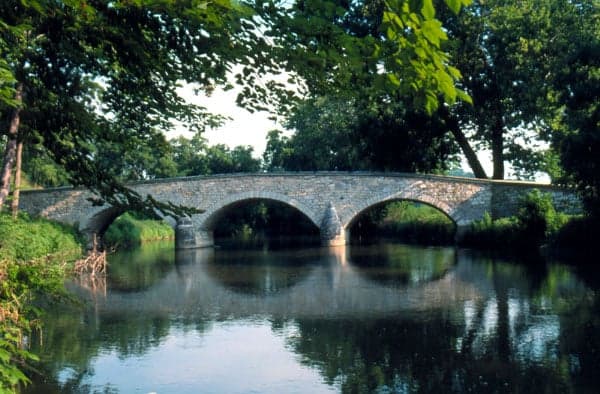
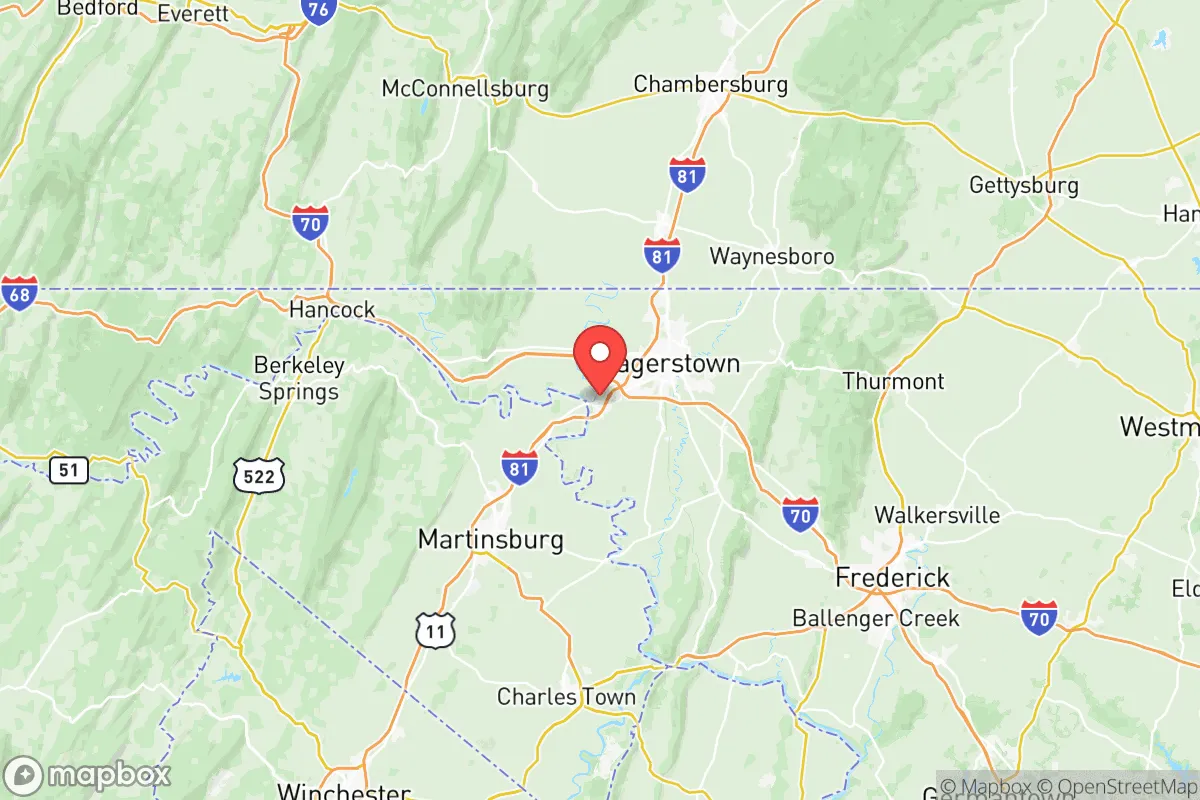
Photo: Wikipedia
Political ClimatePolitical Climate in Washington County
Showing district-level results — no local-only data available.
Local Political AnalysisPolitical Analysis of Washington County
Washington County is a classic blue-collar swing county in a deep-blue state, and that tension defines its politics. While Maryland as a whole carries a Cook PVI of D+17, Washington County sits at D+3, making it one of the most Republican-friendly areas in the state. The county has been drifting rightward over the past decade, driven by population growth in its more rural and exurban stretches, even as the city of Hagerstown itself has held steady as a Democratic-leaning anchor. The result is a place where neither party can take victory for granted, and where local elections often turn on a few thousand votes.
How it compares
The gap between Washington County (D+3) and Maryland’s statewide D+17 is enormous — roughly 14 points of partisan difference. That means a Republican candidate who loses Maryland by 14 points can still win Washington County by a narrow margin. In practice, the county has voted for the Republican presidential candidate in every election since 2000 except 2008 and 2020, when it went for Obama and Biden by very slim margins. The internal geography matters a lot: Hagerstown’s downtown and West End precincts lean reliably blue, while the fast-growing suburbs around Smithsburg, Boonsboro, and Williamsport are solidly red. The swing precincts are in the Halfway and Maugansville areas, where newer subdivisions and commuter populations create a more mixed electorate. By contrast, the rest of Maryland is dominated by the D+20+ suburban counties around DC and Baltimore, which drown out the Western Maryland vote in statewide races.
What this means for residents
For conservative residents, Washington County is a rare pocket of political comfort in Maryland. Local government — the county commission and school board — has been Republican-controlled for most of the last two decades, and gun rights, lower taxes, and limited development are mainstream positions. A conservative can live here and feel their vote matters in local races, even if statewide elections are a lost cause. For liberal residents, the situation is more mixed. You’ll find like-minded neighbors in Hagerstown’s core and around the downtown arts district, but you’re in a clear minority in the county as a whole. That said, the county’s D+3 lean means Democrats can and do win local offices — the current county commission has two Democrats — and statewide Democratic candidates still campaign here, knowing they need to run up the score in Western Maryland to offset losses on the Eastern Shore. The practical effect is that policy debates are more moderate than in deep-red rural counties: zoning fights, school funding, and opioid crisis response tend to be pragmatic rather than ideological.
Culturally, Washington County is distinct from the rest of Maryland in ways that go beyond party registration. The county is part of the Hagerstown-Martinsburg, MD-WV metro area, and its economy and identity are tied more to the I-81 corridor and the Pennsylvania border than to the DC suburbs. You’ll see more Confederate battle flags on pickup trucks in Boonsboro than you will in Bethesda, but you’ll also find a growing Hispanic population in Hagerstown that is shifting the electorate slowly. The county’s politics are less about national culture wars and more about local bread-and-butter issues: road funding for the I-81 widening, the future of Meritus Health, and the balance between preserving farmland and allowing warehouse development. That’s the real Washington County story — a place where the national partisan labels fit loosely, and where the actual political fights are about how to manage growth in a corridor that connects the Northeast to the South.

State Political ClimatePolitical Climate in Maryland
State Political AnalysisPolitical Environment in the State
Maryland is a solidly Democratic state with a Cook PVI of D+17, meaning it votes about 17 points more Democratic than the national average in presidential elections. The state hasn't voted for a Republican presidential candidate since George H.W. Bush in 1988, and the Democratic lean has only deepened over the past two decades as the Washington, D.C. suburbs have grown and diversified. However, this blue veneer masks a deeply divided political landscape — the state is essentially two different political worlds: the densely populated, liberal D.C. and Baltimore metro areas, and the conservative, rural Western Shore, Eastern Shore, and mountain regions.
Urban vs. rural divide
The political map of Maryland is a study in contrasts. The Democratic stronghold is anchored by the Washington, D.C. suburbs — Montgomery County and Prince George's County — which together cast roughly a third of the state's votes and deliver margins of 70-80% for Democrats. Baltimore City is even more lopsided, routinely voting 85-90% Democratic. The Baltimore suburbs, particularly Howard County and Baltimore County, also lean blue, though less overwhelmingly. In contrast, the rural areas tell a different story. Garrett County in the far west, Carroll County north of Baltimore, and the entire Eastern Shore — including Worcester County (home to Ocean City) — vote Republican by 20-30 points. Frederick County, once a reliably red exurb, has become a bellwether: it voted for Trump in 2016 and 2020 but by shrinking margins, and in 2024 it flipped to Harris, reflecting the slow creep of D.C. suburbanization westward. The divide isn't just about party — it's about density, income, and education. The urban core is diverse, highly educated, and affluent; the rural areas are whiter, older, and more working-class.
Policy environment
Maryland's policy environment is shaped by its Democratic supermajority in the General Assembly and a governor who, even when Republican (Larry Hogan, 2015-2023), was constrained by veto-proof majorities. The state has a progressive income tax structure with rates from 2% to 5.75%, plus local "piggyback" taxes that push the top combined rate over 8% in places like Montgomery County. Property taxes are high, especially in the D.C. suburbs, but the state also offers generous homestead credits and circuit breaker programs for low-income residents. Sales tax is 6%, with no tax on groceries or prescription drugs. Education spending is among the highest in the nation per pupil, driven by the 2021 Blueprint for Maryland's Future law, which pumps billions into early childhood education, teacher pay, and career programs. Healthcare is heavily regulated — the state runs its own insurance exchange, expanded Medicaid under the ACA, and has strict certificate-of-need laws for hospitals. Election laws are among the most accessible in the country: no-excuse mail-in voting, same-day registration, early voting, and automatic voter registration at the DMV. Gun laws are restrictive — a "may issue" concealed carry system (though a 2022 Supreme Court ruling forced a shift to "shall issue"), a ban on assault weapons, a 10-round magazine limit, and a "red flag" law. The state also has a strong shield law for journalists and broad public records access, though enforcement is uneven.
Recent policy direction
Over the past five years, Maryland has moved decisively left on several fronts. In 2023, the legislature passed the Trans Health Equity Act, requiring Medicaid to cover gender-affirming care, and the Abortion Care Access Act, which expanded the pool of providers who can perform abortions and created a state-funded abortion training program. In 2024, the Rights and Reproductive Freedom Act further codified abortion access and protected providers from out-of-state lawsuits. On gun policy, the 2023 Gun Safety Act banned firearms in most public places, including parks, hospitals, and transit, though parts were struck down by federal courts. On education, the Blueprint for Maryland's Future is the biggest policy shift — it mandates billions in new spending, but implementation has been rocky, with local school boards struggling to find teachers and facilities. On property rights, the state has tightened rent control in Baltimore and Montgomery County, and in 2024 passed a law requiring landlords to accept housing vouchers. On voting, the 2024 Voter Empowerment Act expanded automatic registration to state agencies and made it easier to cure mismatched signatures on mail-in ballots. On privacy, the Maryland Online Data Privacy Act (2024) gives residents the right to access, correct, and delete personal data held by companies, though it exempts nonprofits and small businesses. The overall direction is toward more regulation, more state spending, and more individual rights on social issues — but with a corresponding tightening of gun rights and property rights that conservatives will find frustrating.
Civil unrest & political movements
Maryland has a history of political activism that ranges from the 2015 Baltimore protests after Freddie Gray's death to the 2020 George Floyd demonstrations that saw widespread property damage in Baltimore and D.C. suburbs. The state's sanctuary policies are a flashpoint: Montgomery County and Baltimore City are "sanctuary" jurisdictions that limit cooperation with federal immigration enforcement, and the state itself has a 2019 law barring state and local police from asking about immigration status. This has led to tension with the Trump administration and periodic calls from Republican lawmakers for a "rule of law" crackdown. On the right, the Maryland Republican Party has been split between moderate Hogan-style pragmatists and a more populist, Trump-aligned wing that has gained ground in rural counties. The Maryland Shall Issue gun rights group is active and has successfully sued the state over several gun laws. Election integrity has been a minor issue — Maryland uses paper ballots with audits, and there have been no major fraud allegations, but some rural counties have passed symbolic resolutions calling for election audits. The most visible political movement in recent years has been the parents' rights push, particularly in school board races in Frederick, Carroll, and Harford counties, where conservative parents have mobilized against critical race theory and LGBTQ-inclusive curricula. These movements have won some local school board seats but have not shifted state policy.
Projection
Over the next 5-10 years, Maryland's Democratic lean is likely to deepen, not weaken. The D.C. suburbs continue to grow — Montgomery County added 50,000 residents between 2020 and 2025, and Frederick County is the fastest-growing in the state — while rural counties are stagnant or losing population. The in-migration is disproportionately young, diverse, and college-educated, which tends to favor Democrats. The Republican Party in Maryland is increasingly confined to a shrinking rural base, and even a popular moderate like Larry Hogan couldn't win a Senate seat in 2024 (he lost to Angela Alsobrooks by 10 points). The state's fiscal trajectory is a concern — the Blueprint for Maryland's Future is projected to create a $3 billion structural deficit by 2030, which will likely force tax increases or spending cuts. The state's high cost of living, driven by housing and taxes, may eventually slow in-migration, but for now, the political direction is clear: more progressive policies, more state control, and a widening gap between the blue urban core and the red rural periphery. A conservative moving to Maryland should expect to live in a state where their vote is unlikely to matter in statewide elections, but where local control — particularly in counties like Carroll, Garrett, and Worcester — can still provide a buffer against the most progressive policies.
For a new resident, the bottom line is this: Maryland offers a high quality of life with excellent schools, strong job markets, and beautiful natural areas, but it comes with high taxes, heavy regulation, and a political environment that is deeply frustrating for conservatives. If you're moving to the D.C. suburbs, you'll be in a liberal bubble where your politics are the norm. If you're moving to the Eastern Shore or Western Maryland, you'll be in a conservative enclave where you can live your life largely free of state interference on most issues, but you'll have no real say in statewide elections. The state's trajectory is toward more Democratic control, more spending, and more progressive social policies — so if that aligns with your values, you'll find plenty to like. If not, you'll need to decide whether the trade-offs are worth it.
* Values derived from national, state, county, city and local statistics and may differ in a specific area. Last updated: 2026-07-25T16:23:46.000Z
Narrative content on this page is AI-generated and may contain mistakes. Verify any details that matter before acting on them.
ReloMaps may earn a commission from affiliate links at no extra cost to you.

