
Photo: Wikipedia
Political ClimatePolitical Climate in Mableton, GA
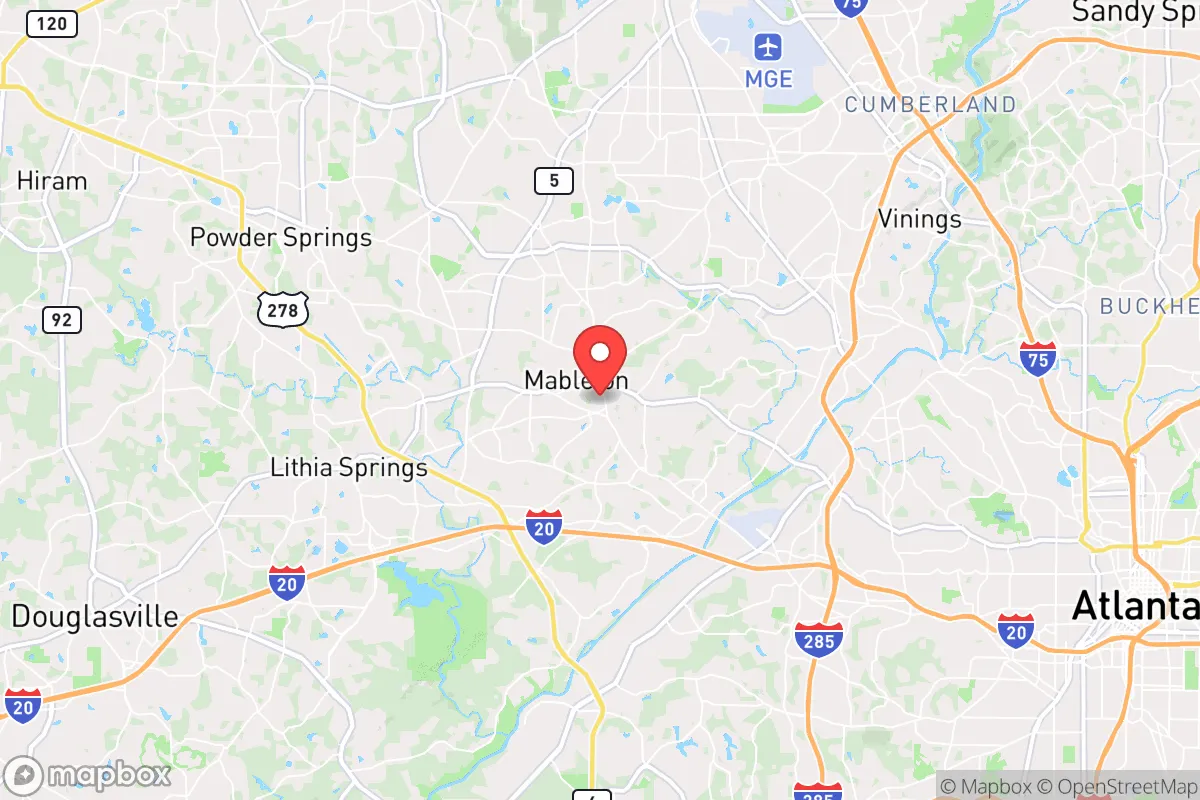
District shown is the primary district for this city’s centroid. Cities may span multiple districts.
Local Political AnalysisPolitical Analysis of Mableton, GA
Mableton is a solidly blue stronghold in metro Atlanta, with a Cook Partisan Voting Index of D+25 that places it among the most Democratic-leaning suburbs in Georgia. Over the past decade, the city’s politics have shifted leftward as new residents—many from inside the Perimeter and other progressive enclaves—have moved into the area, drawn by more affordable housing and proximity to Atlanta. While Mableton was historically a more moderate, working-class community, the 2020s have cemented it as a reliably Democratic vote in Cobb County, which itself has flipped from red to purple to light blue over the same period.
How it compares
Mableton’s D+25 rating is far more Democratic than Cobb County as a whole (which leans about D+5) and dramatically more so than neighboring counties to the north and west. For context, nearby towns like Acworth and Kennesaw in northern Cobb County are more politically mixed, with significant conservative populations, while Powder Springs to the west leans slightly more moderate. Drive 20 minutes south to Douglasville in Douglas County, and you’ll find a similar Democratic tilt, but with a more moderate flavor. The contrast is sharpest when you head toward the exurbs: Paulding County to the west is reliably Republican (R+20 or so), and Cherokee County to the north is even redder. So Mableton sits in a blue bubble within a county that’s still competitive, but increasingly trending left. The state of Georgia overall is a true toss-up—roughly R+3 in recent presidential cycles—meaning Mableton’s politics are about 28 points more Democratic than the state average. That’s a bigger gap than you’d see in most Atlanta suburbs, and it reflects the city’s role as a hub for progressive-leaning families, young professionals, and Black voters who make up a majority of the population.
What this means for residents
For liberal residents, Mableton feels like a safe space where Democratic candidates are a given in local elections, and progressive policies around housing, transit, and environmental justice get serious airtime. The city council and mayor are reliably Democratic, and you’ll see yard signs for statewide Democratic candidates in every other front yard. For conservative residents, the reality is that you’re in the minority, but not an isolated one—Cobb County still has plenty of red precincts, and you can find like-minded neighbors in the northern parts of the county or just over the line in Paulding. The practical effect is that local government tends to prioritize issues like affordable housing, public transit expansion (the proposed Bus Rapid Transit along the I-285 corridor), and equity-focused community development. Taxes are moderate for metro Atlanta, and the city’s recent incorporation in 2023 has given Mableton more local control over zoning and policing, which has been a mixed bag for both sides—progressives wanted more oversight, while conservatives worry about overregulation.
Culturally, Mableton stands out for its strong sense of community identity that predates its incorporation. The city has a lively downtown area along Veterans Memorial Highway, with a mix of old-school barbecue joints, new breweries, and a growing arts scene. Politically, the city’s trajectory is almost certainly toward becoming even more Democratic as development continues and younger, more diverse families move in. Longtime residents sometimes joke that Mableton is “the last affordable blue spot in Cobb,” and that’s likely to hold true for the next decade. If you’re looking for a place where your vote feels like it counts in a deep blue context, but you still want access to the broader Atlanta economy, Mableton delivers—just don’t expect the political temperature to change anytime soon.

State Political ClimatePolitical Climate in Georgia
State Political AnalysisPolitical Environment in the State
Georgia has transformed from a reliably Republican stronghold into the nation’s premier swing state over the past two decades, with a partisan lean that now sits at a razor-thin margin. In 2024, Donald Trump carried the state by just 1.2 points, while in 2020 Joe Biden became the first Democrat to win Georgia since 1992. The state’s political trajectory is driven by explosive growth in the Atlanta metro, a rapidly diversifying electorate, and a resilient Republican base in the exurbs and rural counties. For a relocator, this means living in a state where every election is a national battleground, and where your vote carries outsized weight.
Urban vs. rural divide
The political map of Georgia is a study in stark contrasts. The Atlanta metro core—including Fulton, DeKalb, Cobb, and Gwinnett counties—is the engine of the Democratic coalition. Fulton County alone delivered 73% of its vote to Biden in 2020, and Gwinnett, once a Republican suburb, has flipped decisively blue. Meanwhile, the state’s vast rural and small-town regions—places like Rome, Valdosta, and Waycross—vote Republican by margins of 70% or more. The exurban ring, including counties like Forsyth, Cherokee, and Paulding, remains deeply red, with Forsyth County giving Trump 65% in 2024. The key battlegrounds are the “collar counties” around Atlanta—Cobb, Gwinnett, Henry, and Newton—where suburban voters, particularly college-educated women and Asian American communities, have shifted left. Outside Atlanta, the only other blue strongholds are the smaller cities of Athens (home to UGA), Savannah, and Augusta, each of which provides a liberal enclave in otherwise conservative regions.
Policy environment
Georgia’s policy landscape is a mix of conservative governance and pragmatic moderation. The state has a flat income tax rate of 5.49%, which is scheduled to drop to 4.99% by 2029 under legislation passed in 2022. Property taxes are relatively low, with a median effective rate of 0.87%, though they vary widely by county. The state is a “right-to-work” state with a Republican-controlled legislature that has consistently passed business-friendly tort reform and regulatory streamlining. Education policy is a flashpoint: Georgia has a robust school choice program, including the Georgia Promise Scholarship Act (2024), which provides $6,500 vouchers for students in low-performing districts. However, the state’s public schools rank 35th nationally in per-pupil spending, and teacher pay remains below the national average. Healthcare is a mixed bag—Georgia is one of the 10 states that has not expanded Medicaid, leaving roughly 300,000 low-income adults in the coverage gap. Election laws have been hotly contested: the 2021 SB 202 law added voter ID requirements for absentee ballots, limited drop boxes, and restricted third-party ballot collection, while also expanding early voting hours in most counties.
Recent policy direction
Georgia’s recent legislative sessions have moved decisively on several fronts that matter to relocators. On gun rights, the state enacted permitless carry (SB 319) in 2022, allowing any legal gun owner to carry a concealed firearm without a license. On parental rights and education, the “Parents’ Bill of Rights” (SB 449, 2022) requires schools to notify parents of any changes to a student’s mental or physical health services, a law that has drawn national attention. On speech and privacy, the state passed a “Heartbeat Bill” (HB 481) in 2019, banning abortion after six weeks, which was upheld by the Georgia Supreme Court in 2022. Property rights remain strong, with no statewide rent control and a homestead exemption that caps annual assessment increases at 3% for owner-occupied homes. On voting access, the state has expanded early voting to three weeks and requires all counties to offer at least one Saturday of early voting, while also implementing strict voter roll maintenance. Medical and bodily autonomy is sharply limited: the six-week abortion ban includes exceptions for rape, incest, and life of the mother, but has been criticized for its narrow scope. On surveillance, Georgia has no statewide ban on facial recognition by law enforcement, though Atlanta has imposed its own restrictions.
Civil unrest & political movements
Georgia has been a focal point for political activism on both sides. The 2020 election cycle saw massive “Stop the Steal” protests in Atlanta and at the state capitol, culminating in the January 6, 2021, rally that included many Georgia activists. On the left, the 2020 racial justice protests in Atlanta were among the largest in the country, with the “Cop City” movement—opposing a planned police training facility in DeKalb County—sparking ongoing protests and legal battles. Immigration politics are heated: Georgia was one of the first states to pass an Arizona-style immigration enforcement law (HB 87, 2011), and local sheriffs in counties like Hall County (Gainesville) and Whitfield County (Dalton) have active 287(g) agreements with ICE. There is no sanctuary city policy in Georgia; state law prohibits any local government from adopting such policies. Election integrity remains a live issue: the 2021 SB 202 law was challenged in court, and the 2024 election saw record turnout with no major irregularities, though partisan distrust persists. A new resident will notice political yard signs, campaign volunteers at grocery stores, and frequent local debates about school board and county commission races—politics is not a spectator sport here.
Projection
Over the next 5-10 years, Georgia is likely to remain a toss-up state, with a slight trend toward competitiveness. The Atlanta metro’s growth—adding roughly 100,000 new residents per year—will continue to dilute the Republican advantage in rural areas. However, the exurban and rural base is not shrinking; it is becoming more concentrated and more motivated. The key demographic wildcard is the growing Asian American and Hispanic populations, which are currently split roughly 60-40 Democratic but are not monolithic. If Republicans continue to gain ground with Hispanic voters (as they did in 2024), the state could shift right. Conversely, if Democratic turnout among Black voters (who make up 33% of the electorate) remains high, the state will stay competitive. The state’s political future will be decided in the suburbs of Kennesaw, Peachtree Corners, and Loganville—places where new arrivals from other states are changing the electorate. A relocator moving in now should expect to live in a state where the political climate is volatile, where every election cycle brings national attention, and where the policy direction could swing significantly depending on which party controls the governor’s mansion and legislature.
For a new resident, the bottom line is that Georgia offers a conservative policy environment—low taxes, gun-friendly laws, school choice, and limited government—but with a political landscape that is genuinely competitive. If you are a conservative, you will find your values reflected in state law, but you will also live in a state where Democrats hold real power in the cities and can win statewide. If you are a liberal, you will find strong communities in Atlanta, Athens, and Savannah, but you will face a state government that is often hostile to your priorities. The practical takeaway: Georgia is not a deep red state where you can ignore politics, nor a blue state where your vote is taken for granted. It is a battleground, and that means your voice—and your vote—matters more here than almost anywhere else in the country.
* Values derived from national, state, county, city and local statistics and may differ in a specific area. Last updated: 2026-08-22T15:29:38.000Z
Narrative content on this page is AI-generated and may contain mistakes. Verify any details that matter before acting on them.
ReloMaps may earn a commission from affiliate links at no extra cost to you.

