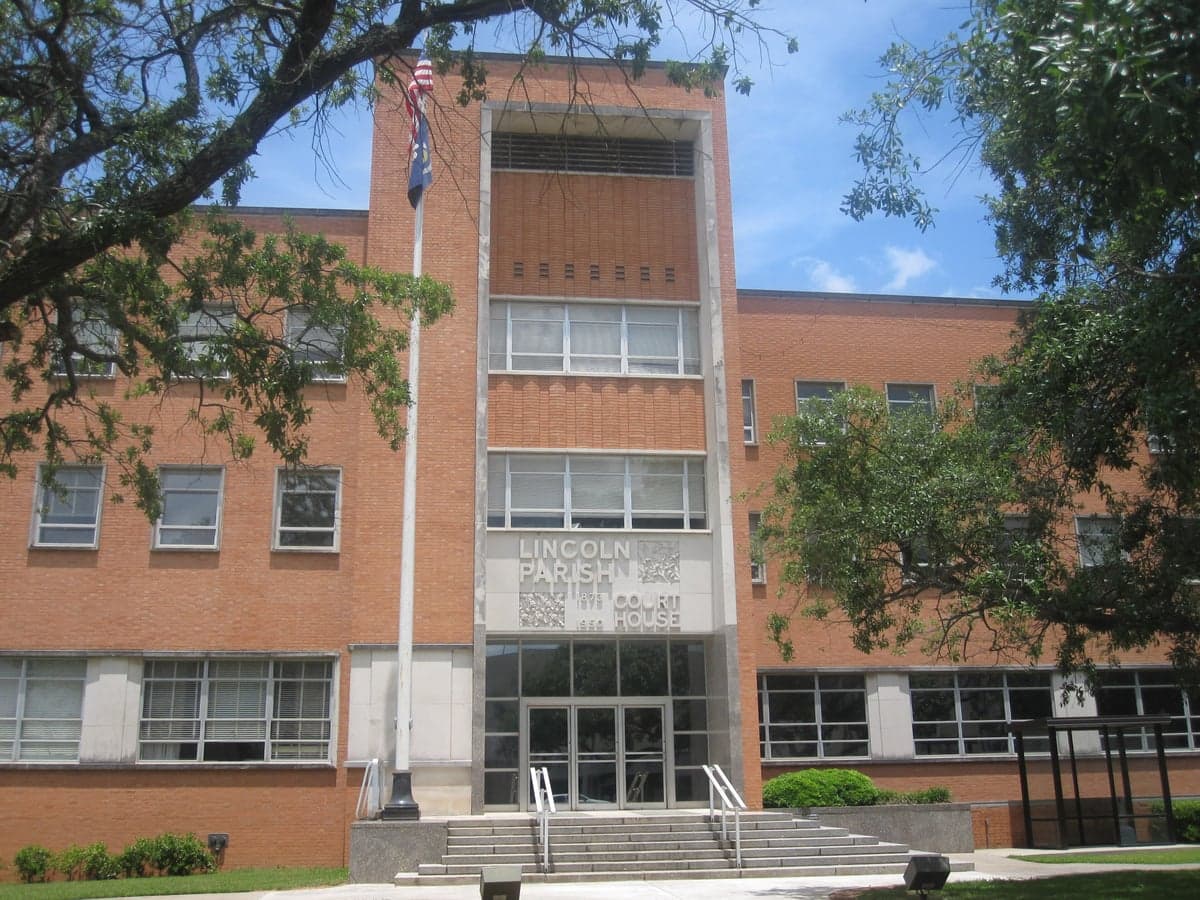
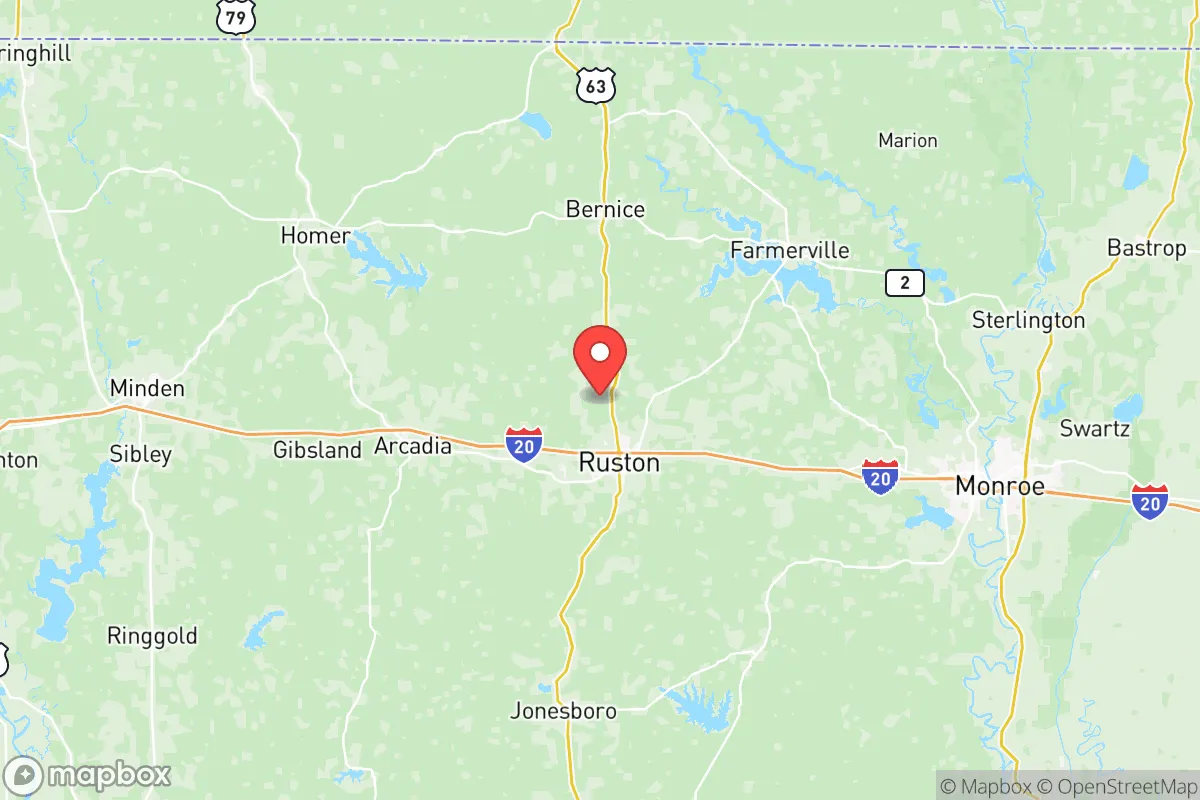
Photo: Wikipedia
Political ClimatePolitical Climate in Lincoln County
Showing district-level results — no local-only data available.
Local Political AnalysisPolitical Analysis of Lincoln County
Lincoln County is one of the most reliably Republican areas in Louisiana, anchored by a Cook Partisan Voting Index of R+26 that places it far to the right of the state average. The county has been trending redder for two decades, driven by population growth in the Ruston area and a steady exodus of moderate Democrats from the voter rolls. In the 2024 presidential race, the county delivered roughly 72% of its vote to the Republican ticket, a margin that has widened by about 8 points since 2016. The shift is most visible in the precincts around Ruston's expanding suburban fringe, where new subdivisions and Louisiana Tech-affiliated families have solidified GOP dominance.
How it compares
Louisiana as a whole is a competitive but right-leaning state with a Cook PVI around R+12, meaning Lincoln County is roughly 14 points more conservative than the state baseline. The difference is stark when you compare Ruston to the state's more Democratic strongholds like New Orleans or Baton Rouge. Within Lincoln County itself, the political geography is not uniform. Ruston's historic downtown and the Louisiana Tech campus precincts are the only areas that regularly vote Democratic, typically breaking 55-60% for the party in statewide races. The rural precincts around Dubach, Vienna, and Simsboro are deep red, often hitting 80% Republican or higher. The swing precincts are in the newer subdivisions along I-20 west of Ruston and around Choudrant, where growth is fastest and voters are reliably conservative but less entrenched than the older rural areas. This internal variation means the county's R+26 label masks a real urban-rural divide that matters for local races.
What this means for residents
For conservative residents, the political climate means local government is overwhelmingly aligned with their views. The Lincoln Parish Police Jury, school board, and Ruston city council are all Republican-majority bodies, and policy debates tend to center on tax rates, infrastructure, and development rather than cultural flashpoints. For liberal residents, the reality is more isolating. Progressive candidates rarely win countywide office, and Democratic voters in the rural precincts often feel their votes are symbolic. However, the Louisiana Tech campus provides a visible liberal counterweight, and Ruston's city elections are competitive enough that a well-organized progressive candidate can win a council seat. The practical effect is that most residents, regardless of party, experience a low-drama local politics focused on potholes, school funding, and economic development rather than the nationalized fights seen in more evenly divided parishes.
Culturally, Lincoln County is more traditionalist than the state as a whole, with stronger church attendance and a more pronounced gun culture. The county was an early adopter of Louisiana's concealed-carry permitless carry law, and the local sheriff's office is notably pro-Second Amendment. On the other hand, Ruston's university presence means the county has a small but visible arts scene and a more diverse food culture than its rural neighbors. The biggest policy distinction is in education: Lincoln Parish has maintained a parish-wide school system with relatively strong funding, avoiding the charter-school battles that have roiled Baton Rouge and New Orleans. This consensus reflects a broader local preference for stability over experimentation, a trait that defines the county's political character as much as its partisan lean.

State Political ClimatePolitical Climate in Louisiana
State Political AnalysisPolitical Environment in the State
Louisiana has been a reliably Republican state in federal elections since 2000, but its political reality is far more complex than a simple red-state label suggests. The state’s overall lean is roughly +15 to +20 points Republican in presidential races, but this masks a deeply entrenched Democratic stronghold in New Orleans and a handful of other urban pockets, alongside a powerful, culturally conservative Cajun and rural base that drives the GOP’s dominance. Over the last 20 years, the shift has been dramatic: in 1996, Bill Clinton carried the state; by 2000, George W. Bush won it, and the GOP has only strengthened its grip since, with Donald Trump winning by nearly 20 points in 2020. The trajectory is one of slow, steady Republican consolidation, but with enough local Democratic resilience to keep things interesting.
Urban vs. rural divide
The political map of Louisiana is a textbook study in the urban-rural split. New Orleans and its immediate suburbs in Orleans Parish are the state’s most reliable Democratic stronghold, routinely delivering 75-80% of the vote to Democratic presidential candidates. Baton Rouge, the state capital, is a purple city with a Democratic lean, but its surrounding East Baton Rouge Parish has been trending left as the city grows more diverse. In contrast, the vast rural and exurban parishes—like Livingston, Tangipahoa, and St. Tammany north of Lake Pontchartrain—are deeply Republican, often voting 70-80% for GOP candidates. The Acadiana region, centered around Lafayette and stretching into Cajun country, is culturally conservative and reliably Republican, though with a libertarian streak on issues like gun rights and taxes. The northwest corner, anchored by Shreveport, is a mix: Shreveport itself is a Democratic-leaning city, but the surrounding Bossier and Caddo parishes are solidly red. The Florida Parishes (the strip east of Baton Rouge) are some of the most conservative in the state, with places like Mandeville and Covington in St. Tammany Parish serving as suburban Republican strongholds. The only real Democratic outposts outside New Orleans are pockets in Baton Rouge, Shreveport, and a few majority-Black rural parishes along the Mississippi River, like Madison and East Carroll, which vote overwhelmingly Democratic but have small populations.
Policy environment
Louisiana’s policy environment is a mix of low taxes and high regulatory complexity. The state has no personal income tax on Social Security benefits and a flat corporate income tax rate of 7.5%, but sales taxes are among the highest in the nation, often exceeding 10% in some parishes when local taxes are added. Property taxes are relatively low, which appeals to homeowners. The state’s regulatory posture is generally business-friendly, but the oil and gas industry exerts heavy influence, and environmental regulations are often contested. Education policy is a battleground: Louisiana has a robust school choice program, including the Louisiana Scholarship Program and a growing charter school sector, but public school performance remains near the bottom nationally. Healthcare is a mixed bag—the state expanded Medicaid under the Affordable Care Act in 2016, a move that was controversial among conservatives, but the system remains strained, especially in rural areas. Election laws are moderately restrictive: voter ID is required, early voting is available for 7 days, and no-excuse absentee voting is allowed. The state has not seen the kind of sweeping election law changes that have occurred in other Southern states, but it did pass a 2022 law that tightened absentee ballot procedures.
Recent policy direction
Recent legislation in Louisiana points in a consistently conservative direction, with a focus on gun rights, parental control in education, and tax reform. In 2021, the state passed a constitutional carry law, allowing residents to carry concealed firearms without a permit, a major win for gun rights advocates. On education, Louisiana enacted a 2023 law requiring schools to notify parents of any material changes in a student’s health or well-being, including discussions of gender identity, aligning with the broader parental rights movement. The state also passed a near-total abortion ban in 2022, with no exceptions for rape or incest, reflecting its strong pro-life stance. On property rights, Louisiana is a “stand your ground” state, and its Castle Doctrine is among the strongest in the country. Tax policy has seen incremental moves toward reduction: in 2023, the state cut its corporate income tax rate from 8% to 7.5% and eliminated the inventory tax for manufacturers. On voting and ballot access, Louisiana has not gone as far as some states in restricting mail-in voting, but it did pass a 2022 law that requires absentee ballots to be received by election day, rather than postmarked by that date. Privacy and surveillance laws are relatively weak, with no comprehensive state data privacy law, though there have been efforts to regulate facial recognition use by law enforcement. Medical and bodily autonomy is heavily restricted post-Dobbs, with no exceptions for rape or incest, and the state has also banned gender-affirming care for minors as of 2023.
Civil unrest & political movements
Louisiana has a history of political activism that reflects its deep divides. The state saw significant protests in 2020 following the death of George Floyd, with large demonstrations in New Orleans and Baton Rouge, including a notable protest at the Louisiana State Capitol. The Black Lives Matter movement has a strong presence in New Orleans, while conservative activism is more diffuse but visible in the form of Second Amendment rallies and anti-abortion protests, particularly around the state capitol. Immigration politics are less heated than in border states, but there have been flashpoints over sanctuary city policies—New Orleans has a “sanctuary city” ordinance that limits cooperation with federal immigration enforcement, which has drawn criticism from state Republicans. Secession and nullification rhetoric is minimal, though there is a strong strain of Cajun cultural identity that sometimes manifests in anti-federal sentiment. Election integrity controversies flared after 2020, with some Republican legislators pushing for audits, but no major fraud was found. The most visible political flashpoint for a new resident would likely be the constant tension between New Orleans’ progressive policies and the state government’s conservative agenda, which plays out in battles over everything from Confederate monuments to policing.
Projection
Over the next 5-10 years, Louisiana is likely to remain a solidly Republican state, but with a slowly growing Democratic base in its urban centers. In-migration is modest and mostly from other Southern states, which tends to reinforce the existing political balance rather than shift it. The biggest demographic trend is the continued decline of rural populations and the growth of the New Orleans and Baton Rouge metros, which could slowly make the state more competitive at the margins, but not enough to flip it. The state’s conservative policy direction is likely to continue, with further tax cuts, expanded school choice, and more restrictions on abortion and transgender rights. A new resident moving in now should expect a state where conservative values dominate state policy, but where local politics in New Orleans and Baton Rouge can feel like a different world. The practical takeaway is that if you lean conservative, you’ll find a welcoming policy environment and a like-minded community in most of the state; if you lean liberal, you’ll find your political home in New Orleans or Baton Rouge, but you’ll be swimming against the current at the state level.
For a new resident, the bottom line is that Louisiana offers a low-tax, high-freedom environment for conservatives, with strong gun rights, school choice, and a pro-business climate. Liberals will find vibrant communities in New Orleans and Baton Rouge, but will face an uphill battle on state-level issues like abortion and LGBTQ+ rights. The state’s political climate is stable and predictable—don’t expect any dramatic flips—but the cultural and policy divide between urban and rural areas means your experience will vary dramatically depending on where you choose to live. If you’re looking for a place where your vote matters less in statewide races but where local politics can be deeply engaging, Louisiana fits the bill.
* Values derived from national, state, county, city and local statistics and may differ in a specific area. Last updated: 2026-07-20T16:30:40.000Z
Narrative content on this page is AI-generated and may contain mistakes. Verify any details that matter before acting on them.
ReloMaps may earn a commission from affiliate links at no extra cost to you.

