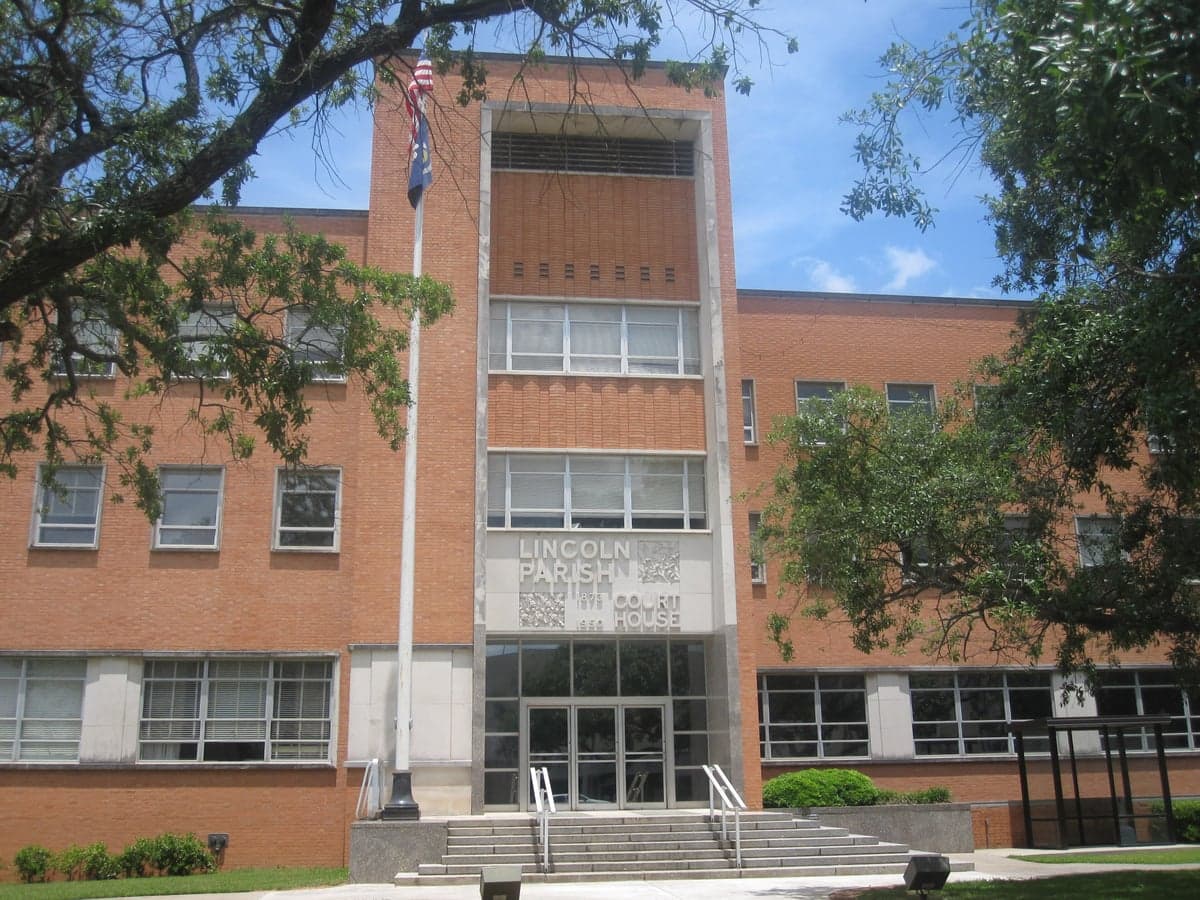
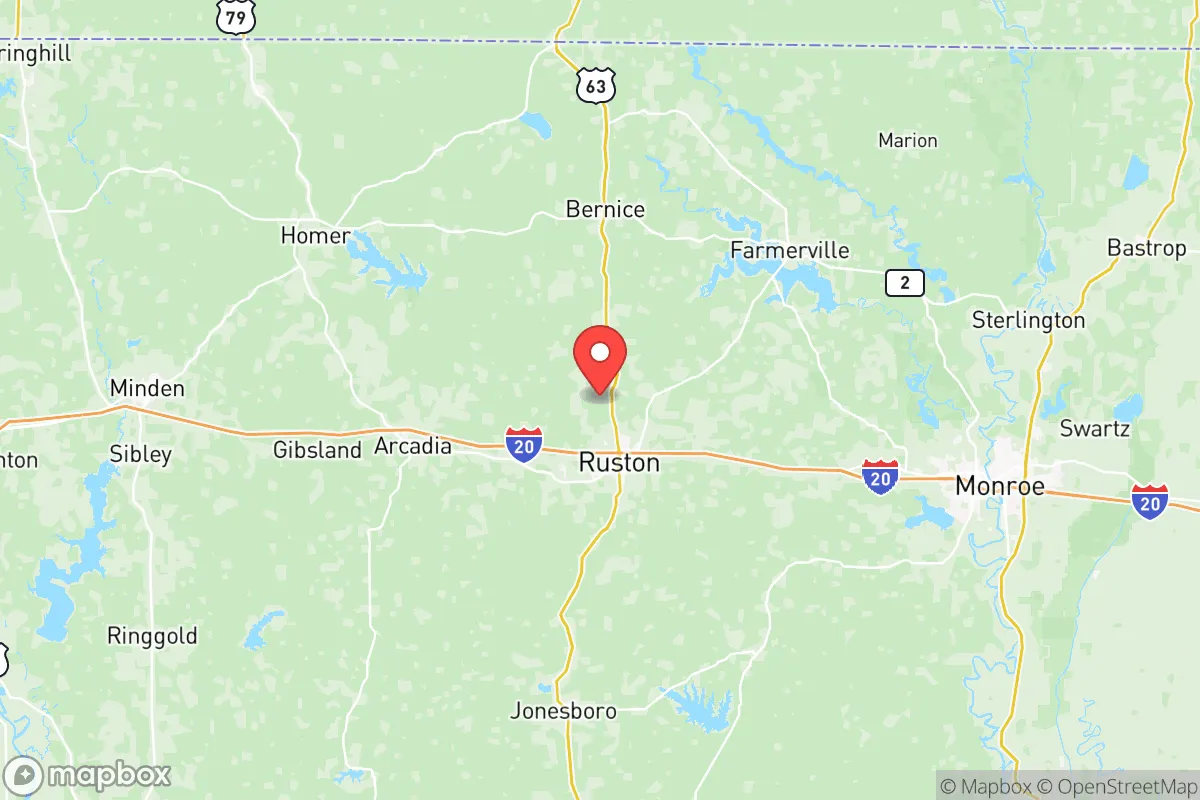
Photo: Wikipedia
Demographics of Lincoln County
Affluence Level in Lincoln County
A below-average socioeconomic profile. Incomes, home values, and educational attainment trail the U.S., with higher poverty and unemployment.
People of Lincoln County
The people of Lincoln Parish, Louisiana, today number roughly 48,160, forming a community defined by its deep-rooted biracial character and a strong institutional anchor in Ruston. The population is 52.5% White and 36.9% Black, with a very small foreign-born share of just 1.2%, reflecting a region shaped far more by centuries of domestic migration and settlement than by recent international immigration. This is a place where the historic Black and White populations have coexisted for generations, creating a distinctive cultural and social landscape centered around Louisiana Tech University, the piney hills of North Louisiana, and a network of small towns like Grambling, Dubach, and Simsboro.
Settlement & growth (pre-1960)
Long before European settlement, the area that is now Lincoln Parish was part of the homeland of the Caddo Confederacy, particularly the Adai and Doustioni peoples, who lived in settled agricultural villages along the region's waterways. French explorers and traders passed through in the late 1600s and early 1700s, but sustained European-American settlement did not begin in earnest until after the Louisiana Purchase in 1803. The land was part of the great piney woods belt of North Louisiana, and early settlers were primarily of Scots-Irish and English descent, moving into the area from the older Southern states of Georgia, the Carolinas, and Tennessee in the 1810s through the 1840s. They were drawn by the availability of cheap, fertile land for small-scale cotton farming and timber, establishing homesteads along the major creeks and the nascent trails that would become the towns of Vienna, Mount Zion, and the future parish seat of Ruston.
Lincoln Parish was officially created in 1873 from parts of Bienville, Claiborne, and Union Parishes, named in honor of President Abraham Lincoln during the Reconstruction era. The arrival of the Vicksburg, Shreveport and Texas Railroad in the 1880s was the transformative event, and the town of Ruston was founded as a railroad stop and quickly grew into the parish's commercial and population center. The railroad brought a wave of new settlers, including merchants, tradesmen, and a significant number of Black families moving within the South during the post-Reconstruction period, seeking economic opportunity and community in the growing railroad and timber economy. The founding of Louisiana Tech University (then Louisiana Industrial Institute) in 1894 anchored Ruston as an educational hub, drawing faculty and students from across the region and creating a stable, educated middle class that would define the town's character for the next century.
The early 20th century saw the timber industry boom, with vast stands of longleaf pine logged and milled in towns like Dubach, Simsboro, and Choudrant. This industry attracted a wave of rural White and Black laborers, creating a network of company towns and sawmill communities. The Great Depression hit the timber and cotton economy hard, but the presence of Louisiana Tech and the establishment of Grambling State University (originally the Colored Industrial and Agricultural School) in 1901 provided a crucial economic and social anchor for both races. Grambling, in particular, became a magnet for Black families across the South, growing into a nationally known center for Black higher education and a distinct community within the parish. By 1960, Lincoln Parish was a stable, biracial, rural-to-small-city society, with a population that was overwhelmingly native-born, Protestant, and deeply tied to the land, the university, and the timber industry.
Modern era (post-1965)
The post-1965 era in Lincoln Parish has been defined less by international immigration and more by the continuation of domestic migration patterns and the profound effects of the Civil Rights Movement. The foreign-born population remains minuscule at 1.2%, meaning the parish has been largely untouched by the waves of immigration from Latin America, Asia, and Africa that transformed much of the United States. Instead, the demographic story of the last 60 years has been one of suburbanization around Ruston, the growth of Louisiana Tech and Grambling State, and a gradual outmigration of younger, college-educated residents to larger metropolitan areas in Texas and the Southeast.
The most significant demographic shift has been the consolidation of the Black population in Ruston and Grambling, and the gradual diversification of Ruston's suburbs. Grambling remains a uniquely important community, a historically Black college town that continues to draw Black students and faculty from across the country, though its permanent population has declined slightly as younger graduates often leave for job markets in Dallas, Houston, and Atlanta. Ruston has grown steadily, annexing surrounding subdivisions and attracting new residents from other parts of Louisiana and the broader South, drawn by the university, the relatively low cost of living, and the area's reputation as a safe, family-oriented community. The White population has become more concentrated in the newer subdivisions on the south and west sides of Ruston, while older neighborhoods near downtown and the university have seen a more integrated pattern. The small towns of Dubach, Simsboro, and Choudrant have remained predominantly White and have seen population stagnation or slight decline as the timber industry has mechanized and young people have moved to Ruston or out of state.
The Hispanic population, while still small at 3.6%, has grown modestly since 2000, primarily through the arrival of families working in the poultry processing plants and construction industries in and around Ruston. This community is dispersed rather than concentrated in a single enclave, and has begun to establish small businesses and churches. The East/Southeast Asian population (0.9%) and Indian subcontinent population (0.4%) are almost entirely tied to Louisiana Tech, consisting of graduate students and faculty in engineering and the sciences, and they tend to live in Ruston near the university campus. The college-educated share of the population stands at 36.0%, a figure driven heavily by the two universities and significantly higher than the Louisiana state average, giving the parish a more educated and professional character than its rural neighbors.
The future
Lincoln Parish is likely to remain a stable, biracial community with a strong university presence, but it faces the demographic headwinds common to much of rural Louisiana: an aging population, outmigration of young adults, and slow overall growth. The population has hovered around 48,000 for the last two decades, and projections suggest it will remain near that level or decline slightly through 2040. The Hispanic and Asian populations will likely continue to grow slowly, driven by university recruitment and niche labor needs, but the parish will remain overwhelmingly native-born and biracial for the foreseeable future. The most dynamic growth will continue to be in Ruston's suburban fringe, particularly along the Interstate 20 corridor, where new housing developments and retail are attracting families from across the region. Grambling will likely see its permanent population continue to shrink as the town's economy remains tied to the university, but its cultural and historical significance will endure. Dubach, Simsboro, and Choudrant will likely continue their slow decline, becoming bedroom communities for Ruston and Monroe.
For someone moving to Lincoln Parish today, the area offers a distinctive blend of small-town Southern life, a strong university culture, and a deeply rooted biracial community that has navigated its history with a degree of stability uncommon in many parts of the South. The low crime rates, affordable housing, and access to higher education are genuine draws, but the limited economic diversity and slow population growth mean that career opportunities outside of education, healthcare, and local government are constrained. The parish is becoming more suburban and more educated, but it remains a place where the past is very much present, and where the character of the community is still defined by the generations of families who have lived there since the days of the railroad and the sawmill.

* Values derived from national, state, county, city and local statistics and may differ in a specific area. Last updated: 2026-07-20T16:30:40.000Z
Narrative content on this page is AI-generated and may contain mistakes. Verify any details that matter before acting on them.
ReloMaps may earn a commission from affiliate links at no extra cost to you.

