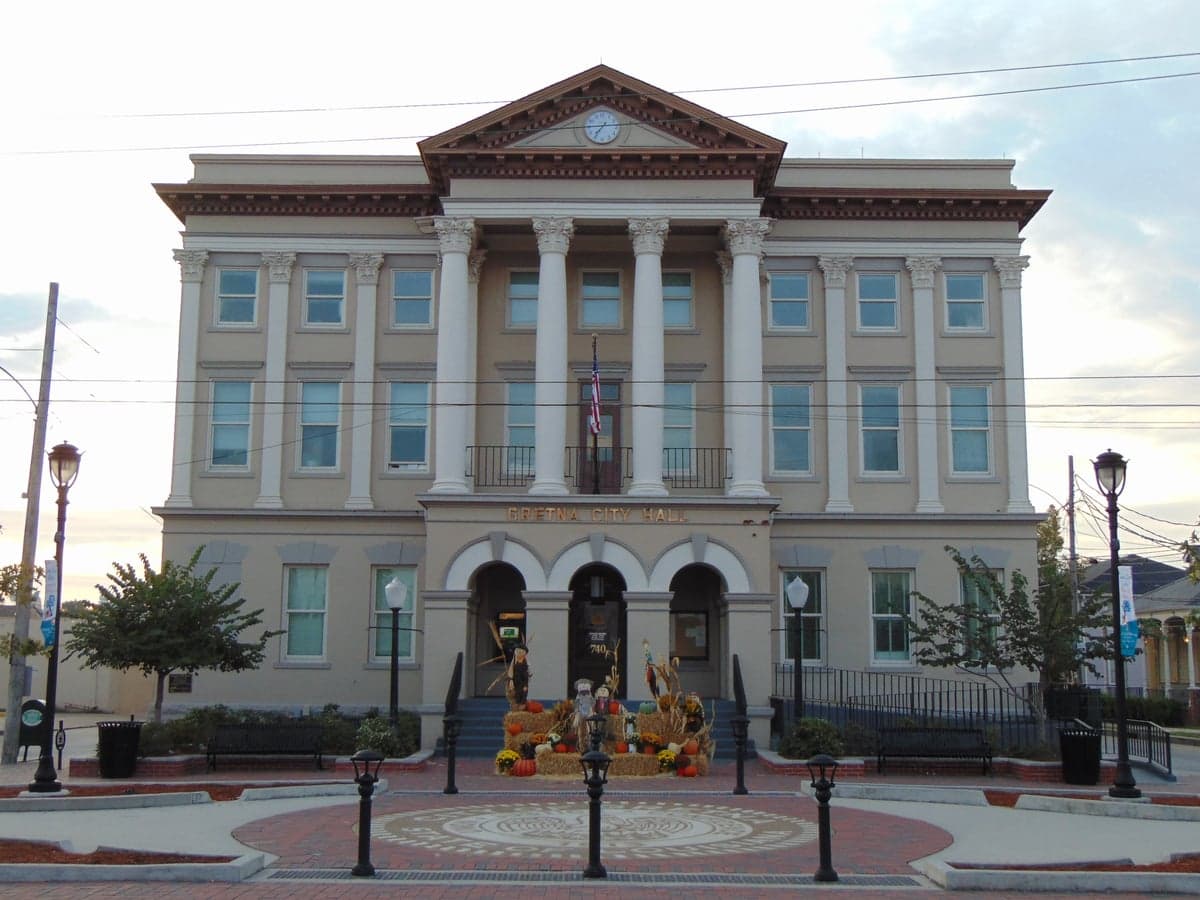
Photo: Wikipedia
Political ClimatePolitical Climate in Jefferson County
Showing district-level results — no local-only data available.
Local Political AnalysisPolitical Analysis of Jefferson County
Jefferson Parish, Louisiana, is a solidly conservative area with a Cook Partisan Voting Index (PVI) of R+19, meaning it votes about 19 points more Republican than the national average. That’s a significant step to the right of Louisiana as a whole, which sits at R+10, and it reflects a long-standing trend where the suburbs of New Orleans have become a Republican stronghold even as the state has drifted rightward. The shift has been gradual but steady—places like Metairie and Kenner, which were once more competitive, now reliably deliver double-digit margins for GOP candidates, while the parish’s more diverse and urbanized precincts in Gretna and Harvey still show some Democratic resistance.
How it compares
Compared to Louisiana’s statewide R+10, Jefferson Parish is nearly twice as Republican-leaning, which puts it in the same league as other deep-red suburban parishes like St. Tammany (R+22) but far to the right of Orleans Parish (D+30). The internal geography matters a lot here. The northern part of the parish—think Old Metairie, Lakeview, and the areas around Lakeside Shopping Center—is where the GOP machine is strongest, with precincts routinely hitting 70-80% Republican. In contrast, the West Bank communities like Gretna, Terrytown, and parts of Harvey have a more mixed electorate, with some precincts tipping Democratic, especially in lower-income and more racially diverse neighborhoods. The swing precincts are mostly in the central corridor around Elmwood and River Ridge, where moderate suburbanites and younger families can flip a race if turnout is high. Over the last decade, the parish has moved about 4-5 points to the right, driven by white flight from New Orleans and a growing population of conservative-leaning retirees and commuters.
What this means for residents
For conservative residents, Jefferson Parish is a comfortable place politically. Local offices—from the parish president to the school board—are dominated by Republicans, and the tax policies reflect that, with relatively low property taxes and a business-friendly environment. You’ll find plenty of GOP campaign signs in Metairie yards and conservative talk radio on in the diners. For liberal residents, it’s a different story. While you won’t face outright hostility, you’ll be in the minority, and progressive candidates rarely win parish-wide races. The Democratic strongholds in Gretna and Harvey do provide some representation, but those voices are often drowned out in parish council votes. The practical effect is that policy leans conservative on issues like zoning, law enforcement funding, and school choice, but the parish still maintains a pragmatic streak—Jefferson isn’t as ideologically rigid as some rural parishes, and there’s a live-and-let-live attitude in daily life.
One cultural distinction that sets Jefferson apart from the rest of Louisiana is its suburban identity. Unlike the rural Cajun country or the urban energy of New Orleans, Jefferson Parish is a commuter hub with strip malls, chain restaurants, and a heavy focus on family life and local sports leagues. The political climate here is less about culture war flashpoints and more about practical governance—keeping roads paved, schools decent, and taxes low. That’s why even in a deep-red area, you’ll see occasional crossover voting for moderate Democrats in local races, especially if they’re seen as competent. Looking ahead, the parish is likely to stay R+19 or even nudge rightward as the population ages and new subdivisions fill up with out-of-state transplants from other red states. But the West Bank’s growing diversity could slowly shift the balance in a decade or two, making Jefferson a place to watch for subtle political change.

State Political ClimatePolitical Climate in Louisiana
State Political AnalysisPolitical Environment in the State
Louisiana is a solidly Republican state with a Cook PVI of R+10, but calling it a simple red state misses the complex reality on the ground. For the last two decades, the state has shifted rightward in presidential elections — George W. Bush won it by 15 points in 2004, Donald Trump carried it by 19 in 2016 and 2020, and the trend held in 2024 — but this top-line number masks a deep cultural and geographic split between the reliably Democratic, majority-Black urban crescent and the overwhelmingly conservative, white rural and suburban parishes. The dominant coalition is a fusion of evangelical Protestants, Cajun and rural conservatives, and business interests, held together by a shared skepticism of federal overreach and a fierce attachment to local control. For a relocator, the practical takeaway is that your day-to-day political experience will vary enormously depending on whether you land in New Orleans, Baton Rouge, Lafayette, or a small town like Minden or Ville Platte.
Urban vs. rural divide
The political map of Louisiana is essentially a story of two Louisianas. The urban core — New Orleans (Orleans Parish) and its inner suburbs, plus Baton Rouge (East Baton Rouge Parish) — vote reliably Democratic. In 2020, Joe Biden won Orleans Parish with 83% of the vote, making it one of the most Democratic urban counties in the South. Baton Rouge, home to Louisiana State University and a large Black professional class, went 54% for Biden. Shreveport (Caddo Parish) in the northwest is another Democratic stronghold, voting 58% for Biden, driven by its majority-Black population and unionized industrial base. Meanwhile, the rest of the state is deeply Republican. The Acadiana region — Lafayette and surrounding parishes like St. Landry, Vermilion, and Acadia — is culturally conservative and reliably red; Lafayette Parish itself went 62% for Trump. The Florida Parishes north of Lake Pontchartrain, including Livingston Parish (75% Trump) and St. Tammany Parish (68% Trump), are among the most Republican areas in the entire Gulf South. The rural northeast, around Monroe (Ouachita Parish) and Alexandria (Rapides Parish), also leans heavily red. The key suburban battlegrounds are places like Jefferson Parish (the suburbs between New Orleans and the airport), which voted 54% for Trump in 2020 — a bellwether that has shifted right over the last decade as white working-class voters there abandoned the Democratic Party.
Policy environment
Louisiana's policy posture is broadly conservative, but with a populist and often pragmatic bent. The state has no state income tax on corporate income (phased out in recent years) and a flat 3% individual income tax rate as of 2025, following a series of tax reforms that lowered rates and broadened the base. Sales taxes are high — the average combined state and local rate is around 9.5%, among the highest in the nation — which means the tax burden falls disproportionately on consumption rather than income. Property taxes are relatively low, with a homestead exemption that shields the first $75,000 of a home's value from parish property taxes. Education policy is a mixed bag: Louisiana has a robust school choice landscape, including a statewide voucher program (the Louisiana Scholarship Program) and a growing charter school sector, especially in New Orleans, which is now almost entirely a charter district. However, public school performance metrics remain near the bottom nationally. Healthcare policy is defined by the state's decision to expand Medicaid under the Affordable Care Act in 2016 — a move made by a Democratic governor (John Bel Edwards) that was opposed by the Republican legislature but has since become entrenched. Election laws are moderately restrictive: the state requires a photo ID to vote, has no-excuse absentee voting, and recently implemented stricter signature verification rules. There is no ballot initiative process in Louisiana, meaning all policy changes go through the legislature — a feature that insulates the state from the kind of direct-democracy battles seen in places like California or Florida.
Recent policy direction
Over the last five years, Louisiana has moved decisively right on a range of cultural and economic issues. In 2024, the legislature passed a near-total abortion ban with no exceptions for rape or incest, triggered by the Dobbs decision, and Governor Jeff Landry signed it into law. On gun rights, Louisiana is a constitutional carry state (permitless carry for adults 18 and older) since 2021, and the legislature has repeatedly rejected red-flag law proposals. On education and parental rights, the state passed the "Parents' Bill of Rights" in 2023, requiring schools to notify parents of curriculum changes and medical services, and in 2024 banned classroom instruction on sexual orientation and gender identity through 12th grade (the "Don't Say Gay" law). On property rights, Louisiana remains a stronghold of mineral rights protection — surface owners have limited power to block oil and gas drilling on their land if the mineral rights are severed, a feature that matters enormously in rural parishes. On taxation, the trend is toward lower income taxes and higher consumption taxes; the 2024 tax reform package cut the individual rate from 4.25% to 3% and eliminated the corporate franchise tax. On voting and ballot access, the state has tightened rules around absentee ballot drop boxes and signature verification, but has not gone as far as Georgia or Texas in restricting early voting hours. On privacy and surveillance, Louisiana has no comprehensive state data privacy law, though a bill is pending in the 2025 session. The overall direction is toward a more culturally conservative, low-income-tax, high-sales-tax model that prioritizes energy production and school choice.
Civil unrest & political movements
Louisiana has a long history of political turbulence, but in recent years the flashpoints have been more localized than statewide. The 2020 Black Lives Matter protests in Baton Rouge and New Orleans were large and occasionally violent, particularly after the killing of Alton Sterling in 2016 and the police killing of Ronald Greene in 2019 (whose death was covered up for years). These events galvanized a progressive activist movement in the urban core, but also hardened conservative backlash in the suburbs and rural areas. Immigration politics are less heated here than in border states — Louisiana has a relatively small foreign-born population (about 4%), and the state has no sanctuary city policies; in fact, the legislature passed a law in 2024 requiring local law enforcement to cooperate with ICE detainers. Secession and nullification rhetoric is present but marginal; a "Louisiana secession" bill was introduced in 2021 but went nowhere. Election integrity controversies flared after 2020, with Republican legislators pushing for a forensic audit of the 2020 election results in the state (which Trump won easily), but no major irregularities were found. The most visible political flashpoint for a new resident would likely be the coastal erosion and climate adaptation debate — a deeply polarizing issue that pits the oil-and-gas industry (which funds much of the state's budget) against environmental advocates and coastal communities losing land at the rate of a football field per hour. This is not a left-right issue in the usual sense; many coastal parishes are heavily Republican but also support litigation against oil companies for wetland damage.
Projection
Over the next 5-10 years, Louisiana is likely to become more Republican at the state level, but the urban-rural divide will widen. Demographic trends favor the GOP: the state's population is aging, white, and increasingly concentrated in the exurban and rural parishes that vote red, while the Democratic-leaning urban cores of New Orleans and Baton Rouge are losing population (New Orleans has shrunk by about 15% since Hurricane Katrina). In-migration is modest and tends to come from other Southern states, reinforcing the conservative tilt. The biggest wildcard is the coastal crisis: as more land is lost and insurance costs skyrocket, the state's fiscal model — heavily dependent on oil-and-gas revenue and property taxes — could come under severe strain, potentially forcing a realignment of priorities. A relocator moving in now should expect a state that remains culturally conservative, with low income taxes and high sales taxes, a robust school choice system, and a political culture that values local control and resists federal mandates. The Democratic Party will remain competitive only in the urban crescent and a few majority-Black rural parishes; statewide, Republicans will likely hold a supermajority in the legislature for the foreseeable future.
For a new resident, the bottom line is straightforward: if you are a conservative, you will find Louisiana's political climate broadly welcoming, with policy aligned on guns, taxes, education, and abortion. If you are a liberal, you will find a state where your vote matters most in local elections in New Orleans, Baton Rouge, or Shreveport, but where state-level policy will consistently run against your preferences. The practical reality is that Louisiana is a place where politics is deeply personal and local — your parish government, your school board, and your sheriff matter more than the governor or the legislature in your daily life. The state's political culture is less about ideological purity and more about relationships, patronage, and a certain live-and-let-live attitude that can surprise newcomers. Just know that the "live and let live" has limits, and they are increasingly defined by the cultural conservatism of the legislature and the governor's office.
* Values derived from national, state, county, city and local statistics and may differ in a specific area. Last updated: 2026-06-17T14:32:28.000Z
Narrative content on this page is AI-generated and may contain mistakes. Verify any details that matter before acting on them.
ReloMaps may earn a commission from affiliate links at no extra cost to you.

