Political ClimatePolitical Climate in Lexington Fayette Urban County, KY
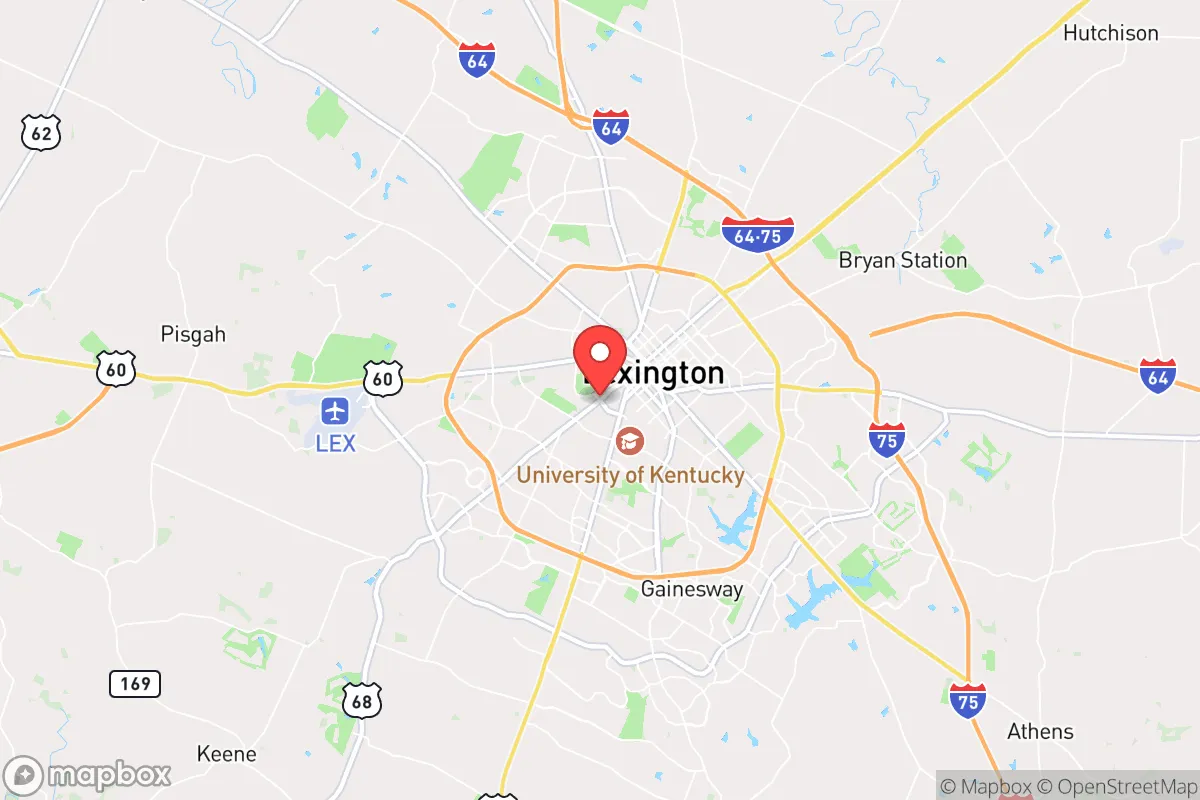
District shown is the primary district for this city’s centroid. Cities may span multiple districts.
Local Political AnalysisPolitical Analysis of Lexington Fayette Urban County, KY
Lexington Fayette Urban County is a distinct blue dot in a deeply red state. While Kentucky as a whole carries a Cook PVI of R+15, Lexington’s PVI of R+7 reflects a county that leans Republican but is far more competitive than the rest of the state. In practice, this means the city has voted for Democratic presidential candidates in recent cycles (Biden won Fayette County by about 10 points in 2020), while statewide offices like governor and senator often go Republican by narrower margins here than in rural counties. The trajectory is toward a slow but steady Democratic lean, driven by the University of Kentucky’s influence, a growing professional class, and an influx of younger residents from out of state.
How it compares
Drive 30 minutes south to Nicholasville in Jessamine County, and you’ll find a PVI of R+20—a world away politically. Head east to Winchester (Clark County, R+18) or west to Frankfort (Franklin County, R+9), and the contrast is stark. Lexington is the only urban county in Kentucky that consistently votes blue in presidential races; Louisville (Jefferson County) is more purple but still leans Democratic. The state’s R+15 rating means that outside of Lexington and Louisville, most counties vote Republican by 20 to 40 points. This makes Lexington a political island where local elections often hinge on moderate Republican versus Democrat, while statewide candidates must tack hard right to win rural votes. The city’s Democratic lean is about 8 points bluer than the state average, but still 7 points redder than the national average—so it’s not a progressive stronghold by any means.
What this means for residents
For conservative residents, Lexington offers a rare chance to live in a city where your vote actually matters in local races—unlike in deep-red rural counties where primaries decide everything. You’ll find plenty of Republican neighbors, especially in the suburbs like Hamburg or near Keeneland, and the county’s GOP apparatus is well-organized. For liberal residents, the city provides a bubble where progressive policies on housing, transit, and climate are debated seriously, even if they rarely pass. The Urban County Council has a Democratic majority, but it’s a moderate one—think zoning reforms and bike lanes, not defunding police. In practice, this means both sides can find community: conservatives at church or the horse park, liberals at the farmers’ market or UK campus. The real tension is between Lexington and the state legislature in Frankfort, which often preempts local ordinances on things like minimum wage or nondiscrimination—a constant source of frustration for city leaders.
Culturally, Lexington stands apart from the rest of Kentucky in its embrace of the “urban” part of its name. You’ll see more electric cars, more craft breweries, and more out-of-state license plates than in surrounding towns. The horse industry is a rare unifier—both conservatives and liberals love the Derby and Keeneland sales—but on social issues like LGBTQ rights or marijuana, the city is notably more permissive than the state at large. The local paper, the Herald-Leader, leans center-left, while statewide outlets like the Courier Journal are more balanced. If you’re moving here, expect to navigate a place where your neighbors might disagree on politics but will still wave at you at the grocery store—it’s that classic Kentucky politeness, even when the yard signs clash.

State Political ClimatePolitical Climate in Kentucky
State Political AnalysisPolitical Environment in the State
Kentucky is a deeply Republican state with a Cook PVI of R+15, meaning it votes about 15 points more Republican than the national average in presidential elections. The state has shifted sharply rightward over the past 20 years: in 2000, Kentucky was a competitive swing state that went for George W. Bush by just 4 points, but by 2024, Donald Trump carried it by over 30 points. The dominant coalition is a mix of rural and exurban conservatives, working-class voters in manufacturing and coal country, and a growing number of suburban Republicans in the Louisville and Lexington metros. Democrats still hold some local offices in urban centers and a handful of ancestral Democratic strongholds in the eastern coalfields, but statewide, the GOP controls every constitutional office, both U.S. Senate seats, and supermajorities in the state legislature.
Urban vs. rural divide
The political map of Kentucky is a textbook example of the urban-rural split. Louisville (Jefferson County) and Lexington (Fayette County) are the only reliably Democratic metros, with Louisville voting about 15 points more Democratic than the state average and Lexington about 10 points. These cities are home to the University of Kentucky, the state's largest hospital systems, and a growing professional class. Northern Kentucky — the suburban Cincinnati counties of Boone, Kenton, and Campbell — has shifted from purple to solid red over the last decade, driven by an influx of families from Ohio and Indiana. Bowling Green, home to Western Kentucky University and a large immigrant community, is a rare swing area that has trended Republican in recent cycles. The rest of the state — from the Jackson Purchase in the west to the Appalachian coalfields in the east — votes overwhelmingly Republican. Pike County in the east, once a Democratic stronghold due to unionized coal miners, flipped hard to Trump and now votes R+50 or more. Owensboro and Paducah are reliably red, with local politics dominated by chamber-of-commerce conservatism.
Policy environment
Kentucky's policy environment is conservative but pragmatic. The state has a flat income tax that is being phased down from 5% to 4% by 2026, with a goal of elimination. Property taxes are low, and there is no tax on Social Security benefits. The regulatory posture is business-friendly, with right-to-work laws and tort reform caps on damages. Education policy is a flashpoint: the state has a robust school choice movement, with charter schools legalized in 2022 (though none have opened yet) and a growing number of private school scholarship tax credits. Healthcare is a mixed bag: Kentucky expanded Medicaid under the Affordable Care Act, covering over 400,000 residents, but the state has also imposed work requirements and premiums for some enrollees. Election laws are moderately restrictive: voters must show photo ID, early voting is limited to three days before an election (plus a few additional days for primaries), and no-excuse absentee voting was repealed after the pandemic. The state has a Republican supermajority that can override gubernatorial vetoes, which it did frequently during the term of Democratic Governor Andy Beshear (2019–present).
Recent policy direction
Kentucky's recent legislative sessions have moved decisively rightward on a broad range of issues. On gun and self-defense law, the state passed constitutional carry in 2019, allowing permitless concealed carry, and has preempted nearly all local gun ordinances. Parental and education rights saw a major push in 2022 with the "Parents' Bill of Rights" (SB 138), which requires schools to notify parents about curriculum changes and prohibits instruction on sexual orientation or gender identity in elementary grades. Speech protections are strong, with no hate speech laws and a campus free speech law passed in 2018. Privacy and surveillance are less protected: Kentucky has no statewide ban on facial recognition by police, and the state has a robust license plate reader network. Medical and bodily autonomy is sharply restricted: abortion is banned with no exceptions for rape or incest, only for life-threatening conditions. Property rights are generally strong, with no statewide rent control and limited eminent domain use, though the state has seen controversy over natural gas pipeline easements. Taxation is trending downward, with the flat tax phase-down and a 2024 law exempting military pensions from state income tax. Voting and ballot access tightened in 2021 with the repeal of no-excuse absentee voting and the addition of stricter voter ID requirements.
Civil unrest & political movements
Kentucky has a history of political activism on both sides. The 2020 racial justice protests in Louisville following the death of Breonna Taylor were among the largest in the country, drawing national attention and resulting in the passage of "Breonna's Law" banning no-knock warrants. The state has a small but active liberty movement centered around the Kentucky Freedom Coalition, which pushes for lower taxes and gun rights. Immigration politics are relatively low-key compared to border states, but there have been flashpoints in Louisville and Bowling Green over sanctuary city proposals, which were preemptively banned by state law in 2019. Election integrity controversies flared after 2020, with Republican legislators passing a series of bills to tighten voting procedures, though no major fraud was found. Secession or nullification rhetoric is rare but occasionally surfaces in Appalachian counties frustrated with federal environmental regulations on coal mining. A new resident would notice that political signs and flags are common in rural areas, but in Louisville and Lexington, the atmosphere is more mixed and generally tolerant of diverse viewpoints.
Projection
Over the next 5-10 years, Kentucky is likely to become even more Republican at the state level, but with a growing urban-liberal counterweight. In-migration is modest compared to Sun Belt states, but the people moving in tend to be retirees from the Midwest and younger professionals drawn to Louisville and Lexington's lower cost of living. The Democratic Party's base is shrinking in rural areas as older ancestral Democrats die off, and the party is becoming increasingly concentrated in the two major cities and a few college towns like Richmond (Eastern Kentucky University) and Murray (Murray State University). The state's flat tax phase-down and business-friendly posture will likely continue, but education funding and healthcare access will remain contentious. A new resident moving in now should expect a state that is culturally conservative, with low taxes and limited government services, but with a vibrant urban minority that pushes back on social issues. The political climate is stable and predictable — no one is expecting a sudden flip — but the cultural divide between Louisville and the rest of the state will likely widen.
For a new resident, the bottom line is this: if you are conservative, you will find Kentucky deeply aligned with your values on taxes, guns, and social policy. If you are liberal, you will find a welcoming community in Louisville or Lexington, but you will have little political power at the state level and will need to accept that state law will often conflict with your preferences. The state offers a low cost of living, a relatively safe environment, and a slower pace of life, but the trade-off is a government that is ideologically committed to limited public services and traditional social norms. Know what you're signing up for, and you'll be fine.
* Values derived from national, state, county, city and local statistics and may differ in a specific area. Last updated: 2026-06-22T21:16:39.000Z
Narrative content on this page is AI-generated and may contain mistakes. Verify any details that matter before acting on them.
ReloMaps may earn a commission from affiliate links at no extra cost to you.

