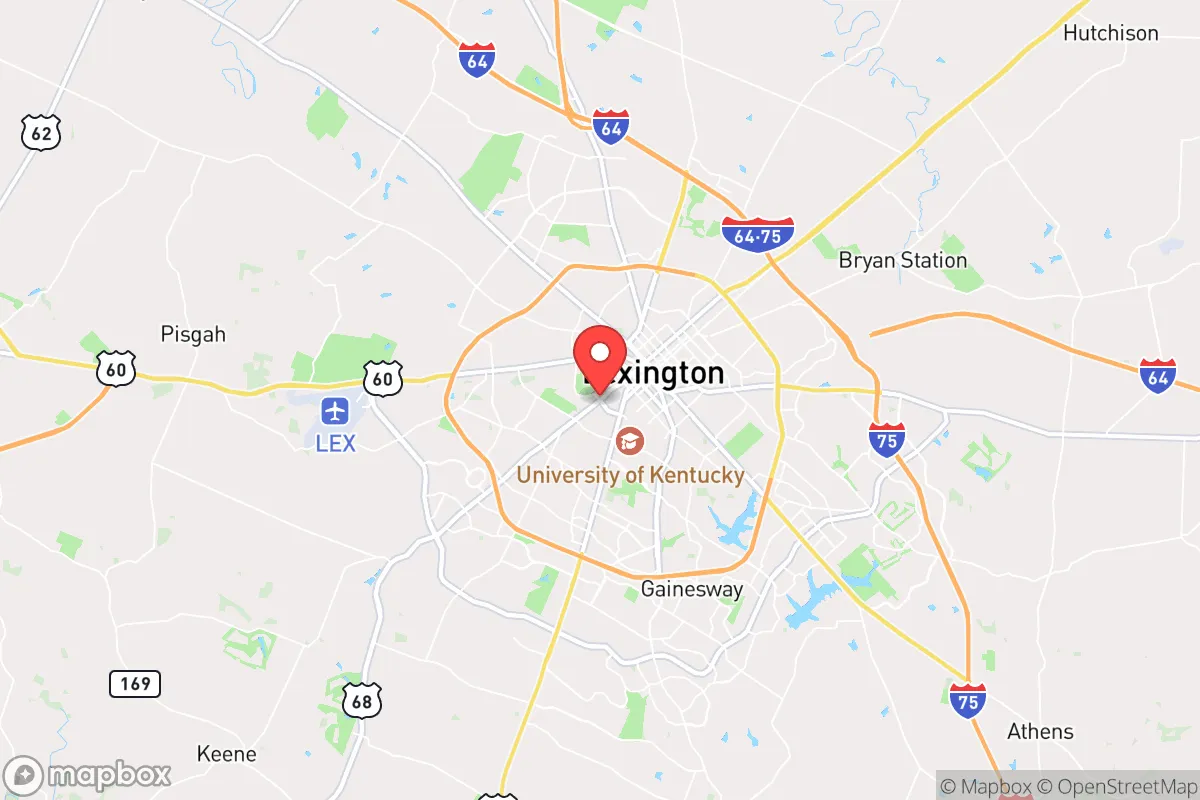
Personal Sovereignty in Lexington Fayette Urban County, KY
Viable for self-reliance. Generally workable, though some barriers may limit total independence.
What does Personal Sovereignty tell us?
Personal Sovereignty measures your capacity for self-reliance and independence with minimal government friction. Higher scores mean fewer barriers between you and the way you want to live... but it assumes you have the space you need and good neighbors.
What does this tell us?
Personal Sovereignty measures your capacity for self-reliance and independence with minimal government friction. Higher scores mean fewer barriers between you and the way you want to live... but it assumes you have the space you need and good neighbors.
State Policy
Energy independence: Importer (60% of energy produced in-state)
Personal Liberty
Homesteading

Personal Liberty Analysis
Lexington-Fayette Urban County Government operates under a unique consolidated city-county structure that creates a distinctly mixed environment for personal sovereignty. While Kentucky generally maintains a light-touch regulatory posture compared to coastal states, Lexington’s urban governance layer adds meaningful constraints on individual autonomy that residents must navigate carefully. The area offers strong protections for self-defense and property rights at the state level, but local zoning codes and tax policies impose real limits on self-reliance and off-grid living that differ sharply from rural Kentucky counties just 30 minutes away.
Tax burden and regulatory posture: how heavy is the hand of local government?
Kentucky’s overall tax burden ranks near the middle nationally, but Lexington adds significant local impositions. The state income tax is a flat 4.5% (2025 rate, down from 5% in 2023), with a scheduled phase-down to 4% by 2026 under bipartisan legislation. Property taxes in Fayette County run approximately $0.82 per $100 of assessed value for the general fund, plus school and special district levies that push the effective rate to roughly $1.20–$1.40. This is notably higher than surrounding counties like Jessamine ($0.68) or Woodford ($0.72). Lexington also imposes a 2.25% occupational license fee on gross wages earned within the urban county—a tax that applies even if you live outside city limits but work inside. For a household earning $80,000, that’s $1,800 annually in local wage tax alone, a burden absent in most Kentucky counties. Regulatory posture is moderate: building permits are required for most structural work, with typical review times of 2–4 weeks for residential additions. The urban county government enforces a stormwater utility fee ($4.50/month per equivalent residential unit) and maintains a rental inspection program for multi-unit properties. Business licensing is straightforward—a $100 annual fee for most home-based operations—but home occupation permits restrict customer traffic and signage. Overall, Lexington’s tax and regulatory environment is heavier than rural Kentucky but lighter than comparable Midwestern cities like Columbus or Nashville.
Self-defense and gun law specifics: what can you legally carry and where?
Kentucky is a constitutional carry state since 2019, meaning no permit is required to carry a concealed firearm for anyone 21 or older who can legally possess a firearm. Lexington-Fayette Urban County cannot preempt state firearms law, so local ordinances banning open carry or imposing magazine capacity limits are invalid. However, the city enforces no-gun zones in government buildings, public parks during school hours, and within 1,000 feet of school property under federal law. Stand-your-ground protections are codified in Kentucky Revised Statutes §503.055, with no duty to retreat in any place where a person has a right to be. Castle doctrine applies to occupied vehicles and workplaces, not just dwellings. The state issues concealed carry permits (optional, but useful for reciprocity in 37 other states) through the county sheriff’s office; Fayette County processes applications within 30–45 days, with a $60 fee and mandatory 8-hour training course. Private property owners may prohibit firearms with conspicuous signage, and this is common at UK HealthCare facilities and some downtown bars. For long guns, no registration or waiting period exists; private sales between individuals require no background check. The practical effect: Lexington residents enjoy broad self-defense rights comparable to rural Kentucky, but encounter more posted restrictions in commercial and institutional settings. The Fayette County Sheriff’s Office reports approximately 4,500 active concealed carry permits as of 2025, representing about 3% of the adult population—lower than the state average of 6%, reflecting the urban environment’s cultural norms.
Self-reliance and homesteading viability: lot sizes, zoning, and off-grid feasibility
Lexington’s urban growth boundary (UGB), established in 1958 and strictly enforced, severely limits homesteading and self-reliance options within the urban county. Minimum lot sizes in the Rural Service Area (outside the UGB) are 10 acres, but these parcels are increasingly rare and expensive—averaging $15,000–$25,000 per acre in 2025. Inside the UGB, standard residential lots range from 0.15 to 0.5 acres, with no zoning allowance for livestock (chickens are permitted only in the Rural Service Area, and beekeeping requires a $50 permit with neighbor notification). Off-grid living is effectively illegal: all dwellings must connect to municipal water and sewer within the UGB, and the building code requires grid-tied electrical service for new construction. Rainwater collection is permitted but limited to 500 gallons of storage without a permit, and solar panels require building department approval with structural engineering sign-off. Composting toilets are not allowed as primary sanitation. For those willing to live 20–30 minutes outside Lexington, adjacent counties like Jessamine, Woodford, and Bourbon offer dramatically different conditions: 1–5 acre lots under $10,000 per acre, no building permit for agricultural structures under 1,000 square feet, and full allowance for chickens, goats, and small-scale farming. The Fayette County Cooperative Extension Service reports that only 12% of county land is in agricultural production, down from 18% in 2010, reflecting steady conversion to suburban development. For a reader prioritizing self-reliance, Lexington proper is a poor fit; the surrounding rural counties are far more viable for homesteading, with the trade-off of longer commutes and fewer urban amenities.
Personal liberties: parental rights, medical autonomy, speech, and property
Kentucky law provides strong protections for parental rights under KRS §158.183, which requires school districts to notify parents of any curriculum changes involving human sexuality or family life and allows opt-outs. Lexington’s Fayette County Public Schools have been a flashpoint: the district’s “Family Life and Human Sexuality” curriculum requires parental opt-in (not opt-out) for grades 4–12, and the school board has resisted state-level transparency mandates, leading to ongoing litigation. Medical autonomy is mixed: Kentucky bans nearly all abortions (trigger law effective 2022, with no exceptions for rape or incest), and the state requires parental consent for minors seeking any medical treatment. However, Lexington has a needle exchange program and a municipal ID program for undocumented residents, both opposed by state legislators. Vaccine mandates are prohibited for public school attendance under 2023 state law, and COVID-19 vaccine mandates for employment were banned in 2024. Free speech protections are robust: Lexington’s public forums (Triangle Park, Courthouse Plaza) require only a $25 permit for amplified sound, and the city has not attempted to restrict political signage on private property beyond standard size limits (6 square feet per sign). Property rights are generally strong, but the urban county’s historic preservation ordinance affects roughly 4,000 parcels in designated districts, requiring approval from the Board of Architectural Review for exterior changes—a constraint that can delay renovations by 60–90 days. Eminent domain is rarely used for private development; the last major case was the 2018 expansion of the Lexington Convention Center. Overall, personal liberties in Lexington are strongest in speech and parental rights, moderate in property rights (with preservation overlay), and weakest in medical autonomy due to state-level restrictions that are popular among conservative residents.
Compared to other areas of the country, Lexington-Fayette Urban County offers a moderate-to-high level of personal sovereignty for a city of its size (population ~325,000). The state’s constitutional carry law, flat income tax, and parental rights protections place it well ahead of blue-state metros like Portland or Denver. However, the urban county’s zoning restrictions, occupational tax, and preservation ordinances create a noticeably heavier hand than rural Kentucky or neighboring states like Tennessee (which has no income tax and weaker zoning). For a conservative-leaning reader who values self-reliance and minimal government, Lexington is a compromise: you get strong Second Amendment rights and school choice (the state’s charter school law passed in 2022, though no charters yet operate in Fayette County), but you trade away homesteading feasibility and face a local tax burden that funds urban services. The sweet spot for maximum personal sovereignty is likely a rural property in Jessamine or Woodford County, with Lexington as a job and amenity hub—a pattern many local conservatives already follow.

* Values derived from national, state, county, city and local statistics and may differ in a specific area. Last updated: 2026-06-22T21:16:39.000Z
Narrative content on this page is AI-generated and may contain mistakes. Verify any details that matter before acting on them.
ReloMaps may earn a commission from affiliate links at no extra cost to you.

