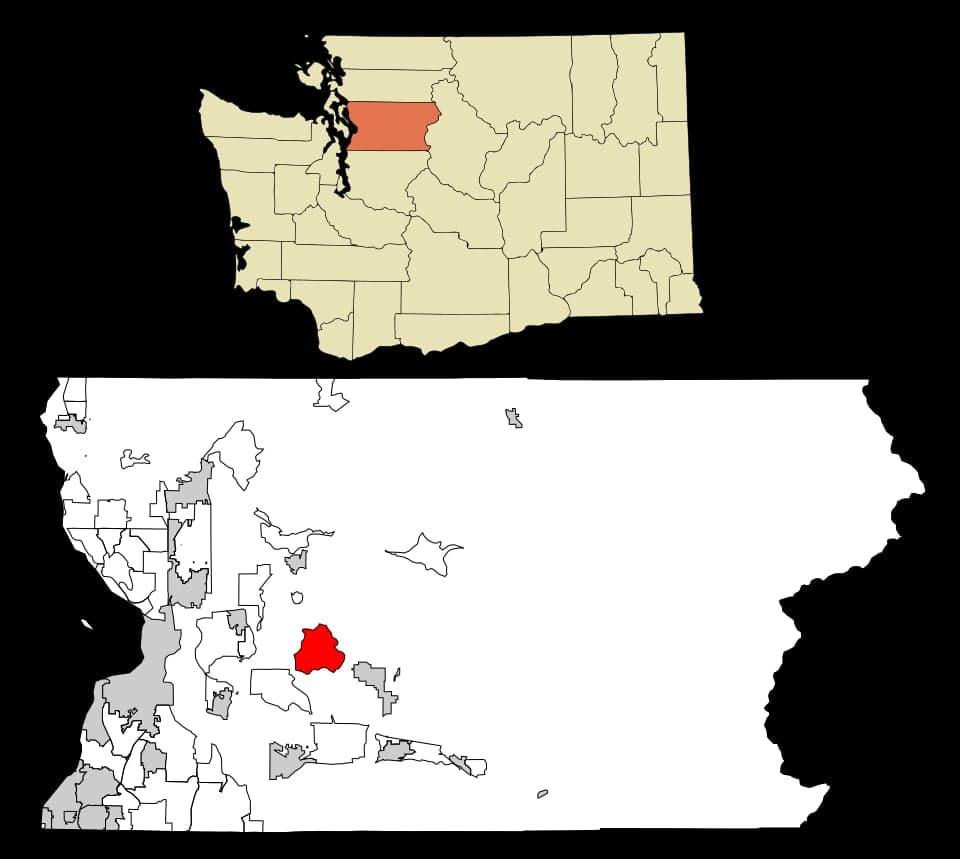
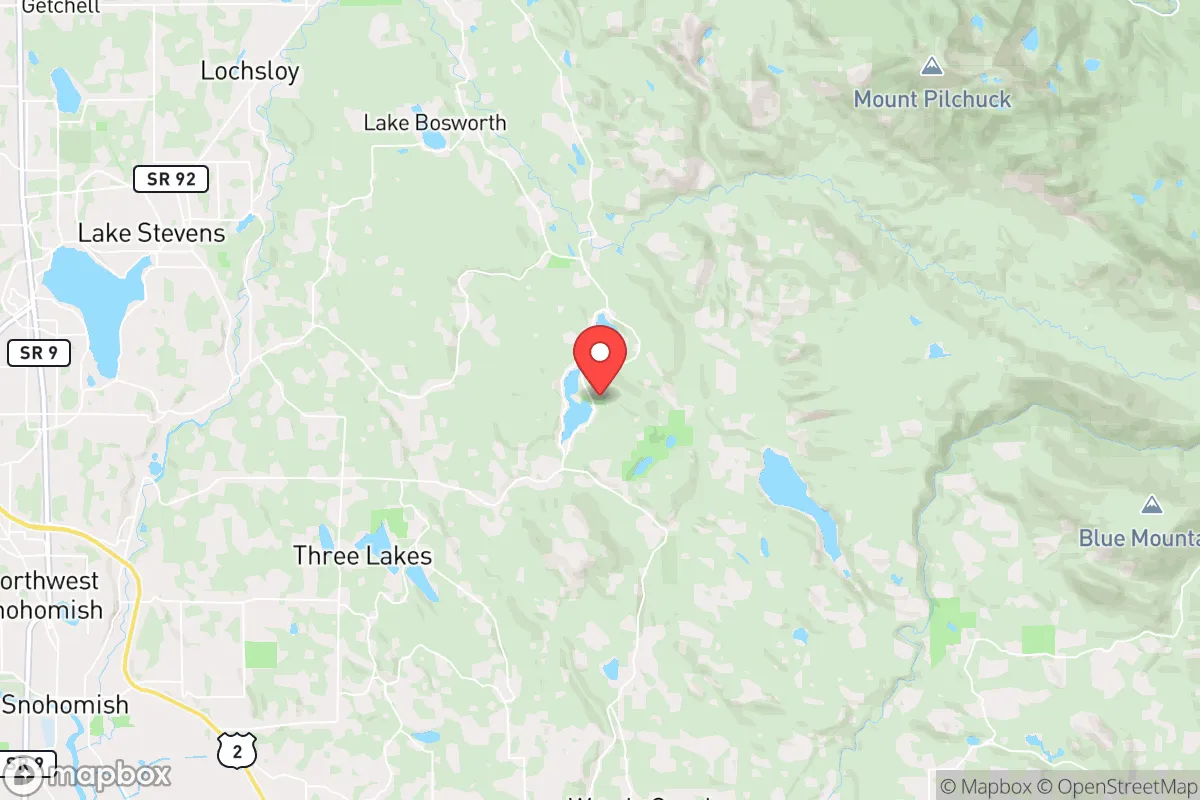
Photo: Wikipedia
Political ClimatePolitical Climate in Lake Roesiger, WA
District shown is the primary district for this city’s centroid. Cities may span multiple districts.
Local Political AnalysisPolitical Analysis of Lake Roesiger, WA
Lake Roesiger leans Democratic, with a Cook PVI of D+3, making it a reliably blue pocket in a state that has trended leftward for decades. The area has shifted steadily from its more independent roots, driven by an influx of remote workers and retirees from the Seattle metro who value the lakefront lifestyle but bring urban voting patterns. While you won't see the same intensity as in downtown Seattle, local precincts consistently deliver Democratic margins of 5-8 points in statewide races, a trend that has solidified since the 2016 election.
How it compares
Compared to the broader state of Washington—which has a Cook PVI of D+8—Lake Roesiger is slightly less Democratic, but still firmly in blue territory. The key difference is the surrounding context: the lake sits in Snohomish County, a Democratic stronghold, but it's bordered by more conservative areas like Granite Falls and Arlington to the north and east. Those towns lean Republican by 10-15 points in local elections, creating a visible political contrast within a 15-minute drive. In Lake Roesiger itself, you'll find a mix of longtime residents who vote split-ticket and newer arrivals who are reliably Democratic, giving the area a more moderate feel than the county's urban core. The state as a whole is shaped by King County's massive Democratic turnout, but Lake Roesiger's smaller, more rural setting means local issues—like lake access, septic regulations, and timber management—often override party loyalty in local races.
What this means for residents
For conservative residents, Lake Roesiger is a place where you can live without feeling politically isolated, but you'll be in the minority in most local elections. You'll find plenty of neighbors who share your views on property rights and gun ownership, but you'll lose most county-level races by a 55-45 margin. For liberal residents, the area offers a comfortable baseline—your candidates usually win—but you'll encounter more pushback on issues like growth restrictions and environmental regulations than you would in Seattle. The practical effect is that local governance tends toward compromise: the county council, which controls land-use decisions, often splits along party lines, but the lake's unique geography (it's a small, unincorporated community) means most decisions are handled at the county level, where the Democratic majority sets policy. You'll see more attention to water quality and shoreline management than in conservative areas, but less aggressive housing or transit initiatives than in urban centers.
Culturally, Lake Roesiger feels like a blue-collar lake community with a progressive overlay. The local general store and boat launch are where you'll hear conversations about both fishing regulations and climate policy, often in the same breath. The area has resisted the kind of partisan polarization seen in other parts of Snohomish County—neighbors tend to know each other by name, not party affiliation. That said, the trajectory is clear: as more people move from the I-5 corridor for the lake lifestyle, the Democratic lean will likely strengthen, pushing the area closer to the state's D+8 average over the next decade. For now, it's a place where you can own a boat and a Biden yard sign without either feeling out of place.

State Political ClimatePolitical Climate in Washington
State Political AnalysisPolitical Environment in the State
Washington state has been a reliably Democratic stronghold for over a decade, but its political reality is far more complex than a simple blue label. The state hasn't voted for a Republican presidential candidate since 1984, and Democrats currently hold all statewide executive offices and both U.S. Senate seats. However, this dominance is almost entirely driven by King County (Seattle) and a handful of other urban centers, while vast swaths of eastern and central Washington vote as red as any state in the South. The last 20 years have seen a steady leftward drift in state policy, accelerated by tech-industry in-migration and a growing activist base in the Puget Sound region, but that same period has also hardened a deep rural conservative identity that shows no signs of fading.
Urban vs. rural divide
If you draw a line roughly along the Cascade Range, you get two different Washingtons. West of the Cascades, the I-5 corridor from Vancouver through Portland-adjacent areas, Olympia, Tacoma, Seattle, and up to Everett and Bellingham is the engine of Democratic power. King County alone casts about 30% of the state's vote and routinely delivers margins of 70-80% for Democrats. Pierce County (Tacoma) has been trending blue but remains more competitive, while Snohomish County (Everett) is now solidly Democratic. East of the Cascades, the story flips. Spokane County, once a Republican stronghold, has become a swing county — it voted for Trump in 2020 but by a much narrower margin than in 2016. The real red heartland is the Columbia Basin: Yakima, Benton (Richland/Kennewick), Franklin (Pasco), and Grant (Moses Lake) counties vote Republican by 20-30 points. The most conservative corner is the far southeast — Asotin and Garfield counties — where Trump won by over 40 points. What's interesting is the suburban fringe: places like Maple Valley and Bonney Lake east of Seattle, or Camas and Washougal near Portland, are purple-to-light-red enclaves where conservative families have clustered to escape urban politics while still commuting to tech jobs.
Policy environment
Washington's policy landscape is defined by two big structural features: no state income tax and a highly progressive (some would say aggressive) regulatory apparatus. The lack of income tax is a major draw for conservatives, but it's paired with high property taxes, a steep state sales tax (6.5% base, often 9-10% with local add-ons), and a business gross receipts tax (B&O) that hits small businesses hard. The state has a strong public-sector union presence, a robust minimum wage ($16.28 in 2025, indexed to inflation), and paid family leave funded by payroll deductions. On education, Washington funds its public schools through a complex levy system that has been repeatedly litigated; the McCleary decision forced the state to dramatically increase K-12 funding, but outcomes remain uneven — wealthy suburban districts like Bellevue and Mercer Island excel, while rural districts in Ferry and Stevens counties struggle. Healthcare is dominated by the Washington Health Benefit Exchange (state-run ACA marketplace), and the state has expanded Medicaid. Election laws are among the most accessible in the country: universal vote-by-mail, same-day registration, and automatic voter registration at the DMV. There is no voter ID law beyond signing your ballot envelope, which is a flashpoint for conservatives who worry about fraud.
Recent policy direction
The last five years have seen a cascade of legislation that signals where the state is heading. On guns, Washington passed a ban on "assault weapons" (defined by features, not function) in 2023, a ban on high-capacity magazines in 2022, and a requirement for safe storage and a 10-day waiting period. A 2024 law imposes a 10-day waiting period on all firearm purchases and requires a training certificate. Self-defense law is governed by a "reasonable belief" standard, but there is no "stand your ground" statute — a duty to retreat applies outside the home. On parental rights, the state passed a law in 2023 that shields gender-affirming care providers from out-of-state subpoenas, and school districts are required to allow students to use their chosen name and pronouns without parental notification if the student requests it — a major concern for conservative families. On speech, Washington has a strong anti-SLAPP law, but social media platforms are subject to content moderation transparency requirements. Privacy law is relatively strong: the Washington Privacy Act (2021) gives consumers rights over data collection, and the state has a strict biometric privacy law. On medical autonomy, Washington has legalized assisted suicide (Death with Dignity Act), recreational marijuana, and has some of the strongest abortion protections in the country, including a 2023 law that shields providers from out-of-state lawsuits. Property rights are constrained by the Growth Management Act, which forces cities and counties to designate urban growth boundaries — this has driven up housing costs in desirable areas and frustrated rural landowners who want to subdivide. On taxes, the state passed a capital gains tax (7% on gains over $250,000) in 2021, which was upheld by the state Supreme Court as an excise tax, not an income tax — a workaround that may invite further expansion.
Civil unrest & political movements
Washington has a visible protest culture, especially in Seattle and Portland-adjacent Vancouver. The 2020 CHOP/CHAZ occupation in Seattle's Capitol Hill neighborhood was a national flashpoint, and while such events haven't repeated, the city still sees regular marches on issues from police reform to Palestinian rights. On the right, the Washington State Republican Party has been fractured between a moderate wing (centered in Spokane and the suburbs) and a more populist, Trump-aligned faction that dominates rural counties. The "Three Percenters" and other militia-adjacent groups have a presence in the eastern part of the state, particularly around Spokane and Stevens County, where there have been standoffs over land use and federal authority. Immigration politics are tense: Washington is a "sanctuary state" (2019 law limits local law enforcement cooperation with ICE), and the state has funded legal defense for immigrants facing deportation. This has created friction in agricultural areas like Yakima and the Tri-Cities, where farm labor relies heavily on immigrant workers but local sentiment is often anti-sanctuary. Election integrity remains a live issue — the 2022 secretary of state race was one of the closest in the country, with Republican challenger Mark Miloscia losing by less than 1% after a recount, and conservative activists continue to challenge the vote-by-mail system in court.
Projection
Over the next 5-10 years, expect Washington to continue its leftward drift on social and environmental policy, but with increasing friction as the urban-rural divide widens. The tech-driven in-migration to Seattle's suburbs (Redmond, Kirkland, Bellevue) and the Portland exurbs (Vancouver, Camas) will keep the state's overall lean blue, but the growth of Spokane and the Tri-Cities as affordable alternatives could slowly shift the balance in eastern Washington toward purple. The capital gains tax is almost certainly a precursor to a broader income tax — the state Supreme Court's ruling left the door open, and progressive legislators have already introduced bills to expand it. On guns, expect further restrictions: licensing requirements, liability insurance mandates, and possibly a ban on semiautomatic rifles altogether. The parental rights battle will intensify, with likely legislation requiring schools to notify parents of a student's gender identity change — a bill that failed in 2024 but will return. The Growth Management Act will be reformed to allow more housing density in urban areas, but rural property rights will remain constrained. A new resident moving in now should expect a state where their vote matters less in statewide races (which will stay blue) but very much in local races — school board, city council, county commission — where the culture war battles are being fought and won.
For a conservative relocator, the bottom line is this: Washington offers a high quality of life with no income tax, stunning natural beauty, and a strong economy, but you will be living in a state where your values on guns, parental rights, and taxes are increasingly at odds with the dominant political culture. If you move to a red enclave like Spokane Valley, the Tri-Cities, or a rural county like Stevens or Ferry, you can find like-minded neighbors and local representation, but you'll still be subject to state laws you didn't vote for. For a liberal relocator, the state is largely aligned with your values, but you'll pay for it in high housing costs and a growing urban-rural tension that can feel like two different countries sharing a border. Either way, the key is picking the right town — Washington is less a single political entity than a collection of fiercely independent regions that happen to share a governor.
* Values derived from national, state, county, city and local statistics and may differ in a specific area. Last updated: 2026-10-11T18:48:14.000Z
Narrative content on this page is AI-generated and may contain mistakes. Verify any details that matter before acting on them.
ReloMaps may earn a commission from affiliate links at no extra cost to you.

