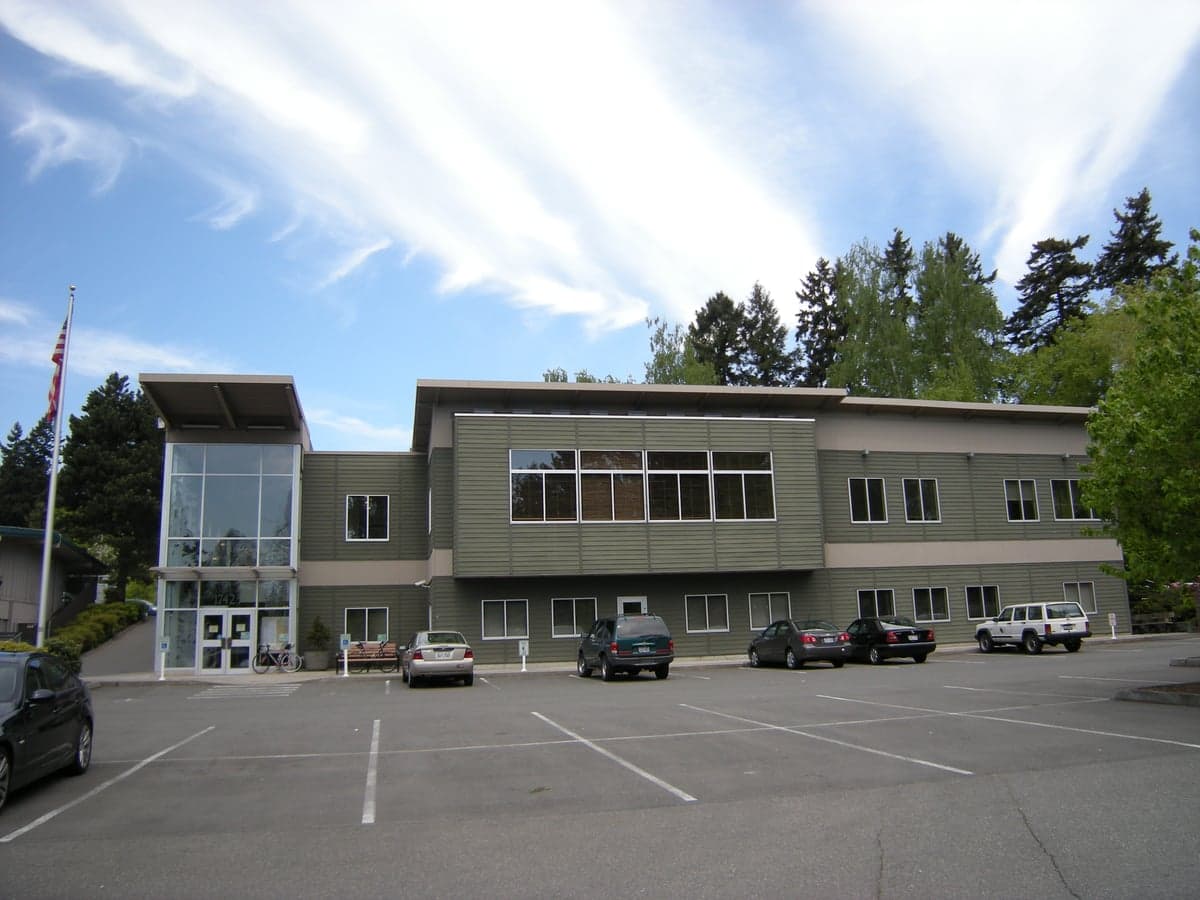
Photo: Wikipedia
Political ClimatePolitical Climate in Lake Forest Park, WA
District shown is the primary district for this city’s centroid. Cities may span multiple districts.
* Lean and PVI are calculated from Lake Forest Park, WA’s own 2020 presidential results (precinct returns summed to the city), with 2024 estimated from the surrounding county’s 2020–2024 shift, Cook-style. Sources: state election offices; VEST 2020 precinct results (CC BY 4.0).
Political rankings in Washington
- Most Conservative Cities in Washington
- Most Liberal Cities in Washington
- Best Conservative-Leaning Towns on the West Coast
- Best Conservative-Leaning Towns in the Pacific Northwest
- Most Affordable Liberal-Leaning Small Towns in the U.S.
- Safest Liberal-Leaning Cities in the U.S.
- Most Conservative Counties in Washington
- Most Liberal Counties in Washington
Local Political AnalysisPolitical Analysis of Lake Forest Park, WA
Lake Forest Park is about as blue as it gets in Washington State, with a Cook Partisan Voting Index of D+39, making it one of the most reliably Democratic suburbs in the entire Seattle metro area. That number isn't just a statistic—it means the district votes nearly 40 points more Democratic than the national average, a margin that has only widened over the last decade as the city has become a bedroom community for Seattle and Bellevue professionals. The local electorate is overwhelmingly progressive, with Democratic presidential candidates routinely pulling 80% or more of the vote here, and the city council has been uniformly nonpartisan but functionally left-leaning for as long as anyone can remember.
How it compares
Compared to Washington State as a whole, Lake Forest Park is significantly more liberal. The state overall leans Democratic but is far more competitive—think D+7 or D+8 in recent cycles—thanks to more moderate suburbs like Spokane Valley and rural areas like Yakima County that pull the average rightward. Within King County, Lake Forest Park sits in a cluster of deep-blue suburbs that includes Shoreline, Kenmore, and Bothell, but it stands out even among them. For contrast, drive 15 minutes north to Mill Creek or Snohomish, and you'll find communities that are still Democratic but with a much stronger Republican minority—often 35-40% of the vote. Lake Forest Park's D+39 rating puts it in the same league as Seattle's Capitol Hill or Madison Park, not your typical suburban swing territory.
What this means for residents
For liberal residents, the political climate feels natural and affirming. Local policies on environmental protection, affordable housing, and transit-oriented development are generally supported, and the city's Tree Board and Parks Commission are active and well-funded. Conservative residents, while a distinct minority, aren't invisible—there are still a few Republican-leaning households, particularly in the older lakefront properties—but they often feel out of step on local issues like zoning density or school funding levies. The practical effect is that political discourse here tends to be polite but one-sided; you won't find much public debate about tax cuts or Second Amendment issues at city council meetings. That said, the city's small size (about 13,000 people) means most politics is hyperlocal—potholes, tree preservation, and the Lake Forest Park Towne Centre redevelopment—so partisan divides rarely dominate daily life.
Culturally, Lake Forest Park has a distinct identity that sets it apart from both Seattle and the more conservative suburbs to the north. The city's 1978 tree preservation ordinance is a point of pride, and the Third Place Commons in the Towne Centre functions as a de facto town square where political differences are less visible than shared interests in local food, live music, and community events. The trajectory is clear: as the Seattle metro area continues to grow and housing prices push families north, Lake Forest Park will likely become even more Democratic and more aligned with urban progressive values. For anyone moving here, the political reality is straightforward—this is a place where liberal policies are the baseline, and the few conservative voices that remain are more likely to be heard over coffee at the Commons than at the ballot box.

State Political ClimatePolitical Climate in Washington
State Political AnalysisPolitical Environment in the State
Washington State has been a reliably Democratic stronghold for over a decade, but its political landscape is far more complex than a simple blue label. The state hasn't voted for a Republican presidential candidate since 1984, and Democrats control every statewide office and both legislative chambers. However, this dominance masks a deep and growing urban-rural chasm, with the Seattle metro area's massive population driving the statewide results while vast swaths of Eastern Washington remain deeply conservative. Over the last 20 years, the state has shifted leftward on social and environmental policy, but the margin has tightened in some areas as conservative voters consolidate in rural counties and exurbs.
Urban vs. rural divide
The political map of Washington is essentially two states. King County, home to Seattle, casts about a third of all votes in the state and routinely delivers 70-75% of them to Democratic candidates. That alone is enough to swing statewide elections. The I-5 corridor from Seattle down through Tacoma and Olympia forms the Democratic spine, with Pierce and Thurston counties being more competitive but still trending blue. Across the Cascade Range, the story flips. Spokane County, the state's second-most populous, has become a Republican stronghold, voting +12 for Trump in 2024. Yakima and the Tri-Cities (Kennewick, Pasco, Richland) are reliably red, while rural counties like Ferry, Stevens, and Garfield routinely vote 70%+ Republican. The Puget Sound region's growth has only amplified this divide, as tech workers and out-of-state transplants pour into Seattle and its close-in suburbs like Redmond and Bellevue, while Eastern Washington's population grows more slowly and remains culturally and politically distinct.
Policy environment
Washington's policy environment is defined by its lack of a state income tax, which is a major draw for many relocators. The state relies heavily on a high sales tax (typically 8-10% depending on locality) and property taxes. For a conservative-leaning resident, the absence of income tax is a clear plus, but the regulatory posture is among the most progressive in the nation. The state has a strong public sector union presence, a robust minimum wage that adjusts annually for inflation, and some of the strictest environmental regulations in the country, including a cap-and-trade program for carbon emissions. Education policy is controlled at the state level, with a fully funded public school system that ranks well nationally, but school choice options are limited compared to many red states. Healthcare is heavily regulated, and the state runs its own insurance exchange under the ACA. Election laws are among the most accessible in the country: Washington has universal vote-by-mail, automatic voter registration at the DMV, and same-day registration. Ballot access is easy, but the top-two primary system means that in many districts, two Democrats or two Republicans can face off in the general election, effectively locking out third parties.
Recent policy direction
The last five years have seen Washington move decisively left on several fronts. In 2023, the legislature passed a sweeping assault weapons ban (HB 1240) and a high-capacity magazine ban, along with a requirement for a 10-day waiting period and enhanced background checks on all firearm sales. Self-defense laws have been tightened; the state no longer allows open carry at public meetings or protests. On parental and education rights, Washington has moved in the opposite direction of many red states, with laws protecting LGBTQ+ students' rights to use chosen names and pronouns without parental notification in some school districts. Speech and privacy laws are generally protective of individual rights, but the state has a strong public records act that can expose personal information. Medical and bodily autonomy is broadly protected: Washington codified abortion rights into law in 1991 and has expanded access since, including requiring insurance coverage for abortion and gender-affirming care. Property rights are constrained by the Growth Management Act, which limits development in rural areas and forces denser urban planning. On taxation, the state recently enacted a capital gains tax on high earners (over $250,000 in gains), which is being challenged in court but currently in effect. Voting access has been expanded with automatic voter registration and pre-registration for 16- and 17-year-olds.
Civil unrest & political movements
Washington has a long history of political activism, from the WTO protests in Seattle in 1999 to the CHOP/CHAZ autonomous zone in 2020. The latter was a flashpoint that still resonates in local politics, with conservatives pointing to it as a symbol of progressive overreach and liberals defending it as a response to police violence. Immigration politics are a major dividing line: Washington is a sanctuary state, with state law prohibiting local law enforcement from cooperating with federal immigration authorities in most circumstances. This has led to tensions in more conservative areas like Yakima County, where local officials have pushed back. Election integrity controversies have been relatively muted compared to other states, thanks to the well-established vote-by-mail system, but some rural counties have seen calls for hand-counting ballots. Secession rhetoric exists at the margins, with some Eastern Washington counties periodically floating the idea of forming a separate state (the "Liberty" state movement), but it has never gained serious legislative traction. The most visible political movements are the environmental activism centered in Seattle and the gun rights activism centered east of the Cascades.
Projection
Over the next 5-10 years, Washington's political trajectory is likely to continue its gradual leftward drift, but with important caveats. The Seattle metro area's growth shows no signs of slowing, driven by the tech industry, which will continue to add Democratic voters. However, there is a growing backlash against some progressive policies, particularly around public safety, homelessness, and education. The 2024 election saw some suburban areas shift rightward compared to 2020, suggesting that the Democratic margin may have peaked. In-migration patterns are mixed: Washington still attracts liberal-leaning transplants from California and Oregon, but it also sees an influx of conservative-leaning retirees and remote workers to areas like Spokane and the Columbia River Gorge. The state's housing crisis and high cost of living may eventually slow population growth, which would dampen the pace of political change. A new resident moving in now should expect a state that remains Democratic-controlled but with increasingly competitive legislative races in the suburbs and a persistent rural-urban cultural divide that shows no signs of healing.
For a conservative-leaning relocator, the bottom line is that Washington offers a high quality of life in many respects—no income tax, stunning natural beauty, and a strong economy—but you will be living under a progressive state government that is actively expanding gun control, environmental regulation, and social welfare programs. If you're moving to Eastern Washington or a red-leaning exurb, you'll find like-minded neighbors and local representation, but you'll have limited ability to change state-level policy. For a liberal relocator, the state is largely aligned with your values, though you may find the cost of living and housing scarcity frustrating. Either way, Washington is a place where your vote matters most in local and legislative races, and where the political conversation is shaped as much by geography as by ideology.
* Values derived from national, state, county, city and local statistics and may differ in a specific area. Last updated: 2026-11-15T00:14:09.000Z
Narrative content on this page is AI-generated and may contain mistakes. Verify any details that matter before acting on them.
ReloMaps may earn a commission from affiliate links at no extra cost to you.

