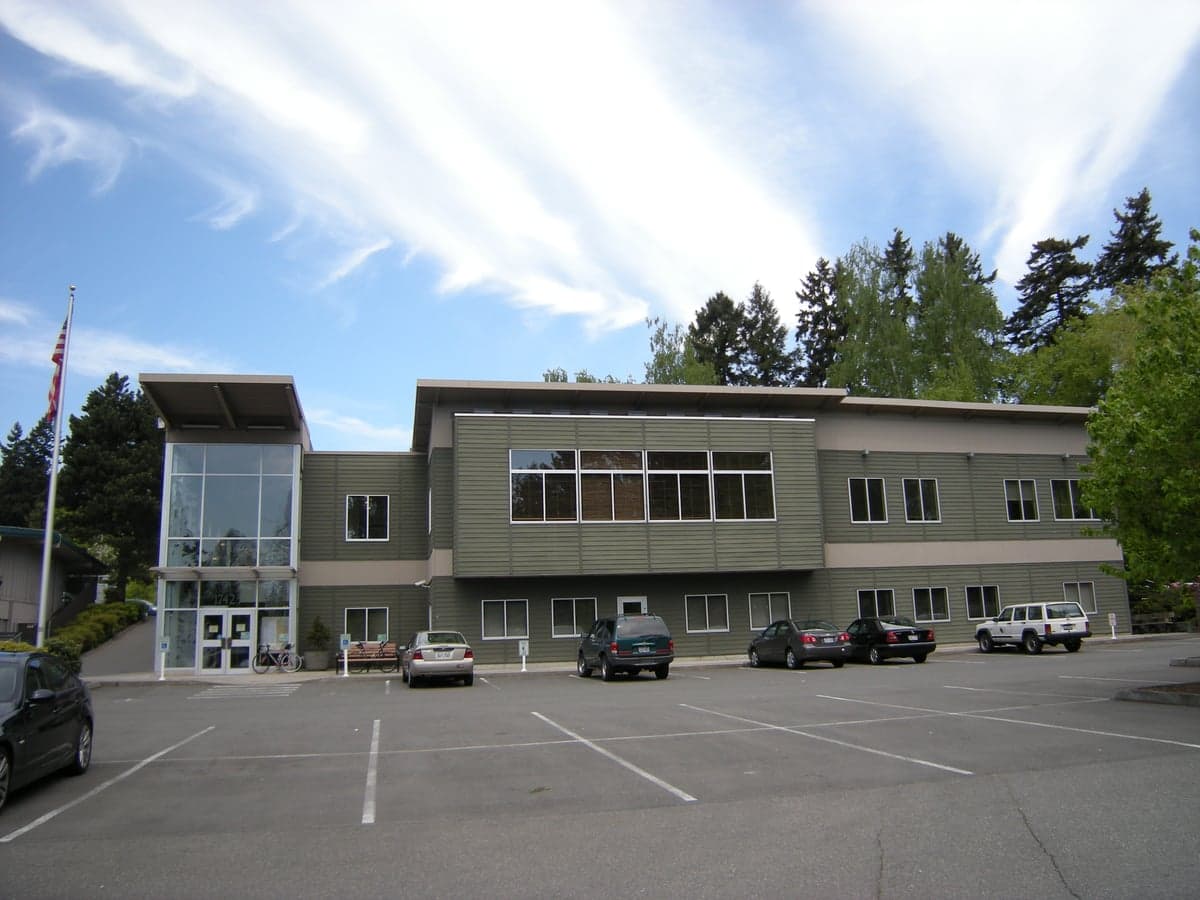
Photo: Wikipedia
Demographics of Lake Forest Park, WA
Affluence Level in Lake Forest Park, WA
A wealthy area with high-earning, well-educated households. Incomes, home values, and educational attainment meaningfully outpace national averages.
People of Lake Forest Park, WA
Lake Forest Park today is a small, highly educated city of 13,356 residents, where a majority-white population (71.1%) coexists with a notable East/Southeast Asian community (10.4%) and smaller Black (4.2%) and Hispanic (5.0%) groups. With 66.0% of adults holding a college degree and only 5.5% foreign-born, the city skews professional, family-oriented, and native-born — a character distinct from the more diverse, renter-heavy suburbs closer to Seattle. Its identity is shaped by deep-rooted single-family neighborhoods, a strong sense of environmental stewardship around the Thornton Creek watershed, and a quiet, almost insular residential culture that values privacy and local governance.
How the city was settled and grew
Lake Forest Park was not a pioneer-era settlement. The area was originally inhabited by the Snohomish and Duwamish people, who used the Lake Washington shoreline for fishing and seasonal camps. Euro-American homesteaders arrived slowly in the late 19th century, drawn by timber and the promise of lakefront property. The city’s modern history begins in 1912, when the Ole Hanson Company — the same firm that later developed the planned community of Lake Forest Park, Illinois — platted a suburban retreat on the former site of a logging camp. The original lots were marketed to Seattle’s upper-middle class as summer homes and year-round estates, and the early population was overwhelmingly white, Protestant, and professional. The Sheridan Beach neighborhood, along the lake, became the first concentration of permanent residents, many of whom commuted to Seattle via the new interurban rail line. Lake Forest Park Drive and the area around Ballinger Way saw modest infill during the 1920s and 1930s, but the city remained sparsely populated until after World War II. The post-war boom brought a wave of returning veterans and Boeing employees, who built ranch-style homes in neighborhoods like North City and Briarcrest. These were almost entirely white, middle-class families, and the city incorporated in 1961 partly to control zoning and preserve its low-density, single-family character against annexation by Seattle or Shoreline.
Modern era (post-1965)
The 1965 Hart-Cellar Act had a modest direct effect on Lake Forest Park, as the city’s high housing costs and lack of rental stock limited the arrival of new immigrant groups compared to nearby cities like Mountlake Terrace or Lynnwood. Instead, the city’s demographic change came primarily through domestic migration. The 1970s and 1980s saw an influx of professionals drawn by the city’s reputation for strong schools (the Shoreline School District) and large wooded lots. The East/Southeast Asian population — now 10.4% of residents — began to grow in the 1990s, concentrated in the Ballinger Way corridor and the newer subdivisions off 25th Avenue NE, where families sought access to the district’s highly rated elementary schools. The Black population (4.2%) and Hispanic population (5.0%) are more dispersed, with no single neighborhood showing a strong ethnic concentration; these groups are spread across the city’s older housing stock in North City and the Sheridan Beach area. The Indian-subcontinent population remains very small at 0.8%, reflecting the city’s lack of the employment anchors — tech campuses, hospitals, or universities — that draw larger South Asian communities to Redmond or Bellevue. The foreign-born share (5.5%) is roughly half the King County average, underscoring that Lake Forest Park remains a predominantly native-born, English-speaking community.
The future
Lake Forest Park’s population is slowly diversifying, but the pace is constrained by housing supply and cost. The city has little undeveloped land and a strong single-family zoning ethos, which limits the construction of apartments or townhomes that might attract younger, more diverse households. The East/Southeast Asian share is likely to continue its gradual increase, driven by families seeking the Shoreline School District and proximity to Asian-American commercial hubs in Shoreline and Edmonds. The Black and Hispanic shares are expected to grow modestly, primarily through the aging and turnover of existing housing stock in North City and Briarcrest, where homes are relatively more affordable. The white population, while still the majority, will continue its slow decline as older residents age in place and younger buyers reflect a more diverse regional pool. The city’s cultural identity — environmentally conscious, politically moderate-to-liberal, and family-focused — is unlikely to shift dramatically, but the next decade will see a slightly more multiethnic version of the same character.
For someone moving in now, Lake Forest Park offers a stable, low-density, highly educated community where demographic change is gradual rather than disruptive. The city is becoming slightly more diverse, but it remains a place where the dominant culture is white, professional, and native-born, and where new residents — regardless of background — are expected to fit into an established suburban rhythm centered on schools, nature, and local civic life.

* Values derived from national, state, county, city and local statistics and may differ in a specific area. Last updated: 2026-11-15T00:14:09.000Z
Narrative content on this page is AI-generated and may contain mistakes. Verify any details that matter before acting on them.
ReloMaps may earn a commission from affiliate links at no extra cost to you.

