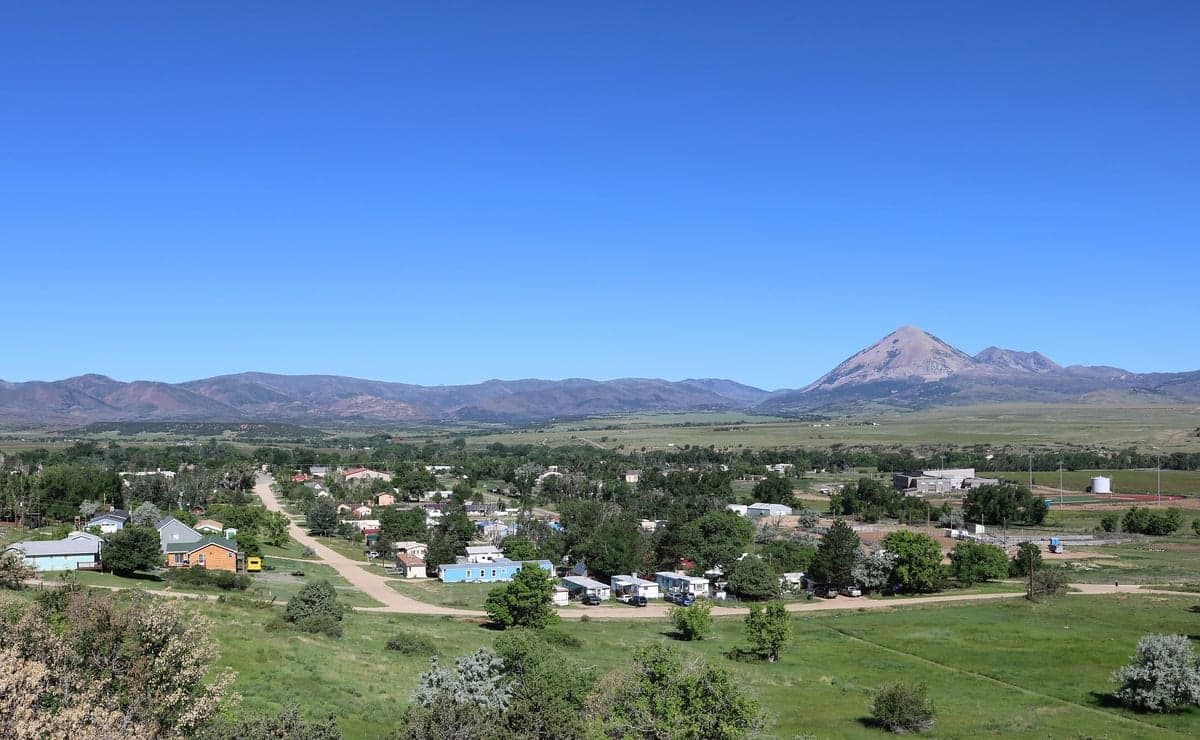
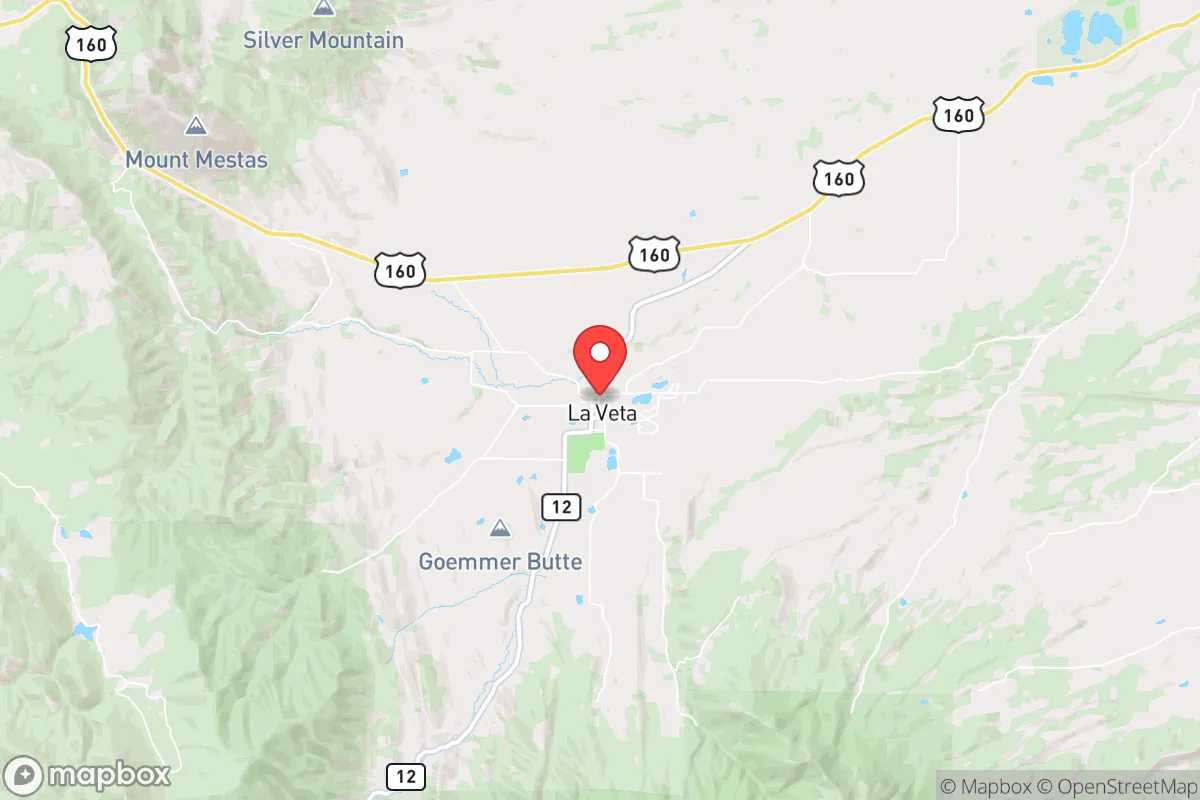
Photo: Wikipedia
Political ClimatePolitical Climate in La Veta, CO
District shown is the primary district for this city’s centroid. Cities may span multiple districts.
Local Political AnalysisPolitical Analysis of La Veta, CO
La Veta sits in Huerfano County, and politically it’s a bit of an island in a sea of change. The area carries a Cook PVI of R+5, meaning it leans about five points more Republican than the national average, but that number only tells part of the story. The real picture is a town that has been shifting—slowly but steadily—from a deep-red ranching outpost into a more purple, arts-and-retirement community, while the surrounding county still votes solidly conservative.
How it compares
To understand La Veta, you have to look at its neighbors. Drive 20 miles east to Walsenburg, the county seat, and you’ll find a working-class town that votes more Democratic, fueled by a mix of longtime Hispanic families and newer transplants drawn by cheap housing. Head 30 miles west over La Veta Pass into the San Luis Valley, and places like Alamosa and Monte Vista lean blue in a way that feels almost foreign to the Front Range. But the immediate rural area around La Veta—the ranchland stretching toward Cuchara and the Spanish Peaks—is reliably Republican. In the 2024 election, Huerfano County as a whole went for Trump by a comfortable margin, even as La Veta’s own precincts showed a much tighter split. The R+5 PVI reflects that tension: the town itself is competitive, but the surrounding countryside pulls the district right.
What this means for residents
For conservatives, La Veta is still a comfortable place to live. The county GOP is active, and local issues like water rights, property taxes, and land-use regulations tend to dominate the conversation in a way that favors traditional rural values. You’ll see Trump flags on pickup trucks in the summer, and the local coffee shop isn’t shy about Fox News on the TV. But for liberals, the picture is more nuanced. The town has a visible arts community—the Spanish Peaks Arts Council, the La Veta Library, and the weekly farmers market all skew progressive—and the influx of retirees from Denver, Texas, and California has brought a steady trickle of blue votes. That said, being a Democrat here means you’re in the minority, and you’ll likely hear about it at the post office or the hardware store. The practical reality is that local elections are often decided by a few dozen votes, so both sides have to actually show up and talk to their neighbors.
What this means for residents
What sets La Veta apart from much of Colorado is its resistance to the state’s broader leftward drift. While the Front Range—Denver, Boulder, Fort Collins—has become reliably Democratic, and even the Western Slope is trending purple, Huerfano County has held its ground. The state as a whole has a Cook PVI that leans Democratic, but that’s driven almost entirely by the urban corridor. In La Veta, you won’t find much appetite for the kind of progressive policies that dominate the statehouse in Denver, like strict gun control or the push for universal health care. Instead, the local conversation is about keeping the town’s character intact—preserving the historic downtown, managing short-term rentals, and keeping the school district funded. The trajectory over the next decade is likely more of the same: a slow, generational shift toward the center, but with enough ranching and mining heritage to keep the area from ever flipping blue outright. For anyone moving here, the advice is simple: keep your politics to yourself at first, listen more than you talk, and you’ll find that most folks care less about your party and more about whether you’re a good neighbor.

State Political ClimatePolitical Climate in Colorado
State Political AnalysisPolitical Environment in the State
Colorado has shifted from a classic swing state to a reliably Democratic-leaning state over the past two decades, but it is not a monolith. The state’s political identity is a tale of two geographies: the booming Front Range urban corridor (Denver, Boulder, Fort Collins, Colorado Springs) that drives statewide elections, and the vast, sparsely populated rural counties east of I-25 and on the Western Slope that vote overwhelmingly Republican. In 2024, Donald Trump won the state’s rural counties by margins of 40 to 60 points, yet still lost Colorado by roughly 11 points overall, a pattern that has held since Barack Obama first carried the state in 2008.
Urban vs. rural divide
The political map of Colorado is drawn along the I-25 corridor, where over 80% of the state’s population lives. Denver, Boulder, and the inner-ring suburbs of Aurora and Lakewood are the Democratic engine room, delivering margins that no Republican statewide candidate has overcome since 2004. The shift is most dramatic in the suburbs: Jefferson County, once a classic swing county that backed George W. Bush twice, has voted Democratic by double digits in every presidential election since 2012. Arapahoe County and Larimer County (home to Fort Collins) have followed the same trajectory, powered by an influx of college-educated professionals and out-of-state transplants.
Colorado Springs, the state’s second-largest city, remains the notable conservative stronghold on the Front Range. El Paso County is the political base for the state GOP, reliably voting 15-20 points to the right of the state average, anchored by military installations like Fort Carson and Peterson Space Force Base, as well as a dense network of evangelical churches. The rural Eastern Plains — towns like Lamar, Yuma, and Sterling — are deeply Republican, with economies tied to agriculture and oil and gas. The Western Slope, including Grand Junction and Montrose, has trended redder over the last decade, driven by frustration with federal land management and oil and gas regulations. The only real Democratic outposts west of the Continental Divide are the resort counties of Pitkin (Aspen), Summit, and Eagle, which vote like Boulder despite their small populations.
Policy environment
Colorado’s policy environment is a mix of progressive state-level priorities and a strong tradition of direct democracy. The Taxpayer’s Bill of Rights (TABOR), passed in 1992, caps state revenue growth at inflation plus population growth and requires voter approval for any tax increase. This has kept Colorado’s income tax rate at a flat 4.4% — one of the lowest in the nation — and forced the state to refund surplus revenue to taxpayers in years of strong growth. However, voters have repeatedly carved out exceptions, approving bond issues and time-limited tax hikes for schools and transportation.
On regulation, Colorado is a national leader in environmental policy, with aggressive renewable energy mandates and strict oil and gas setbacks that have effectively limited new drilling near residential areas. The state has a robust regulatory framework for cannabis, which was legalized in 2012, generating over $300 million in annual tax revenue. Education policy is a flashpoint: Colorado uses a school funding formula that relies heavily on local property taxes, creating wide disparities between wealthy Front Range districts and rural schools. The state has also become a leader in mail-in voting, with universal mail ballots sent to every registered voter since 2014, and same-day voter registration.
Recent policy direction
The last five years have seen Colorado’s Democratic trifecta (governor, House, Senate) push a distinctly progressive agenda, but with notable limits. On gun policy, the state passed a 2023 law banning the sale of firearms to anyone under 21, a red flag law in 2019, and a 2024 measure requiring a 3-day waiting period for firearm purchases. These laws have made Colorado a national test case for gun control, and they remain deeply unpopular in rural counties, several of which have passed symbolic “Second Amendment sanctuary” resolutions.
On parental and education rights, the state has moved the opposite direction from many conservative states. Colorado passed a 2023 law requiring schools to use a student’s chosen name and pronouns, and it has not restricted curriculum on race or gender identity. School choice remains robust, however, with a strong charter school sector and an open enrollment system that allows students to attend any public school in their district. On healthcare, Colorado created a public option insurance plan in 2021 and has expanded Medicaid aggressively, but it has not moved toward single-payer. Property rights are a growing concern for rural landowners, as the state has tightened land-use planning rules and pushed for denser housing in Front Range suburbs. On voting, Colorado’s mail-in system is among the most accessible in the country, with automatic voter registration through the DMV and ballot drop boxes in every county.
Civil unrest & political movements
Colorado has a visible and active protest culture, centered in Denver and Boulder. The 2020 George Floyd protests in Denver were large and occasionally violent, leading to a controversial police accountability law that limited qualified immunity for officers. The state has also been a flashpoint for immigration politics: Denver has struggled with an influx of migrants bused from Texas since 2023, straining city budgets and creating tension between the state’s sanctuary policies and local resource constraints. The state legislature passed a 2023 law prohibiting local law enforcement from cooperating with federal immigration enforcement in most cases, but rural sheriffs have publicly refused to comply.
On the right, the most organized movement is the rural county “liberty” network, which has pushed for secession from the state in the past. In 2013, 11 rural counties voted to explore forming a new state called “North Colorado,” a symbolic protest that fizzled but signaled deep alienation. The movement has evolved into a more practical push for local control, with counties like Weld and El Paso challenging state preemption on oil and gas, gun laws, and land use. Election integrity controversies have been less pronounced than in other states, though a 2022 audit of voting machines in Mesa County led to criminal charges against the county clerk, a prominent election denial figure.
Projection
Colorado’s political trajectory over the next decade points toward continued Democratic dominance at the state level, but with a narrowing margin. The state’s population growth is concentrated in the already-blue Front Range, and in-migration from California and Texas skews younger and more educated, which historically favors Democrats. However, the cost-of-living crisis in Denver and Boulder is pushing some families to exurbs like Castle Rock, Parker, and Windsor, which are more politically mixed and could become competitive swing areas. The rural vote will remain deeply Republican but will continue to lose relative weight as the population concentrates along I-25.
The wildcard is the state’s housing affordability crisis. If Colorado fails to build enough housing, the state could see an out-migration of young families to cheaper states like Wyoming or Texas, which would dampen Democratic margins. Conversely, if the state successfully densifies its suburbs, the political map will only become more urban and more Democratic. Expect the state to remain a Democratic stronghold for the next decade, but with a more competitive margin in gubernatorial races than in presidential ones.
For a new resident, the practical takeaway is that Colorado rewards political engagement but punishes ideological purity. A conservative moving to Colorado Springs or the Eastern Plains will find a welcoming community and a strong local political network, but will have little influence on statewide policy. A liberal moving to Denver or Boulder will find their views reflected in state law, but will pay a premium for housing and deal with a state government that is increasingly assertive on land use and environmental regulation. The state’s TABOR tax cap and direct democracy tradition mean that ballot measures are a regular feature of life, and both sides have learned to use them effectively. Colorado is not a place where you can assume your politics are shared by your neighbors — it is a state where you will need to make your case, and where the outcome is often decided by the unaffiliated voters who make up the largest voting bloc in the state.
* Values derived from national, state, county, city and local statistics and may differ in a specific area. Last updated: 2026-09-05T17:18:36.000Z
Narrative content on this page is AI-generated and may contain mistakes. Verify any details that matter before acting on them.
ReloMaps may earn a commission from affiliate links at no extra cost to you.

