Photo: Wikipedia
Demographics of La Veta, CO
Affluence Level in La Veta, CO
A middle-class area roughly in line with national averages across income, home values, education, and employment.
People of La Veta, CO
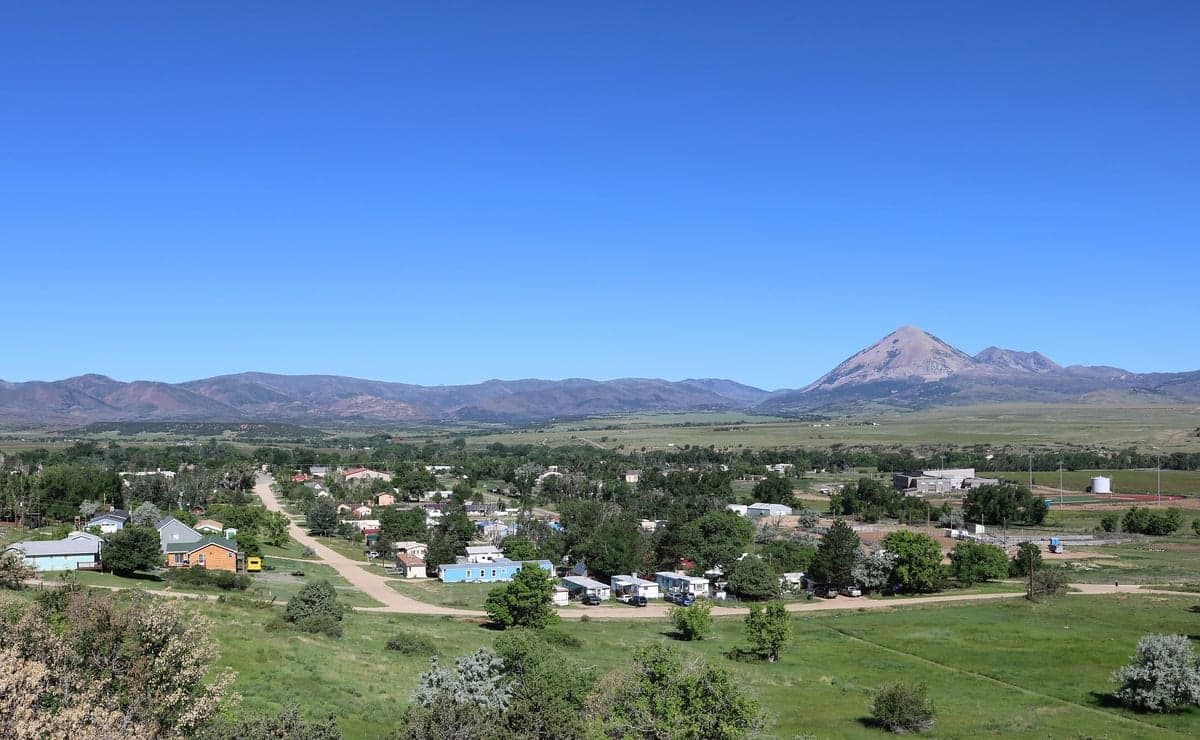
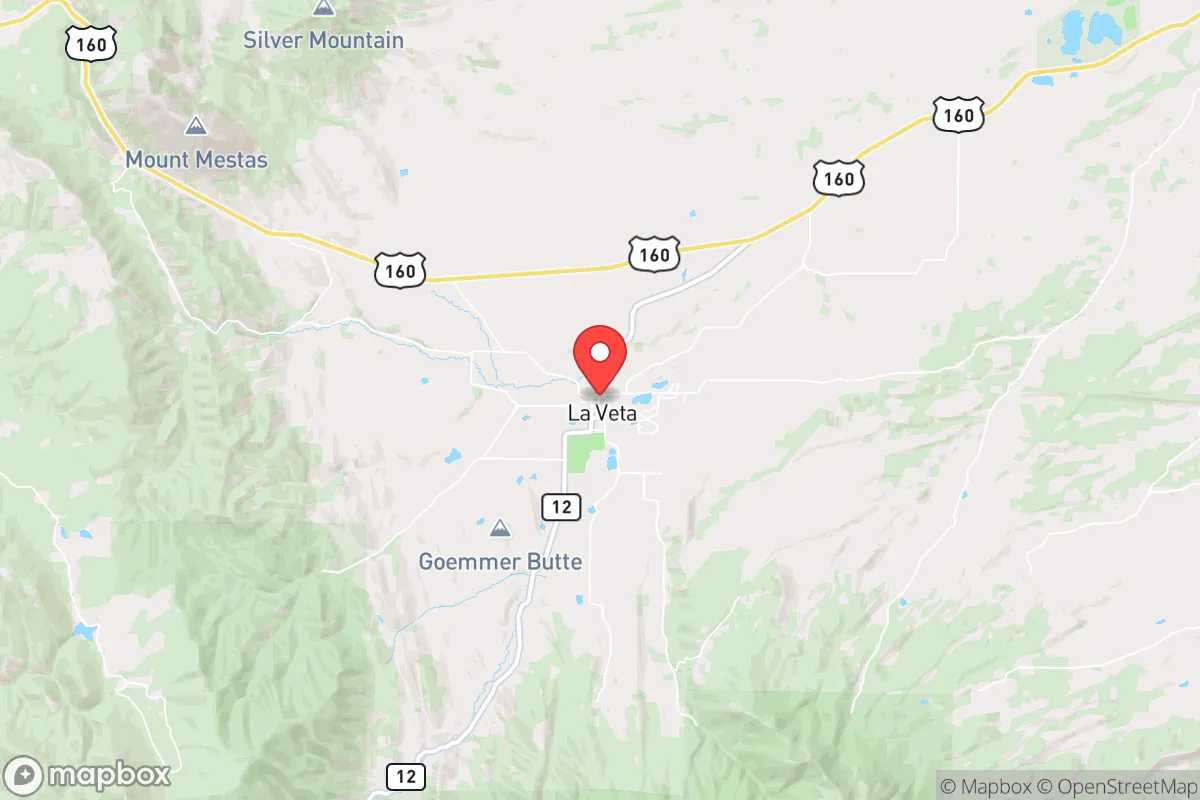
La Veta, Colorado, is a town of 751 residents where the population is overwhelmingly white (94.8%) and entirely native-born, with zero foreign-born residents recorded in the latest data. The Hispanic share stands at 4.1%, and there are no measurable Black, Asian, or Indian-subcontinent populations. This is a deeply rooted, homogeneous community in the Spanish Peaks region of Huerfano County, where 37.1% of adults hold college degrees — a figure that reflects a notable influx of educated retirees and remote workers drawn to the mountain setting.
How the city was settled and grew
La Veta's human history begins with the Spanish land grant of 1843, the Vigil and St. Vrain Grant, which brought Hispano settlers into the Cuchara Valley. The town itself was formally founded in 1862 by Colonel John M. Francisco, who built a trading post along the Mountain Branch of the Santa Fe Trail. The arrival of the Denver and Rio Grande Railroad in 1876 transformed the settlement from a ranching outpost into a coal-mining and agricultural hub, and it was incorporated in 1876 — the same year Colorado achieved statehood.
The original Hispano families, many bearing surnames like Vigil, Maes, and Trujillo, settled along what is now the Ryus Avenue corridor, building adobe homes near the plaza that still anchors the town's historic core. Anglo ranchers and railroad workers clustered in the Francisco Plaza district, named for the town's founder, where the old trading post and saloons gave way to brick storefronts. A wave of European immigrants — primarily Italian and Slavic coal miners — arrived between 1890 and 1920, establishing the Birch Street neighborhood on the town's north side, where modest company houses still stand. The coal economy collapsed by the 1930s, and La Veta's population stagnated for decades, with many younger residents leaving for Denver or Pueblo.
Modern era (post-1965)
The post-1965 era brought no significant immigration to La Veta; the foreign-born share remains zero. Instead, the town's modern growth has come from domestic in-migration, particularly after the 1980s when the Spanish Peaks became a destination for artists, retirees, and second-home buyers. The East Street extension and the Birch Street neighborhood absorbed much of this new construction, with contemporary homes replacing older lots. The Hispanic share, which was historically higher when the coal mines employed local Hispano families, has declined to 4.1% as younger Hispanic residents moved to larger cities and were not replaced by new arrivals.
Today's La Veta is bifurcated: the Francisco Plaza district and Ryus Avenue corridor retain their historic character and are increasingly occupied by out-of-state transplants, while the Birch Street neighborhood remains a mix of longtime locals and newer retirees. The college-educated share of 37.1% is roughly double the state average for rural towns, reflecting the draw of the nearby Cuchara ski area (now closed) and the town's reputation as an arts colony, anchored by the Spanish Peaks Arts Alliance and the La Veta Gallery Walk.
The future
La Veta's population is aging and slowly shrinking — the 751 residents represent a decline from roughly 900 in the 1990s. The town is not becoming more diverse; the white share has held steady above 94% for two decades, and the Hispanic share has drifted downward. New residents are overwhelmingly white, college-educated, and over 50, drawn by mountain views and the low cost of living relative to Colorado's Front Range. The East Street extension is the only area seeing active new construction, with a handful of custom homes going up each year, but there is no subdivision development or major employer to attract younger families.
Over the next 10–20 years, La Veta will likely become older and slightly smaller, with the demographic profile resembling a retirement community more than a working town. The school district, already consolidated with neighboring Walsenburg, may face further enrollment declines. The cultural identity is shifting from its Hispano-ranching roots toward an Anglo, arts-oriented, second-home character — a trend visible in the conversion of historic adobe homes into galleries and vacation rentals.
For someone moving in now, La Veta offers a stable, safe, and culturally active small town, but it is not a place of demographic dynamism. The population is homogeneous, aging, and increasingly affluent relative to the surrounding county. Newcomers will find a welcoming community of fellow transplants, but should expect limited diversity, minimal job opportunities, and a town whose future depends on retirees and remote workers rather than new families or industry.

* Values derived from national, state, county, city and local statistics and may differ in a specific area. Last updated: 2026-09-05T17:18:36.000Z
Narrative content on this page is AI-generated and may contain mistakes. Verify any details that matter before acting on them.
ReloMaps may earn a commission from affiliate links at no extra cost to you.

