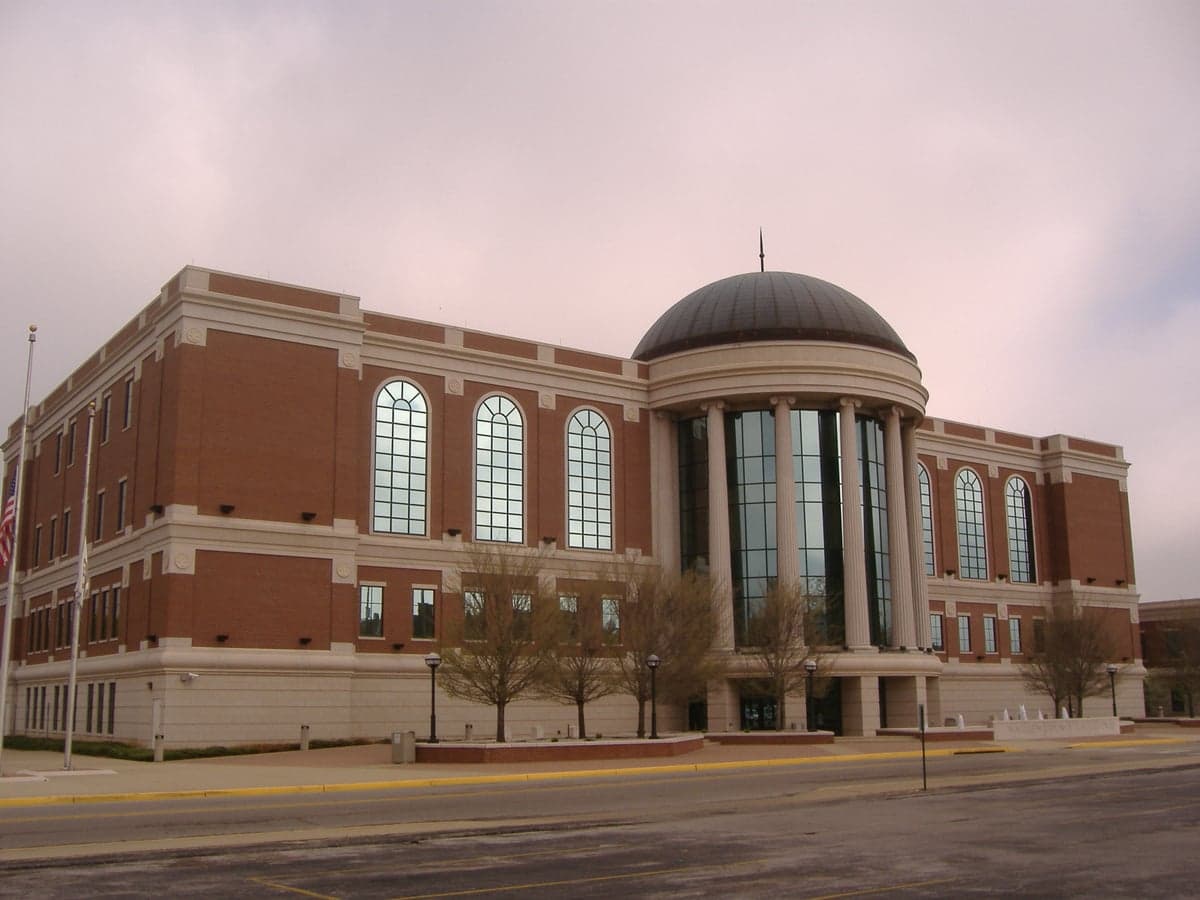
Photo: Wikipedia
Political ClimatePolitical Climate in Warren County
Showing district-level results — no local-only data available.
Local Political AnalysisPolitical Analysis of Warren County
Warren County, Kentucky, is a reliably Republican stronghold with a Cook PVI of R+20, making it five points more conservative than the state of Kentucky as a whole (R+15). This isn't a new development; the county has been trending red for decades, but the shift has accelerated noticeably since the early 2000s. The biggest driver is the explosive growth of Bowling Green, which now pulls in a mix of conservative-leaning retirees from the Rust Belt, young families drawn by the Corvette plant and logistics jobs, and a significant population of immigrants—many from Myanmar and Latin America—who tend to vote more conservatively on social issues than the national average for their demographics. That said, the county isn't a monolith. The city of Bowling Green itself has a visible Democratic presence, especially in precincts around Western Kentucky University (WKU) and the historic downtown, where you'll find a younger, more educated, and more diverse electorate. In the 2022 gubernatorial race, these precincts broke for the Democrat Andy Beshear, while the rural outlying towns like Smiths Grove, Plum Springs, and Richardsville voted overwhelmingly for his Republican opponent. The swing precincts are the suburban fringe areas just outside the Bowling Green city limits—places like the neighborhoods off Scottsville Road and the newer developments near the Greenwood Mall—where ticket-splitting is common, and local races can be genuinely competitive.
How it compares
Compared to the rest of Kentucky, Warren County is a bit of an outlier in its intensity. While the state as a whole is solidly red, it still has deep-blue pockets in Louisville, Lexington, and the eastern coalfields. Warren County lacks those large, reliably Democratic urban centers. The WKU precincts are the closest thing, but they're small and don't offset the massive rural and suburban turnout. In practice, this means that a Republican candidate for statewide office can expect to win Warren County by a margin of roughly 20 to 25 points, while the same candidate might only win the state by 10 to 15 points. The county's R+20 PVI reflects this consistent, reliable GOP performance. For a conservative resident, this means your vote carries extra weight in a primary—local races are often decided in the Republican primary, and the general election is a formality. For a liberal resident, it means your vote is a drop in a very red bucket, but you can still have a real impact in city council races, school board elections, and the occasional state legislative contest where a moderate Democrat can win by focusing on local issues like infrastructure and education funding.
What this means for residents
For daily life, the political climate translates into a few tangible realities. The county government is reliably conservative, so you'll see lower property tax rates than in Jefferson or Fayette counties, but also fewer public services—things like public transit and social services are lean. The school board has been a flashpoint in recent years, with conservative majorities pushing for curriculum transparency and parental rights, while a vocal minority of liberal parents and teachers push back. On the cultural side, Bowling Green has a lively arts scene and a growing food culture that feels more cosmopolitan than the surrounding countryside, but the county's politics remain firmly rooted in traditional values. Gun rights are broadly supported, and you'll see open carry in rural areas. The biggest policy distinction from the rest of Kentucky is the county's aggressive economic development strategy—Warren County has been a leader in offering tax incentives to attract manufacturing and logistics, which has created a jobs boom but also strained infrastructure and housing. Looking ahead, the county's political trajectory is likely to stay red, but the growing diversity of Bowling Green could slowly shift the suburban precincts toward purple over the next decade, especially if national Democratic messaging on the economy gains traction with the immigrant and working-class communities that form the backbone of the local workforce.

State Political ClimatePolitical Climate in Kentucky
State Political AnalysisPolitical Environment in the State
Kentucky is a solidly Republican state with a Cook PVI of R+15, meaning it votes about 15 points more Republican than the national average in presidential elections. The state has shifted sharply rightward over the past 20 years, driven by the collapse of the old Democratic machine in rural areas and the realignment of white working-class voters. While Louisville and Lexington remain blue-leaning urban islands, the rest of the state—from the Ohio River counties to the Appalachian east—has become deeply conservative, with Republicans now holding supermajorities in both chambers of the General Assembly and every statewide office except the outgoing governor’s seat.
Urban vs. rural divide
The political map of Kentucky is a study in contrasts. Louisville (Jefferson County) and Lexington (Fayette County) are the only reliably Democratic metros, each delivering 60%+ for Joe Biden in 2020. These cities anchor the state’s blue vote, driven by younger professionals, university communities (University of Louisville, University of Kentucky), and a growing minority population. But outside those two counties, the landscape flips hard. Bowling Green (Warren County) and Owensboro (Daviess County) are solidly Republican, with Warren County voting +30 R in 2024. The real story is in the exurban and rural counties: Oldham County, just northeast of Louisville, is one of the most Republican counties in the nation (80%+ Trump), while Pike County in the east flipped from reliably Democratic to +50 R over the past decade. The Northern Kentucky suburbs of Cincinnati—Boone, Kenton, and Campbell counties—have trended red but remain more competitive, with Boone County going +18 R in 2024, down from +25 in 2020, as some suburban voters drift toward the center.
Policy environment
Kentucky’s policy environment reflects its conservative lean. The state has a flat income tax that is being phased down from 5% to 4% by 2026, with a goal of elimination. There is no state-level property tax on real estate; local governments levy property taxes, and rates are low by national standards. The state is a right-to-work state (since 2017) and a constitutional carry state (since 2019), meaning no permit is needed to carry a concealed firearm. Education policy is dominated by school choice: the state passed a limited education savings account (ESA) program in 2022, though it was struck down by the state Supreme Court in 2023 on procedural grounds. A new, more carefully crafted ESA bill is expected in 2025. Healthcare is a mixed bag: Kentucky expanded Medicaid under the Affordable Care Act in 2014, and about 30% of the population is on Medicaid, but the state has not pursued a state-based exchange or other progressive reforms. Election laws are moderately restrictive: voters must show a photo ID, absentee voting requires an excuse, and early voting is limited to three days before Election Day (though a 2024 law expanded in-person absentee voting to two weeks). There is no same-day registration.
Recent policy direction
The last five years have seen a clear conservative shift across multiple fronts. On gun and self-defense law, Kentucky passed constitutional carry in 2019 and a “stand your ground” law in 2022, removing the duty to retreat in public. On parental and education rights, the state banned critical race theory in K-12 classrooms in 2022 and passed a “Parents’ Bill of Rights” in 2023, requiring schools to notify parents of curriculum changes and medical services. On speech and privacy, Kentucky enacted a law in 2023 prohibiting public universities from requiring diversity statements in hiring, and a 2024 law restricts the collection of biometric data by private companies. On medical and bodily autonomy, the state passed a near-total abortion ban in 2022 (with exceptions only for life of the mother, rape, and incest, but no exceptions for fatal fetal anomalies). A 2023 law banned gender-affirming care for minors, overriding a veto from Governor Andy Beshear. On property rights, the state has not passed a broad “takings” reform, but a 2024 law limits local governments’ ability to regulate short-term rentals like Airbnb. On taxation, the income tax rate is being cut annually, and the state eliminated the corporate license tax in 2023. On voting and ballot access, a 2024 law tightened voter ID requirements and reduced the cure period for absentee ballot signature mismatches from 7 days to 3 days. The overall direction is toward lower taxes, fewer regulations on firearms and business, and more parental control over education, while restricting abortion and transgender care.
Civil unrest & political movements
Kentucky has seen relatively low levels of civil unrest compared to coastal states, but there have been notable flashpoints. The 2020 Breonna Taylor protests in Louisville were the most intense, with months of demonstrations, clashes with police, and a state of emergency declared. The city remains a focal point for racial justice activism, with ongoing debates over police reform and the city’s consent decree with the Department of Justice. On the right, the Kentucky Freedom Coalition and local Moms for Liberty chapters have been active in school board meetings, particularly in suburban counties like Oldham and Boone. Immigration politics are less visible than in border states, but Louisville has a growing immigrant community (mostly from Latin America and Southeast Asia), and a 2024 law requires local law enforcement to cooperate with ICE detainers. There is no sanctuary city policy in any Kentucky jurisdiction. Election integrity controversies have been muted compared to states like Georgia or Arizona, but a 2022 audit of Fayette County’s 2020 election found no evidence of fraud, despite some conservative activists calling for a hand recount. The secession or nullification rhetoric is minimal; Kentucky is not a state where such movements gain traction. A new resident would notice the political divide mostly in the contrast between Louisville’s progressive activism and the rest of the state’s quiet, church-centered conservatism.
Projection
Over the next 5-10 years, Kentucky is likely to become more Republican, but with a growing urban-suburban tension. In-migration is modest compared to Sun Belt states, but the people moving in tend to be retirees from the Midwest and younger families from Ohio and Indiana, who lean conservative. The Louisville and Lexington metros are growing slowly, but their Democratic margins are not expanding fast enough to offset the rural reddening. The state’s Republican supermajority is likely to persist, and the income tax phase-out will continue, possibly reaching zero by 2035. The biggest wildcard is the suburban shift: counties like Boone and Kenton are seeing an influx of remote workers from Cincinnati, who are more moderate on social issues. If that trend accelerates, Northern Kentucky could become a swing region within a decade, but it won’t flip the state. A new resident moving in now should expect a stable, conservative policy environment with low taxes, broad gun rights, and limited government intervention in daily life, but with a persistent urban-rural cultural divide that plays out in state politics.
For a new resident, the bottom line is this: Kentucky offers a low-tax, low-regulation environment with strong protections for gun owners and parents, but with limited access to abortion and gender-affirming care. If you’re conservative, you’ll find a state that largely aligns with your values, especially outside Louisville and Lexington. If you’re liberal, you’ll find two vibrant cities with progressive communities, but you’ll be living under a state government that is actively moving in the opposite direction. The practical takeaway is to choose your county carefully—Oldham and Boone for deep red, Jefferson and Fayette for blue, and the rest of the state for a reliably conservative experience.
* Values derived from national, state, county, city and local statistics and may differ in a specific area. Last updated: 2026-07-23T04:52:05.000Z
Narrative content on this page is AI-generated and may contain mistakes. Verify any details that matter before acting on them.
ReloMaps may earn a commission from affiliate links at no extra cost to you.

