
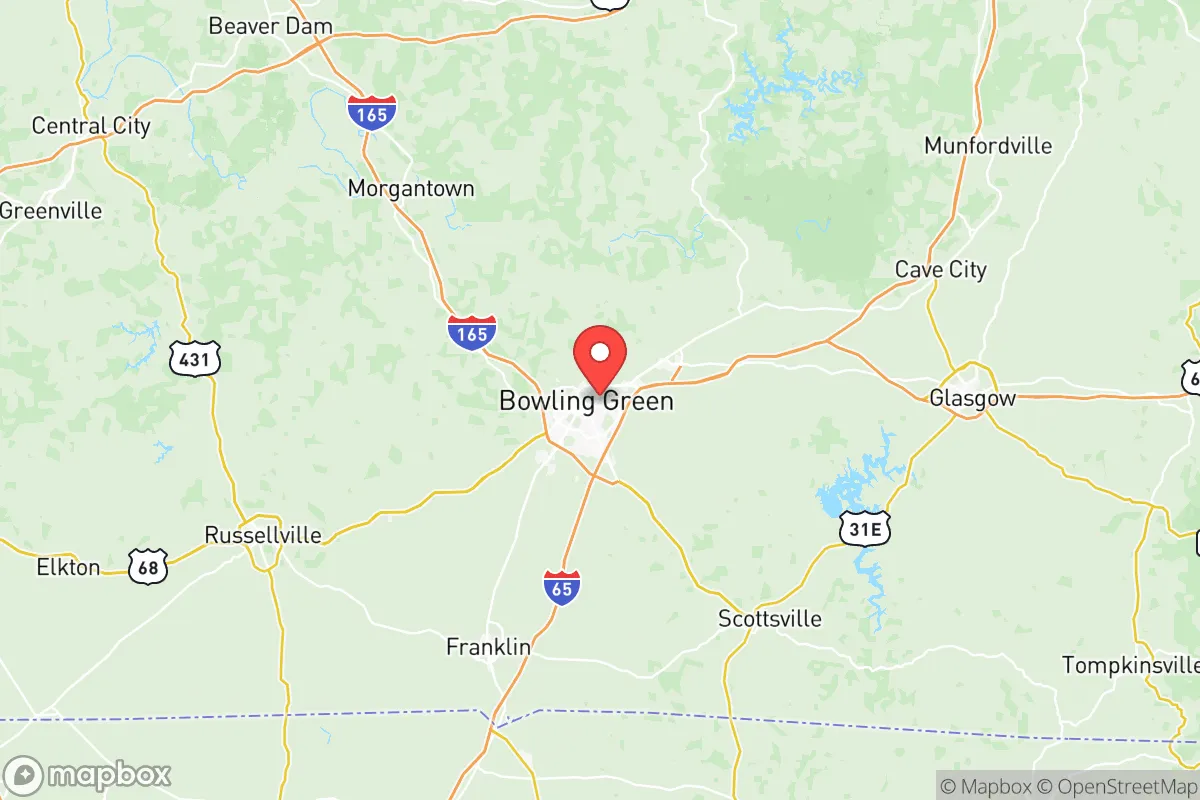
Photo: Wikipedia
Personal Sovereignty in Warren County
Viable for self-reliance. Generally workable, though some barriers may limit total independence.
What does Personal Sovereignty tell us?
Personal Sovereignty measures your capacity for self-reliance and independence with minimal government friction. Higher scores mean fewer barriers between you and the way you want to live... but it assumes you have the space you need and good neighbors.
What does this tell us?
Personal Sovereignty measures your capacity for self-reliance and independence with minimal government friction. Higher scores mean fewer barriers between you and the way you want to live... but it assumes you have the space you need and good neighbors.
State Policy
Energy independence: Importer (60% of energy produced in-state)
Personal Liberty
Homesteading

Personal Liberty Analysis
Warren County, Kentucky, anchored by the city of Bowling Green, offers a notably high degree of personal sovereignty relative to many urbanized areas in the Bluegrass State and the broader Midwest. The county’s regulatory environment is generally light-touch, with a strong cultural emphasis on self-reliance, particularly in its rural precincts and smaller towns like Smiths Grove, Plum Springs, and Woodburn. While Bowling Green itself has a more structured municipal code, the county’s overall posture leans toward individual autonomy, making it a viable option for those seeking to minimize government entanglement in daily life.
Tax burden and regulatory posture: How Kentucky compares to surrounding states
Kentucky’s state-level tax structure is a significant draw for sovereignty-minded individuals. The state has a flat individual income tax rate of 4.5% as of 2025, with a scheduled reduction to 4.0% by 2026, and no state-level tax on Social Security benefits. Property taxes in Warren County are among the lowest in the state, with a countywide rate of roughly $0.12 per $100 of assessed value for general purposes, plus a school district rate that brings the total effective rate to about 0.8% to 1.0% of market value. This is substantially lower than neighboring Tennessee’s effective property tax rates (which average 0.7% but vary widely) and far below the 1.5%+ rates common in Ohio and Indiana. The regulatory posture in Warren County is business-friendly, with no county-level zoning in unincorporated areas—meaning property owners in places like Rich Pond or Alvaton face fewer restrictions on land use than those within Bowling Green’s city limits. The city of Bowling Green does enforce a unified development code, but it is generally considered moderate compared to peer cities like Lexington or Louisville. For a reader prioritizing low tax burden and minimal regulatory friction, Warren County’s unincorporated areas offer a clear advantage.
Self-defense and gun law specifics: What Kentucky’s permitless carry means for Warren County
Kentucky is a permitless carry (constitutional carry) state for both open and concealed carry of handguns, effective since 2019. This means any law-abiding adult 21 or older can carry a firearm without a license, background check, or training requirement. Warren County’s sheriff’s office, led by Sheriff Brett Hightower, has a publicly stated pro-Second Amendment posture, and the county is home to a robust firearms culture, with multiple shooting ranges and gun shops in and around Bowling Green. The city of Bowling Green does not impose additional local gun ordinances beyond state law, so the same rules apply countywide. However, readers should note that Kentucky law prohibits carry in certain locations, including K-12 schools, courthouses, and government meetings, and private property owners can still ban firearms. The state also has a “stand your ground” law, codified in KRS 503.080, which removes the duty to retreat before using deadly force in self-defense. For a reader who views self-defense as a core personal liberty, Warren County’s legal environment is among the most permissive in the region, comparable to Tennessee or Indiana but with a lower property tax burden.
Self-reliance and homesteading viability: Lot sizes, zoning, and off-grid feasibility across the county
Homesteading and off-grid living are highly viable in Warren County’s unincorporated areas, but feasibility varies sharply by location. In the rural stretches around Smiths Grove (northwest of Bowling Green) and Woodburn (south), minimum lot sizes are typically 1 to 5 acres in subdivisions, but many parcels are available in 10- to 40-acre tracts with no county zoning restrictions. The county does not require building permits for agricultural structures or accessory buildings under 200 square feet in unincorporated areas, and there is no countywide ban on rainwater collection, composting toilets, or solar panels. However, the Barren River Area Development District (BRADD) enforces some septic system standards, and the Kentucky Division of Water requires permits for wells. Off-grid electricity is legal, but connecting to the grid is required if you want to sell power back. Within Bowling Green city limits, zoning is more restrictive: minimum lot sizes are typically 6,000 to 10,000 square feet for single-family homes, and accessory dwelling units (ADUs) are permitted only in certain zones. For a reader seeking maximum self-reliance, Plum Springs and Rich Pond offer a middle ground—closer to Bowling Green’s amenities but still in unincorporated areas with minimal regulation. Overall, Warren County is far more homestead-friendly than the Louisville or Lexington metro areas, but less so than truly rural counties like Edmonson or Butler to the east.
Personal liberties: Parental rights, medical autonomy, speech, and property rights in practice
Kentucky law generally supports parental rights in education and healthcare, with a 2022 law (HB 563) requiring schools to notify parents of any changes to a student’s services or monitoring related to mental, emotional, or physical health. Warren County Public Schools, the third-largest district in the state, has implemented these policies, and the school board has a conservative majority. Medical autonomy is more limited: Kentucky has a near-total abortion ban (with exceptions only for life of the mother, rape, or incest), and the state does not have a right-to-try law for terminally ill patients, though it does allow medical marijuana for qualifying conditions starting in 2025. Speech protections are robust under both the U.S. and Kentucky constitutions, and Warren County has no local ordinances restricting public assembly or protest beyond state law. Property rights are strongly protected: Kentucky is a “Dillon’s Rule” state, meaning local governments only have powers explicitly granted by the state, which limits the ability of Bowling Green or the county to impose new restrictions without legislative approval. For a reader concerned about property rights, the county’s lack of rent control, no countywide inclusionary zoning, and a relatively straightforward eminent domain process (with compensation at fair market value) are positive indicators. The city of Bowling Green does enforce a rental inspection program, but it applies only to rental properties, not owner-occupied homes.
In summary, Warren County offers a strong personal sovereignty profile for a conservative-leaning reader, particularly in its unincorporated areas and smaller towns. The combination of low property taxes, permitless carry, minimal zoning outside city limits, and state-level protections for parental rights and property owners places it ahead of most Kentucky counties and well ahead of urban centers like Louisville or Lexington. For a reader willing to live outside Bowling Green’s city limits—in places like Smiths Grove, Woodburn, or Rich Pond—the autonomy environment is among the best in the state, rivaling rural Tennessee or Indiana but with a lower overall tax burden. The trade-off is proximity to amenities: Bowling Green offers a Walmart, a regional hospital, and Western Kentucky University, but the truly off-grid lifestyle requires a 15- to 30-minute drive to those services. For a family or individual who values personal freedom over convenience, Warren County is a strong contender.

* Values derived from national, state, county, city and local statistics and may differ in a specific area. Last updated: 2026-07-23T04:52:05.000Z
Narrative content on this page is AI-generated and may contain mistakes. Verify any details that matter before acting on them.
ReloMaps may earn a commission from affiliate links at no extra cost to you.

