
Photo: Wikipedia
Political ClimatePolitical Climate in Scott County
Showing district-level results — no local-only data available.
Local Political AnalysisPolitical Analysis of Scott County
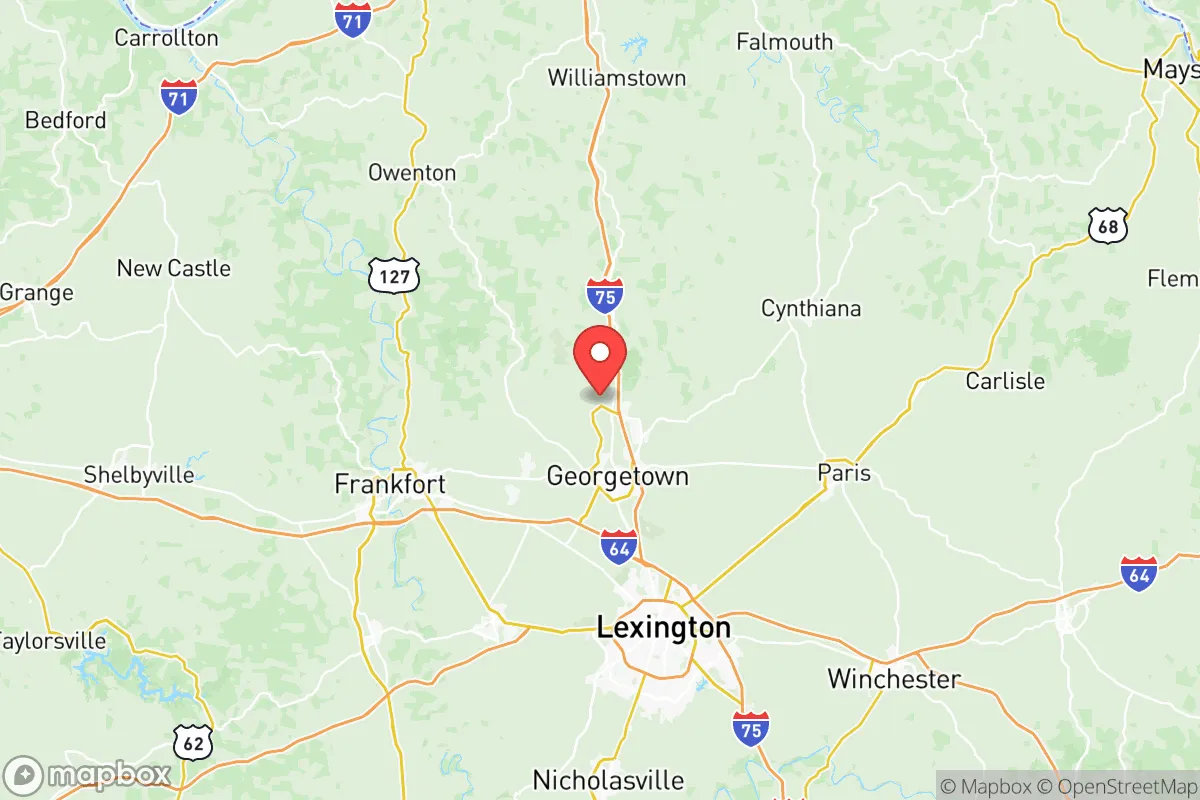
Scott County, Kentucky, is a classic example of a suburbanizing area that's becoming more politically competitive even as the state around it grows redder. The county's Cook Partisan Voting Index (PVI) of R+7 puts it notably to the left of Kentucky's statewide R+15, a gap that reflects the influence of fast-growing Georgetown and its expanding commuter population tied to Lexington. While the county still leans reliably Republican in most elections, the margin has been shrinking in recent cycles, with Democratic candidates occasionally winning precincts in the city of Georgetown itself, particularly around the Toyota plant and the newer subdivisions off Cherry Blossom Way. The rural stretches north and east of town, around Stamping Ground and Sadieville, remain deeply conservative, but the county's overall trajectory is toward a more purple shade of red.
How it compares
The R+7 vs. R+15 split between Scott County and the rest of Kentucky is not trivial. In practical terms, that means Scott County is about 8 points more Democratic-leaning than the state average. For context, a Republican presidential candidate might win Scott County by 12-14 points, while winning the state by 20+. This dynamic is driven almost entirely by Georgetown's growth: the city has added roughly 10,000 residents since 2010, many of them younger professionals and families moving from Lexington or out of state for jobs at Toyota, Amazon, and the growing logistics sector. These newcomers tend to be more moderate or even left-leaning on issues like education funding and infrastructure, even if they vote Republican at the presidential level. Meanwhile, the rural precincts in the county's northern half vote like the rest of rural Kentucky—solidly red, with little variation. The result is a county that feels politically split in a way that the state as a whole does not.
What this means for residents
For conservative residents, Scott County remains a comfortable place to live politically. The county commission, school board, and most local offices are held by Republicans, and the local GOP is active and well-organized. Conservative voters in Stamping Ground or Sadieville can expect their values to be reflected in local policy, from low taxes to Second Amendment protections. For liberal residents, the picture is more nuanced. While you won't find a progressive majority anywhere in the county, Georgetown's urban core and the areas near the Toyota plant have enough Democratic-leaning voters to make local elections competitive in some precincts. A liberal resident living in the newer subdivisions off US-25 can find like-minded neighbors, but they'll likely be in the minority at the county level. The practical effect is that Scott County is not a place where either side feels silenced, but conservatives clearly hold the upper hand in local governance.
Culturally, Scott County stands apart from much of the rest of Kentucky in its economic orientation. The Toyota plant, which employs over 8,000 people, has created a workforce that is more diverse and more tied to global manufacturing than the coal and agriculture economies that dominate eastern and western Kentucky. This has fostered a pragmatic, business-friendly political culture that sometimes puts local Republicans at odds with the state party's more culturally conservative wing. For example, Scott County has been more willing to invest in public infrastructure and education than some of its more rural neighbors. The county's politics are conservative, but they are a conservatism shaped by growth, industry, and the practical needs of a suburbanizing population—not the culture-war conservatism that dominates in other parts of the state.

State Political ClimatePolitical Climate in Kentucky
State Political AnalysisPolitical Environment in the State
Kentucky is a deeply conservative state, with a Cook Partisan Voting Index of R+15, meaning it votes about 15 points more Republican than the national average in presidential elections. The state has shifted sharply rightward over the past two decades: in 2000, Kentucky was a competitive swing state that went for George W. Bush by just 4 points, but by 2024, Donald Trump carried it by over 30 points. The dominant coalition is a mix of rural and small-town voters, evangelical Christians, and working-class whites, with the GOP holding supermajorities in both chambers of the state legislature and all but one statewide office.
Urban vs. rural divide
The political map of Kentucky is a textbook case of the urban-rural split. The state's two major population centers—Louisville (Jefferson County) and Lexington (Fayette County)—are the only reliably blue areas, consistently voting Democratic by double digits. Louisville, the largest city, is a union-heavy, racially diverse metro that anchors the state's Democratic base, while Lexington, home to the University of Kentucky, pulls in younger, college-educated voters. The rest of the state is overwhelmingly Republican. The Northern Kentucky suburbs of Cincinnati (Boone, Kenton, and Campbell counties) have shifted from swing territory to solidly red over the past decade. Bowling Green, home to Western Kentucky University and a growing immigrant population, is a rare purple dot in the south-central region, while Paducah and Ashland in the east are deeply conservative. The most dramatic shift has been in the eastern coalfields—places like Pikeville and Hazard—which were once Democratic strongholds (the "Blue Dog" era) but now vote Republican by 50-point margins, driven by cultural alignment and opposition to federal environmental regulations.
Policy environment
Kentucky's policy environment is among the most conservative in the nation. The state has a flat income tax that is being phased down from 5% to 4% by 2026, with a goal of eventual elimination. There is no state-level property tax on real estate; instead, local governments levy property taxes, keeping overall tax burdens low. The state is a right-to-work state (enacted in 2017), and public-sector unions have been weakened by subsequent legislation. On education, Kentucky has a robust school choice movement: the legislature passed a charter school law in 2017 (though no charters have opened yet) and created education opportunity accounts (vouchers) in 2021, though they were struck down by the state Supreme Court in 2023. Healthcare policy is dominated by the state's Medicaid expansion under the Affordable Care Act, which was implemented by a Democratic governor in 2014 and has been retained by subsequent Republican administrations, though with work requirements added. Election laws have tightened: Kentucky requires photo ID to vote, has restricted absentee voting, and shortened the early voting window. The state is also a "constitutional carry" state for firearms, meaning no permit is needed to carry a concealed weapon.
Recent policy direction
The last five years have seen Kentucky accelerate its conservative policy agenda. In 2023, the legislature passed a near-total abortion ban with no exceptions for rape or incest, only for medical emergencies—this after voters rejected a constitutional amendment in 2022 that would have declared no right to abortion. On gun rights, the state enacted permitless carry in 2019 and preempted local governments from enacting their own firearm ordinances. Parental rights have been a major focus: a 2022 law banned transgender girls from participating in girls' school sports, and a 2023 law restricted gender-affirming care for minors. On education, the legislature passed a "Don't Say Gay" style bill in 2023 that limits classroom discussion of sexual orientation and gender identity. Property rights have been strengthened with a 2021 law limiting eminent domain for carbon pipelines. On privacy and surveillance, Kentucky has no broad data privacy law, but it does have a biometric privacy law passed in 2022. Voting access has been restricted: the 2021 election reform law reduced the early voting window from three weeks to two weeks and eliminated same-day voter registration. The overall direction is toward maximizing individual liberty in economic and gun matters while restricting it on social and medical issues.
Civil unrest & political movements
Kentucky has seen significant political activism on both sides in recent years. The 2020 racial justice protests in Louisville following the death of Breonna Taylor were among the largest in the nation, with months of demonstrations, property damage, and a heavy police and National Guard presence. That movement led to "Breonna's Law," which banned no-knock warrants in Louisville, though the state legislature has not passed a statewide ban. On the right, the "Let Them Play" movement in 2020-2021 saw parents and students protesting school closures and mask mandates, particularly in suburban Oldham County and Boone County. The state has also been a flashpoint for election integrity debates: in 2020, then-Governor Andy Beshear (a Democrat) and the Republican-led legislature clashed over mail-in voting, leading to a lawsuit that limited the expansion. There is no sanctuary city movement in Kentucky; in fact, a 2023 law requires local law enforcement to cooperate with federal immigration authorities. Secession or nullification rhetoric is minimal, though there is a small "State of Franklin" movement in eastern Kentucky that talks about forming a separate state, but it has no political traction.
Projection
Over the next 5-10 years, Kentucky is likely to become even more Republican, but with a twist. The urban centers of Louisville and Lexington will continue to grow and become more Democratic, while the rural and exurban areas will become even more conservative. The key demographic shift is in-migration: Kentucky is attracting retirees and remote workers from higher-cost states like California, Illinois, and Ohio, who tend to be conservative and are drawn by low taxes and gun-friendly laws. The Bowling Green area is seeing the most growth, with a mix of immigrant labor (largely from Central America and Southeast Asia) and conservative newcomers, which could make it a swing area in the long run. The state's Republican Party is also likely to move further right on social issues, given the supermajority and the influence of groups like the Family Foundation of Kentucky. However, there is a growing libertarian streak, especially among younger conservatives, that could moderate the party on drug policy (medical marijuana was legalized in 2023) and criminal justice reform. The biggest wildcard is the state's education system: if school choice expands and public schools continue to struggle, it could accelerate the suburban flight that is already reshaping the political map.
For a new resident, the bottom line is this: Kentucky is a state where conservative values are deeply embedded in law and culture, and that is unlikely to change. If you are a conservative, you will find a welcoming policy environment with low taxes, strong gun rights, and a government that is actively pushing a social conservative agenda. If you are a liberal, you will find two blue cities where you can live comfortably, but you will have little political power at the state level and will face a legislature that is actively hostile to your views on abortion, LGBTQ rights, and education. The practical takeaway is that Kentucky is a state where your local community matters more than your state government—choose your county carefully, because the political reality varies dramatically between Louisville and the rest of the state.
* Values derived from national, state, county, city and local statistics and may differ in a specific area. Last updated: 2026-06-16T13:54:03.000Z
Narrative content on this page is AI-generated and may contain mistakes. Verify any details that matter before acting on them.
ReloMaps may earn a commission from affiliate links at no extra cost to you.

