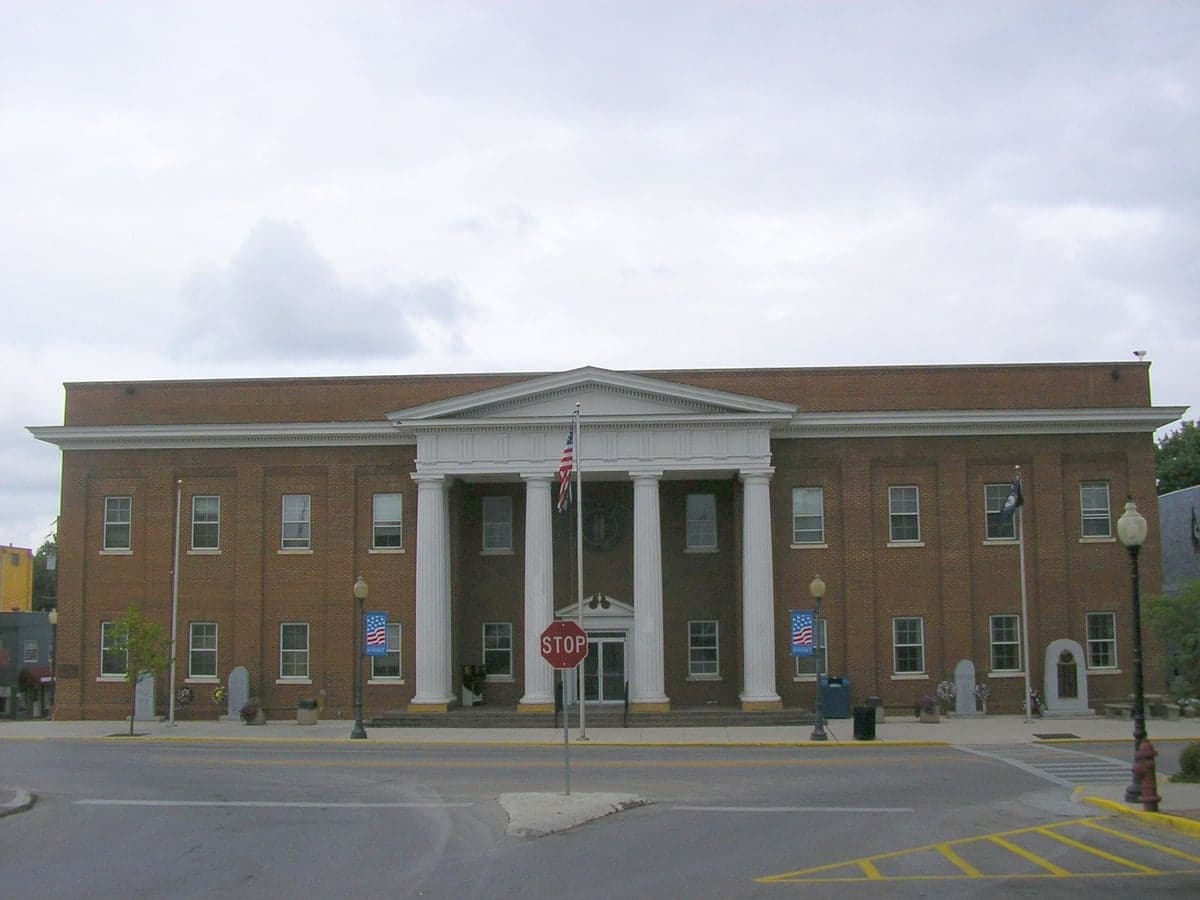
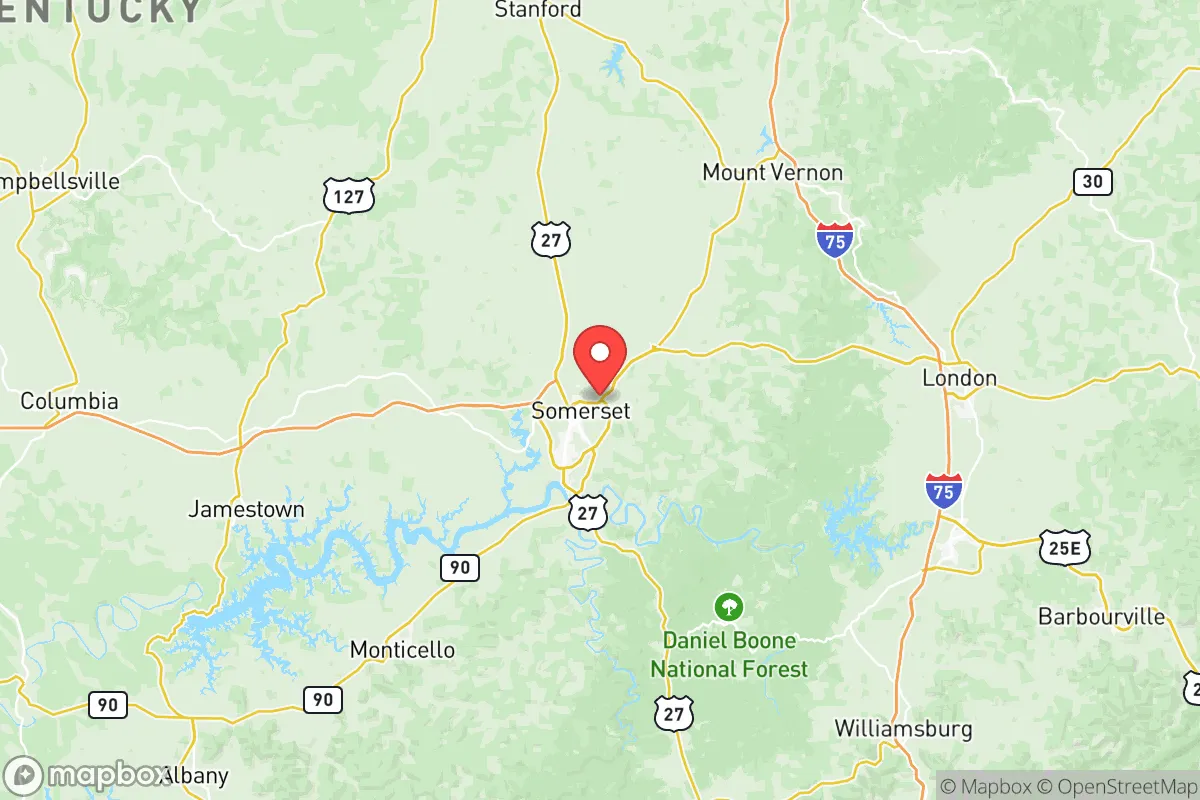

Photo: Wikipedia
Political ClimatePolitical Climate in Pulaski County
Showing district-level results — no local-only data available.
Local Political AnalysisPolitical Analysis of Pulaski County
Pulaski County is one of the most reliably Republican counties in Kentucky, with a Cook Partisan Voting Index (PVI) of R+32 — more than double the state's already solid R+15 rating. This isn't a recent shift; the county has voted Republican in every presidential election since 2000, and the margins have only widened. In 2024, Donald Trump carried Pulaski County by roughly 70 points, a number that would have seemed extreme even a decade ago. The trend is clear: the area is getting redder, and it's doing so faster than the state average.
How it compares
To understand Pulaski County's politics, you have to look at the contrast with the rest of Kentucky. The state as a whole is R+15, meaning it leans Republican by 15 points relative to the national average. Pulaski County, at R+32, is more than twice as conservative. That gap isn't uniform across the county, though. Somerset, the county seat and largest city, is the most moderate area — it's still reliably red, but you'll find a handful of precincts here that vote closer to 60-40 Republican, rather than the 80-20 splits you see in the rural stretches. Burnside and Ferguson lean even harder red, with precincts routinely hitting 85% Republican or higher. There are no real "blue" towns in Pulaski County; the closest thing to a swing area is the Somerset precinct around the Lake Cumberland Regional Hospital, where a mix of healthcare workers and retirees sometimes produces a slightly more balanced vote. But even there, it's still a Republican win by a comfortable margin.
What this means for residents
For conservative residents, Pulaski County is about as comfortable as it gets. Local offices — from the county judge-executive to the school board — are almost uniformly held by Republicans, and policy debates tend to focus on tax cuts, Second Amendment rights, and economic development. For liberal residents, the reality is different. You're in a clear minority, and that shapes daily life. Political conversations at work or in social settings often assume a conservative baseline, and progressive viewpoints can feel isolated. That said, Somerset has a small but active Democratic group that meets monthly, and the county's growing retiree population from out of state has introduced a slightly more diverse set of opinions. The practical effect is that liberal residents often find their political voice in state-level or national issues rather than local ones, where their vote carries less weight.
Culturally, Pulaski County stands apart from the rest of Kentucky in a few ways. The county is deeply influenced by Lake Cumberland, which brings in a seasonal tourism economy and a transient population that softens some of the more insular tendencies you see in neighboring counties like McCreary or Wayne. The local school system, Pulaski County Schools, is one of the few in the region to offer a full-time virtual academy, a policy that was driven by conservative parents' concerns about curriculum transparency. On the other hand, the county's reliance on manufacturing — companies like Fruit of the Loom and Halter Marine are major employers — means that economic pragmatism sometimes trumps ideological purity. You'll hear plenty of "small government" talk, but when a factory expansion is on the line, the county commission is quick to offer tax incentives. That's the Pulaski County way: deeply conservative, but with a practical streak that keeps things moving.

State Political ClimatePolitical Climate in Kentucky
State Political AnalysisPolitical Environment in the State
Kentucky is a solidly Republican state with a Cook PVI of R+15, meaning it votes about 15 points more Republican than the national average in presidential elections. The state has shifted dramatically over the past 20 years — from a competitive battleground that went for Bill Clinton twice in the 1990s to a deep-red stronghold where Donald Trump won by 26 points in 2020 and 30 points in 2024. The dominant coalition is a mix of rural and small-town voters, working-class whites, and evangelical Christians, with the GOP now holding supermajorities in both chambers of the state legislature and all but one statewide office.
Urban vs. rural divide
The political map of Kentucky is a textbook case of the urban-rural split. The two major population centers — Louisville (Jefferson County) and Lexington (Fayette County) — are the only reliably blue areas, with Louisville voting about 20 points more Democratic than the state average and Lexington about 15 points. These cities are surrounded by deep-red suburbs and exurbs: Shelbyville, Richmond, and Georgetown all vote Republican by 20-30 points. The rest of the state is overwhelmingly Republican, with the eastern Appalachian counties — Pikeville, Hazard, Prestonsburg — being some of the most Republican in the nation, often voting 70-80% for GOP candidates. The western part of the state, including Paducah and Bowling Green, is also solidly red, though Bowling Green (home to Western Kentucky University) has a slight moderating influence. The only other notable blue dot is Covington across the river from Cincinnati, which leans Democratic due to its urban character and proximity to Ohio.
Policy environment
Kentucky’s policy environment is conservative but not radically so. The state has a flat income tax that is being phased down from 5% to 4% by 2026, with a goal of elimination. There is no state-level property tax on real estate, though local governments levy them. The regulatory posture is business-friendly, with right-to-work laws and a tort reform cap on non-economic damages. Education policy is a flashpoint: the state has a school choice program (the Education Opportunity Account Act) that provides tax credits for private school scholarships, but it’s limited and has faced legal challenges. Healthcare is dominated by the expansion of Medicaid under the Affordable Care Act, which was implemented by then-Governor Matt Bevin (R) and has been maintained by his successors. Election laws are moderately restrictive: voter ID is required, early voting is limited to three days (including a Saturday), and no-excuse absentee voting was eliminated after the pandemic. The state does not have a “stand your ground” law, but it does have a “castle doctrine” and a permitless carry law (passed in 2019).
Recent policy direction
Kentucky’s recent legislative direction has been consistently conservative, with a focus on cultural and economic issues. In 2023, the legislature passed a near-total abortion ban with exceptions only for life of the mother, rape, and incest (with reporting requirements). The same year, it passed a law banning gender-affirming care for minors, overriding the governor’s veto. On gun rights, the state enacted permitless carry in 2019 and has not passed any significant restrictions since. On education, the legislature passed a “Parents’ Bill of Rights” in 2022 that requires schools to notify parents about curriculum changes and allows them to opt their children out of certain materials. On property rights, the state has a strong eminent domain protection law, and there is no statewide rent control. On privacy and surveillance, Kentucky has a biometric privacy law that requires consent before collecting biometric data, but it’s weaker than Illinois’s. On voting, the state passed a law in 2021 that shortened the early voting window and tightened absentee ballot rules, but it also expanded in-person early voting to three days (previously only one). The overall direction is toward more conservative cultural policy and lower taxes, but with a pragmatic streak on economic issues like Medicaid expansion.
Civil unrest & political movements
Kentucky has seen its share of political flashpoints, but they are less intense than in some other states. The most notable recent unrest was the 2020 protests in Louisville following the death of Breonna Taylor, which led to several nights of clashes between protesters and police, and the eventual passage of “Breonna’s Law” banning no-knock warrants. The state has a small but active progressive movement centered in Louisville and Lexington, with groups like the Kentucky Student Environmental Coalition and the Kentucky Poor People’s Campaign. On the right, the Kentucky Freedom Coalition and the Kentucky Family Foundation are influential, pushing for school choice, anti-abortion legislation, and religious liberty protections. Immigration politics are relatively quiet — Kentucky has a small foreign-born population (about 4%), and there are no sanctuary cities. There is no serious secession or nullification movement, though some rural counties have passed symbolic “Second Amendment sanctuary” resolutions. Election integrity controversies flared after 2020, with some Republican legislators pushing for audits, but no major changes were enacted. The most visible political flashpoint for a new resident would likely be the ongoing debate over school choice and the state’s abortion ban, which are regularly in the news.
Projection
Over the next 5-10 years, Kentucky is likely to remain solidly Republican, but the margin may narrow slightly due to in-migration from blue states and the growth of the Louisville and Lexington suburbs. The state’s population is aging and slowly declining in rural areas, while the urban centers are growing modestly. The flat tax phase-down will likely continue, making the state more attractive to retirees and remote workers. The abortion ban and transgender care restrictions are unlikely to be repealed unless there is a major shift in the legislature, which is currently gerrymandered to favor Republicans. The biggest wild card is the state’s education system: if school choice expands significantly, it could draw more families from neighboring states, but it could also exacerbate rural school closures. A new resident moving in now should expect a state that is culturally conservative, low-tax, and business-friendly, but with a growing urban-liberal minority that will keep the political conversation lively. The state is unlikely to flip blue in the next decade, but the margin of Republican victory could shrink from 30 points to 20 points in presidential races.
For a new resident, the bottom line is that Kentucky offers a stable, conservative political environment with low taxes and a strong sense of local community. If you’re a conservative, you’ll find your values reflected in state law and local culture. If you’re a liberal, you’ll find like-minded communities in Louisville and Lexington, but you’ll be in the minority statewide and will need to accept that state policy will not align with your views. The state is not a political battleground — it’s a settled red state where the main debates are about how conservative to be, not whether to be conservative at all.
* Values derived from national, state, county, city and local statistics and may differ in a specific area. Last updated: 2026-07-18T12:23:37.000Z
Narrative content on this page is AI-generated and may contain mistakes. Verify any details that matter before acting on them.
ReloMaps may earn a commission from affiliate links at no extra cost to you.

