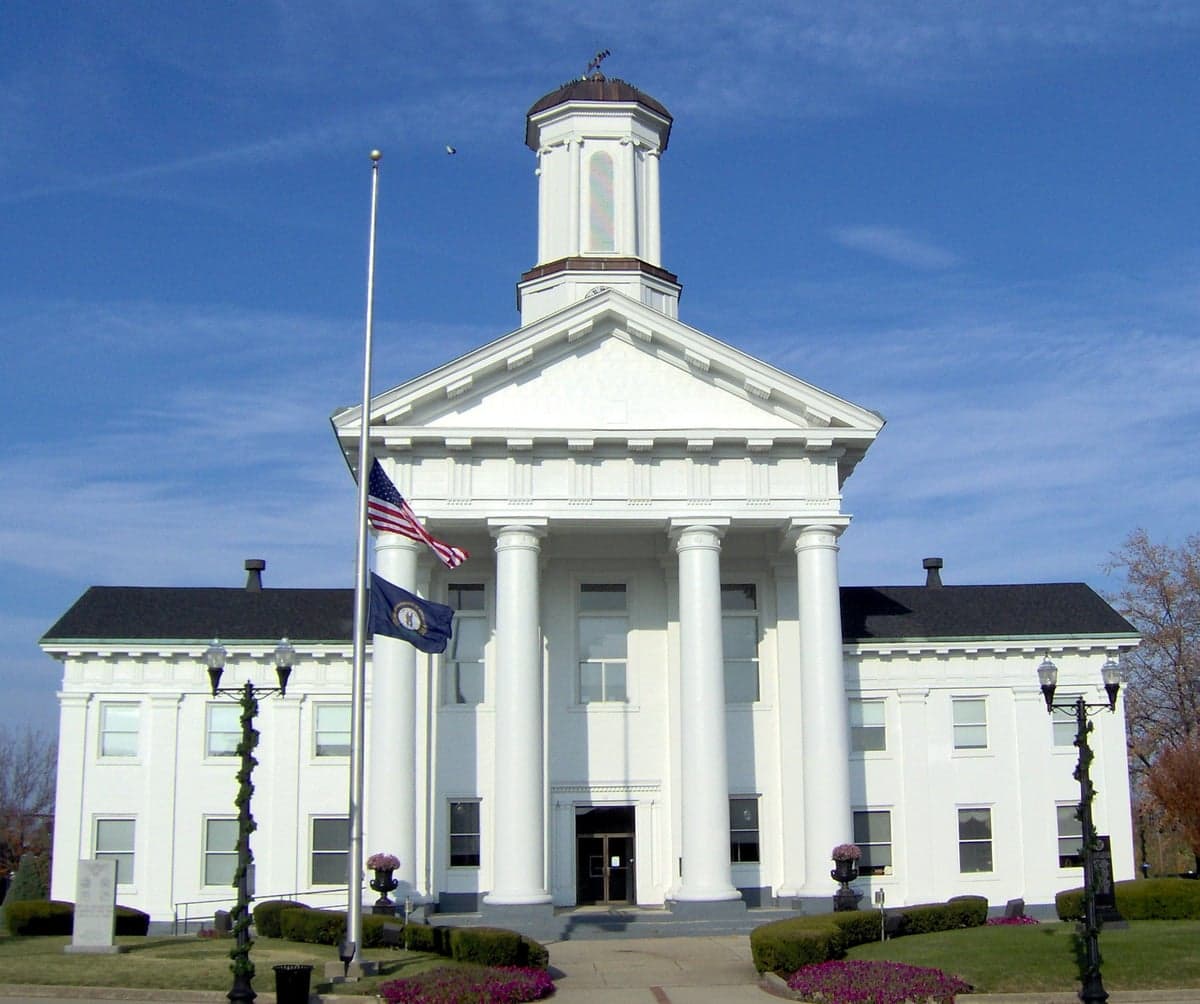
Photo: Wikipedia
Political ClimatePolitical Climate in Madison County
Showing district-level results — no local-only data available.
Local Political AnalysisPolitical Analysis of Madison County
Madison County, Kentucky, sits in a political sweet spot that's more competitive than the rest of the state, with a Cook Partisan Voting Index (PVI) of R+7 — meaning it leans Republican by 7 points, but is notably less red than Kentucky's statewide R+15. Over the past decade, the county has shifted rightward, but not as dramatically as many rural Kentucky counties. The real story is the internal split: Richmond, the county seat and home to Eastern Kentucky University (EKU), has become a blue-leaning island in a sea of red, while Berea and the rural areas around Waco and Kingston vote solidly Republican. The swing precincts are in the suburban fringe of Richmond — places like the Lake Reba area and the new developments along I-75 — where moderate voters decide local races.
How it compares
Compared to Kentucky as a whole, Madison County is a relative battleground. The state's R+15 PVI reflects deep-red strongholds like the Jackson Purchase and eastern coal counties, where Republicans routinely win by 30-40 points. In Madison County, the margin is tighter because of EKU's influence — the university brings in a steady stream of younger, more liberal faculty and students, and the city of Richmond has voted for Democratic candidates in recent gubernatorial and Senate races. For example, in the 2023 governor's race, Democrat Andy Beshear won Madison County by a slim margin, while he lost most other counties of similar size. Berea, with its artsy, progressive enclave around Berea College, also provides a small but consistent blue vote. The rural precincts, however, are deeply conservative — think gun rights, low taxes, and strong support for the GOP. This creates a county where the overall R+7 masks a genuine urban-rural divide, unlike the more uniformly red counties to the east and west.
What this means for residents
For conservative residents, Madison County is a comfortable place to live — they dominate county commission races, the school board, and the sheriff's office, and they can expect their views on fiscal policy and Second Amendment rights to be the default. For liberal residents, especially those in Richmond or Berea, the political climate is more of a mixed bag. You'll find like-minded neighbors in the college neighborhoods or downtown Berea, but you'll also encounter plenty of "Trump 2024" signs on the rural roads. The practical effect is that local policy tends to be moderate — the county government avoids the culture-war extremes seen in some rural Kentucky counties, partly because the EKU and Berea College communities provide a counterweight. For example, Madison County has not passed the kind of anti-LGBTQ ordinances seen in some neighboring counties, and the public schools in Richmond are more diverse and progressive than those in the rural parts of the county.
One cultural distinction that sets Madison County apart is the strong presence of Berea College, which is tuition-free and draws students from across the country and world. This gives Berea a distinctly progressive, international vibe that feels out of place in rural Kentucky. Meanwhile, Richmond's economy is tied to EKU and the growing healthcare sector, which attracts a mix of moderates and liberals. The rural areas, by contrast, are dominated by agriculture and small manufacturing, with a more traditionalist outlook. If you're moving here, your experience will depend heavily on which part of the county you choose — Richmond's west side near EKU feels like a small college town, while the eastern part near Kingston feels like deep-red Kentucky. The county's political trajectory is likely to stay R+7 for the near future, as the growth of Richmond's suburbs brings in more moderate voters, but the rural areas show no signs of flipping. For both conservatives and liberals, Madison County offers a rare thing in Kentucky: a place where your vote actually feels like it could matter in a close race.

State Political ClimatePolitical Climate in Kentucky
State Political AnalysisPolitical Environment in the State
Kentucky is a deeply red state with a Cook PVI of R+15, meaning it consistently votes about 15 points more Republican than the national average in presidential elections. Over the past 20 years, the state has shifted dramatically from a competitive swing state—where it voted for Bill Clinton in 1992 and 1996—to a solidly Republican stronghold, driven by the realignment of rural and working-class voters away from the Democratic Party. The dominant coalition is a mix of rural conservatives, evangelical Christians, and increasingly, suburban voters in the exurbs of Louisville and Cincinnati, while the Democratic base is now largely confined to the urban cores of Louisville, Lexington, and a handful of college towns.
Urban vs. rural divide
The political map of Kentucky is a textbook case of the urban-rural split. The two major metros—Louisville (Jefferson County) and Lexington (Fayette County)—are the only reliably blue areas, with Louisville voting for Joe Biden by about 20 points in 2020 and Lexington by about 15 points. These cities are home to the state's major universities (University of Louisville, University of Kentucky), a growing professional class, and a more diverse population. Outside these islands, the rest of the state is overwhelmingly Republican. The rural counties of eastern Kentucky (e.g., Pike, Floyd, Harlan) were once Democratic strongholds due to unionized coal miners, but they flipped hard to Trump in 2016 and have stayed red, often voting 70-80% Republican. The western part of the state, including the Purchase area around Paducah and the Pennyrile region around Hopkinsville, is also deeply conservative, with counties like Graves and Marshall routinely voting 75%+ Republican. A notable exception is the city of Bowling Green, home to a growing immigrant and refugee population (including a large Burmese community), which leans slightly more Democratic than its surrounding Warren County, though the county itself still votes Republican by about 20 points. The suburbs of Louisville—like Oldham County and Shelby County—are among the most Republican in the state, with Oldham County voting +40 R in 2020, making it a key driver of the state's overall lean.
Policy environment
Kentucky's policy environment is solidly conservative, with a low-tax, low-regulation posture that appeals to many relocators. The state has a flat income tax rate of 4.5% (as of 2025, down from 6% in 2018, with a path to 4% by 2026), no estate tax, and relatively low property taxes (average effective rate around 0.8%). Sales tax is 6% on most goods, but groceries and prescription drugs are exempt. The regulatory climate is business-friendly, with a right-to-work law (passed in 2017) and a tort reform system that caps non-economic damages in medical malpractice cases at $250,000. On education, Kentucky has a school choice program—the Education Opportunity Account Act (2022)—that provides tax credits for donations to scholarship funds for private school tuition, though it's been challenged in court. The state also has a near-total abortion ban (triggered by Roe v. Wade's overturn in 2022), with exceptions only to save the mother's life, and no exceptions for rape or incest. Election laws are moderately restrictive: voter ID is required, early voting is limited to three weeks (including two Saturdays), and no-excuse absentee voting was made permanent in 2021. The state does not have a "stand your ground" law, but it does have a Castle Doctrine and a concealed carry permit system that is shall-issue (permits must be granted if criteria are met).
Recent policy direction
Over the past five years, Kentucky has moved decisively to the right on several fronts. In 2023, the legislature passed a near-total ban on gender-affirming care for minors, overriding Governor Andy Beshear's veto, and also passed a law requiring schools to notify parents if a student requests a name or pronoun change. On gun rights, the state enacted permitless carry (constitutional carry) in 2019, allowing any adult who can legally own a firearm to carry it concealed without a permit. On education, the 2022 "Parents' Bill of Rights" (HB 563) requires schools to post curriculum materials online and allows parents to opt their children out of any instruction they find objectionable. On property rights, the state has no statewide rent control, and a 2024 law (HB 5) limits local governments' ability to regulate short-term rentals like Airbnb. On taxes, the 2022 tax reform package (HB 8) set the state on a path to eliminate the individual income tax entirely, contingent on revenue triggers. On voting, the state passed a 2021 law (SB 1) that shortened the absentee ballot window and required a notarized affidavit for absentee voters who are not in the military or overseas—a move that was criticized by voting rights groups but upheld in court. On medical freedom, Kentucky has no vaccine mandate for state employees or students, and a 2023 law (HB 220) prohibits employers from requiring COVID-19 vaccines as a condition of employment. The overall direction is toward maximizing individual liberty on gun rights, parental control, and tax burden, while restricting liberty on abortion and transgender medical care.
Civil unrest & political movements
Kentucky has seen relatively low levels of civil unrest compared to other states, but there have been notable flashpoints. The 2020 protests over the death of Breonna Taylor in Louisville were among the largest in the nation, with sustained demonstrations for months, a state of emergency, and the eventual firing of one officer and federal charges against others. This event deepened the urban-rural divide, with Louisville's Democratic leadership clashing with the Republican-controlled state legislature over police reform (the legislature passed a limited "Breonna's Law" banning no-knock warrants in 2021). On the right, the state has a strong gun rights movement, with the Kentucky State Rifle and Pistol Association being a major lobbying force. Immigration politics are less heated than in border states, but there is a small but vocal anti-sanctuary movement—Kentucky passed a law in 2020 (HB 4) requiring local law enforcement to cooperate with federal immigration authorities, effectively banning sanctuary cities. There is no serious secession or nullification movement, though some rural counties have passed symbolic "Second Amendment sanctuary" resolutions. Election integrity has been a recurring topic, with the 2020 election seeing Trump win Kentucky by 26 points, but no major controversies—the state's Republican Secretary of State, Michael Adams, has been praised for running smooth elections. A new resident would notice the political divide most in the stark difference between a Louisville coffee shop and a rural diner in Pikeville, but actual civil unrest is rare outside of the 2020 protests.
Projection
Over the next 5-10 years, Kentucky is likely to become even more Republican, driven by two trends: the continued out-migration of younger, more liberal residents from rural areas to cities outside the state (especially Nashville and Charlotte), and the in-migration of conservative retirees and remote workers from higher-tax states like California, Illinois, and New York. The suburbs of Louisville and Lexington are growing fastest—places like Georgetown (Scott County) and Richmond (Madison County)—and these areas are trending more Republican, not less, as they fill with families seeking lower taxes and conservative school policies. The Democratic base in Louisville and Lexington is aging and not being replenished by new arrivals at the same rate. The state's income tax is likely to be eliminated entirely by 2030, which will further attract fiscal conservatives. However, the state's aging population and low birth rate could create economic headwinds, potentially leading to more pressure for Medicaid expansion (already in place under Beshear) and education funding. A new resident moving in now should expect a state that is solidly red, with a policy environment that will continue to favor low taxes, gun rights, and parental control, but with a persistent urban-liberal minority that will keep the state from becoming as uniformly conservative as, say, Alabama or Mississippi.
For a new resident, the bottom line is this: if you're a conservative, you'll find Kentucky's political climate deeply welcoming—low taxes, strong gun rights, and a government that generally stays out of your business. If you're a liberal, you'll find a state where your vote in statewide elections is effectively meaningless, but where you can live comfortably in Louisville or Lexington with like-minded neighbors and a vibrant cultural scene. The practical takeaway is that Kentucky is a state where your personal politics will largely determine your experience—but where the cost of living and quality of life are high enough that many people on both sides find it a worthwhile trade-off.
* Values derived from national, state, county, city and local statistics and may differ in a specific area. Last updated: 2026-07-23T04:02:29.000Z
Narrative content on this page is AI-generated and may contain mistakes. Verify any details that matter before acting on them.
ReloMaps may earn a commission from affiliate links at no extra cost to you.

