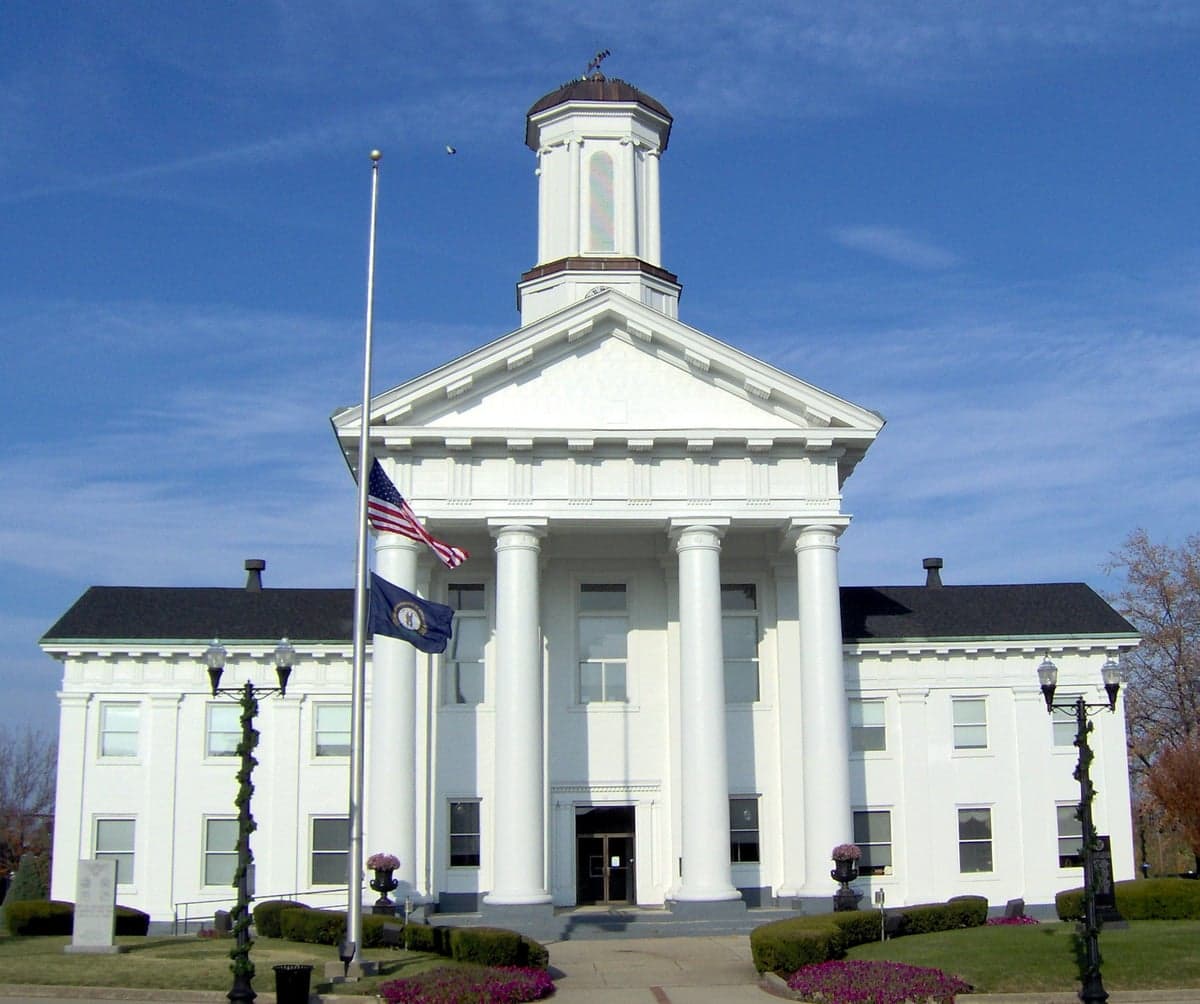
Photo: Wikipedia
Demographics of Madison County
Affluence Level in Madison County
A middle-class area roughly in line with national averages across income, home values, education, and employment.
People of Madison County
Madison County, Kentucky, is a predominantly white, college-educated community of 94,064 residents, anchored by the city of Richmond and the presence of Eastern Kentucky University. The county’s population is notably less diverse than the national average, with 88.0% identifying as white, 3.5% as Black, 3.4% as Hispanic, and a very small foreign-born share of just 1.4%. This demographic profile reflects a region shaped by early Appalachian settlement, a stable agricultural and manufacturing economy, and limited recent international immigration, giving it a character that is both historically rooted and culturally conservative.
Settlement & growth (pre-1960)
Long before European settlement, the land that is now Madison County was part of the hunting grounds of the Shawnee and Cherokee nations, who used the Kentucky River valley and the surrounding Bluegrass region for seasonal hunting and travel. No permanent Native American villages existed within the county’s borders, but the area was crisscrossed by the Warriors’ Path, a major trail used by indigenous peoples and later by early European explorers.
The first permanent European settlers arrived in the 1770s, primarily Scots-Irish and English pioneers moving west through the Cumberland Gap. These early settlers were drawn by the promise of fertile land under Virginia’s land grant system, and they established the first settlements along the Kentucky River, including the town of Richmond (founded 1798) and the smaller community of Berea (founded 1854). The Scots-Irish, in particular, brought a strong tradition of self-reliance, Presbyterianism, and suspicion of centralized authority—traits that still echo in the county’s political culture today. By 1800, Madison County’s population was almost entirely white, with a small number of enslaved Black laborers working on tobacco and hemp farms.
The 19th century saw gradual growth driven by agriculture and the arrival of the Louisville and Nashville Railroad in the 1850s, which connected Richmond to broader markets. The Civil War deeply divided the county, as it did much of Kentucky, with many residents supporting the Union while others fought for the Confederacy. After emancipation, freed Black families concentrated in small communities like Berea, which became a rare integrated town in the post-Reconstruction South thanks to the founding of Berea College in 1855—the first interracial and coeducational college in the South. However, the 1904 Day Law, which mandated racial segregation in Kentucky schools, forced Berea College to exclude Black students until 1950, and the Black population in the county began a long decline that continues today.
From 1900 to 1960, Madison County’s population grew slowly but steadily, reaching about 33,000 by 1950. The economy remained tied to agriculture (tobacco, corn, and livestock) and light manufacturing, with small factories opening in Richmond and Berea. The county saw little of the large-scale immigration from Southern and Eastern Europe that transformed industrial cities in the North; instead, its growth came from natural increase and modest in-migration from surrounding Appalachian counties. By 1960, the population was still overwhelmingly white and native-born, with a small Black community concentrated in Berea and the rural areas around Waco and Kingston.
Modern era (post-1965)
The 1965 Hart-Cellar Act, which dramatically increased immigration from Asia and Latin America, had a minimal impact on Madison County. The foreign-born population today stands at just 1.4%, far below the national average of about 14%. The county’s small Hispanic population (3.4%) is the largest immigrant-origin group, with most families arriving from Mexico and Central America in the 1990s and 2000s to work in agriculture, construction, and the service industry. These Hispanic residents are dispersed throughout the county, with small concentrations in Richmond and Berea, but no distinct ethnic enclave has formed.
The Black population, at 3.5%, has remained stable but small, reflecting the broader pattern of Black out-migration from rural Kentucky to urban centers like Lexington and Louisville. The Asian population (East and Southeast Asian) is tiny at 0.8%, and the Indian-subcontinent population is negligible at 0.1%. These groups are almost entirely composed of professionals and academics associated with Eastern Kentucky University in Richmond, and they tend to live in the university’s surrounding neighborhoods rather than forming ethnic clusters.
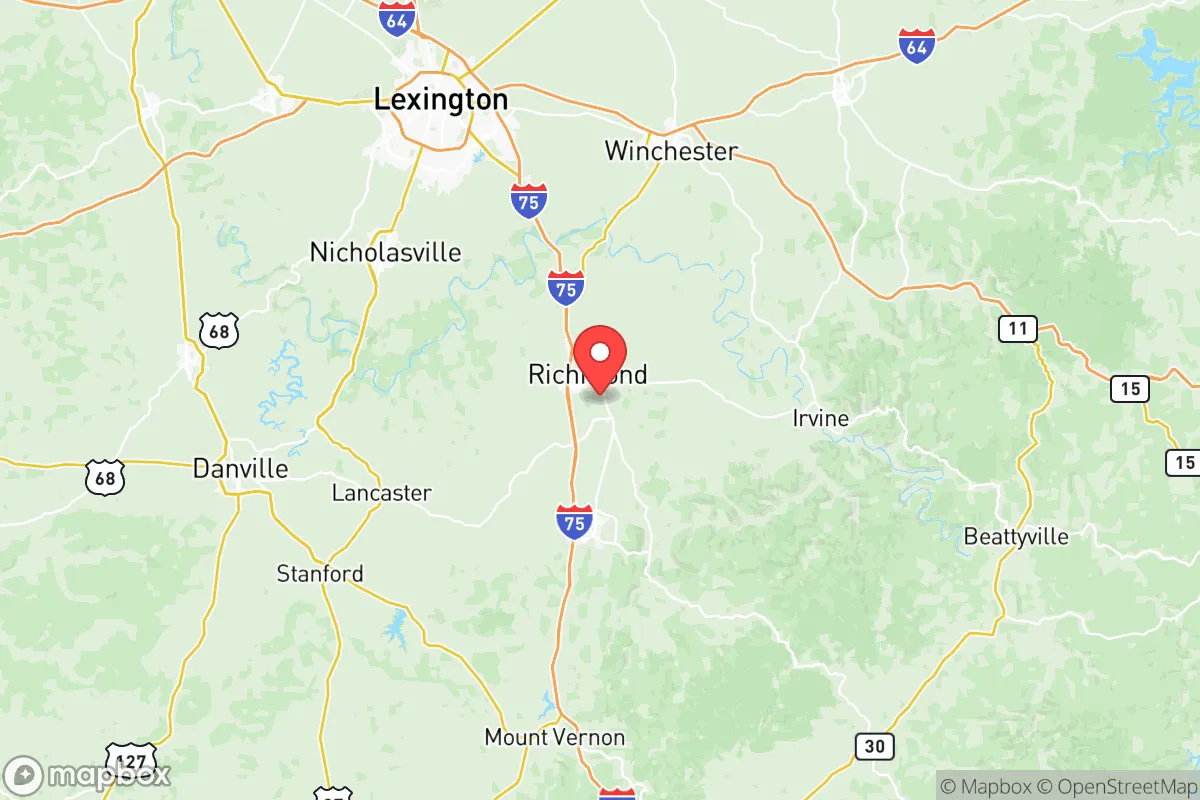
The most significant demographic shift since 1965 has been domestic: the growth of Richmond as a regional hub for education, healthcare, and manufacturing. Eastern Kentucky University expanded from a teachers’ college to a comprehensive regional university, drawing students and faculty from across the state and, to a lesser extent, the nation. The construction of Interstate 75 in the 1960s and 1970s connected Madison County to Lexington (20 miles north) and Knoxville, making it a viable commuter suburb for Lexington workers. This fueled suburban-style development in Richmond and along the I-75 corridor, with new subdivisions and shopping centers replacing farmland. The county’s population more than doubled from 1960 to 2020, from 33,000 to 94,000, driven almost entirely by white domestic migration from other parts of Kentucky and the Rust Belt.
The future
Madison County is projected to continue growing slowly, reaching roughly 105,000–110,000 by 2040, driven by its affordability relative to Lexington and its role as a regional education and healthcare center. The population will likely remain predominantly white, with the Hispanic share rising modestly to around 5–6% as second-generation families grow and new arrivals are drawn to construction and service jobs. The Black and Asian shares are expected to remain small, as the county lacks the economic diversity and urban amenities that attract larger minority populations.
The county’s cultural identity is evolving slowly. The old Scots-Irish and Appalachian heritage remains strong, visible in the prevalence of Baptist and Methodist churches, the popularity of hunting and outdoor recreation, and a general skepticism of rapid change. However, the growing presence of Lexington commuters and EKU faculty is introducing more secular and politically moderate voices, particularly in Richmond and the newer subdivisions along I-75. The rural areas around Berea, Waco, and Kingston remain more traditional and conservative.
For someone moving in now, Madison County offers a stable, safe, and affordable environment with a strong sense of local identity. The trade-off is limited diversity—both ethnic and cultural—and a pace of life that can feel insular to newcomers from more cosmopolitan areas. The county is becoming slightly more suburban and diverse, but it will remain, for the foreseeable future, a predominantly white, college-educated community with deep roots in Appalachian and Bluegrass traditions.

* Values derived from national, state, county, city and local statistics and may differ in a specific area. Last updated: 2026-07-23T04:02:29.000Z
Narrative content on this page is AI-generated and may contain mistakes. Verify any details that matter before acting on them.
ReloMaps may earn a commission from affiliate links at no extra cost to you.

