
Photo: Wikipedia
Political ClimatePolitical Climate in Hopkins County
Showing district-level results — no local-only data available.
Local Political AnalysisPolitical Analysis of Hopkins County
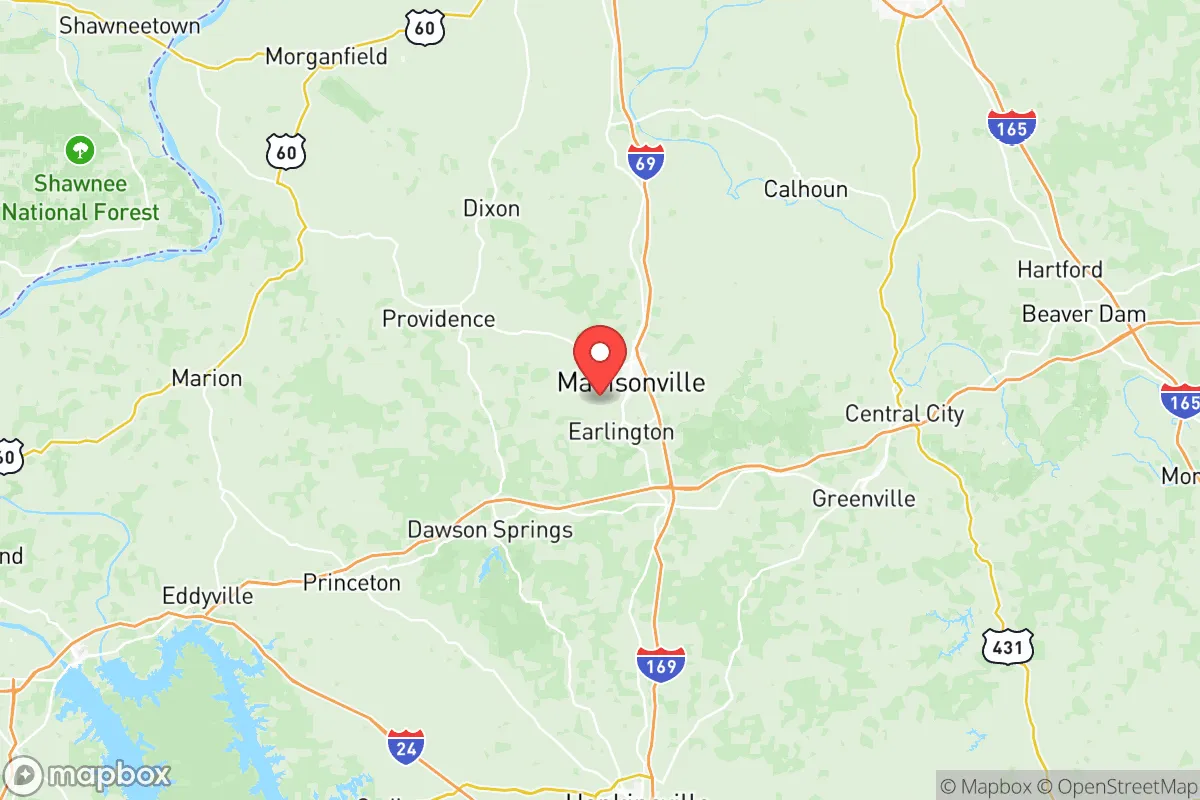
Hopkins County, anchored by the city of Madisonville, is one of the most reliably Republican corners of Western Kentucky, carrying a Cook PVI of R+23 that puts it a solid eight points to the right of the state as a whole (R+15). That gap has actually widened over the last decade; while Kentucky was already a safe red state, Hopkins County has been trending deeper red, with straight-ticket GOP voting now the norm in most precincts. The shift mirrors the broader collapse of the old Blue Dog Democrat machine that once dominated local courthouse politics, but the county still holds some interesting micro-variation that catches even longtime residents off guard.
How it compares to Kentucky statewide
The R+23 figure means Hopkins County votes about as Republican as the most conservative parts of the state — think Clinton or Wayne County. Statewide, Kentucky's R+15 is driven heavily by the Louisville and Lexington suburbs; strip those out, and the rest of the state leans closer to R+20. Hopkins County is emblematic of that rural and exurban shift. The margin in 2024 was roughly 72-26 for the GOP presidential ticket, well above the statewide 62-36 split. But the county isn't a monolith. Madisonville proper has a handful of precincts around the courthouse square and near the hospital that split closer to 55-45 or even 50-50, reflecting its sizeable African American population (around 15%) and union-aligned voters at the old strategic metals plants. Head west to Dawson Springs, devastated by the 2021 tornadoes, and you'll find pockets of Democratic sympathy tied to FEMA recovery frustrations and a lingering independent streak. Meanwhile, Earlington, Nortonville, and Mortons Gap are reliably deep-red, often hitting 80% GOP. The swing precincts are really the semi-rural strips along the Pennyrile Parkway — places like Hanson and Mannington — where local council races can flip 5-10 points based on a single issue like school funding versus a new industrial park.
What this means for residents
For a conservative family, Hopkins County offers a political environment that feels almost tailor-made. The county commission, school board, and most city councils (except Madisonville's slightly more balanced body) are solidly Republican. Property taxes stay low, the local gun culture is respected, and church-led social policy — from school prayer to anti-abortion ordinances — is the baseline. For liberal residents, the reality is more constrained but not hostile. The Democratic presence that survives in Madisonville is organized enough to be a vocal minority — you'll see "We Believe" signs in yards near the university and the regional hospital — and progressive candidates for city council often get 40% of the vote in the urban core. But statewide issues like school choice vouchers or abortion restrictions pass here with overwhelming majorities, and local activism tends to focus on pragmatic issues (economic development, flood control) rather than ideological fights.
The biggest cultural distinction here versus Lexington or Louisville is the near-total absence of suburban suburbanization pressure. No one expects Hopkins County to turn purple anytime soon. The economic base — mining, healthcare (Baptist Health Madisonville), and light manufacturing — doesn't generate the kind of high-tech or academic cohort that swings a county left. The long-term trajectory is steady, not dramatic: 2028 will probably see another R+22 or R+24 result. For newcomers, what matters is that the political culture is old-fashioned Western Kentucky — friendly, neighborly, and quietly partisan. You'll be welcomed into a church potluck without anyone asking your registration, but the odds of meeting a vocal Trump critic at that potluck are low outside of a few specific Madisonville living rooms. It's a place where elections are decided in the primary, and the general is a formality.

State Political ClimatePolitical Climate in Kentucky
State Political AnalysisPolitical Environment in the State
Kentucky is a deeply red state with a Cook PVI of R+15, meaning it votes about 15 points more Republican than the national average in presidential elections. The dominant coalition is a mix of rural, working-class voters, evangelical Christians, and an increasingly conservative-leaning suburban base, though the state has not always been this way—it was a reliably Democratic stronghold in state and local elections as recently as the 1990s. Over the last 20 years, the shift has been dramatic: Democrats held both U.S. Senate seats as late as 2014, but now Republicans hold all but one of the state’s six House seats, both Senate seats, and supermajorities in the state legislature. The 2024 presidential race saw Donald Trump win Kentucky by roughly 30 points, a margin that has widened from about 15 points in 2016, driven largely by the collapse of Democratic support in rural and exurban areas.
Urban vs. rural divide
The political map of Kentucky is a textbook study in the urban-rural split. The state’s two major metros—Louisville (Jefferson County) and Lexington (Fayette County)—are the only reliably blue areas, with Louisville voting about 20 points more Democratic than the state average and Lexington about 15 points. These cities are home to the University of Louisville, the University of Kentucky, and a growing professional class, and they consistently elect Democrats to local offices and the state legislature. But outside these islands, the landscape is overwhelmingly red. The state’s third-largest city, Bowling Green (Warren County), has been trending Republican for a decade and now votes about 20 points to the right of the national average. The coal-mining region of eastern Kentucky—places like Pikeville, Hazard, and Prestonsburg—was once a Democratic stronghold but has flipped hard red, with some counties voting 80% or more for Trump in 2024. The northern suburbs of Cincinnati, such as Boone County and Kenton County, are reliably Republican but with a moderate, business-friendly flavor. The most politically distinct suburb is probably Covington, just across the Ohio River from Cincinnati, which has a small but vocal progressive community and has elected a Democratic mayor in recent cycles, though it still votes Republican in statewide races.
Policy environment
Kentucky’s policy environment is conservative but with a pragmatic, low-tax bent. The state has a flat income tax rate of 4.5% as of 2025, down from 6% in 2018, with a scheduled phase-down to 4% by 2026. There is no state-level property tax on real estate, though local governments levy them. The regulatory posture is business-friendly: Kentucky is a right-to-work state (since 2017), and it has no state-level minimum wage above the federal $7.25. Education policy is a flashpoint: the state has a robust school choice movement, with a 2022 law creating education opportunity accounts (vouchers) for low-income students, though these were struck down by the state Supreme Court in 2023. The legislature is currently considering a constitutional amendment to allow school choice. Healthcare is a mixed bag: Kentucky expanded Medicaid under the Affordable Care Act in 2014, and about 30% of the state’s population is on Medicaid, but the state has also imposed work requirements for able-bodied adults (currently blocked by courts). Election laws are moderately restrictive: Kentucky requires a photo ID to vote, has no-excuse absentee voting only since 2020 (temporarily extended), and has a 14-day early voting period. The state does not have automatic voter registration.
Recent policy direction
The last five years have seen Kentucky move decisively to the right on nearly every axis a relocator might care about. On gun and self-defense law, Kentucky is a constitutional carry state (permitless carry for adults 21 and over, passed in 2019), and it has a strong "stand your ground" law with no duty to retreat. On parental and education rights, the 2022 "Parents’ Bill of Rights" (HB 563) requires schools to notify parents of any changes to a student’s health or well-being, and it bans instruction on sexual orientation or gender identity in grades K-5. On speech, Kentucky has no state-level hate crime law, and the legislature has passed measures to restrict protest-related liability (2021’s SB 175, which shields drivers who hit protesters from civil liability in certain circumstances). On privacy and surveillance, the state has a limited biometric privacy law (2024’s HB 563) but no comprehensive data privacy statute. On medical and bodily autonomy, Kentucky has one of the strictest abortion bans in the nation (trigger law effective 2022, with no exceptions for rape or incest, only to save the mother’s life), and it has banned gender-affirming care for minors (2023’s SB 150). On property rights, Kentucky is a "Dillon’s Rule" state, meaning local governments have only the powers explicitly granted by the state, which limits local zoning and land-use control. On taxation, the flat tax phase-down is the marquee policy, with the goal of eliminating the income tax entirely by 2030. On voting and ballot access, the state has tightened voter ID requirements and shortened the window for absentee ballot requests, though it has also expanded early voting to 14 days.
Civil unrest & political movements
Kentucky has seen its share of political flashpoints. The 2020 protests in Louisville following the death of Breonna Taylor were among the largest in the nation, with weeks of demonstrations, property damage, and a heavy police response. That event galvanized a progressive movement in Louisville, but it also hardened conservative sentiment in the rest of the state, contributing to the GOP’s supermajority in the legislature. The state has a small but active militia movement, particularly in rural areas, and there have been scattered incidents of election integrity skepticism—though Kentucky’s paper ballot system and strict ID laws have kept those controversies quieter than in some other states. Immigration politics are relatively low-key because Kentucky has a small foreign-born population (about 4%), but there have been local flare-ups, such as in Shelbyville, where a meatpacking plant’s hiring of immigrant workers sparked tensions in 2017. There is no sanctuary city policy anywhere in the state; Louisville has a "welcoming city" ordinance but does not limit cooperation with federal immigration authorities. Secession or nullification rhetoric is virtually nonexistent, though there is a persistent strain of Appalachian regionalism that sometimes expresses itself in anti-federal sentiment.
Projection
Over the next 5-10 years, Kentucky is likely to become even more Republican, driven by two trends: the continued out-migration of young, college-educated liberals from rural areas to Louisville and Lexington (or out of state entirely), and the in-migration of retirees and remote workers from higher-tax states like Illinois and California, who tend to be conservative-leaning. The flat tax phase-down will accelerate this, as it makes Kentucky more attractive to high-income earners. The urban-rural divide will deepen: Louisville and Lexington will remain blue, but the suburbs around them—places like Oldham County (Louisville) and Jessamine County (Lexington)—will continue to shift right. The coal counties of eastern Kentucky will continue to lose population, reducing their political clout. The biggest wild card is the state’s education system: if the school choice movement succeeds in passing a constitutional amendment, it could reshape the political landscape by drawing more families to the state. For a new resident, the realistic expectation is that Kentucky will be a solidly red state for the foreseeable future, with a conservative policy environment that is unlikely to change dramatically, but with two distinct blue cities that offer a counterbalance for those who want it.
For a new resident, the bottom line is this: if you are conservative, you will find a state that aligns with your values on taxes, guns, education, and social issues, with a government that is actively moving in your direction. If you are liberal, you will find two welcoming cities with strong cultural amenities and a progressive community, but you will be living in a state where your vote has little impact on statewide elections and where the legislature is actively passing laws you likely oppose. The practical takeaway is that Kentucky offers a clear choice: pick your city carefully, and understand that the state government will be conservative regardless of where you live.
* Values derived from national, state, county, city and local statistics and may differ in a specific area. Last updated: 2026-06-30T07:15:23.000Z
Narrative content on this page is AI-generated and may contain mistakes. Verify any details that matter before acting on them.
ReloMaps may earn a commission from affiliate links at no extra cost to you.

