
Photo: Wikipedia
Personal Sovereignty in Hopkins County
Viable for self-reliance. Generally workable, though some barriers may limit total independence.
What does Personal Sovereignty tell us?
Personal Sovereignty measures your capacity for self-reliance and independence with minimal government friction. Higher scores mean fewer barriers between you and the way you want to live... but it assumes you have the space you need and good neighbors.
What does this tell us?
Personal Sovereignty measures your capacity for self-reliance and independence with minimal government friction. Higher scores mean fewer barriers between you and the way you want to live... but it assumes you have the space you need and good neighbors.
State Policy
Energy independence: Importer (60% of energy produced in-state)
Personal Liberty
Homesteading

Personal Liberty Analysis
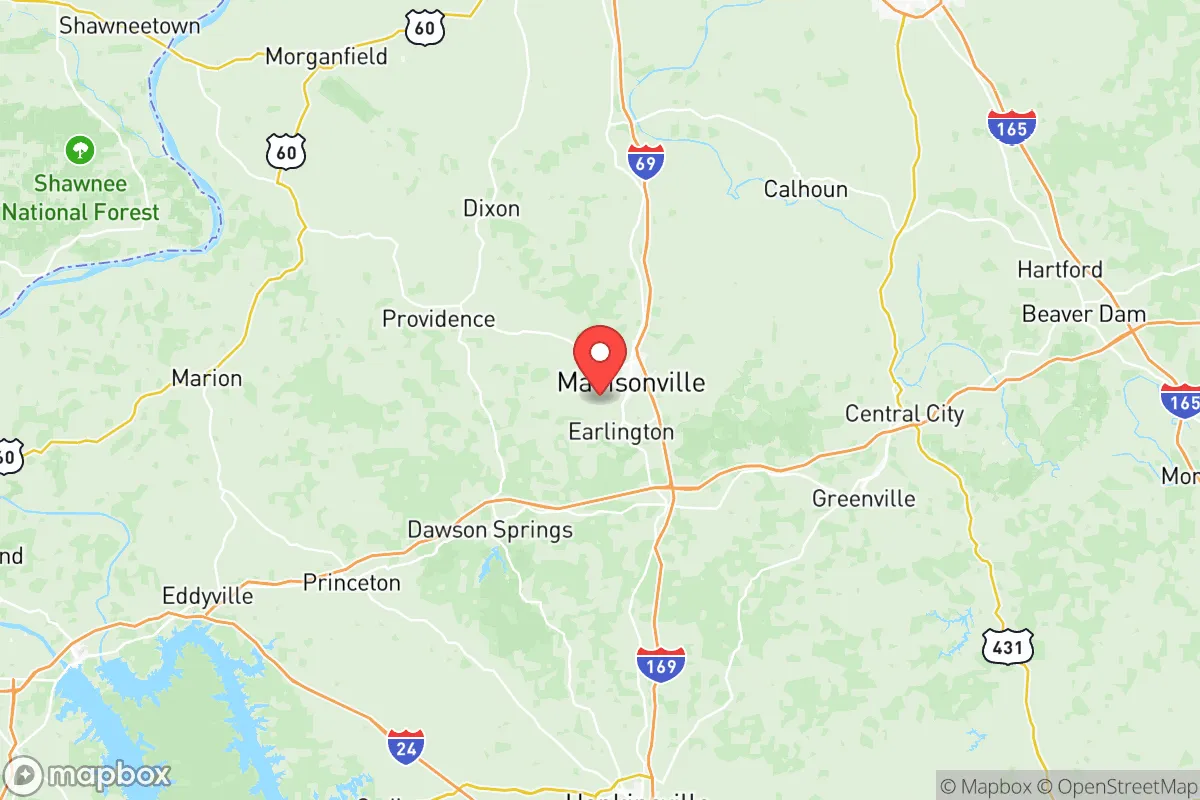
Hopkins County, Kentucky offers an autonomy environment that leans decisively toward personal freedom, with a governing culture that typically permits residents wide latitude in their private and business decisions. The county seat, Madisonville, serves as the economic and administrative center, but the surrounding unincorporated areas and small communities like Earlington, Nortonville, Mortons Gap, and Dawson Springs exhibit even lighter regulatory touches. For individuals and families prioritizing self-direction over government oversight, Hopkins County presents a balance of low taxes, permissive gun laws, and open land-use policies that set it apart from more restrictive urban centers in the state, such as Lexington or Louisville.
Tax burden and regulatory environment for individuals and businesses
Kentucky's state income tax is a flat 4% as of 2026, with scheduled reductions heading toward elimination, and Hopkins County applies no additional local occupational tax on wages, keeping take-home pay higher than in many other Kentucky counties. Property taxes in Hopkins County remain among the lowest in the state, with a combined real estate tax rate (county plus school and fire districts) around $0.72 per $100 of assessed value. This means a $200,000 home carries an annual property tax bill near $1,440, far below the national average. Business licensing is straightforward, and the county does not impose a net profit tax on local enterprises. The zoning regime in Madisonville is moderate—covering standard commercial and residential setbacks—but the county's unincorporated areas are largely free of zoning ordinances. In communities like Earlington, Mortons Gap, and Dawson Springs, residents can operate home-based businesses, park work vehicles on their property, and build accessory structures with minimal red tape. The Kentucky Right to Work law and the state's status as a "business-friendly" jurisdiction further reinforce a low-regulatory posture that attracts conservative-leaning residents.
Self-defense rights and Kentucky gun law specifics affecting daily carry
Kentucky is a constitutional carry state, meaning any law-abiding adult 21 or older can carry a concealed firearm without a permit. This applies fully in Hopkins County, where sheriff's office policy has been historically supportive of Second Amendment rights. The county has a Sheriff Mark "B" who has publicly affirmed that concealed carry permits are issued without unnecessary delay for those who choose to obtain one (useful for reciprocity in other states). Open carry is legal without a license. There are no county-level restrictions on magazine capacity or firearm types, and the state's "stand your ground" law removes any duty to retreat before using deadly force in self-defense. Local gun stores in Madisonville, such as Hopkins County Pawn & Gun, report high traffic from residents stocking up on home-defense firearms. The closest gun range is the Madisonville Gun Club, offering a 200-yard rifle range. In practice, a resident in Nortonville or Dawson Springs faces no practical barriers to carrying a sidearm while running errands or hiking, and the legal environment actively supports those who choose to be armed.
Self-reliance and homesteading viability across Hopkins County
Hopkins County is well-suited for homesteading, self-sufficiency, and off-grid living, especially outside the Madisonville city limits. Minimum lot sizes vary by jurisdiction: within Madisonville, standard residential lots are typically 8,000-10,000 square feet, but unincorporated areas of the county have no minimum lot size requirement for agricultural use. Large parcels of 5, 10, or 20 acres are commonly available, with prices averaging $3,000-$5,000 per acre as of 2026. Zoning in rural areas is minimal or nonexistent, allowing residents to raise livestock—chickens, goats, and even cattle—without a special permit. Gardens, greenhouses, and small orchards are unrestricted. Off-grid viability is high: Kentucky does not require a grid connection for a dwelling, though septic system permitting is required through the county health department. Solar panels, rainwater collection, and composting toilets are all legal, and the county's building code applies only to new construction, not to existing structures or renovations. In Nortonville and Mortons Gap, properties often come with working wells and septic systems already in place, lowering upfront homesteading costs. For families seeking to get off the grid partially or fully, Hopkins County's rural character and lax enforcement provide a realistic path.
Parental rights, medical autonomy, free speech, and property protections
Kentucky law strongly supports parental rights in education and medical decisions. The state's "Parental Rights" statute (KRS 530.780) gives parents the explicit right to direct the upbringing, education, and healthcare of their minor children, and school districts in Hopkins County—particularly the Hopkins County School District—have maintained parental notification policies regarding health services and instructional materials. Medical autonomy is broad: Kentucky does not require a prescription for most over-the-counter medications, and telemedicine access is unrestricted. There is no state or county mask or vaccine mandate in effect as of 2026. The county's health department, based in Madisonville, offers wellness services but does not enforce compulsory health interventions. Free speech and assembly are robust, with no local noise or signage ordinances that would prevent posting political yard signs, and residents in Earlington or Dawson Springs can voice opinions publicly without fear of escalation. Property rights are protected by Kentucky's relatively low property tax caps and the strong "right to farm" law that shields agricultural operations from nuisance lawsuits. The county planning commission's authority is limited to subdivisions of 10 or more lots, so splitting a 20-acre parcel into two 10-acre homesteads requires no county approval. These protections collectively create a high-sovereignty environment where families can live largely as they see fit.
Compared to other regions of Kentucky, Hopkins County ranks in the upper tier for personal sovereignty. Its neighbor to the north, Webster County, is similarly permissive, but Hopkins offers better access to services in Madisonville while retaining rural freedom. In contrast to Fayette or Jefferson counties, which impose stricter zoning, higher taxes, and more regulation on firearms and land use, Hopkins County remains a haven for those who value autonomy. For single individuals and families seeking a place where governmental interference is low and personal responsibility is high, Hopkins County represents a strong option within the southern freedom corridor.

* Values derived from national, state, county, city and local statistics and may differ in a specific area. Last updated: 2026-06-30T07:15:23.000Z
Narrative content on this page is AI-generated and may contain mistakes. Verify any details that matter before acting on them.
ReloMaps may earn a commission from affiliate links at no extra cost to you.

