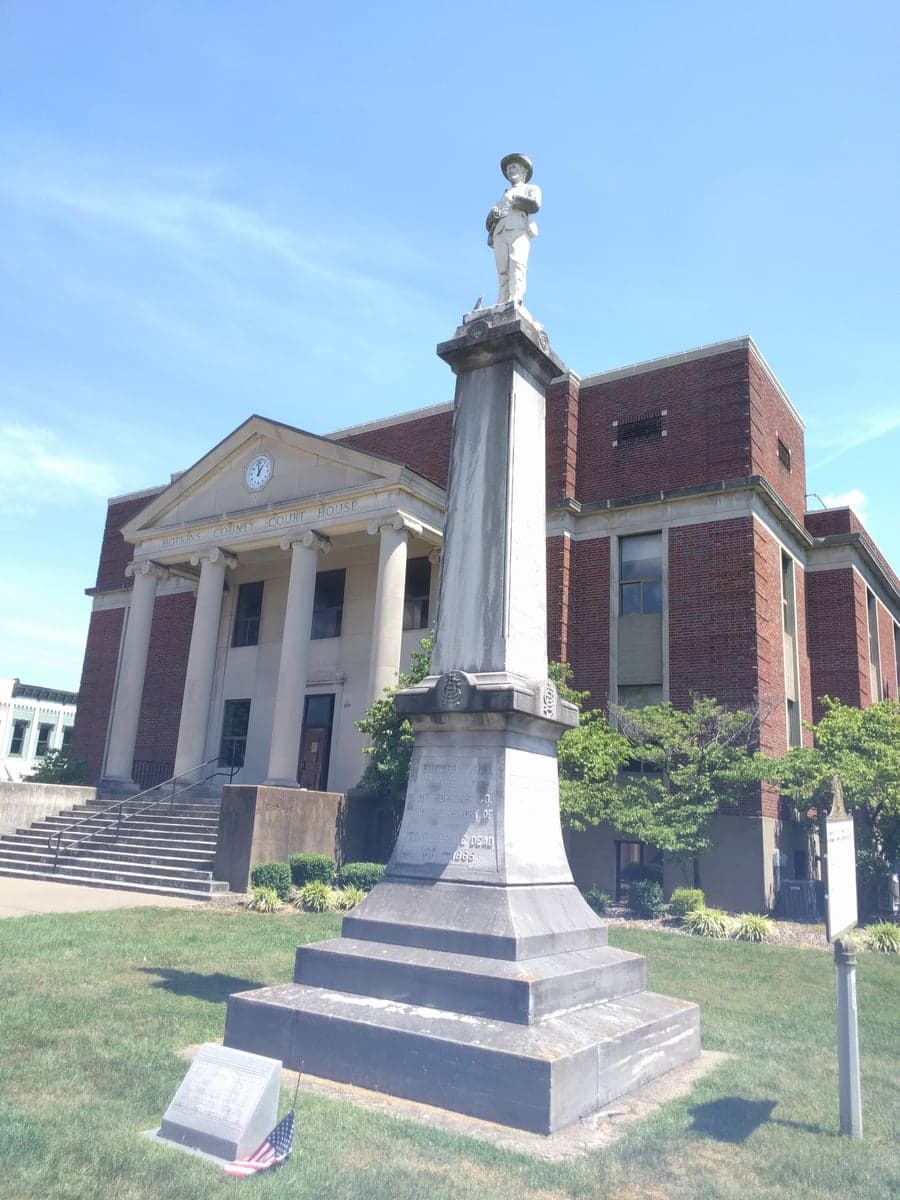
Photo: Wikipedia
Demographics of Hopkins County
Affluence Level in Hopkins County
A below-average socioeconomic profile. Incomes, home values, and educational attainment trail the U.S., with higher poverty and unemployment.
People of Hopkins County
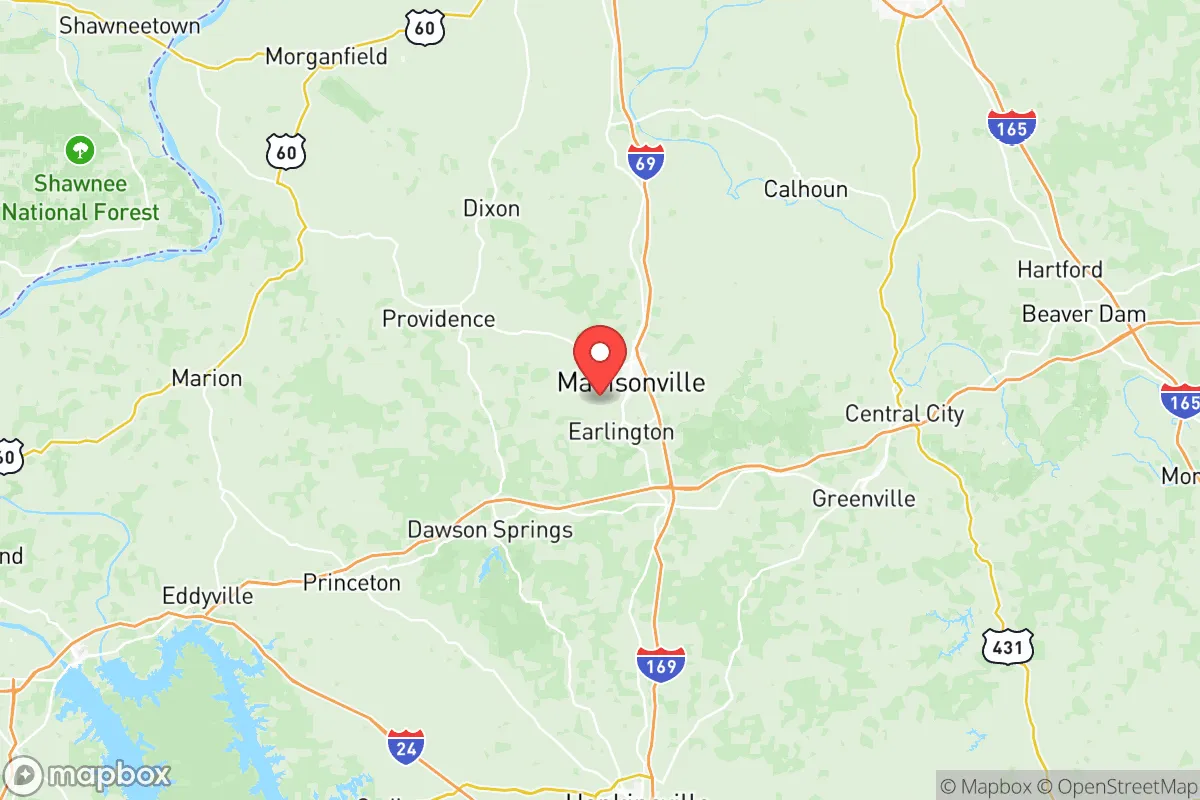
Hopkins County, Kentucky, is home to 45,143 residents, a population that is 87.3% white with a notably small foreign-born share of just 1.2%. The county, anchored by the city of Madisonville, maintains a distinctly rural and Southern character with a strong industrial and mining heritage, and its population today is less racially diverse than the state average. The area’s identity is shaped by deep family roots, a conservative social fabric, and an economy historically tied to coal, manufacturing, and healthcare.
Settlement & growth (pre-1960)
Before European settlement, the land that became Hopkins County was part of the ancestral hunting grounds of the Shawnee and Cherokee nations, who used the region’s abundant game and salt licks. No permanent Native American villages existed here; the area was a contested borderland between tribes and, later, between French and British colonial claims. The first wave of European settlers arrived after the American Revolution, primarily Scots-Irish and English pioneers migrating south and west from Virginia and North Carolina through the Cumberland Gap.
Hopkins County was formally created in 1806 from a section of Henderson County. These early settlers were yeoman farmers who took up land grants in the fertile bottomlands along the Green River, establishing small hamlets like Earlington, Mortons Gap, and the future county seat, Madisonville. The county’s population grew slowly but steadily through the antebellum period, supported by subsistence agriculture, tobacco, and salt production. Slavery existed but was not dominant; by 1860, enslaved African Americans made up about 20% of the county’s population, a figure lower than the Kentucky Bluegrass region. The Reconstruction era saw the establishment of small free Black communities, particularly in and around Madisonville and White Plains.
The transformative moment for Hopkins County’s population came in the late 19th century with the discovery of vast bituminous coal reserves. From the 1880s through the 1920s, the county experienced a boom as mining companies opened shafts and railroads extended into the region. This industrial wave attracted a new population: white miners from the Appalachian coalfields of eastern Kentucky, West Virginia, and Tennessee, along with a smaller number of Italian and Eastern European immigrants who came to work the mines. The town of Nortonville grew rapidly as a rail and mining hub, while Mannington and St. Charles became company towns built around specific coal operations. By 1930, the county’s population had nearly doubled from its 1880 level, reaching roughly 35,000.
World War II and the subsequent decades saw the mining industry consolidate, and manufacturing began to supplement coal as an economic driver. The Great Migration of African Americans out of the South did not significantly alter Hopkins County’s demographics—its Black population share remained relatively stable. The post-war period was primarily one of suburbanization within the county, as families moved from mining camps into expanding neighborhoods in Madisonville and Earlington. By 1960, the county’s population stood at approximately 38,000, almost entirely white and native-born.
Modern era (post-1965)
The 1965 Hart-Cellar Act had little direct impact on Hopkins County, as the region did not attract the major immigrant waves that reshaped larger cities. The foreign-born population today sits at just 1.2%, well below the national average. The limited immigration that has occurred is largely from Mexico and Central America, with Hispanic residents now making up 2.5% of the county’s total. These families have settled primarily in Madisonville, working in agriculture, poultry processing, and the restaurant industry.
The major demographic story of the modern era has been domestic migration and population stagnation. From 1960 to 2020, the county’s population waxed and waned with the coal cycle, peaking at around 47,000 in the 1980s before declining as mechanization and the decline of the coal industry reduced job opportunities. The Black population share has held steady at around 6.1%, concentrated in historic neighborhoods of Madisonville and smaller communities. The Asian and East/Southeast Asian population is negligible at 0.5%, and the Indian-subcontinent population is effectively zero. Suburbanization has been limited, with most growth occurring in newer subdivisions on the outskirts of Madisonville, while smaller towns like Mortons Gap and Dawson Springs have seen population loss.
Economically, the decline of coal has been partially offset by the growth of healthcare and manufacturing. The county has attracted auto parts suppliers and logistics centers, and Baptist Health Madisonville has become a major employer. However, the college-educated share of the population is just 16.6%, roughly half the national average, reflecting the blue-collar roots of the region. This economic transition has not triggered a significant in-migration of new residents, and the county has not seen the sort of Sun Belt boom that has transformed other parts of Kentucky.
The future
The population of Hopkins County is projected to remain relatively flat or decline slightly over the next 10-20 years. The county is aging, with a median age higher than the national average, and out-migration of young adults seeking educational and professional opportunities in urban centers like Lexington and Nashville is expected to continue. Diversity will likely increase slowly but remain low by national standards. The Hispanic population is the only minority group showing measurable growth, though it will take several decades to raise the share significantly above the current 2.5%. The white population share is likely to hold above 85% for the foreseeable future.
The county’s cultural identity remains firmly rooted in its rural and mining heritage. Efforts to diversify the economy through manufacturing and tourism—including outdoor recreation along the Green River and lakes—may attract some domestic migrants from more expensive parts of the country, but at a modest pace. The area’s political leanings, reflecting its demographic and cultural conservatism, will almost certainly remain strongly Republican. Future population growth, if it occurs, will likely concentrate in Madisonville and the I-69 corridor, while the smaller coal towns continue to shrink.
Hopkins County is becoming a quieter, older, and slightly more service-oriented version of its former coal-mining self—a stable, low-density community where family roots run deep, newcomers are few, and the pace of change is slow. For those moving there now, it offers a predictable, affordable lifestyle in a region where neighbors tend to know each other and the cultural expectations are clearly defined.

* Values derived from national, state, county, city and local statistics and may differ in a specific area. Last updated: 2026-06-30T07:15:23.000Z
Narrative content on this page is AI-generated and may contain mistakes. Verify any details that matter before acting on them.
ReloMaps may earn a commission from affiliate links at no extra cost to you.

