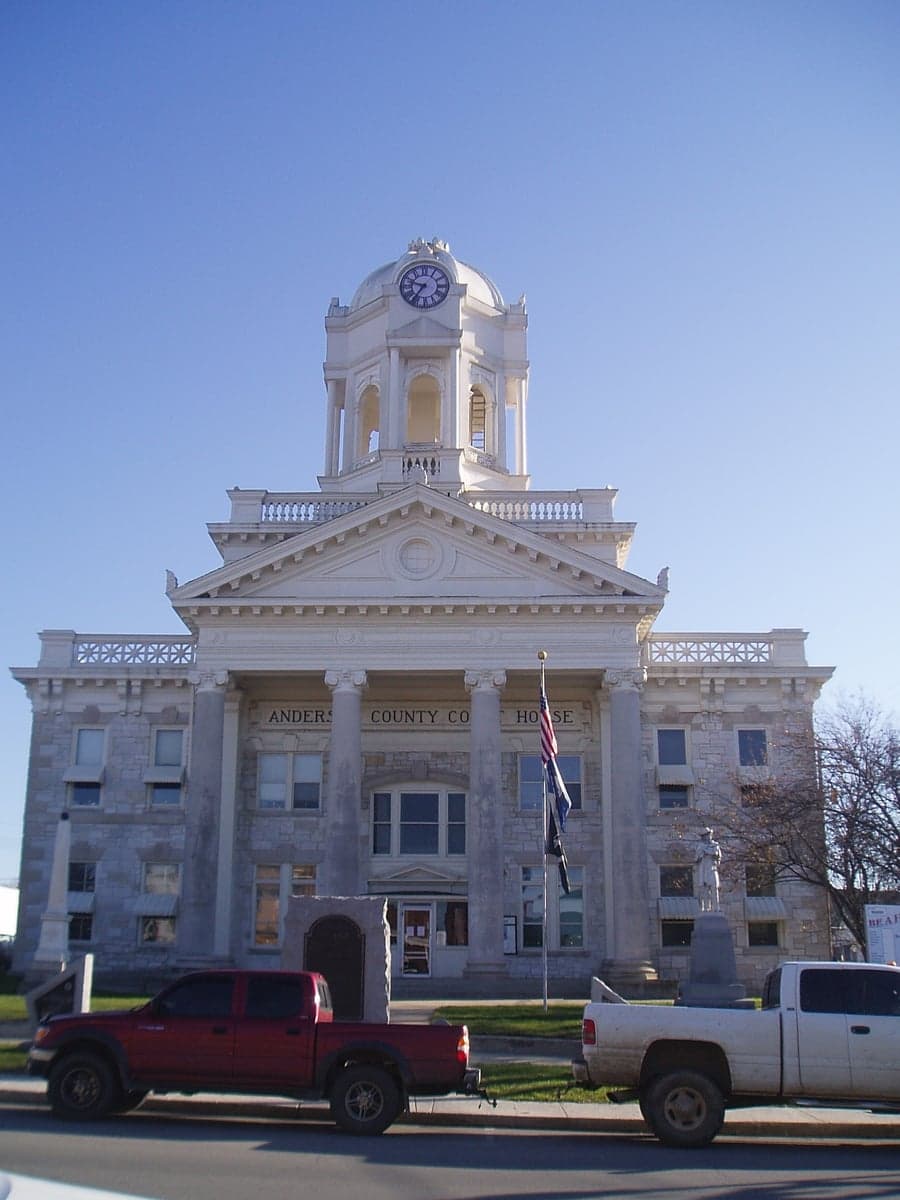
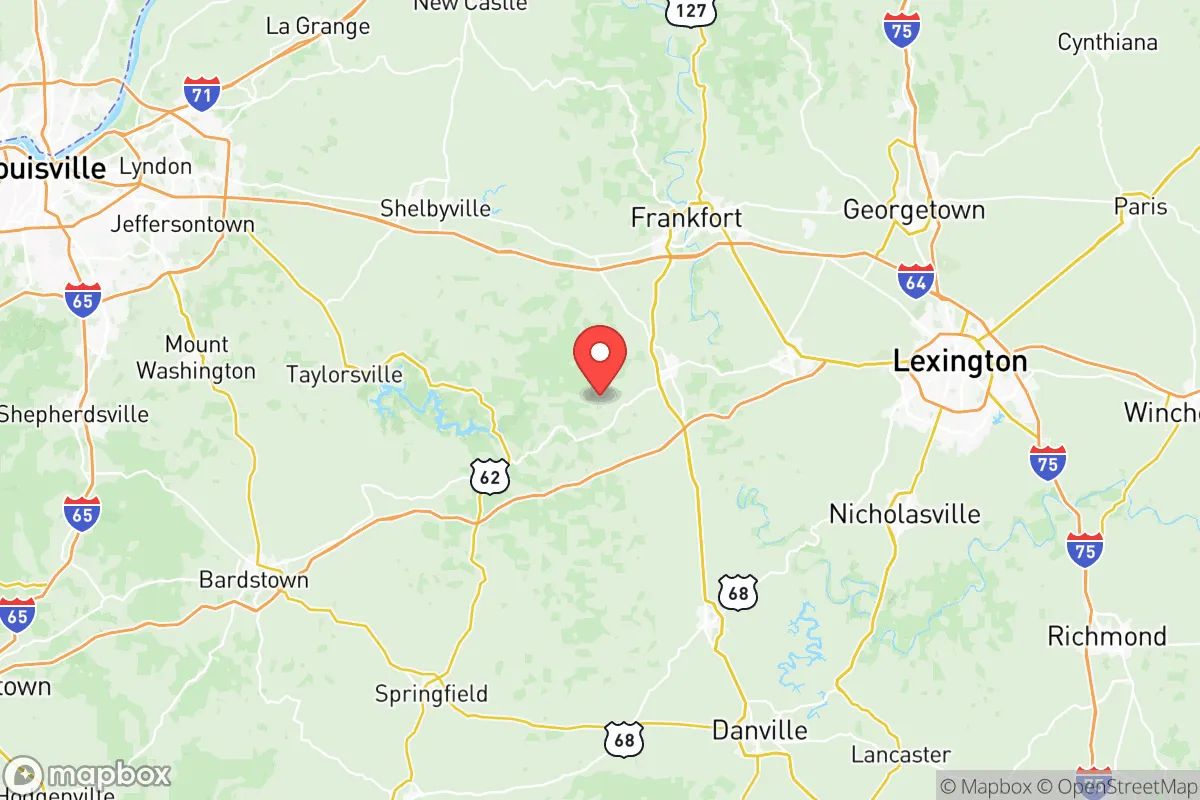

Photo: Wikipedia
Political ClimatePolitical Climate in Anderson County
Showing district-level results — no local-only data available.
Local Political AnalysisPolitical Analysis of Anderson County
Anderson County, Kentucky, is a reliably Republican area with a Cook Partisan Voting Index (PVI) of R+7, though it's notably less conservative than the state as a whole, which sits at R+15. This means while the county consistently votes red, it's not a deep-red stronghold; there's a meaningful Democratic minority and a history of split-ticket voting, especially in local races. The county's political trajectory has shifted rightward over the past decade, mirroring national trends, but it still retains a moderate, pragmatic streak that sets it apart from the state's more heavily Republican rural regions.
How it compares
Anderson County's R+7 PVI is a full eight points less Republican than Kentucky's statewide R+15, making it a relative swing county within the commonwealth. In practice, this means that while a Republican presidential candidate will win the county by a comfortable margin (typically 10-15 points), it's not a foregone conclusion in down-ballot races. For example, the county seat of Lawrenceburg tends to be the most Republican part of the county, with precincts near the courthouse and newer subdivisions voting heavily red. In contrast, the more rural precincts around Alton and Ninevah show a slightly higher Democratic vote share, though still not enough to flip the county. The small community of Bridgeport has historically been a swing precinct, often reflecting the county's overall margin within a few points. This internal variation is more pronounced than in many neighboring counties, where the Republican vote is more uniformly high.
What this means for residents
For conservative residents, Anderson County is a comfortable environment where Republican candidates and conservative values dominate local discourse and policy. The county commission and school board are reliably Republican, and issues like gun rights, lower taxes, and limited government are popular. For liberal residents, the political climate is more challenging but not hostile. They can find community in Lawrenceburg and through local Democratic Party groups, and their votes matter more here than in a deep-red county, as a well-organized campaign can occasionally win a local seat or influence a primary. The moderate lean means that policy debates are often less ideological and more pragmatic, focusing on local issues like infrastructure, schools, and economic development rather than national culture wars. This creates a political reality where both sides can engage in civil discourse, though the conservative majority still sets the overall tone.
Cultural and policy distinctions
One key distinction is Anderson County's relationship with the state government in Frankfort. While the county votes Republican, it has a history of supporting moderate state legislators who prioritize local needs over party line. For instance, the county has been a strong advocate for the Anderson County School District, which is one of the higher-performing districts in the region, and local leaders have pushed for increased state funding for education and infrastructure without the anti-tax fervor seen in deeper-red counties. Culturally, the county is more suburban and commuter-oriented than much of Kentucky, with many residents working in Frankfort or Lexington. This gives it a slightly more diverse economic base and a less insular feel. The presence of the Four Roses Distillery and the Wild Turkey Distillery also brings tourism and a more cosmopolitan influence, softening the hard edges of rural conservatism. In short, Anderson County is a place where you can find a strong Republican majority, but also a willingness to listen and compromise on local issues—a balance that's increasingly rare in Kentucky politics.

State Political ClimatePolitical Climate in Kentucky
State Political AnalysisPolitical Environment in the State
Kentucky is a deeply red state with a Cook Partisan Voting Index of R+15, meaning it consistently votes about 15 points more Republican than the national average in federal elections. Over the past 10-20 years, the state has shifted decisively rightward, driven by the collapse of the old Blue Dog Democrat coalition in rural areas and the cultural realignment of working-class voters. While Democrats once held a near-lock on state government through the 1990s, Republicans now control the governorship, both chambers of the legislature, both U.S. Senate seats, and five of six U.S. House seats. The last Democrat to win a statewide federal race was Andy Beshear’s 2019 gubernatorial victory, which he pulled off by running as a moderate in a year when the Republican incumbent was deeply unpopular. That win was the exception that proves the rule: Kentucky is now as reliably Republican as any state in the South, and its politics are dominated by cultural conservatism, limited-government rhetoric, and a strong gun-rights culture.
Urban vs. rural divide
The political map of Kentucky is a textbook case of the urban-rural split. The only reliably blue stronghold is Louisville (Jefferson County), which delivers about 60% of its vote to Democrats and is the engine of any statewide Democratic hope. Lexington (Fayette County) leans Democratic but is more moderate, often splitting its ticket between local Republicans and national Democrats. The rest of the state is overwhelmingly red. Bowling Green, Owensboro, and Paducah are all solidly Republican, while the rural counties of eastern Kentucky — places like Pikeville, Hazard, and Prestonsburg — have flipped from ancestrally Democratic to deeply Republican over the last two decades. The suburban ring around Louisville, particularly Oldham County, is among the most Republican counties in the nation, routinely voting 75%+ for GOP candidates. The divide is stark: if you live inside the Watterson Expressway in Louisville, you're in a blue bubble; drive 20 minutes east to Shelbyville, and you're in Trump country.
Policy environment
Kentucky's policy environment is shaped by a Republican supermajority that has governed since 2017. The state has a flat income tax that is being phased down from 5% to 4% by 2026, with further cuts likely. There is no state-level property tax on vehicles or business inventory, and the sales tax is a flat 6%. The regulatory posture is broadly pro-business, with right-to-work laws and a tort reform system that caps non-economic damages in medical malpractice cases at $250,000. Education policy has been a flashpoint: the legislature passed a school choice bill in 2022 that created education opportunity accounts, though the state Supreme Court struck it down in 2023 on procedural grounds. A new version is expected. Healthcare is dominated by the expansion of Medicaid under the Affordable Care Act, which former Governor Matt Bevin tried to roll back but which Governor Andy Beshear has preserved. Election laws have tightened: Kentucky requires a photo ID to vote, limits absentee voting to those with a valid excuse, and does not offer same-day registration. The state also has a near-total ban on abortion, with no exceptions for rape or incest, enacted via a trigger law that took effect after Dobbs.
Recent policy direction
Kentucky's recent legislative sessions have moved the state decisively toward a conservative-libertarian model on several fronts. On gun and self-defense law, Kentucky is a constitutional carry state — no permit required to carry a concealed firearm — and has a "stand your ground" law with no duty to retreat. In 2023, the legislature passed a law allowing teachers to carry firearms on school grounds with minimal training. On parental and education rights, the state passed a "Parents' Bill of Rights" in 2022 that requires schools to notify parents of any changes to a student's health or well-being, effectively targeting transgender accommodations. On speech and privacy, Kentucky has no broad surveillance law, but local police routinely use license plate readers and drones; there is no state-level ban on facial recognition. On medical and bodily autonomy, the abortion ban is total, and the state has no shield law for providers who might travel to perform abortions elsewhere. On property rights, Kentucky is a strong "right to farm" state, limiting nuisance lawsuits against agricultural operations. On taxation, the income tax is being phased down, and there is no estate tax. On voting and ballot access, the state has tightened its laws: it purged over 100,000 voters from the rolls in 2023 under a law that removes inactive registrations after two federal election cycles. The overall direction is toward fewer restrictions on gun ownership, lower taxes, and greater parental control over education, while tightening access to abortion and voting.
Civil unrest & political movements
Kentucky has seen its share of political flashpoints, though large-scale civil unrest is rare. The most visible recent event was the 2020 protests in Louisville following the death of Breonna Taylor, which led to months of demonstrations, a state of emergency, and the eventual passage of "Breonna's Law" — a local ordinance banning no-knock warrants in Louisville. The state legislature responded by passing a statewide ban on no-knock warrants in 2021, a rare bipartisan compromise. On the right, the "Constitutional Sheriffs" movement has a foothold in rural counties, with several sheriffs publicly refusing to enforce federal gun laws. Immigration politics are less heated than in border states, but there is a vocal anti-sanctuary movement: in 2023, the legislature passed a law requiring all law enforcement to cooperate with federal immigration authorities, effectively banning any local sanctuary policies. Election integrity remains a live issue: the 2020 election saw Trump win Kentucky by 26 points, but grassroots groups continue to push for hand-counting of ballots and paper-only voting systems. A new resident in a rural county might see "Stop the Steal" signs still posted outside some homes, while in Louisville, "Defund the Police" graffiti has largely faded. The political temperature is high but not boiling — most Kentuckians are polite about their disagreements, but the divides are real and visible.
Projection
Over the next 5-10 years, Kentucky is likely to become more Republican, not less. The demographic trends favor the GOP: the state's population is aging, with the fastest-growing segments being retirees moving to lake communities around Lake Cumberland and Kentucky Lake, who tend to be conservative. The urban centers of Louisville and Lexington are growing slowly, while rural counties are shrinking. In-migration is modest and comes primarily from other red states like Tennessee and Indiana, not from blue states. The only wild card is the continued suburbanization of counties like Boone, Kenton, and Campbell in northern Kentucky (the Cincinnati suburbs), which are becoming more moderate as they fill with white-collar commuters. But even there, the trend is toward center-right, not center-left. The Democratic Party in Kentucky is increasingly confined to Louisville and a few Lexington precincts, and it has no obvious path to rebuilding a statewide coalition. A new resident moving in now should expect to live in a state where Republican dominance is the baseline, where cultural conservatism shapes public policy, and where the political conversation is about how far right to go, not whether to go right at all.
For a new resident, the bottom line is straightforward: if you are conservative, you will find Kentucky deeply aligned with your values on guns, taxes, education, and abortion. If you are liberal, you will find yourself in a clear minority, with limited political power outside of Louisville and Lexington. The practical takeaway is that Kentucky offers a stable, predictable conservative governance environment with low taxes, strong gun rights, and a culture that values self-reliance. The trade-off is that the state's policy direction is unlikely to shift leftward anytime soon, and anyone moving here should be comfortable with that reality. The politics are not hostile — Kentuckians are famously friendly — but they are unambiguous.
* Values derived from national, state, county, city and local statistics and may differ in a specific area. Last updated: 2026-06-28T00:06:06.000Z
Narrative content on this page is AI-generated and may contain mistakes. Verify any details that matter before acting on them.
ReloMaps may earn a commission from affiliate links at no extra cost to you.

