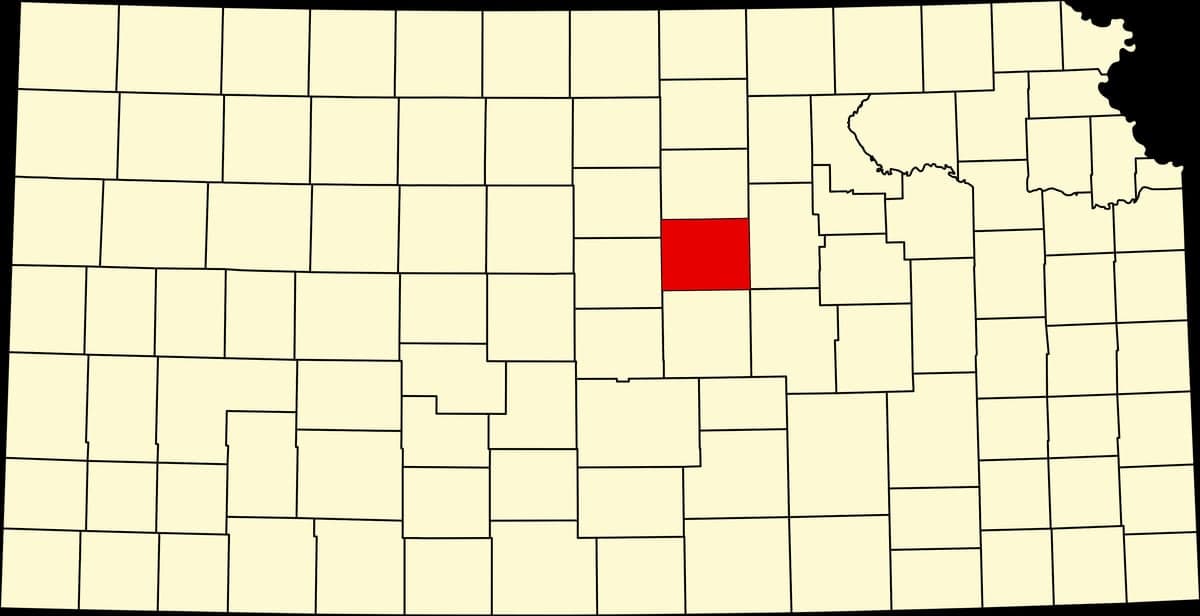
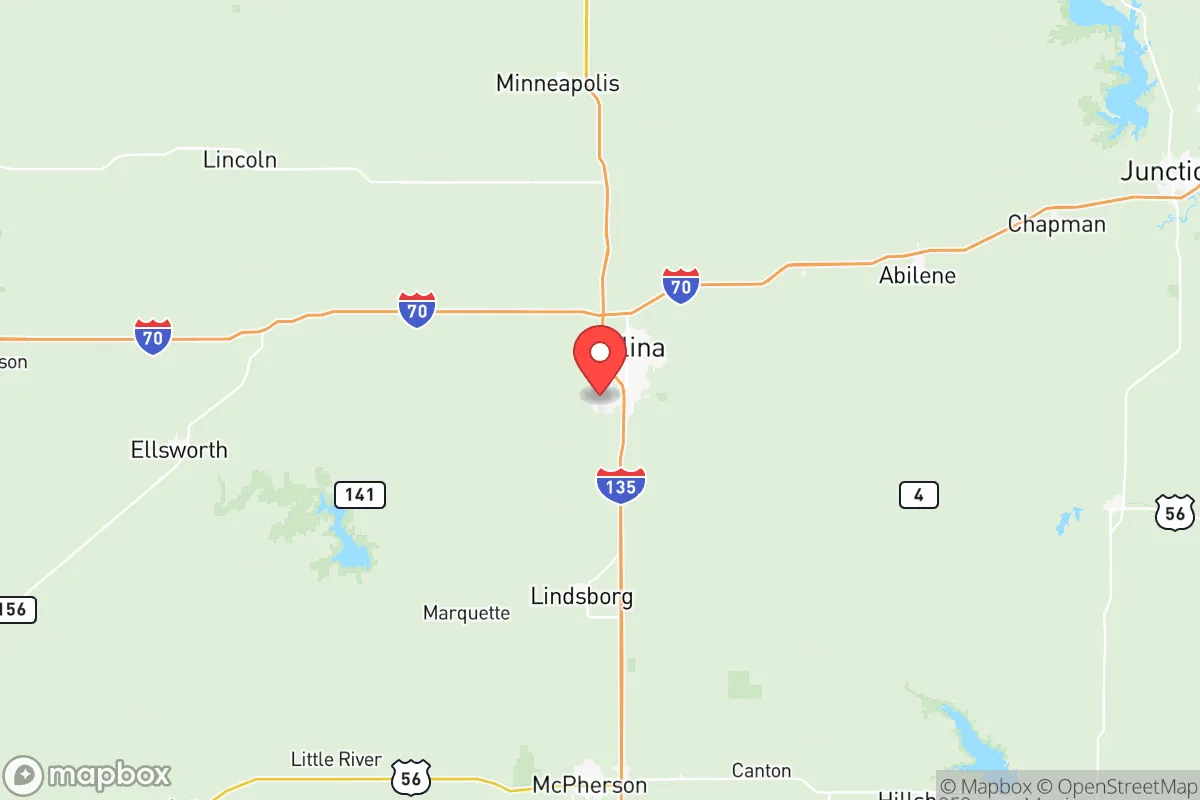
Photo: Wikipedia
Demographics of Saline County
Affluence Level in Saline County
A middle-class area roughly in line with national averages across income, home values, education, and employment.
People of Saline County
Today, Saline County, Kansas, is home to approximately 53,801 residents, a population that is predominantly white (78.7%) but with a significant and growing Hispanic community (12.5%) and smaller Black (3.5%) and East/Southeast Asian (2.0%) populations. The county’s identity is rooted in its agricultural and industrial heritage, centered on the city of Salina, which serves as the regional hub for trade, healthcare, and manufacturing. With a foreign-born population of just 2.4%, Saline County remains less diverse than the national average, but its demographic story is one of steady, incremental change driven by economic opportunity and family migration.
Settlement & growth (pre-1960)
The land that is now Saline County was originally inhabited by the Kaw (Kansa) and Osage nations, who used the Saline River valley for hunting and seasonal camps. Spanish and French explorers passed through the region in the 1700s, but no permanent European settlements were established until after the 1854 Kansas-Nebraska Act opened the territory for organized settlement. The first American settlers were largely of Northern European descent—primarily from the British Isles and Germany—who arrived in the 1850s and 1860s, drawn by the promise of cheap land under the Homestead Act of 1862.
The city of Salina, founded in 1858 by a group of settlers from Ohio and Indiana, quickly became the county’s commercial and transportation center. The arrival of the Kansas Pacific Railway in 1867 transformed Salina into a major shipping point for cattle and grain, attracting a wave of German and Irish immigrants who worked on the railroad and in the burgeoning milling industry. By the 1880s, the county’s population had swelled to over 16,000, with small farming communities like Brookville, Gypsum, and New Cambria serving as ethnic enclaves for German Lutheran and Mennonite families who valued religious freedom and agricultural self-sufficiency.
The early 20th century brought a second wave of European immigrants, including Czechs and Poles, who settled in Assaria and Falun to work the fertile wheat fields. The Dust Bowl of the 1930s hit Saline County hard, causing a temporary population decline as many farm families moved west to California. However, World War II and the subsequent construction of Schilling Air Force Base (1942) in Salina reversed the trend, bringing a new influx of military personnel and civilian workers from across the United States. The base’s presence through the 1950s and 1960s diversified the county’s population, introducing small numbers of Black and Hispanic families to a region that had been overwhelmingly white and Protestant.
Modern era (post-1965)
The closure of Schilling Air Force Base in 1965 was a significant economic blow, but Saline County adapted by pivoting to manufacturing and healthcare. The 1965 Hart-Cellar Act had a limited direct impact on the county, as the foreign-born population remains low at 2.4%. However, the post-1965 period saw a notable increase in domestic migration, particularly from rural areas of Kansas and neighboring states, as families moved to Salina for jobs at companies like Tony’s Pizza (a major employer since the 1970s) and the Salina Regional Health Center.
The most significant demographic shift since 1965 has been the growth of the Hispanic population, which rose from less than 2% in 1970 to 12.5% today. This growth is largely driven by Mexican-American families who came to work in the county’s meatpacking plants and agricultural processing facilities, particularly in Salina and the smaller town of Solomon. These families have established a visible cultural presence, with Spanish-language churches, grocery stores, and annual festivals like the Salina Cinco de Mayo celebration. The Black population, at 3.5%, is concentrated in Salina and traces its roots to both the post-war military presence and later migration from Kansas City and Wichita for manufacturing jobs.
East/Southeast Asian communities (2.0%) are a smaller but stable presence, with families of Vietnamese and Filipino descent working in healthcare and engineering. The Indian subcontinent population is negligible at 0.1%, reflecting the county’s limited draw for high-tech or professional immigrant streams. Suburbanization has been modest, with most growth occurring in Salina’s outer neighborhoods and along the Interstate 70 corridor, rather than in new satellite towns. The county’s college-educated share (29.1%) is below the national average, but Kansas State University’s Salina campus and the local community college have helped retain some younger residents.
The future
Saline County’s population is projected to remain stable or grow slowly over the next 10-20 years, with the Hispanic share likely to continue rising to 15-18% as younger families have higher birth rates and continued migration from Mexico and Central America. The white population will gradually decline in share but remain the majority. The county is not expected to see significant growth in East/Southeast Asian or Black populations unless new industries—such as renewable energy or advanced manufacturing—create a demand for specialized labor.
New communities are likely to concentrate in Salina’s southwestern and northern edges, where new housing developments are being built, rather than in the smaller towns like Bridgeport or Hedville, which face continued population loss. The county’s cultural identity is evolving from a purely rural, agricultural character to a more suburban and service-oriented one, with a growing emphasis on healthcare and education. For newcomers, this means a community that is still affordable and family-oriented, but with increasing diversity in cuisine, language, and religious practice.
For someone moving to Saline County now, the area offers a stable, low-cost environment with a gradually diversifying population. The county is becoming more Hispanic and more suburban, but it remains a place where traditional Midwestern values—community, hard work, and neighborliness—still define daily life. The key question for the next decade is whether the county can attract enough young families and skilled workers to offset the aging of its white population, or whether it will follow the path of many rural Kansas counties toward slow decline.

* Values derived from national, state, county, city and local statistics and may differ in a specific area. Last updated: 2026-07-12T12:41:03.000Z
Narrative content on this page is AI-generated and may contain mistakes. Verify any details that matter before acting on them.
ReloMaps may earn a commission from affiliate links at no extra cost to you.

