Political ClimatePolitical Climate in Mcpherson County
Showing district-level results — no local-only data available.
Local Political AnalysisPolitical Analysis of Mcpherson County
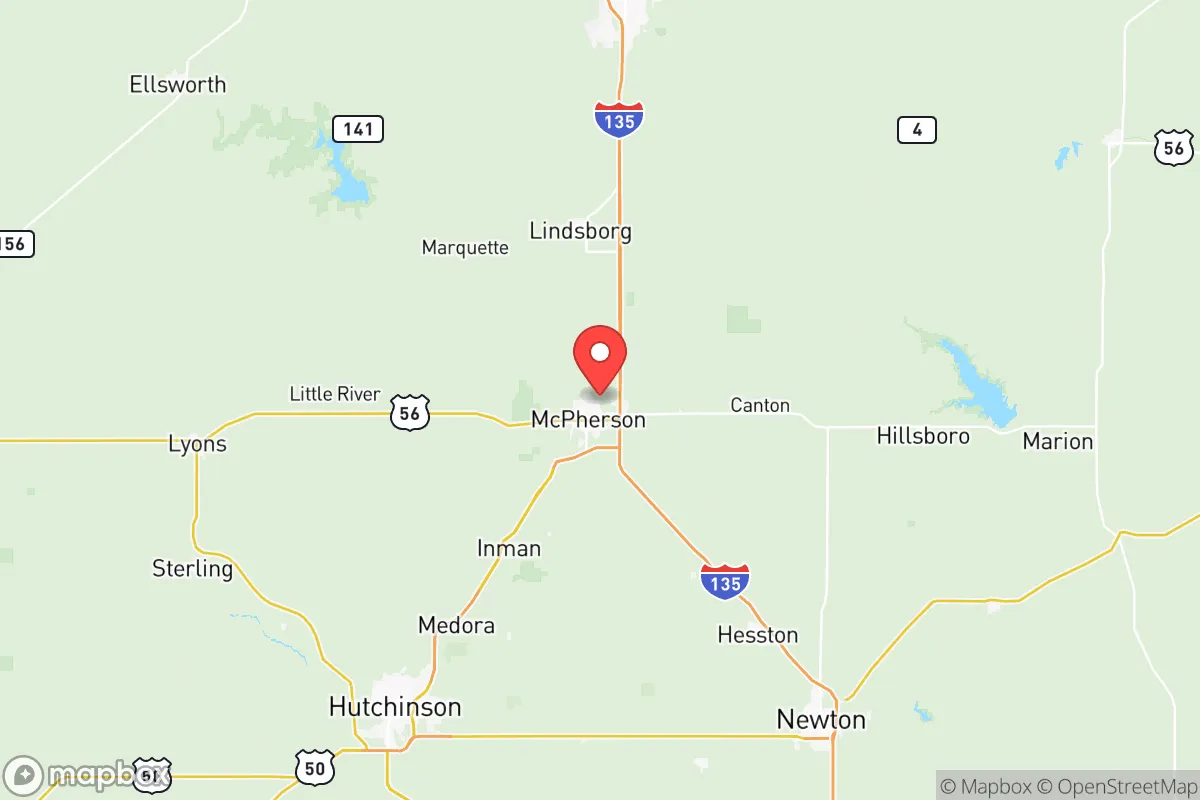
McPherson County, Kansas, is a deeply conservative stronghold with a Cook Partisan Voting Index (PVI) of R+16, making it significantly more Republican than the state of Kansas as a whole, which sits at R+9. This isn't a recent shift; the county has been reliably red for decades, with Republicans routinely winning local races by wide margins. The political center of gravity is firmly in the city of McPherson itself, a hub for manufacturing and healthcare, while the surrounding rural townships and smaller communities like Inman, Lindsborg, and Marquette tend to vote even more heavily Republican. The only real exception is a small pocket around Bethany College in Lindsborg, where a handful of precincts occasionally show a slightly more moderate or even blue-leaning tilt, but it's not enough to move the needle on any countywide race.
How it compares to Kansas as a whole
The R+7 gap between McPherson County and the state average is substantial. While Kansas as a whole has trended redder over the past decade, McPherson County has held steady or even deepened its conservative lean. For context, the state's R+9 PVI already makes Kansas a reliably Republican state in presidential elections, but McPherson County is in a different league entirely. In the 2024 presidential election, McPherson County voted for Donald Trump by a margin of roughly 75% to 22%, compared to the statewide split of about 57% to 40%. This means the county is roughly 18 points more Republican than the state average in actual voting behavior, not just the PVI metric. The difference is driven by a higher concentration of evangelical voters, a strong agricultural base, and a local economy that leans heavily on manufacturing and oil—sectors that have consistently aligned with Republican policy positions on taxes, regulation, and energy.
What this means for residents
For conservative residents, McPherson County offers a political environment where their values are the default. Local government, school boards, and county commissions are almost entirely Republican, meaning policy debates tend to be about how conservative to be, not whether to be conservative. For liberal or moderate residents, the reality is more isolating. There are few organized Democratic or progressive groups, and running for office as a Democrat is largely a symbolic gesture. That said, the county is not a hotbed of political conflict; most people get along fine across party lines in daily life, especially in the city of McPherson where economic interests—like the presence of major employers such as McPherson Hospital and the numerous manufacturing plants—tend to override partisan divides. The real friction points are more cultural than political, often revolving around issues like gun rights, abortion, and religious expression in public life.
One notable cultural distinction is the strong presence of the Lutheran and Mennonite traditions, particularly in Lindsborg and the rural areas, which shapes a more community-oriented, less individualistic brand of conservatism than what you might find in, say, Johnson County. This means there's a genuine emphasis on neighborly support and local charity, even as the politics remain staunchly conservative. Looking ahead, the county's political trajectory seems stable; there's no sign of a significant shift toward the center or left, given the demographic trends of an aging, predominantly white population. For anyone moving here, the key takeaway is that McPherson County is a place where conservative politics are deeply woven into the fabric of daily life, but it's also a place where most people are more focused on the local high school football game or the annual Lindsborg Midsummer's Festival than on national political drama.

State Political ClimatePolitical Climate in Kansas
State Political AnalysisPolitical Environment in the State
Kansas is a solidly Republican state with a Cook PVI of R+9, meaning it typically votes about nine points more conservative than the national average in presidential elections. Over the past 10-20 years, the state has shifted rightward in statewide races, driven by rural consolidation and suburban realignment, though it has also seen periodic Democratic wins in gubernatorial and congressional contests when the GOP nominates candidates perceived as too extreme. The dominant coalition is a mix of rural conservatives, evangelical voters, and increasingly, suburban fiscal conservatives in places like Johnson County who have drifted right on cultural issues even as they sometimes split on education funding.
Urban vs. rural divide
The political map of Kansas is a textbook study in geographic polarization. The eastern third of the state, anchored by the Kansas City metro area, is the most competitive region. Johnson County — suburbs like Overland Park, Olathe, and Lenexa — was once reliably Republican but has trended purple, with Democratic performance improving in presidential cycles as college-educated voters shift left. Wyandotte County (Kansas City, KS) and Douglas County (Lawrence) are the state's Democratic strongholds, delivering margins of 30-40 points for Democrats. Meanwhile, the rest of the state is deeply red. Western Kansas counties like Finney (Garden City) and Ford (Dodge City) have large Latino populations but still vote Republican, though by narrower margins than the overwhelmingly white rural counties. The rural-urban divide is stark: Sedgwick County (Wichita) leans Republican but is more moderate than the surrounding farm counties, while the Flint Hills and northwest Kansas are among the most conservative areas in the nation.
Policy environment
Kansas has a low-tax, low-service policy posture that reflects its conservative lean. The state income tax has a flat rate of 5.7% after the 2024 tax reform, down from a progressive structure in the 1990s. Sales tax is 6.5% at the state level, with local add-ons pushing it higher in some cities. Property taxes are moderate but a perennial complaint, funding local schools heavily reliant on state aid. Education policy has been a flashpoint: the state's school funding formula was ruled unconstitutional multiple times by the Kansas Supreme Court, leading to increased spending that conservatives argue is unsustainable. On social issues, Kansas is conservative: abortion is restricted after 22 weeks, and a 2022 referendum rejected a constitutional amendment that would have explicitly allowed the legislature to ban abortion, preserving the current legal framework. Election laws are moderately restrictive: voter ID is required, and the state has a proof-of-citizenship requirement for voter registration that was partially struck down but remains on the books for federal elections. Gun laws are permissive: permitless carry for adults 21 and older, no state-level assault weapons ban, and a "stand your ground" self-defense law.
Recent policy direction
The last five years have seen Kansas move in a consistently conservative direction on most fronts, with notable exceptions. In 2023, the legislature passed a sweeping tax cut package that flattened the income tax and accelerated elimination of the food sales tax, which was fully repealed in 2025. On guns, the state enacted permitless carry in 2015 and has resisted any post-2020 federal gun restrictions, with a 2023 law prohibiting state enforcement of federal gun regulations. On education, the 2024 school choice expansion created education savings accounts for low-income students, a priority for conservative lawmakers. Parental rights legislation passed in 2023, requiring schools to notify parents of curriculum changes and allowing them to opt children out of certain materials. On medical freedom, Kansas banned COVID-19 vaccine mandates for state employees and contractors in 2023. On privacy, the state passed a data privacy law in 2024 but has not addressed surveillance reform. On bodily autonomy, the 2022 abortion referendum result — a 59-41 vote against removing protections — showed that even in a red state, voters are wary of total bans. The legislature has since passed incremental restrictions but not a full ban. On voting, the state tightened absentee ballot rules in 2021 and purged inactive voters, but same-day registration is still not available.
Civil unrest & political movements
Kansas has seen relatively low levels of civil unrest compared to coastal states, but political movements are active. The most visible flashpoint in recent years was the 2022 abortion referendum, which drew massive turnout and national attention, with both sides pouring money into the state. The result — a victory for abortion rights supporters — surprised many and demonstrated that Kansas voters are more moderate on social issues than the legislature. On the right, the Kansas Republican Party has seen internal battles between the mainstream and the more conservative "MAGA" wing, with former Secretary of State Kris Kobach representing the hardline faction. On the left, the Kansas Democratic Party has focused on suburban gains in Johnson County and organizing in Wichita. Immigration politics are less heated than in border states, but Garden City and Dodge City have seen tensions over meatpacking plant labor. There is no sanctuary city movement of note. Election integrity controversies flared after 2020, with Kobach pushing for stricter laws, but no major fraud was found. A new resident would notice political yard signs and bumper stickers but little street-level activism outside of Lawrence and parts of Kansas City.
Projection
Over the next 5-10 years, Kansas is likely to remain solidly Republican but with a growing suburban swing vote that could make statewide races more competitive. The demographic trends favor the GOP in rural areas, which are aging and shrinking, while the Kansas City suburbs are growing and diversifying. Johnson County's shift toward Democrats in presidential years may continue, but it is not yet enough to flip the state. The in-migration pattern is modest — Kansas is not a high-growth destination like Texas or Florida — but the people moving in tend to be from the Midwest and are often conservative-leaning. The biggest wildcard is the state's fiscal health: the tax cuts of 2023-2025 may constrain future spending, potentially leading to school funding battles that could alienate suburban moderates. On social issues, the 2022 referendum suggests the state will not go full abortion ban, but incremental restrictions will continue. A new resident moving in now should expect a state that is reliably conservative on taxes and guns, but with a pragmatic streak that occasionally surprises.
For someone relocating to Kansas, the bottom line is this: you will live in a state where conservative values dominate policy, but the political culture is less intense than in the Deep South or the Mountain West. The urban-rural divide means your experience will vary dramatically — living in Lawrence or Kansas City, KS feels like a blue island, while a small town in western Kansas is as red as it gets. Property taxes and school funding are the local issues that affect daily life most, not national culture wars. If you are conservative, you will find your views reflected in state law and local governance. If you are liberal, you will find community in the cities and a state that, despite its red lean, rejected a total abortion ban and funds its schools at levels that surprise outsiders. Either way, Kansas is a place where politics is present but not overwhelming, and where the practical realities of farming, weather, and small-town life often matter more than the latest national controversy.
* Values derived from national, state, county, city and local statistics and may differ in a specific area. Last updated: 2026-06-16T13:25:13.000Z
Narrative content on this page is AI-generated and may contain mistakes. Verify any details that matter before acting on them.
ReloMaps may earn a commission from affiliate links at no extra cost to you.

