Demographics of Mcpherson County
Affluence Level in Mcpherson County
A middle-class area roughly in line with national averages across income, home values, education, and employment.
People of Mcpherson County
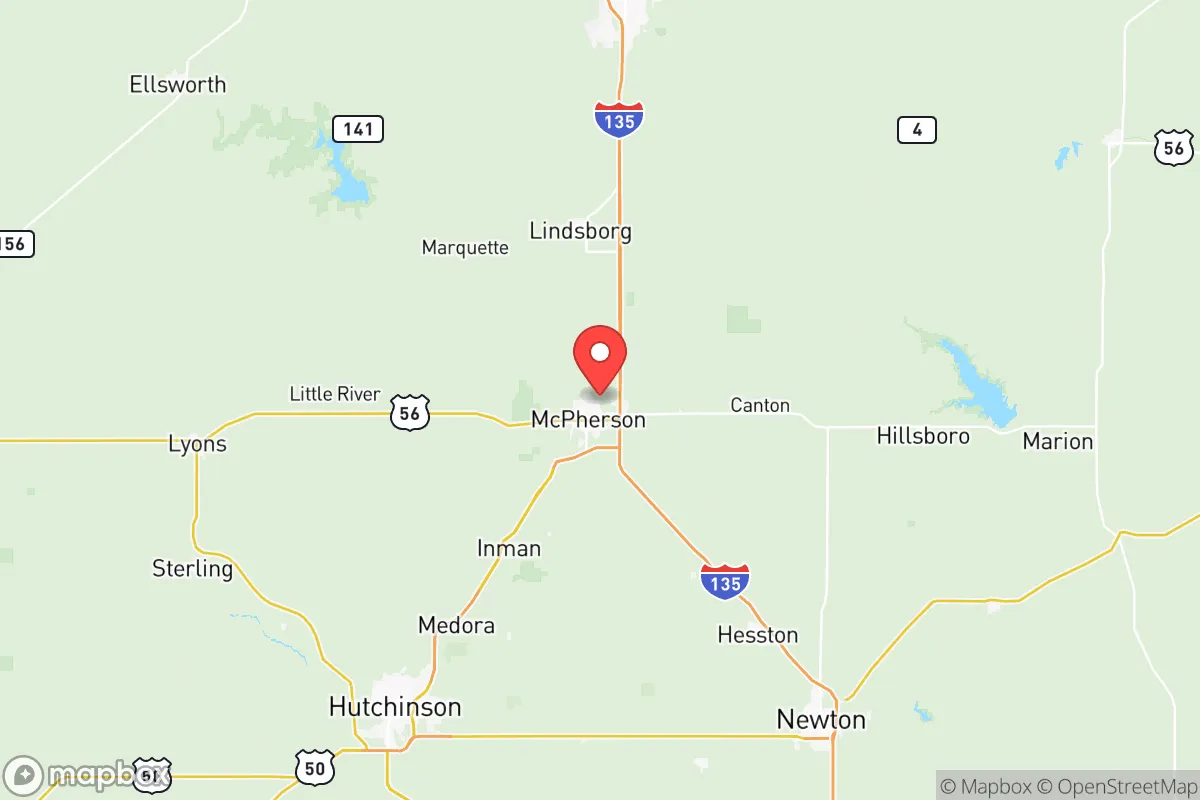
McPherson County, Kansas, is home to 30,130 residents, a population that remains overwhelmingly white (89.6%) with a small but growing Hispanic community (5.4%) and a foreign-born share of just 1.9%. The county’s identity is deeply rooted in its Mennonite and Lutheran heritage, visible in the tidy farmsteads, grain elevators, and the strong sense of community that defines towns like McPherson, Lindsborg, and Inman. With a college-educated rate of 33.1%, slightly above the national average, the population is stable, conservative-leaning, and shaped by a history of deliberate settlement by religious and ethnic groups seeking land and freedom.
Settlement & growth (pre-1960)
Before American settlement, the land that is now McPherson County was part of the traditional territory of the Kaw (Kansa) and Osage nations, who used the region for hunting bison and seasonal camps. The area was ceded to the United States through a series of treaties in the 1820s and 1830s, and by the 1850s, it was officially opened for homesteading under the Kansas-Nebraska Act. No permanent European settlements existed before the Civil War; the county was formally organized in 1873, named after Union General James B. McPherson.
The first major wave of settlers arrived in the 1870s and 1880s, drawn by the promise of cheap land under the Homestead Act and the expansion of the Santa Fe Railroad. The single most influential group was Swedish immigrants, who founded Lindsborg in 1869. Known as "Little Sweden, USA," Lindsborg became the cultural and religious heart of Swedish America in Kansas, with its Bethany College (founded 1881) and the biennial Svensk Hyllningsfest. The Swedes were followed closely by German-speaking Mennonites from Russia, who settled in Inman and Moundridge in the 1870s. These Mennonites brought with them the hard winter wheat that would transform Kansas agriculture, and their pacifist, tight-knit communities remain a defining feature of the county’s rural character.
By 1900, the county’s population had surged past 20,000, with McPherson city emerging as the commercial and political hub. The city’s growth was fueled by the railroad, a thriving grain trade, and the establishment of McPherson College (1887) by the Church of the Brethren. Smaller settlements like Galva, Marquette, and Canton grew as service centers for surrounding farms, each with its own grain elevator, church, and school. The Dust Bowl of the 1930s hit the county hard, but the Mennonite and Swedish communities’ emphasis on soil conservation and cooperative farming helped the region recover faster than many neighboring areas. By 1960, the population had stabilized at around 28,000, with a near-total white, native-born composition.
Modern era (post-1965)
The 1965 Hart-Cellar Act had little direct impact on McPherson County, as the foreign-born population remains just 1.9% today. Instead, the post-1965 era has been defined by domestic migration patterns and the gradual diversification of the county’s rural economy. The most significant demographic shift has been the growth of the Hispanic population, which rose from under 1% in 1990 to 5.4% today. This growth is driven primarily by Mexican-American families moving from Texas and the Southwest for work in agriculture, meatpacking, and manufacturing. These new residents have concentrated in McPherson city and Lindsborg, where they form small but visible communities, often attending Catholic or evangelical churches and contributing to the local labor force.
The East/Southeast Asian population (0.7%) and Black population (1.6%) remain very small, with no distinct ethnic enclaves. Most Asian residents are professionals employed by the county’s manufacturing sector, including companies like Parker-Hannifin and Exide Technologies in McPherson city. The Black population is largely composed of military families stationed at nearby Fort Riley or professionals drawn to the area’s low cost of living and strong schools. There is no measurable Indian-subcontinent population (0.0%).
Suburbanization has been modest compared to the Kansas City or Wichita metros. The county’s population has remained remarkably stable, hovering between 29,000 and 30,000 since 1970. Young adults often leave for college or jobs in larger cities, but many return to raise families, drawn by the low crime rate, strong public schools, and the preservation of Swedish and Mennonite cultural traditions. The county’s political character has shifted rightward over the past two decades, with McPherson County voting Republican by wide margins in every presidential election since 2000.
The future
McPherson County is projected to see slow, modest growth over the next 10-20 years, likely reaching 31,000-32,000 by 2040. The Hispanic population is expected to continue its gradual increase, possibly reaching 8-10% of the total, as younger families move in for affordable housing and agricultural jobs. The white population will remain the overwhelming majority, though the county’s median age (38.5) is slightly above the national average, suggesting a gradual aging of the native-born population. The East/Southeast Asian and Black populations will likely remain small, as the county lacks the urban amenities and ethnic infrastructure that attract larger immigrant communities.
Culturally, the county is becoming slightly more diverse but remains deeply traditional. The Swedish and Mennonite heritage is actively preserved through festivals, museums, and church communities, and newcomers—whether Hispanic or white—are expected to integrate into these existing social structures. The county’s conservative political and religious character is unlikely to change significantly, as the small number of new residents are themselves often drawn to the area for its stability and values. The biggest challenge will be retaining young adults, as the local economy—dominated by agriculture, manufacturing, and healthcare—offers fewer high-skilled jobs than larger metros.
For someone moving in now, McPherson County offers a stable, safe, and culturally cohesive community with strong schools and a low cost of living. The population is overwhelmingly white and native-born, with a small but growing Hispanic presence, and the county’s identity remains firmly rooted in its Swedish and Mennonite founding groups. New residents will find a place where tradition is valued, change comes slowly, and the sense of neighborly responsibility is high—but where diversity, in the broad sense, remains limited.

* Values derived from national, state, county, city and local statistics and may differ in a specific area. Last updated: 2026-06-16T13:25:13.000Z
Narrative content on this page is AI-generated and may contain mistakes. Verify any details that matter before acting on them.
ReloMaps may earn a commission from affiliate links at no extra cost to you.

