Photo: Wikipedia
Political ClimatePolitical Climate in Harvey County
Showing district-level results — no local-only data available.
Local Political AnalysisPolitical Analysis of Harvey County
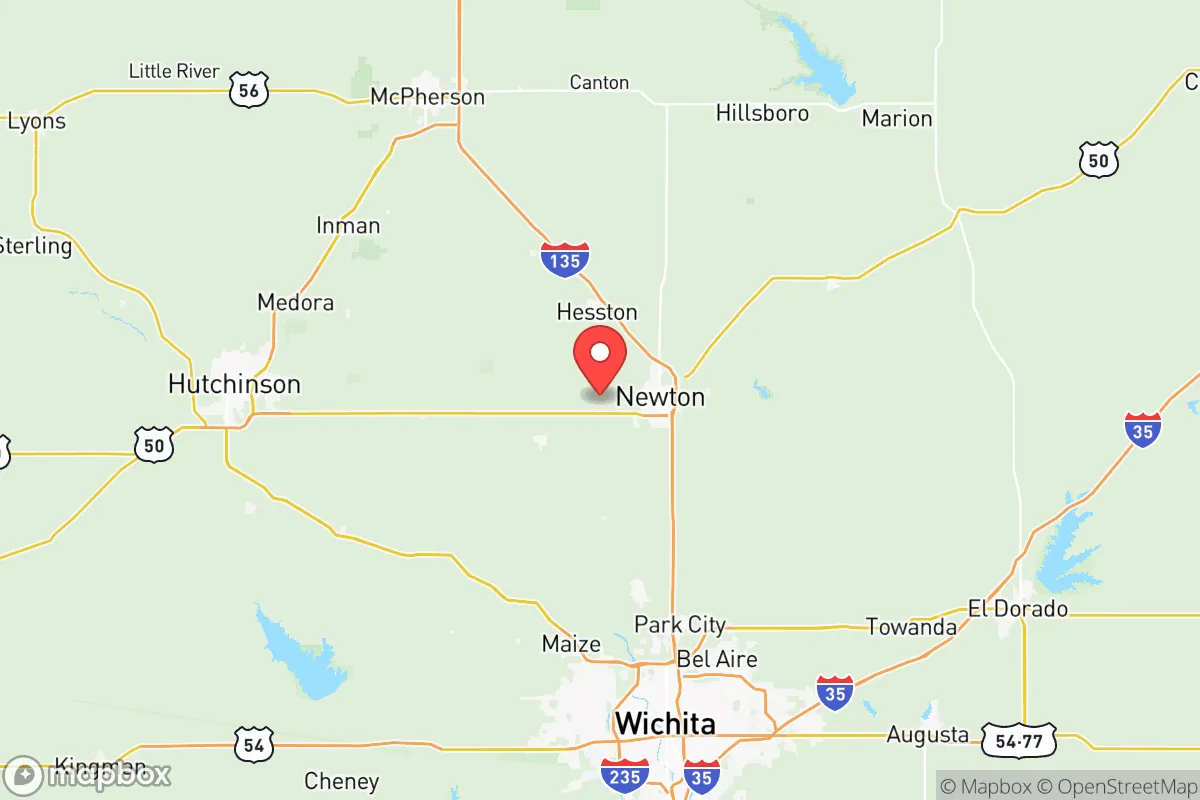
Harvey County, Kansas, leans reliably Republican with a Cook PVI of R+12, making it three points more conservative than the state of Kansas as a whole, which sits at R+9. That gap has widened slightly in recent cycles as the county's rural and exurban precincts have shifted right, even as the state's urban centers like Johnson County have become more competitive. The county hasn't voted for a Democratic presidential candidate since Lyndon Johnson in 1964, and in 2024, Donald Trump carried it by a margin closer to 18 points. But the story isn't uniform across the county — the political reality varies noticeably depending on whether you're in Newton, Hesston, or the unincorporated farming communities to the west.
How it compares
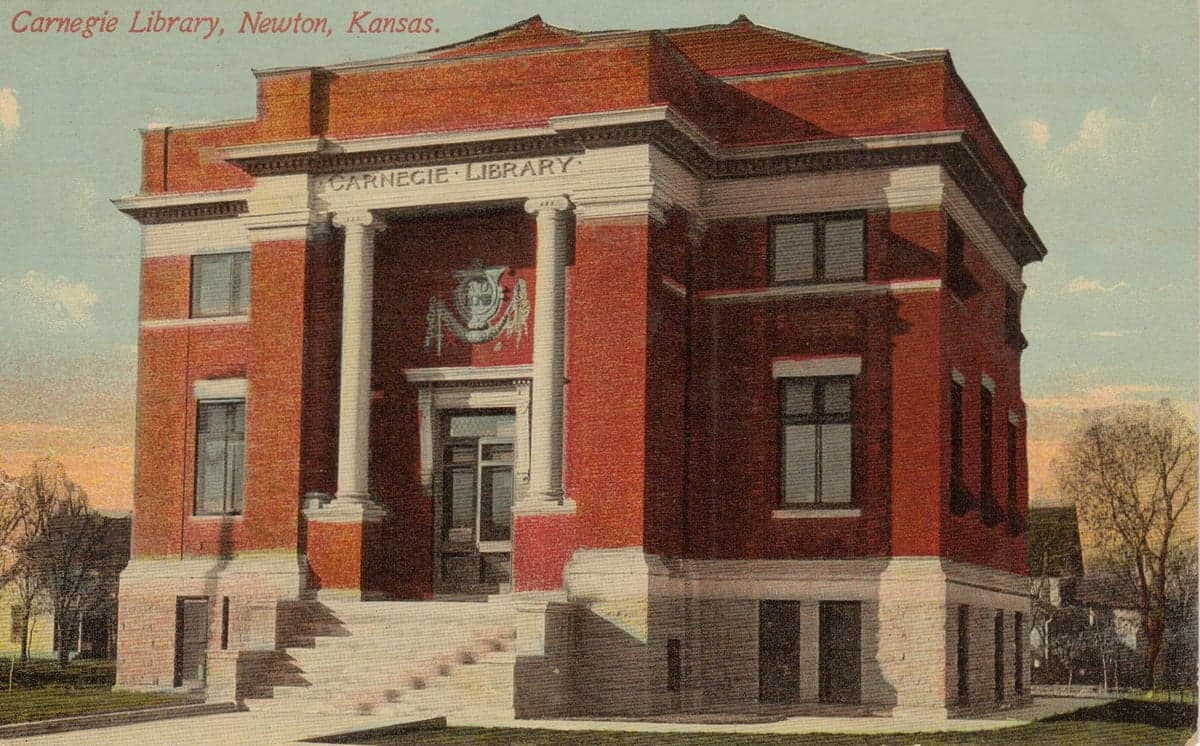
Compared to the state of Kansas, Harvey County is both more Republican and more internally polarized. The state's R+9 PVI is pulled left by the Kansas City suburbs and Lawrence, while Harvey County lacks any comparable Democratic stronghold. The closest thing to a blue pocket is Newton, the county seat and home to Bethel College, where precincts around the downtown and the college campus have trended blue in recent years — Hillary Clinton won a few Newton precincts in 2016, and Joe Biden held them in 2020. Hesston, by contrast, is deeply conservative, anchored by Hesston College (a Mennonite institution) and a strong agricultural base; its precincts routinely deliver 70%+ Republican votes. Halstead and Sedgwick lean red but are less reliably so, with some swing precincts that have shifted toward Democrats in local races when the candidate has a moderate profile. The unincorporated areas west of Newton, around Burrton and Walton, are the most conservative parts of the county, often voting 80% Republican. This internal variation means Harvey County is not a monolith — it's a place where a liberal resident in Newton can find community, while a conservative in Hesston feels fully represented by local government.
What this means for residents
For conservative residents, Harvey County's lean means local offices — county commission, school boards, and the sheriff — are almost always held by Republicans, and policy tends to reflect that. Tax levies are kept low, and the county has resisted some state-level mandates on renewable energy siting and land use. For liberal residents, the political climate can feel isolating outside of Newton, but the county's small size means personal relationships often matter more than party affiliation. Many local decisions, especially around infrastructure and schools, are made with broad input rather than along strict party lines. The county's Mennonite heritage also tempers some of the harder edges of conservative politics — there's a strong tradition of pacifism, community service, and fiscal restraint that doesn't always align with national Republican talking points. That cultural undercurrent is one reason Harvey County has been slower than some neighboring counties to embrace the more confrontational style of politics seen in parts of Sedgwick County to the south.
Looking ahead, the county's political trajectory seems stable but not static. Newton's slow growth and the aging of the rural population could gradually shift the balance toward the center, especially if younger residents moving in from Wichita bring more moderate views. But the county's deep agricultural roots and strong church communities are likely to keep it solidly red for the foreseeable future. For anyone moving here, the key takeaway is that Harvey County offers a genuinely conservative environment with a few blue islands — and a political culture that, while partisan, still values neighborliness over national fights. That's a distinction worth understanding before you arrive.

State Political ClimatePolitical Climate in Kansas
State Political AnalysisPolitical Environment in the State
Kansas has been a reliably Republican state for decades, with a Cook Partisan Voting Index of R+9, meaning it votes about nine points more Republican than the nation as a whole. Over the past 10-20 years, the state has shifted rightward in presidential races—Donald Trump won it by 15 points in 2020 and by a similar margin in 2024—but the picture is more complicated at the state level. A prolonged experiment with deep tax cuts under Governor Sam Brownback (2011-2018) led to budget crises and a bipartisan backlash, resulting in the 2017 tax hike override and the election of Democratic Governor Laura Kelly in 2018. Since then, the legislature has remained firmly Republican, often overriding Kelly’s vetoes, creating a dynamic where the state’s overall conservative lean is tempered by a pragmatic, moderate streak in statewide elections.
Urban vs. rural divide
The political map of Kansas is a textbook case of the urban-rural split. The Kansas City metro area, anchored by Johnson County (Overland Park, Olathe, Lenexa), is the state’s most populous and politically competitive region. Johnson County has been trending blue for a decade—it voted for Hillary Clinton in 2016 and Joe Biden in 2020—driven by an influx of college-educated professionals and suburban families. Wyandotte County (Kansas City, Kansas) is a Democratic stronghold, while Shawnee County (Topeka) leans slightly Democratic. In contrast, the rest of the state is deeply red. Sedgwick County (Wichita) is a bellwether: it’s Republican-leaning but not overwhelmingly so, with the city of Wichita itself providing a moderate counterweight to the surrounding rural areas. Counties like Thomas County (Colby) in the northwest and Finney County (Garden City) in the southwest vote Republican by 40-50 points. The divide isn’t just about population density—it’s cultural. Western Kansas is dominated by agriculture and energy, while the eastern third, especially around Lawrence (home to the University of Kansas), is more liberal and diverse.
Policy environment
Kansas’s policy environment reflects its Republican lean, but with notable moderation on certain issues. The state has a flat income tax rate of 5.7% (as of 2025), down from the progressive rates that existed before the Brownback tax cuts. Sales taxes are relatively high, averaging around 8.5% in many cities when local levies are included. Property taxes are moderate but have been a persistent source of frustration, leading to periodic legislative efforts to cap them. On education, Kansas has a history of school funding lawsuits; the state Supreme Court has repeatedly ruled that the legislature’s funding formula is inadequate, forcing increased spending. This has created tension between conservative lawmakers who want to limit education budgets and moderates who prioritize funding. Healthcare policy is a mixed bag: Kansas did not expand Medicaid under the Affordable Care Act, leaving roughly 150,000 low-income residents in a coverage gap, but the state has a robust network of rural hospitals and telehealth initiatives. Election laws have tightened in recent years: the 2021 election integrity law (HB 2332) requires photo ID for voting and proof of citizenship for voter registration, and it limits advance voting to 14 days. Gun laws are permissive—Kansas is a constitutional carry state (no permit needed for concealed carry), and there is no state-level red flag law. Abortion access has become more restricted since the 2022 Dobbs decision; a 2024 law bans abortion at 22 weeks, with exceptions for life and health, but a 2022 state constitutional amendment to remove abortion protections was rejected by voters, preserving a state-level right.
Recent policy direction
The last five years have seen Kansas move in a broadly conservative direction, but with significant exceptions. On gun rights, the 2023 law allowing permitless carry of firearms (SB 45) was a major win for Second Amendment advocates. On education, the 2021 Parents’ Bill of Rights (HB 2056) gives parents more control over curriculum and library materials, and the 2023 law banning transgender athletes from girls’ sports (SB 160) reflects a cultural conservative push. Tax policy has been a battleground: the 2024 flat tax bill (SB 169) lowered the top rate and simplified brackets, but Governor Kelly vetoed a more aggressive plan that would have eliminated the income tax entirely. On medical freedom, Kansas passed a 2023 law prohibiting COVID-19 vaccine mandates by private employers (HB 2201), a nod to the post-pandemic backlash. Privacy and surveillance are less contentious, but the state has no comprehensive data privacy law, leaving residents reliant on federal protections. Property rights are strong—Kansas has a right-to-farm law that limits nuisance lawsuits against agricultural operations. Voting access has tightened, as noted, but the state has not gone as far as some others in restricting mail-in ballots or early voting. Overall, the direction is conservative but pragmatic, with the legislature often pushing further right than the governor allows.
Civil unrest & political movements
Kansas is not known for widespread civil unrest, but there have been notable flashpoints. The 2022 abortion amendment debate drew large protests and counter-protests at the Statehouse in Topeka, with the amendment’s defeat surprising many observers and energizing both sides. Immigration politics are less visible than in border states, but there have been tensions in southwest Kansas, where meatpacking plants in Garden City and Dodge City employ many immigrant workers. Local law enforcement has generally avoided aggressive immigration enforcement, but the state legislature has considered bills to require cooperation with federal authorities. Election integrity controversies flared after 2020, with some Republican lawmakers questioning the security of mail-in voting, but no major fraud was found. The Kansas Libertarian Party has a small but active presence, occasionally influencing close races. On the left, the Kansas People’s Action and the Mainstream Coalition (a moderate Republican group) have been active in opposing far-right legislation. A new resident would notice the political divide most acutely in the suburbs of Johnson County, where yard signs and bumper stickers for both parties are common, and in rural areas, where conservative sentiment is nearly unanimous.
Projection
Over the next 5-10 years, Kansas is likely to remain a Republican-leaning state, but the trend in the Kansas City suburbs could shift the balance in statewide races. Johnson County’s continued growth—it’s adding about 10,000 residents per year—will make it harder for Republicans to win without moderating their message. The state’s population is aging and slowly declining in rural areas, which could amplify the urban-suburban vote. In-migration is modest, with most newcomers coming from other Midwestern states or the coasts for jobs in healthcare, education, and logistics. The political trajectory will depend on whether the GOP can hold the suburban vote; if it continues to lose ground in Johnson County, Kansas could become a swing state in presidential elections within a decade. At the state level, the legislature will likely remain Republican, but the governor’s race will be competitive. A new resident moving in now should expect a state that is conservative on fiscal and cultural issues but with a pragmatic streak that prevents it from going as far right as some of its neighbors.
For someone relocating to Kansas, the bottom line is that the state offers a conservative policy environment with a few notable exceptions—abortion rights are more protected than in many red states, and the education system is well-funded despite political battles. Liberal residents will find a welcoming community in Lawrence and parts of Johnson County, while conservatives will feel at home almost everywhere else. The political climate is stable but not static, and the growing influence of the Kansas City suburbs means the state’s character could shift noticeably over the next decade. If you’re looking for a place where your vote matters and the political conversation is grounded in real-world issues rather than ideological purity, Kansas is a solid bet.
* Values derived from national, state, county, city and local statistics and may differ in a specific area. Last updated: 2026-06-19T16:15:37.000Z
Narrative content on this page is AI-generated and may contain mistakes. Verify any details that matter before acting on them.
ReloMaps may earn a commission from affiliate links at no extra cost to you.

