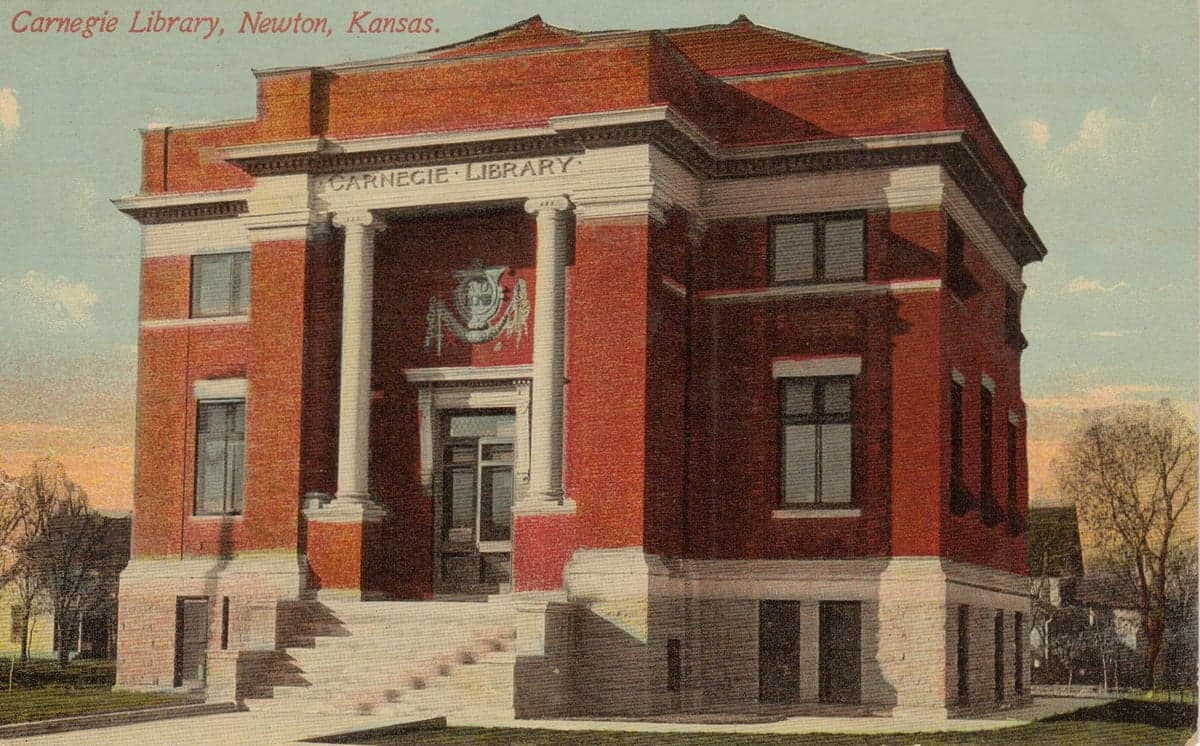
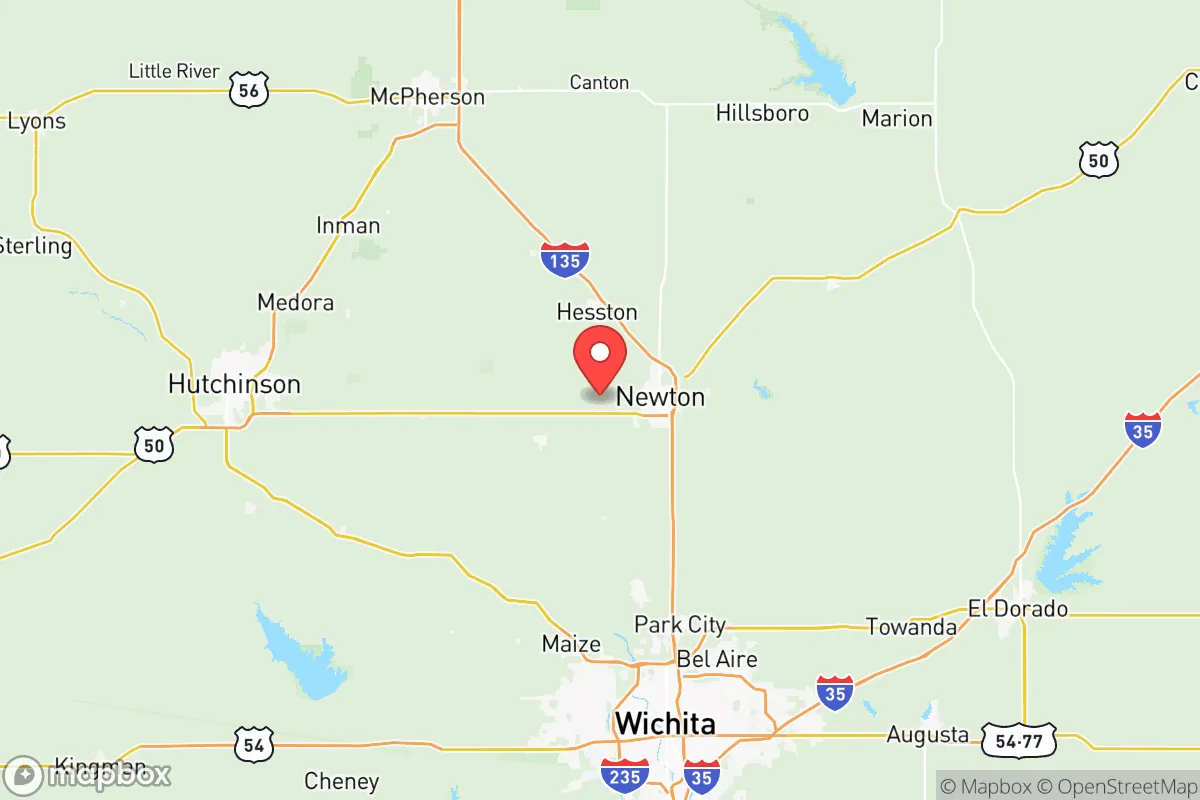
Photo: Wikipedia
Demographics of Harvey County
Affluence Level in Harvey County
A middle-class area roughly in line with national averages across income, home values, education, and employment.
People of Harvey County
Today, Harvey County, Kansas, is home to roughly 33,800 residents who maintain a distinctly Midwestern character rooted in Mennonite and German-Russian heritage, with a growing Hispanic population reshaping the cultural landscape. The county remains predominantly white (81.2%) and sparsely populated by national standards, with a foreign-born share of just 1.2%—well below the national average. Its identity is shaped by a blend of agricultural tradition, small-town conservatism, and a quiet but steady diversification centered in the county seat of Newton and the smaller communities of Halstead, Hesston, and Burrton. For families and individuals considering relocation, Harvey County offers a stable, low-crime environment where community ties remain strong and newcomers are expected to integrate into existing social fabrics rather than transform them.
Settlement & growth (pre-1960)
Before American settlement, the land that became Harvey County was part of the ancestral territory of the Osage and Kansa (Kaw) nations, who used the region for seasonal hunting grounds, particularly for bison. The area was formally opened to non-Native settlement after the 1854 Kansas-Nebraska Act and the subsequent forced removal of Native tribes to reservations in present-day Oklahoma. The first permanent American settlers arrived in the late 1860s and early 1870s, drawn by the promise of cheap land under the Homestead Act and the construction of the Atchison, Topeka and Santa Fe Railway, which established a depot in what would become Newton in 1871.
The defining population wave came between 1874 and the early 1900s, when Mennonite immigrants from the Russian Empire (specifically from the Black Sea region of present-day Ukraine) settled across Harvey County. These German-speaking, pacifist farming families were fleeing religious persecution and military conscription under Tsar Alexander II. They brought with them a hardy winter wheat variety—Turkey Red—that revolutionized Kansas agriculture and made the region a breadbasket. The Mennonites concentrated in and around Newton, Hesston, and Halstead, where they established churches, schools, and the Bethel College (founded 1887 in North Newton), which remains a cultural anchor. A smaller wave of German Lutherans and Swiss immigrants also arrived in the same period, settling in Burrton and Sedgwick (the latter now part of Sedgwick County but historically tied to Harvey County's trade networks).
By 1900, Harvey County's population had reached roughly 18,000, with a near-total white, German-Russian character. The economy was overwhelmingly agricultural—wheat, corn, and livestock—with Newton emerging as a regional rail hub and commercial center. The county remained largely insulated from the Great Migration of African Americans from the South (Black population today is just 1.1%), and the Dust Bowl of the 1930s caused modest out-migration but not the catastrophic depopulation seen in western Kansas. The post-World War II period saw modest growth, with the population rising to about 25,000 by 1960, driven by the expansion of agribusiness and the establishment of manufacturing plants in Newton and Hesston, including the Hesston Corporation (farm equipment).
Modern era (post-1965)
The 1965 Hart-Cellar Act had minimal direct impact on Harvey County, as the region did not attract significant post-1965 immigration from Asia, Africa, or Latin America. Instead, the county's demographic story since the 1970s has been one of slow, steady diversification through domestic migration and natural increase. The most notable shift has been the growth of the Hispanic population, which now stands at 12.1%—up from roughly 3% in 1990. This growth is driven primarily by Mexican-American families moving from Texas and the southwestern U.S. for work in meatpacking, agriculture, and construction. The Newton packing plant (formerly Excel, now Cargill) has been a major employer drawing Hispanic workers since the 1980s, and today Newton's north side has a visible Hispanic commercial corridor with Mexican groceries, bakeries, and churches.
Domestic migration patterns have been modest but notable. Harvey County has experienced a slow but steady outflow of young adults to larger cities like Wichita (just 20 miles south) and Kansas City, while attracting some retirees and remote workers seeking lower housing costs and a quieter lifestyle. The county's white population has aged and declined slightly in absolute numbers, while the Hispanic population has grown younger and larger. The East/Southeast Asian population (0.7%) and Black population (1.1%) remain very small, concentrated in Newton and tied to professional roles in healthcare and education at Newton Medical Center and Hesston College. The Indian-subcontinent population is effectively zero, reflecting the county's lack of tech or academic magnets that draw South Asian professionals.
Suburbanization has been limited. Unlike the sprawling suburbs of Johnson County (Kansas City), Harvey County's towns have retained their compact, walkable cores. Hesston has grown modestly as a bedroom community for Wichita commuters, while Halstead and Burrton have remained stable agricultural service centers. The county's overall population has grown only about 8% since 1990, reflecting a pattern of slow, organic change rather than explosive growth.
The future
Harvey County is likely to become modestly more diverse but not dramatically so over the next 10-20 years. The Hispanic share of the population is projected to rise to 15-18% by 2040, driven by higher birth rates among Hispanic families and continued labor migration to Newton's meatpacking and agricultural sectors. The white population will continue to age and shrink slightly, but the county will remain overwhelmingly white and culturally Midwestern. The foreign-born share may rise to 2-3% but will stay far below national averages, as Harvey County lacks the economic magnets—major universities, tech hubs, or refugee resettlement programs—that drive large-scale immigration elsewhere.
New residents will likely continue to concentrate in Newton and Hesston, where housing stock, schools, and jobs are most available. The county's cultural identity will evolve slowly: Mennonite traditions (plain dress, pacifism, community service) will remain visible but increasingly symbolic, while Hispanic cultural elements—Spanish-language church services, quinceañeras, Mexican restaurants—will become more mainstream. The county's political character, already conservative, may shift slightly as Hispanic voters, who tend to lean moderate-to-conservative on social issues in rural Kansas, become a larger voting bloc. Out-migration of young adults to Wichita and beyond will continue, but the county's stable economy (agribusiness, manufacturing, healthcare) and low cost of living will keep it from depopulating.
For someone moving in now, Harvey County offers a place where tradition and gradual change coexist. The population is not growing fast, but it is stable and rooted. Newcomers will find a community that values self-reliance, church involvement, and neighborly familiarity. The county is becoming slightly more diverse and slightly more connected to the Wichita metro area, but it remains, at its core, a collection of small towns where the past century's German-Russian and Mennonite foundations still shape daily life. If you are seeking rapid urban energy or ethnic enclaves, look elsewhere. If you want a safe, affordable, and culturally coherent place to raise a family or retire, Harvey County is a strong candidate.

* Values derived from national, state, county, city and local statistics and may differ in a specific area. Last updated: 2026-06-19T16:15:37.000Z
Narrative content on this page is AI-generated and may contain mistakes. Verify any details that matter before acting on them.
ReloMaps may earn a commission from affiliate links at no extra cost to you.

