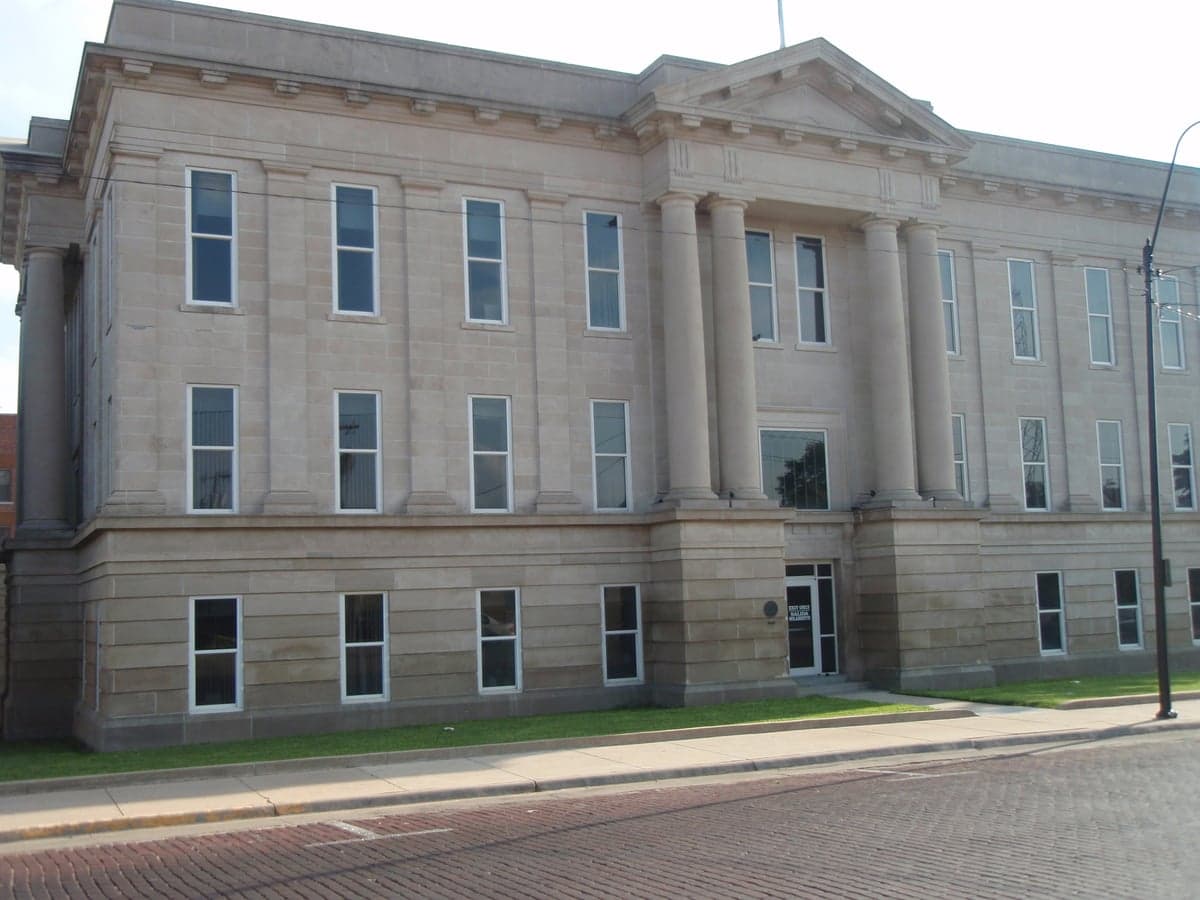
Photo: Wikipedia
Demographics of Ford County
Affluence Level in Ford County
A middle-class area roughly in line with national averages across income, home values, education, and employment.
People of Ford County
Ford County, Kansas, is a predominantly Hispanic and White community of 34,133 residents, shaped by a century of agricultural labor, meatpacking, and railroad work. The county seat, Dodge City, anchors a population that is 58.2% Hispanic, 36.4% White, and 2.2% Black, with a foreign-born share of 14.8%—more than double the national average. This is a working-class, family-oriented region where Spanish is widely spoken, Catholic and Evangelical churches are prominent, and the economy revolves around beef processing, feedlots, and farming. The county’s identity is a blend of Old West heritage and a modern, majority-minority population that is younger and more diverse than much of rural Kansas.
Settlement & growth (pre-1960)
Before American settlement, the area that is now Ford County was part of the vast hunting grounds of the Plains Apache, Comanche, and Kiowa nations, who followed bison herds across the Arkansas River valley. Spanish and French explorers passed through in the 16th–18th centuries, but no permanent European settlements took hold until after the 1854 Kansas–Nebraska Act opened the territory to homesteading. The U.S. Army established Fort Dodge in 1865 along the Santa Fe Trail to protect wagon trains and railroad construction, and the fort’s presence drew the first Anglo-American traders, soldiers, and freighters.
The real population wave arrived with the railroad. The Atchison, Topeka and Santa Fe Railway reached Dodge City in 1872, transforming the site from a buffalo-hunting camp into a cattle-shipping hub. During the 1870s and 1880s, cowboys, drovers, and merchants flooded in, and Dodge City earned its reputation as the “Cowboy Capital of the World.” The town’s population boomed from a few hundred in 1873 to over 1,800 by 1880. Homesteaders—mostly native-born White Americans from the Midwest and Upper South—also claimed land under the 1862 Homestead Act, establishing farms around the smaller towns of Spearville (founded 1879), Bucklin (1886), and Ford (1885). These early settlers were overwhelmingly Protestant, English-speaking, and tied to wheat and cattle.
Mexican immigration began in earnest during the 1910s and 1920s, when the Santa Fe Railroad actively recruited Mexican laborers to lay and maintain track across western Kansas. Many of these workers settled in Dodge City’s south side, forming the nucleus of what would become a large Mexican-American community. The railroad also brought a smaller number of Italian and Greek immigrants, though their numbers remained modest. The Dust Bowl of the 1930s hit Ford County hard, driving some farm families off the land, but the county’s population actually grew during the 1940s as wartime demand for beef and wheat kept the local economy afloat. By 1950, Ford County had 19,670 residents, the vast majority White, with a Mexican-origin population of roughly 5–7%.
Modern era (post-1965)
The 1965 Hart-Cellar Act opened the door to a new wave of immigration, but Ford County’s modern demographic transformation was driven even more by the expansion of the meatpacking industry. In 1967, Iowa Beef Processors (later IBP, now Tyson Fresh Meats) opened a massive slaughterhouse in Dodge City, and similar plants followed in nearby Garden City and Liberal. These plants recruited heavily from rural Mexico and Central America, offering wages that far exceeded what workers could earn at home. By the 1980s, Dodge City’s Hispanic population had surged past 25%, and by 2000 it had reached 45%. The 2020 Census recorded a Hispanic share of 58.2%, making Ford County one of the most heavily Hispanic counties in the Great Plains.
This wave settled primarily in Dodge City, where neighborhoods south of the railroad tracks—especially around Avenue A and the old downtown—became overwhelmingly Mexican and Central American. Smaller numbers of Hispanic families also moved to Spearville and Bucklin, drawn by work at feedlots and grain elevators. The foreign-born population reached 14.8% by 2020, with the majority born in Mexico, followed by Guatemala and El Salvador. The county’s Black population, at 2.2%, is small but stable, concentrated in Dodge City and employed in meatpacking and service jobs. East and Southeast Asian residents (0.4%) and Indian-subcontinent residents (0.0%) are virtually absent, reflecting the county’s lack of high-tech or professional-sector employment.
Domestic migration has been less dramatic. Since the 1980s, some native-born White families have left for larger cities in Kansas and Colorado, a pattern common across rural Kansas. However, the county’s total population has held relatively steady—34,133 in 2020, down only slightly from 34,819 in 2000—because Hispanic in-migration and higher birth rates have offset White out-migration. The county’s median age is 33.5, significantly younger than the Kansas median of 37.0, driven by the large Hispanic family population.
The future
Ford County is likely to become more Hispanic and more foreign-born over the next 10–20 years. The meatpacking industry shows no signs of relocating, and the plants continue to recruit immigrant labor. The Hispanic share could approach 65–70% by 2040, while the White share will continue to decline gradually. The county’s Black and Asian populations are expected to remain small, as there are no major industries or universities attracting those groups. New immigrant arrivals may shift slightly toward Central America (Guatemala, Honduras) rather than Mexico, reflecting broader migration patterns.
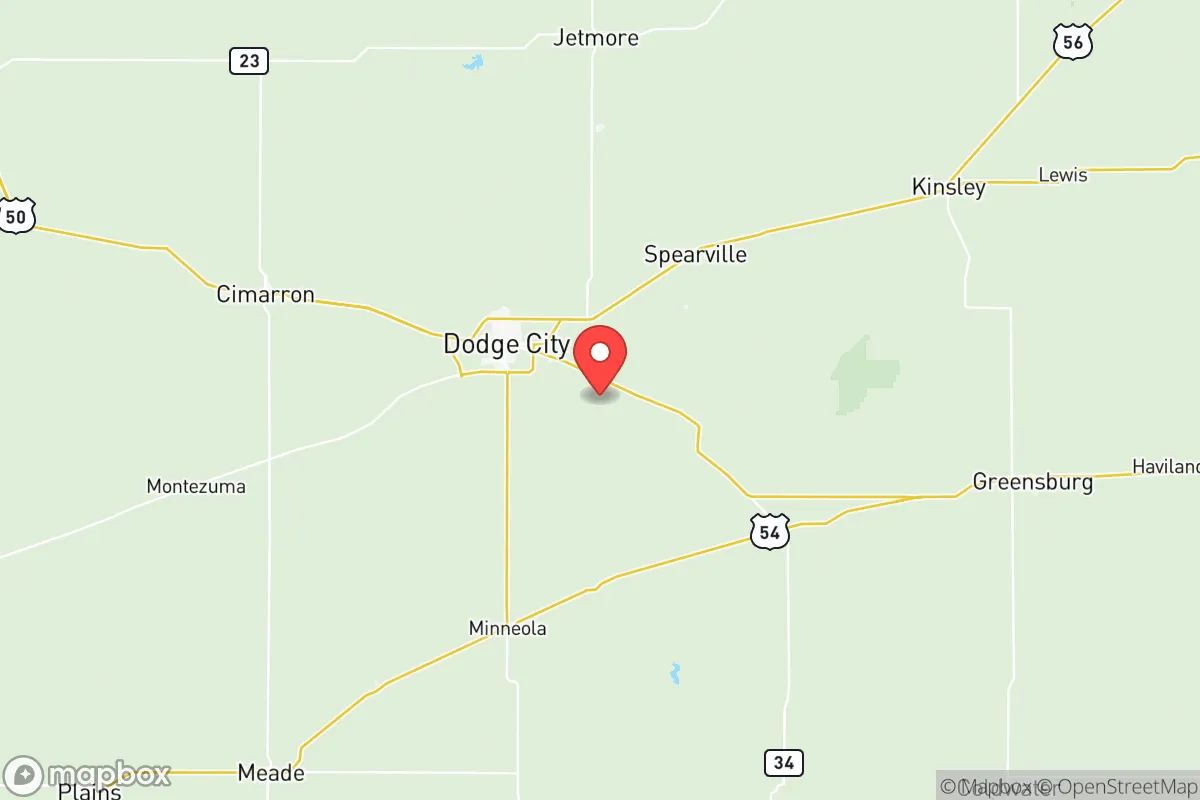
Geographically, growth will concentrate in Dodge City, which already holds about 85% of the county’s population. The smaller towns—Spearville, Bucklin, and Ford—will likely continue to shrink, as young people leave for Dodge City or larger cities. Culturally, the county is becoming a bilingual, bicultural community where Hispanic traditions (quinceañeras, Catholic feast days, Mexican cuisine) are mainstream, while the Old West cowboy heritage remains a tourist draw but less central to daily life. Politically, Ford County leans Republican but is less conservative than surrounding counties, reflecting the more working-class, union-influenced Hispanic electorate.
For someone moving in now, Ford County offers a stable, family-oriented community with a strong sense of place, affordable housing, and a job market anchored by the meatpacking industry. The trade-off is limited economic diversity, a low college-attainment rate (20.7%), and a cultural landscape that is increasingly Hispanic and working-class. It is not a place of rapid change or high growth, but of steady demographic evolution—a rural county where the future looks more like the present, only more so.

* Values derived from national, state, county, city and local statistics and may differ in a specific area. Last updated: 2026-07-15T06:29:06.000Z
Narrative content on this page is AI-generated and may contain mistakes. Verify any details that matter before acting on them.
ReloMaps may earn a commission from affiliate links at no extra cost to you.

